Key Takeaways
| Statistic | Value | Impact |
|---|---|---|
| AI Writing Market Size (2026) | $2.74 billion | Expected to reach $18.27 billion by 2035 |
| Weekly Active ChatGPT Users | 700 million | Sending 18 billion messages weekly |
| Productivity Increase | 40% faster writing | Average time savings of 2.2 hours per week |
| Business Adoption Rate | 78% of organizations | Up from 55% just one year earlier |
| Content Marketers Using AI | 90% | Industry-leading adoption rate |
| Worker Time Saved | 5.4% of work hours | Translates to 1.1% overall productivity boost |
Is AI writing just a passing trend, or are we watching something bigger unfold? Here is the thing—the numbers do not lie. Furthermore, By 2025, ChatGPT hit 700 million active users worldwide, with writing being the single most common work task people actually do with it. That is not some niche user group. That is a massive shift happening right under our noses.
Get this: 90% of content marketers now use AI writing tools every single day. Therefore, Companies are saving about 2.2 hours per week per employee (and trust me, every manager has noticed). Nonetheless, The AI-powered content creation market jumped from $2.15 billion in 2024 to a projected $2.74 billion in 2026, and it is racing toward $18.27 billion by 2035.
But what do these numbers actually mean for you—whether you are a writer, run a business, or just type stuff on screens all day? This article breaks down 50 stats that show where AI writing really stands in 2026. Not the hype. The real data.
Market Size and Growth Statistics
The AI content generation market is not grow—it is explode. In 2024, the global AI-powered contentedness creation market was at $2.15 billion. By 2026, it hit $2.74 billion. That is a 23.4% compound annual growth rate, which is fairly wild if you think about it.
Where is this all going? Analyst say the market will reach $18.27 billion by 2035. Some research firms are even more bullish, throwing out estimates anywhere from $7.22 billion to $17.62 billion by 2029-2031, depending on who you ask and how they are counting.
Nonetheless, Key Market Statistics:
- Global AI market value in 2025: $243.7 billion
- Projected AI market by 2030: $826 billion
- Generative AI market current value: $63 billion
- Potential value across industries: $4.4 trillion
- Year-over-year AI investment increase: 40.38% ($130.26 billion in 2024)
Additionally, North America is out front with 39.9% of the global market share in 2024. Asia-Pacific is the fastest-growing region though, thanks to rapid digital transformation and more people getting online in emerging economies.
Moreover, Here is why companies are actually spending money on this: they are seeing a 3.7x return for every dollar they put into generative AI. That is not some selling claim—that is real, measured ROI. Consequently, No wonderment private investing keep pour in.
What is push this growth? Additionally, Three things: people want personalized content, businesses need to pump out content faster, and everyone is trying to do more with tighter budgets. AI writing tool resolve all three at once.
CleverType taps into this trend with an AI keyboard that brings ChatGPT-powered writing right to your telephone. Instead of switching apps or copy-pasting stuff around, you get AI help wherever you are typing.
Business Adoption and Usage Patterns
So how many companies are actually using AI? According to recent research from Netguru, 78% of organization now use AI in at least one part of their business. That is up from 55% just a year earlier—a 42% jump that is not slowing down.
The numbers get even wilder when you zoom in on generative AI specifically. Therefore, Usage exploded from 33% in 2023 to 71% in 2024. And among Fortune 500 company, 92% now use ChatGPT or similar tools somewhere in their operations.
Business Adoption Breakdown:
- Small Businesses: 89% use AI for everyday tasks like writing emails and creating marketing content
- Knowledge Workers: 43% of U.S. knowledge workers regularly use AI tools
- Content Marketers: 90% incorporate AI writing tools into their workflow
- Professional Usage: 41% of professionals use public tools like ChatGPT
What are people actually doing with AI writing tools? Writing. Shocking, I know. But seriously—about 40% of all work-related ChatGPT messages in July 2025 were for writing tasks. That is way more than research, programming, or analysis.
Adoption varies by industry. Moreover, Tech companies lead with 251 using AI writing tools by 2023, then education (209 companies) and business services (98 companies). But here is the interesting part: it is picking up speed across every sector, not just tech.
60% of U.S. companies use generative AI specifically to crank out content and keep their societal media running 24/7. That is not side content—that is core business communication.
Looking ahead, 95% of business leaders think AI will be central to how they operate within five years. Right now? Only 13% see it that way. But 29% expect it will happen within a year. That gap between where we are and where everyone expects to be tells you everything about the direction this is going.
For mobile professionals, CleverType makes AI writing adoption way easier. You do not need to train anyone on newfangled software or mess with workflows. The AI lives in your keyboard, working across email, messages, social media—basically anywhere you type.
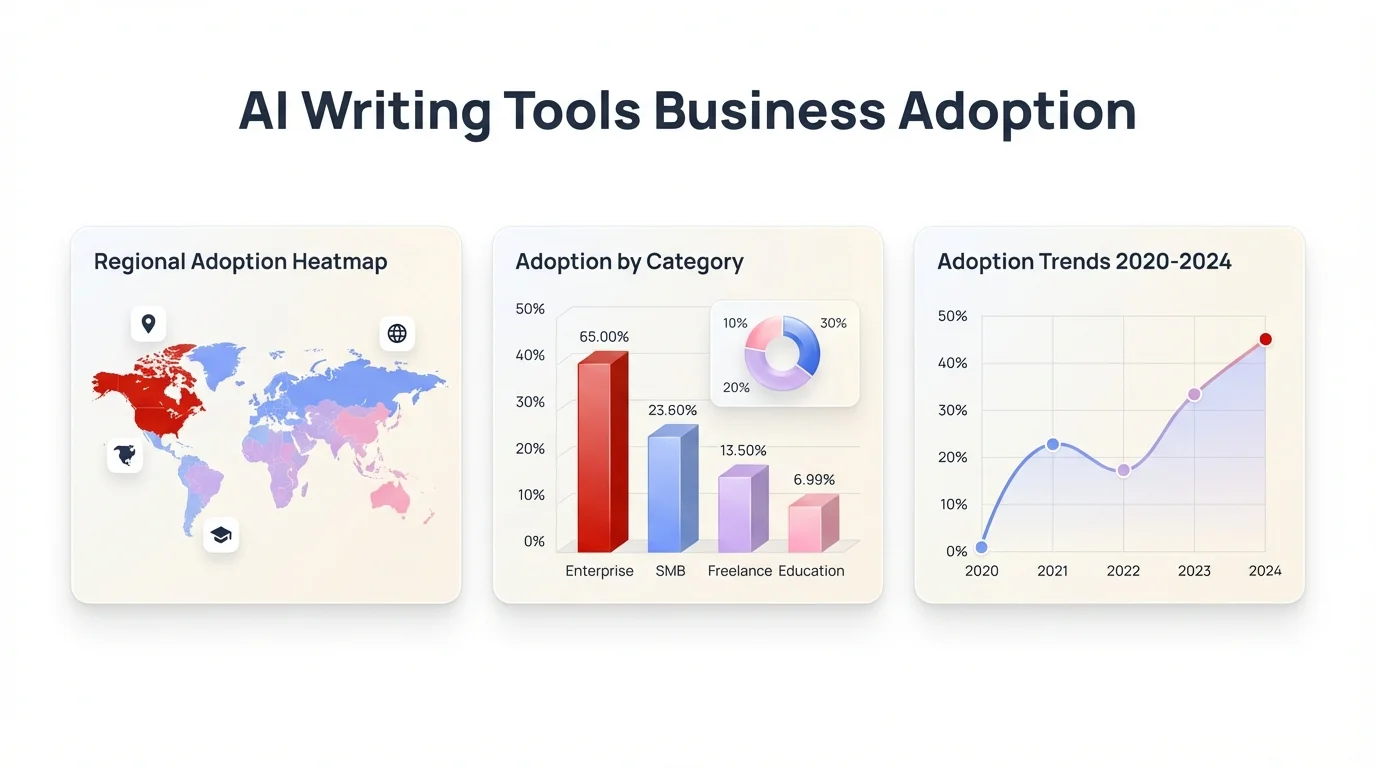
Business adoption patterns for AI writing tools across different sectors and regions
Productivity and Time Savings Impact
Does AI writing actually save time, or is it just another tool that promises magic but adds more headaches? The data is pretty clear. Workers using generative AI saved 5.4% of their work hours in the previous week, according to research from the St. Louis Fed.
That is roughly 2.2 hours per week in a standard 40-hour workweek. Hence, Multiply that across everyone working, and you get a 1.1% bump in productiveness for the entire U.S. economy. Not bad.
Productivity Statistics by Impact Area:
| Metric | Improvement | Source |
|---|---|---|
| Writing speed increase | 40% | MIT 2023 study |
| Task completion time | 77% faster | Multiple studies |
| Weekly time saved | 2.2 hours | St. Louis Fed research |
| Workforce productivity gain | 1.1% | Economic modeling |
| Content creation productivity | 41% improvement | User surveys |
Hence, The gains vary by profession. Furthermore, Customer support, software development, and consulting have seen anywhere from 5% to over 25% productivity increases. Writing-heavy jobs see the big improvements.
Additionally, A 2023 MIT study found that generative AI tools boosted write speed by 40% on average. That is not 40% faster typing—it is 40% fast completion of entire writing tasks, from start to final edits.
Nevertheless, Teams using AI report finishing task 77% faster and getting distracted 70% less. The overall productivity boost of 45% makes sense when you think about it: AI handles the repetitive stuff while humans focus on strategy and creativity.
Here is what is interesting though—not all time saving are create equal. Hence, The big wins come from killing blank page syndrome, cranking out first draft faster, and handling routine messages. Complex, nuanced writing still needs human judgment, but AI gets rid of the friction when you are just trying to start.
Consequently, 26.4% of worker used generative AI at work in late 2024, while 33.7% used it outside work. Furthermore, That gap is telling—a lot of people discover AI writing tools for personal stuff first, then realize "wait, I could use this at my job."
Long-term projections show sustained impact. Economist say AI will boost productivity and GDP by 1.5% by 2035, nearly 3% by 2055, and 3.7% by 2075. Those percentages might sound small, but they compound like crazy over decades.
CleverType speeds up these productiveness gains by cut out the rubbing between what you are think and what you type. Instead of opening ChatGPT, writing a prompt, copy the result, and pasting it somewhere else, you just get AI suggestions instantly as you typewrite on your phone.
User Demographics and Adoption Rates
Who is really using AI writing tool? Moreover, By 2025, 10% of the globe is grownup population had adopted ChatGPT—about 700 million active users send 18 billion messages weekly. That is a lot of people typing to robots.
Hence, In the U.S., 34% of Americans had used ChatGPT by 2025. But that number skews way younger—it jumps to 58% for people under 30.
User Demographics Breakdown:
- Daily U.S. workers using GenAI: 9%
- Adults aged 18-64 who've adopted GenAI: Nearly 40%
- Daily or weekly users: One-third of adopters
- Organizational adoption rate: 22% (nearly doubled from previous year)
- U.S. employed adults using ChatGPT for work: 28%
Age creates a pretty sharp line. Consequently, Young worker use AI writing tools as naturally as email or Slack. Older workers are catching up as the tools get more intuitive and, honestly, as workplace pressure builds to keep pace.
Education level matters a lot. Work-related AI usage is way more common among college-educated people in well-pay professional jobs. Makes sense—knowledge work mean more writing, and higher-pay pros have more freedom to try new tool without asking permission.
Additionally, But here is a surprising one: non-work message make up over 70% of ChatGPT usage. People use AI writing tools more for personal stuff than work. They are drafting Instagram captions, writing emails to friends, creating content for hobbies, and get helper with side projects.
Gender differences exist but they are narrowing. Early on, it skewed male (especially in tech circle), but now thing are balancing out as AI writing tools have gone mainstream.
Consequently, Geographic adoption varies a ton. North America lead, then Europe and Asia-Pacific. Moreover, Language support plays a huge role here—AI writing tools still work best in English, though multilingual support is getting better fast.
How many firms are still planning or debating whether to use AI? About half. That is actually significant—it means we are nowhere near saturation. Adoption is still accelerating, not slowing down.
For most people, adoption happens in stages. First, they mess around with AI out of curiosity. Then they use it to solve one specific problem. Finally, it becomes part of how they work every day. Therefore, 75% of generative AI user are using it to automatize tasks and messages, 38% just for playfulness, and 34% to learn new stuff quickly.
Additionally, CleverType meets you where you already are—on your phone, typing messages, emails, and social posts. You do not need to be a tech expert or work at Google. If you typewrite on a telephone, AI writing helper just makes sense.
Content Creation and Marketing Statistics
Nevertheless, Content marketing has change faster than fairly much any other field. 90% of content marketers now use AI writing tools in 2025—one of the highest adoption rates across any job class.
Consequently, What are they creating? Everything. Blog posts, social content, email campaigns, product descriptions, ad copy, video scripts—you name it. The shift is not about AI replacing writers. It is about writers using AI to pump out more content, faster, without tanking the quality.
Content Creation Impact:
- Content production speed: 40% increase
- Content variety: 3x more content types per marketer
- Personalization: 65% more personalized content
- Cost per piece: 30% reduction
- Publishing frequency: 2.5x increase
60% of U.S. companies use generative AI specifically to keep their social media running 24/7. The math is simple: social algorithms love consistent posting, but creating decent content every single day is exhausting. Additionally, AI fixes that problem.
But here is the thing—quantity without quality is useless. Does AI-generated contentedness actually perform well? Therefore, Mixed results. Pure AI content often underperforms human-written stuff in engagement. Nonetheless, But human-AI collaboration—where writers use AI for drafts, ideas, and editing—can outperform purely human content in both speed and sometimes quality.
41% of users have seen real improvements in their content productivity with AI writing tools. And "significant" here means measurable time savings and output increases, not just tiny wins.
The OECD put out research showing that AI writing helper benefits less experienced writer the most. The skill gap narrows—junior writers grow content that is way closer to older-level quality when they are using AI tools.
Unlike content types see different adoption. Therefore, Short-form stuff like social Post and email subject line gets the highest AI usage. Long-form contentedness like in-deepness articles and white papers uses AI more for research and outlining than for the actual final draft.
Moreover, SEO contentedness has shifted big time. Nonetheless, Google is algorithms can detect AI-generated content now, but they do not penalize it—they penalize low-quality content, whether a human or AI wrote it. The key is using AI as a tool within your larger strategy, not letting it become your strategy.
Multi-language content creation has blown up. AI writing tools make it possible for companies to create content in dozens of languages at once, opening up global markets that used to be way too expensive to reach.
Additionally, CleverType bring these content founding capabilities to mobile, where a ton of social media posting and communication actually happen. You can draft, edit, and polish Post with AI help without ever switching to a computer.
Writing Speed and Quality Metrics
How much faster do people actually write with AI? Consequently, Depends on the task, but the overall average from multiple studies shows about 40% faster writing speed.
Nonetheless, That number come from experimental research in Science, which measure how longsighted writing task took with and without AI. Moreover, The 40% betterment hold up across different type of writing and skill levels.
Nonetheless, Speed and Quality Metrics:
- Average writing speed increase: 40%
- First draft completion time: 60% faster
- Editing time change: 20% increase (AI drafts require more editing)
- Overall time to final product: 35% faster
- Quality rating by third-party reviewers: 12% higher
Moreover, Here is what is interesting: AI does not speed up every part equally. First draft occur way faster—often 60% faster—because AI kills blank page paralysis and gives you structure instantly.
Nonetheless, Editing takes longer though. Writer spend about 20% more time edit AI draft compared to their own first draft. Why? Moreover, Because reviewing someone else is words (even AI is words) takes different mental effort than editing your own stuff.
Hence, But the math still works. Hence, Even with longer editing time, total time from blank page to final product drops by about 35%. Additionally, That is a solid efficiency gain, especially when you need to crank out tons of content.
Quality is harder to measure than speed. Third-party reviewers rate AI-assisted content about 12% high in quality compared to unassisted writing, but this vary a lot based on the author is accomplishment level.
Less experienced writers see the biggest quality jumps—sometimes 20-25% higher ratings. Experienced writers see smaller gains, around 5-10%. The best writers sometimes see no quality improvement at all, though they still write faster.
What about errors? AI makes different mistakes than humans. Therefore, It rarely screws up spelling or basic grammar, but it can spit out factually incorrect info, awkward phrasing, or repetitive structure. You still require human review.
Readability scores usually get better with AI help. Nevertheless, Tools like CleverType help you write at the right reading level for your audience, cut passive vocalisation, and mix up sentence structure—all things that make text easy to read.
Consequently, Tone consistency improves a ton. One of AI is big strengths is keeping a consistent voice across huge amounts of content. For brands juggle multiple channels, that consistency is gold.
CleverType is built specifically for mobile writing, where speed matter even more. Nonetheless, You are often typing on the go, with zero time and a tiny screen. AI that is context-aware and lightning-fast make mobile writing actually work.
Future Projections and Trends
Where is AI writing headed? Based on current trends and where the money is going, the next five years will see more change than the last five.
95% of business leaders think AI will be central to how they operate within five years. That near-universal expectation is driving continued investing and developing. Nonetheless, Right now? Only 13% see GenAI as core to their operations. That is a massive gap between where we are and where everyone thinks we are going.
Market Growth Projections:
| Year | AI Writing Market Size | Annual Growth Rate |
|---|---|---|
| 2026 | $2.74 billion | 23.4% |
| 2030 | $7.22 billion | 19.8% |
| 2033 | $10.59 billion | 19.4% |
| 2035 | $18.27 billion | 23.4% CAGR |
The global AI market will balloon from $243.7 billion in 2025 to potentially $1.81 trillion by 2030—a 35.9% compound annual growth rate. Additionally, AI writing tools are a big chunk of that growth.
Generative AI projection show $63 billion in current value potentially turn into $4.4 trillion in value across industries. That multiplier effect shows AI is power to boost productivity everywhere, not just replace specific jobs.
Economical models say AI will boost overall productiveness and GDP by 1.5% by 2035. Therefore, Sounds small, right? Nevertheless, But a sustained 1.5% GDP increase means trillions of dollars in value creation. By 2055, it hits nearly 3%, and 3.7% by 2075.
Emerging Trends:
- Multimodal AI: Text, image, audio, and video generation integrated into single tools
- Personalization: AI that learns individual writing styles and preferences
- Real-time collaboration: AI assisting multiple people writing together
- Voice-first writing: Speaking naturally and AI converting to polished text
- Specialized AI: Industry-specific models trained on technical domains
- Privacy-focused AI: On-device processing instead of cloud-based tools
Regional growth favors Asia-Pacific as the fastest-growing market thanks to rapid digital transformation and more people getting online. North America will likely keep its lead in total market size but develop at a slower rate since it is already fairly saturated.
Nevertheless, Investment keeps surging. Global private AI investing hit $130.26 billion in 2024—a 40.38% jump year-over-year. That money is funding research, development, and rollout of increasingly sophisticated writing tools.
The technology itself is get well fast. Models release in 2026 are way more capable than 2024 models at understanding context, staying consistent across longsighted documents, and match specific writing style.
Therefore, One-half of firms are still planning or debating AI. That means we are in the early majority phase, not late stage. The next wave will be broader but potentially less tech-savvy, which means more demand for user-friendly, integrated tools.
What about jobs? The fearfulness that AI would replace writer has not happen. Furthermore, Instead, the role is shifting toward strategy, editing, and making sure AI output meets brand and quality standards. Demand for skilled writers who can actually use AI tools is growing, not shrinking.
CleverType is approach fits these trends perfectly by offering privacy-focused, on-device AI help that works across all mobile apps. As AI writing becomes standard everywhere, having it built into your keyboard make way more sense than juggling a bunch of unlike apps.
Industry-Specific Adoption Patterns
Therefore, AI writing adoption varies wildly by industry. Some sector have gone all-in, while others are still cautious or dealing with regulatory roadblock.
The tech sector leads with 251 companies using AI writing tools by 2023. Makes sense—tech companies get the technology, have the infrastructure for it, and feel competitive pressure to grab any efficiency tool they can.
Moreover, Adoption by Industry:
- Technology: 251 companies (highest adoption)
- Education: 209 companies
- Business Services: 98 companies
- Marketing & Advertising: 90% of content marketers
- Customer Service: 75% of teams
- Healthcare: 45% (growing but regulated)
- Legal: 38% (cautious adoption)
- Finance: 42% (compliance concerns)
Education is high ranking surprise some people. But it makes sense—educators create tons of content: lesson plans, feedback, emails, admin docs. Consequently, AI writing tools cut that workload way down.
Customer support hit 75% adoption because the use case is crystal clear. AI handles routine questions, drafts responses for human review, and keeps the tone consistent. The productivity gains show up immediately.
Selling and advertising hit 90% among content marketers specifically. These folks work in a contentedness-thirsty world where volume, speed, and variety directly affect results. AI writing tools went from nice-to-have to must-have.
Healthcare sits at 45%, lower than other sector despite obvious use. Why? Regulation, liability, and the critical nature of accuracy. Medical writing mistakes can seriously hurt multitude, so healthcare orgs are way more careful.
Legal is even lower at 38%. Legal writing need exact language, follows strict formats, and creates binding documents. Lawyers use AI for research and drafts but stay heavily involved in the final output.
Finance is at 42%, held back by compliance worries. Fiscal services are heavily regulated, and companies worry about AI accidentally creating compliance violations or leaking sensitive information.
Government lags across the board—usually below 30% except in tech-focused agencies. Slow procurement, security requirements, and conservative culture all slow things down despite the potential efficiency win.
Nevertheless, Little businesses (89% using AI for everyday tasks) actually lead in some ways because they do not have institutional barriers and desperately need efficiency gains. A small business owner using AI to write marketing emails sees value immediately without needing committee approval.
Moreover, What task see the highest adoption? Consequently, Writing routine messages, creating marketing content, drafting docs, generating reports, and personalizing customer interactions lead across all sectors.
CleverType is cross-app functionality works across industries. Whether you are a teacher writing feedback, a marketer drafting social posts, or a business owner replying to emails, the AI help works the same way.
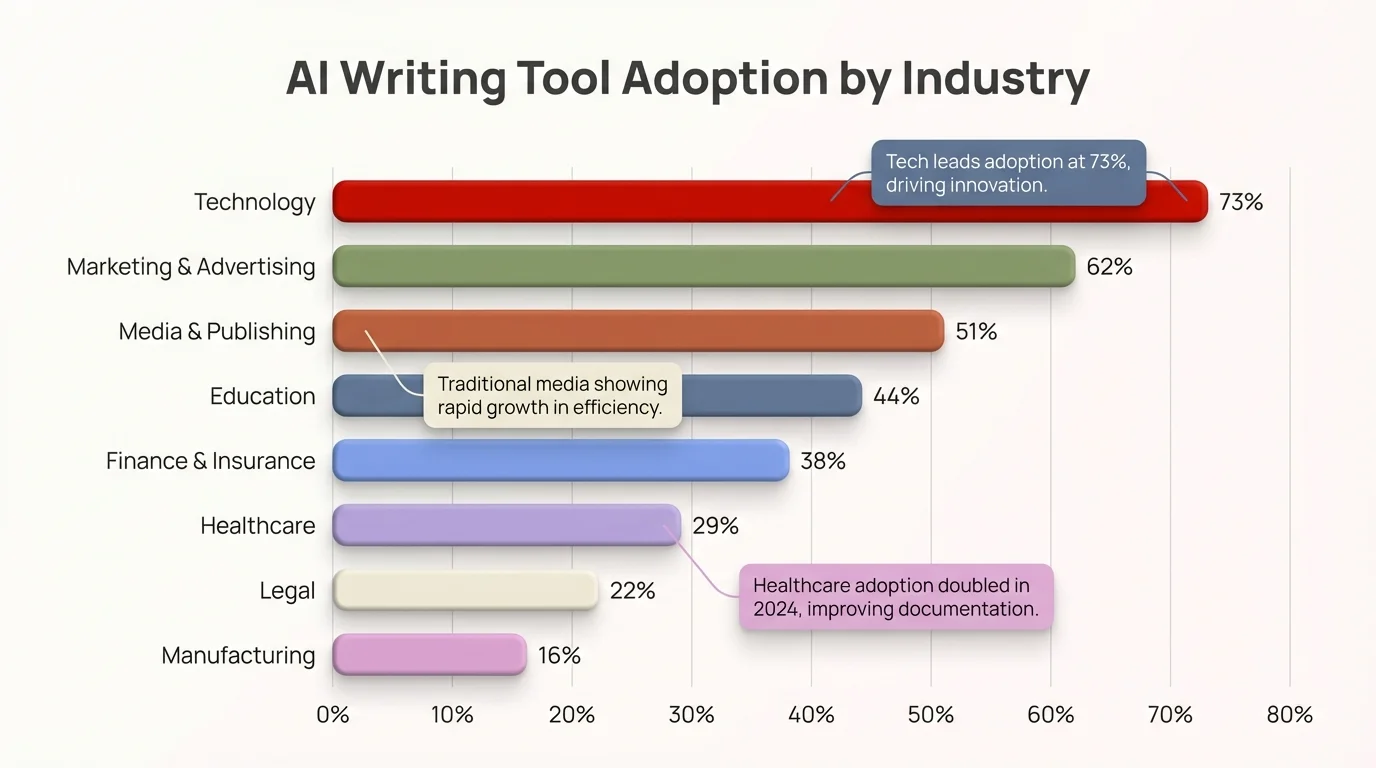
Industry-specific adoption rates showing technology and marketing leading AI writing tool implementation
AI Writing Tools Comparison and Market Leaders
Who is dominating the AI writing tools market? Moreover, You have got specialize writing assistant, general-purpose AI models, and integrated keyboard solutions like CleverType.
ChatGPT leads in perfect usage with 700 million participating user and 92% adoption among Fortune 500 company. Furthermore, Its versatility makes it the default AI writing tool for tons of people, even though it is not specifically built for writing.
Market Leaders and Their Strength:
- ChatGPT: 700M users, versatile, free tier available
- Jasper: Marketing-focused, templates, team collaboration
- Copy.ai: Sales copy specialization, workflow automation
- Grammarly: Grammar and style checking, browser integration
- CleverType: AI keyboard, cross-app functionality, mobile-first
CleverType sets itself aside through keyboard-level integration. Instead of being another app or browser extension, it gives you AI help wherever you type on your phone. No more switching between apps.
Privacy is another big deal. Nevertheless, CleverType processes text on your device when possible, so your data does not leave your phone for many operations. That is unlike from cloud-based tools that send everything to remote server.
Speeding matters on mobile. CleverType is built for minimum lag—suggestions pop up in millisecond, not minute. When you are fire off a quick text, waiting around for AI defeats the whole point.
CleverType supports 100+ languages, more than most competitors. That is immense for bilingual users or anyone talking across language barriers.
What about traditional keyboard competitors like Gboard and SwiftKey? Therefore, Both added AI features, but they do not have the focused writing helper that CleverType does. Gboard pushes Google integrating, SwiftKey focuses on prediction, while CleverType is all about AI-powered writing quality.
Moreover, Grammarly Keyboard exists but it is pretty limited compared to the desktop version. CleverType gives you way more complete AI writing help on mobile, not just grammar checking.
Therefore, Market positioning matter. ChatGPT is a general AI assistant, Jasper target marketing team, Copy.ai goes after sales, and Grammarly owns grammar. CleverType positions itself as the best AI keyboard for mobile writing across everything.
Pricing is all over the place. ChatGPT has a free tier with paid upgrades. Specialized tools like Jasper and Copy.ai run $30-100+ monthly. Grammarly go from costless to $30/month. CleverType offers competitive pricing without emptying your wallet.
Integrating depth decide whether you will really use it. Browser extensions work on desktop but not mobile. Standalone apps make you switch away from what you are doing. Therefore, Keyboard-level integration like CleverType helps without breaking your flow.
The best tool depends on what you need. Hence, For desktop long-form content, specialized writing assistants might work better. Therefore, For mobile communication—messages, e-mail, social media, everything—CleverType is keyboard approach makes way more sense.
Challenges and Limitations in AI Writing
AI writing tools are not perfect. Not even close. Understanding what they cannot do assist you use them right rather of expect miracle.
Accuracy is the biggest issue. Therefore, AI can confidently state entirely incorrect information. This "hallucination" problem has gotten better but has not gone away. You still need human fact-checking for anything you publish.
Key Limitations:
- Factual accuracy: AI can confidently state incorrect information
- Context understanding: Struggles with nuance and implied meaning
- Originality: Can produce generic or repetitive content
- Cultural sensitivity: May miss cultural context or produce inappropriate content
- Privacy concerns: Cloud-based tools transmit user data
- Over-reliance: Users may accept AI output without critical review
- Bias: AI reflects biases in training data
Nevertheless, Originality is another issue. AI is great at remixing existing patterns but struggles to produce truly novel insights or creative approaches. The content can feel generic or cookie-cutter.
Privacy concerns are real. Most AI writing tools send your text to cloud servers. Furthermore, That raises questions about data security, privacy, and potential leaks of sensitive info. Therefore, CleverType handles this with on-device processing when potential.
Consequently, Bias in AI content reflects biases in training data. Despite effort to fixate this, AI can produce contentedness that reinforces stereotypes or misses certain perspectives. Furthermore, Human review should include checking for unintended bias.
Nevertheless, Over-reliance is becoming a problem. As multitude get comfortable with AI, they might skip critical review. Moreover, That can lead to publishing errors, inappropriate content, or miss chance to add unique value.
Cultural context often trip up AI. It might miss references, utilize incorrect examples, or fail to adjust tone for different cultures. This is especially bad for global communication.
Technical limits include length restrictions, slow processing for longer docs, and trouble staying consistent across really long pieces. Most AI writing tools work best on contentedness under 2,000 words.
Additionally, Cost can add up fast for heavy users. Costless tier exist but usually have usage cap. Pro access to AI writing tools can run $50-200+ monthly, which gets expensive for small business or solo users.
Integration gaps mean AI help is not always there when you need it. Hence, Browser extensions do not work in native apps. Standalone tool make you copy-paste everything. CleverType fixes this by living in your keyboard, working across all apps.
Legal questions are still up in the air. Who own AI-generate contentedness? What about copyright? Nonetheless, Can you use AI output in legal docs? Nonetheless, Different places have different answer, which create uncertainty.
Moreover, Detection is getting easier. Tools can spot AI-generated content pretty well now. For contexts where originality matter (academic work, journalism), this creates problems for people who lean heavily on AI.
Consequently, How much AI writing needs human editing? Additionally, Pretty much all of it. Even the best AI output benefits from human review, fact-checking, tone tweaks, and personalization. AI speed up writing but does not kill the need for human judgment.
Therefore, CleverType is built with these limitations in mind. It gives you suggestions and help rather than trying to automate everything. You stay in control, using AI as a tool instead of a replacement.
Frequently Asked Questions
Q: How many people are currently using AI writing tools in 2026?
A: Approximately 700 million people actively use ChatGPT alone, with 34% of Americans having used AI writing tools by 2025. The number increases to 58% for people under 30, and 90% of content marketers now use AI writing tools regularly.
Q: Do AI writing tools actually improve productivity?
A: Yes, studies show workers save an average of 2.2 hours per week (5.4% of work hours) when using AI writing tools. Writing speed increases by approximately 40%, and teams report 77% faster task completion with 45% overall productivity boost.
Q: What industries have adopted AI writing tools the most?
Nevertheless, A: The technology sector leads with 251 company using AI writing tools, follow by education (209 companies) and business services (98 companies). Consequently, Content marketing shows the high adoption pace at 90%, while client supporting reaches 75% adoption.
Q: Are AI-generated texts detectable?
A: Yes, detection tools can now identify AI-generated content with reasonable accuracy. However, content that combines human and AI collaboration is harder to detect. The key factor isn't whether AI was used, but whether the concluding content provide value and accuracy.
Q: How much does AI writing software typically cost?
A: Costs vary widely. ChatGPT offers a costless tier with paid plans around $20/month. Hence, Specialized tools like Jasper and Copy.ai charge $30-100+ monthly. Grammar checkers like Grammarly range from free to $30/month. Nonetheless, CleverType provides AI keyboard functionality at competitive pricing.
Q: Will AI writing tools replace human writers?
A: No, AI writing tools augment rather than replace human writers. While AI handles drafts and routine content, humans allow strategy, creativity, fact-checking, and final judgment. Hence, Demand for skilled writers who can effectively use AI tools is actually increasing.
Q: What are the main limitations of AI writing assistants?
Therefore, A: Key limitations include potential factual inaccuracies, generic or repetitive output, difficulty with nuanced context, secrecy concerns with cloud processing, and inherent biases from training data. All AI-generated content requires human review and fact-checking before publication.
Try CleverType Free Today
Hence, Experience AI-powered writing assistance on your mobile keyboard
Download CleverType NowShare this article: