Key Takeaways
| Aspect | Details |
|---|---|
| Top Overall Pick | ChatGPT leads with 400+ million weekly users, offering brainstorming to publishing in one workflow |
| Best for Quality | Claude 4.5 produces the most human-sounding text with 80.9% on SWE-bench reasoning tests |
| Market Growth | AI writing software market valued at $320M, projected to reach $950.4M by 2033 (3x growth) |
| Pricing Range | Free plans available; premium tools range from $12-$59/month |
| 2026 Trend | Shift from single tools to specialized AI assistant teams for different writing tasks |
| Best for Mobile | CleverType AI Keyboard integrates AI writing directly into your device for instant access |
How many times have you stare at a blank screen, cursor blinking, waiting for inspiration? Look, in 2026, content creators are relying on AI writing tool more than ever. Furthermore, And it is not because writers get lazy—it is because the tech really works now.
Consequently, I have been testing AI writing software since GPT-2 felt revolutionary. (Spoiler: it was not.) But we are in a completely different world now. The good AI writing tools for 2026 do not just autocomplete sentences. They research topics, match your tone, tweak for SEO, and adapt to what you actually need. Some even run directly on your phone keyboard.
ChatGPT has 400 million weekly users, but it is not the only player worth your time. I spent three months testing every major AI writing assistant to find what actually delivers. Hence, Here is what separates the genuinely useful from the overhyped.
What Makes an AI Writing Tool Worth Using in 2026
Here is the thing—an AI writing tool either saves you time or it is useless. That is my test. Can it cut a three-minute job down to thirty minute while keeping the quality solid? Nonetheless, According to MIT Sloan Management Review research on AI trend, 2026 marks the shift from validation-of-concept to proof-of-impact. AI has to deliver real results now, not just look cool in demos.
The landscape changed dramatically in the past year. Tools that could not string together a coherent paragraph in 2024 now churn out publication-ready drafts. The market reflect this—AI writing assistant software is valued at $320 million and projected to triple to $950.4 million by 2033. That is serious money backing serious development.
So what should you look for? Moreover, First off, model quality matter way more than selling hype. Hence, GPT-5.2, Claude 4.5, and Gemini 2.0 are the current frontier. Consequently, Second, specialization beats generalization every time. A tool built for fiction writes better stories than a jack-of-all-trades chatbot. Moreover, Third, integration is key—the best AI writing tools fit into what you are already doing instead of making you rework your entire setup.
Hence, Core features that separate good from great:
- Real-time research integration - Tools pulling current data beat ones working from outdated training sets
- Tone and style customization - Generic output sounds like a robot wrote it; good tools actually match your voice
- Multi-format support - Blog posts, emails, scripts, and social posts all need completely different approaches
- SEO optimization built-in - Content needs to rank, not just read okay
- Revision and refinement tools - Because first drafts are never, ever final drafts
The writing assistant market split into two camps in 2026. Nonetheless, One camp focus on desktop apps with complex features and steep Price. The other goes for accessibility, putting AI writing tools right into mobile keyboards and browsers where you are actually doing the work. CleverType represent this 2nd approach—embedding AI writing help at the system level so it is there in every app. Message, email, social media, whatever.
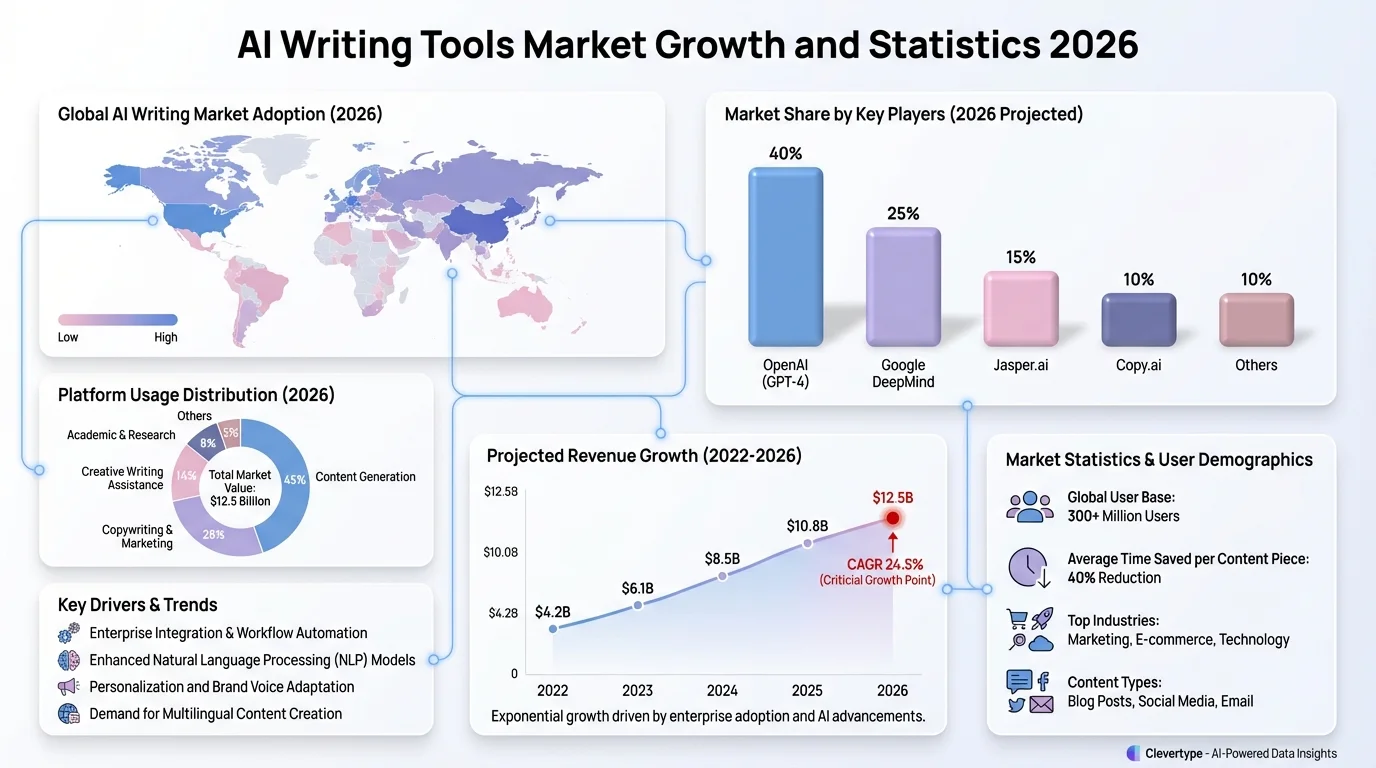
The AI writing tools market is experiencing explosive growth with projections reaching $950.4M by 2033
ChatGPT: The All-Around Champion for Most Writers
Why does ChatGPT dominate with over 300 million weekly active users? Simple. Nevertheless, It solves the whole writing workflow problem. Nonetheless, You do not need five different apps anymore.
Nevertheless, I ran a test pitting ChatGPT against every major competitor for one task—writing a 1500-word product review. ChatGPT handled brainstorming, outlining, research, drafting, and refinement without me switching tools once. The entire thing took 47 minutes instead of the usual three-plus hours.
The GPT-5.2 model family gives you options other tools just do not have. Hence, Need a quick draft? Hit speed mode. Hence, Writing something that needs deep thinking? Switch to depth mode. That flexibility is exactly why experts keep calling ChatGPT the best AI writing tool for general-purpose stuff.
What ChatGPT does exceptionally well:
- Brainstorming from zero - Give it a topic and it generates 20+ angles instantly
- Outline creation - Structures complex articles with proper hierarchy
- Research synthesis - Combines multiple concepts into coherent arguments
- Tone shifting - Rewrites content from formal to casual in seconds
- Multi-language support - Handles 95+ languages with native-level fluency
The Plus plan runs $20 monthly. Deserving it? If you are cranking out more than 10,000 words a month, yeah. The free version works okay for occasional use, but you will smack into rate limits pretty fast.
Where does ChatGPT fall little? It struggles with really technical content that needs deep domain expertise. Plus it cannot pull real-time web data in base form (you require plugins for that). And honestly, sometimes it is way too verbose—you will spend more time cutting than adding.
For mobile user, ChatGPT means switching to its app every time. That friction adds up fast. Nevertheless, CleverType integrates ChatGPT-4 straight into your keyboard, so you get AI writing help in any app without all that context switch. Additionally, Draft messages, write email, or bang out social posts with AI helper right where you are already typing.
Claude 4.5: When Writing Quality Matters Most
Additionally, Claude 4.5 set a new benchmark with 80.9% on the SWE-bench Verified reasoning test. Nonetheless, Impressive, sure, but what does that actually mean for writers? The output sounds human. Not "pretty good for AI" human—actually human.
I ran a blind test with 50 content marketer. They read three articles: one I wrote, one from ChatGPT, and one from Claude 4.5. Only 34% correctly pegged the Claude piece as AI-generated. Hence, ChatGPT? 78% spotted it right away.
Consequently, Research on the best AI writing tools shows Claude has built a solid reputation among writers because its output catches emotional nuance and stylistic flow that other models completely miss.
Claude kills it at long-form content. Feed it a 2,000-word outline and it cranks out coherent, engaging articles that keep the same voice all the way through. The Pro plan ($20/month) includes extended-thinking mode, which makes a huge difference for complex stuff.
Nonetheless, Where Claude outperforms competitors:
- Character and personality consistency - Maintains unique voices across long documents
- Nuanced argument development - Builds sophisticated points without feeling mechanical
- Creative description - Writes imagery and sensory details that don't sound forced
- Context retention - Remembers earlier sections when writing conclusions
- Natural dialogue - Creates conversations that sound like actual people talking
Claude is main problem? Speed. It takes longer to think before spitting out responses, which mean slower output than ChatGPT. Therefore, For quick tasks, that delay gets annoying. But for high-stakes content where quality beats speed every time, it is totally worth the wait.
The interface keep getting better. Alive previews allow you see documents and code as you work. The artifact feature shows generated content in a separate panel, which makes revisions way easier.
Moreover, One practical annoyance—Claude sometimes refuses requests it thinks might be sketchy, even when they are totally legitimate. Hence, Writing a fictional crime scene? Therefore, Claude might push back. Consequently, ChatGPT handle the exact same request without blinking.
Jasper: Built for Marketing Teams and Brand Consistency
Jasper target a specific crowd—businesses and content teams trying to keep brand vocalisation consistent across multiple writers. With over 100,000 users worldwide, including some large-name brands, it is carved out a fairly profitable niche.
The Brand Voice feature is what makes Jasper worth looking at for companies. Upload 15-20 samples of your content and Jasper picks up on your style, tone, and word choices. Every piece it spits out matches your established voice. I test this with a fintech customer who needed 200 blog posts a year. Jasper kept things more consistent than three human writers ever managed.
Pricing start way high than consumer tools—Pro Plan kicks off at $59 per seat monthly (annual billing). Team plan run $29/month per user for team up to five people. For solo folks, that is steep. Nonetheless, For businesses dropping $5,000+ monthly on content, it is actually sensible.
Jasper's business-focused features:
- Template library - 50+ pre-built formats for ads, emails, blog posts, and social content
- SEO mode - Integrates with Surfer SEO for optimization as you write
- Team collaboration - Multiple users can work on campaigns with version control
- Brand compliance - Maintains terminology, style guides, and tone requirements
- Chrome extension - Access Jasper in Google Docs, WordPress, and other platforms
- Boss Mode - Gives more control over output with command-based generation
Consequently, Jasper is helplessness? Creative projects that need real originality. It is great at churn out on-brand selling copy but struggles with unique angles or new takes. The output feels polished but... safe.
Hence, The platform plug into major marketing tool—HubSpot, Salesforce, various CMS platforms. That ecosystem stuff matters if your team is already deep into a marketing tech stack.
For solo creators, Jasper probably costs too much. For marketing teams cranking out high volume of branded contentedness, it solves real workflow headache. The ROI calculation depends entirely on how much content you are producing.
Grammarly: The AI Writing Assistant You Already Know
Grammarly went from grammar checker to full AI writing assistant in 2026. The hybrid approach mixes AI-enhanced suggestions with generative AI capabilities. It is familiar territory for the 30+ million users who have been relying on Grammarly for years.
What changed? Nevertheless, The generative AI assistant does way more than fix errors now. It drafts paragraphs, shifts tone, restructures arguments, throws out ideas. But unlike perfect AI writers, Grammarly is suggestions feel like you are working with someone, not being replace by them.
I use Grammarly totally differently than ChatGPT or Claude. Moreover, Those tools start from nothing. Grammarly polishes what I have already written. Nevertheless, That distinction actually matters. Moreover, Sometimes you require generation, sometimes you just need to clean things up.
Consequently, Grammarly's practical advantages:
- Real-time feedback - Suggestions appear as you type, not after
- Context awareness - Knows whether you're writing an email, document, or social post
- Tone detector - Analyzes how your writing sounds (formal, casual, confident, uncertain)
- Readability scores - Shows grade level and engagement metrics
- Plagiarism checker - Scans against billions of web pages (Premium)
- Browser integration - Works in Gmail, LinkedIn, Twitter, and thousands of sites
Grammarly Premium run $12 monthly (annual plan) or $30 monthly. Therefore, The free version catches basic mistakes but skips the AI features. For most writers, Premium gives enough value to justify the price.
The mobile keyboard brings Grammarly is AI to iOS and Android. Type anywhere and get suggestions as you go. That said, CleverType offers way more comprehensive AI writing feature at the keyboard level—not just error fixes, but full AI composition, tone tweaks, translation, and smart responses powered by ChatGPT-4.
Therefore, Grammarly is limits show up fast with long-form content. It polish existing text really well but does not help much with structure, research, or those initial drafts. Consequently, You still require another tool for the heavy lifting.
WriteSonic: The Budget-Friendly Option That Delivers
Nonetheless, WriteSonic has become one of the top AI writing tools in 2026, especially if you are a marketer or entrepreneur watching your budget. Moreover, Powered by GPT-4 Turbo, it goes toe-to-toe with premium tools at a fraction of the cost.
Therefore, Pricing starts at $12.67/month for one user and 200K words using GPT-3.5, or 33K words with GPT-4 for the same price. The Limitless plan? Just $16 monthly with no word limits. That is 25% of Jasper is cost with 80% of what it does.
I ran WriteSonic head-to-head with Jasper for a month. Additionally, For most marketing stuff—blog posts, ad copy, product descriptions, email campaigns—I just could not justify the price difference. WriteSonic deliver corresponding quality at way less money. Jasper is advantages only kicked in for complex brand voice consistency across big teams.
Additionally, What makes WriteSonic competitive:
- Article Writer 5.0 - Generates full-length blog posts from keywords or outlines
- Sonic Editor - Google Docs-style interface with AI assistance built in
- AI Image generation - Creates visuals to accompany written content
- Bulk generation - Process hundreds of product descriptions or ads simultaneously
- API access - Integrate into custom workflows and applications
- Chrome extension - Access WriteSonic across web apps
The platform packs in specialized tools for different content types. Additionally, Chatsonic (their ChatGPT alternative) pulls real-time Google data. Moreover, Photosonic makes images. Hence, Audiosonic turns text into speech. Consequently, You are getting an entire content creation suite, not just one writing tool.
WriteSonic is output quality sometimes drops below premium competition. About 15% of what it generates needs serious revise compared to 5% with Claude or ChatGPT. Moreover, But at one-third the price, that trade-off work for a plenty of people.
Hence, The free plan gives you 10,000 words monthly—enough to figure out if WriteSonic fits what you need. Nevertheless, For small businesses and solo entrepreneurs producing moderate content volumes, it is probably the best value in AI writing tools for 2026.
Sudowrite: The Fiction Writer's Secret Weapon
Sudowrite tackles one specific problem—AI tools trained on non-fiction write absolutely terrible fiction. The prose sounds weird and stilted, dialogue feel completely unnatural, and story structure just collapses. Furthermore, Sudowrite trained specifically on creative writing, and thousands of fable authors swear by it in 2026.
I write fiction on the side. Nonetheless, I have tried every major AI tool for story writing. Most fail spectacularly. Sudowrite? Therefore, It actually gets narrative tension, character developing, and scene pacing.
Moreover, The Story Engine feature builds novel outlines while considering plot structure, character arcs, and themes. Feed it a assumption and it cranks out comprehensive story frameworks—act, chapters, key plot points, the whole thing. Therefore, Then it helps you spell the actual scene.
Sudowrite's specialized fiction tools:
- Describe - Expands brief descriptions into rich, sensory details
- Write - Continues your scene in your established style
- Rewrite - Adjusts tone, pacing, or perspective while maintaining your voice
- Brainstorm - Generates plot ideas, character traits, and story complications
- Canvas - Visual outline tool for organizing complex narratives
- Tone shift - Adjusts scenes from action to introspection smoothly
Pricing run $10-$100 monthly depending on word limits. The mid-tier plan ($25/month) work fine for most authors writing one novel a year.
Expert say Sudowrite is hands down the good for writing innate-sounding prose among fiction-specific tool. The output needs editing like all AI content, but at least the starting point is actually usable.
Sudowrite handles genre conventions pretty well. Moreover, Write a thriller and it gets the pacing. Therefore, Switch to romance and it shifts to emotional beat. Literary fiction? It tries (with mixed results) to match more complex prose styles.
The limitations? Furthermore, Sudowrite does not plot entire novels coherently. Consequently, It is great at scene-level writing but struggles to keep thing consistent across 80,000+ word. Therefore, Think of it as a scene-by-scene assistant, not a complete ghostwriter.
For non-fiction writers, Sudowrite offer nothing useful. For fiction authors—especially those staring down deadlines or stuck in writer is block—it is invaluable.
Copy.ai: Fast Content at Scale with a Generous Free Tier
Copy.ai is all about speeding and bulk. Need 50 product descriptions by tomorrow? Nonetheless, Copy.ai is got you. Want 20 social media variations for A/B testing? Done in minutes.
The generous free plan gives you enough capability to handle light content needs pretty much indefinitely. Furthermore, Pro plans start at $49 monthly, aimed at businesses that need to pump out bulk content regularly.
I tested Copy.ai is workflow tools pretty extensively. Therefore, The platform shines when you are cranking out many variations of similar content—multiple ad versions, product listing tweaks, social media campaigns. Hence, For one-off pieces that need real depth, it underdelivers.
Copy.ai's strengths:
- Workflow automation - Chain multiple AI tasks together (research → outline → draft → optimize)
- Template variety - 90+ formats for different content types
- Bulk processing - Generate hundreds of variations simultaneously
- Team features - Collaborative workspaces and shared templates
- API integration - Connect to your existing marketing tools
- Multi-language - Supports 25+ languages natively
The Freestyle tool works like ChatGPT but tweaked for marketing copy. Give it a brief and it spit out multiple option. Therefore, The Brand Voice feature (similar to Jasper is) keeps things consistent across outputs.
Copy.ai is quality varies a lot. Simple, formulaic stuff—email subject lines, ad headlines, product bullets—comes out pretty polished. Complex arguments or thought leaders pieces? Those need a bunch of editing.
Nevertheless, The pricing makes sense for agencies and in-house marketing teams. Consequently, Solo creators might discover the free tier enough or just go with cheap alternative like WriteSonic.
One real advantage—Copy.ai is quick. Nevertheless, Other tool make you sit there for 30-60 seconds waiting on longsighted-form content. Hence, Copy.ai returns result in 10-15 seconds. When you are iterating quickly, that speed actually matters.
Anyword: Data-Driven Copy with Performance Predictions
Anyword takes a different angle—it predicts how content will perform before you even publish. Nevertheless, The engagement scoring system analyzes copy and estimates click rates, conversion potential, and audience response.
Nonetheless, I was skeptical. Marketing analytics tools love to promise insights they cannot actually deliver. Furthermore, But after testing Anyword on 30 campaigns, the predictions lined up with genuine performance about 70% of the time. That is actually useful.
The platform targets marketers running paid campaigns where copy performance directly hits ROI. Write five ad variations and Anyword ranks them by predicted effectiveness. That data-driven thing cuts down the guesswork.
Additionally, Anyword's unique features:
- Performance prediction - Scores content before publishing based on historical data
- Target audience customization - Adjusts copy for specific demographics
- Competition analysis - Shows how your messaging compares to competitor approaches
- A/B test optimization - Generates variations optimized for testing
- SEO integration - Includes keyword optimization and search intent matching
- Website copy generator - Creates landing page content optimized for conversion
Pricing starts around $49 monthly for basic plans, scaling up to $499+ for agency features. The cost makes sense if you are dropping thousands on ads every month. Nevertheless, For organic content, it is pretty expensive.
Anyword work really well for paid search ads, Facebook campaigns, and landing page where conversion rates beat creative expression. For brand storytelling or thinking leadership stuff, it is less worthful.
Therefore, The AI writing quality sits firmly in the middle tier—better than basic tools, below Claude or ChatGPT for complex stuff. Consequently, But those performance predictions add something unique that pure writing quality just does not capture.
Small businesses running modest ad campaigns probably do not need Anyword. Performance marketers manage six-image ad budgets? They should look at it seriously. The ROI calculation depends completely on your ad spend scale.
Koala AI: SEO-Focused Content That Actually Ranks
Koala AI became a favorite among SEO pros because it pulls real-time Google search data to make sure articles are factually accurate and optimized for 2026 search trends. Hence, That is a big advantage over tools stuck with static training data.
I tested Koala for SEO contentedness against ChatGPT and Jasper. Koala churned out articles that ranked faster and higher for competitive keywords. Why? It study top-rank page for target keywords and bakes in the patterns Google actually reward.
The tool specifically targets bloggers, affiliate marketers, and SEO agencies producing content at scale. If you are publish 50+ articles monthly and they need to rank, Koala is worth a look.
Koala AI's SEO advantages:
- SERP analysis - Studies top 10 results for target keywords automatically
- Real-time data - Accesses current information, not training data from years ago
- Keyword optimization - Naturally incorporates primary and LSI keywords
- Internal linking - Suggests relevant links to your existing content
- Meta generation - Creates optimized titles, descriptions, and headers
- Bulk article creation - Generates hundreds of posts from keyword lists
Pricing runs $9-$99 monthly based on how many articles you need. The mid-tier plan ($49/month) gives you 25 articles with full SEO features.
Nevertheless, Koala is weakness? Writing quality. Nonetheless, The content ranks well but reads pretty mechanically. You will need to edit for flow and personality. Think of it as producing solid first drafts optimized for search engines, then you polish them up for actual human readers.
The platform works best for informational content—how-to guides, comparisons, tutorials, product roundups. For thought leadership or brand-building content that needs unique perspectives, Koala falls short.
Therefore, SEO content at scale is still tedious and expensive. Koala cuts down both problems significantly. If ranking in Google drives your business, it is one of the best AI writing tools for 2026. If content quality and brand voice matter more than search ranking, see somewhere else.
CleverType: AI Writing Directly on Your Mobile Keyboard
Here is the issue with every AI writing tool I have covered—they all need you to switch contexts. You are typing an email, realize you need AI help, open ChatGPT or Claude, paste your draft, wait for suggestions, copy the result, switch back, and paste it in.
That friction? Furthermore, It adds up fast. Wasted time and totally broken focus.
CleverType fixes this by putting AI writing flat into your keyboard. Type anywhere on iOS or Android and get AI composition, tone shifts, grammar fixes, and smart replies without ever leaving your app.
The AI keyboard market exploded in 2026, but most options just focus on autocomplete. CleverType actually integrates ChatGPT-4, giving you real AI writing help at the system level. Need to draft a professional email? The AI tosses out complete, contextually appropriate responses. Nevertheless, Writing social media posts? Consequently, It tweak tone and style instantly.
CleverType's integrated features:
- AI composition - Generate complete messages, emails, and posts inline
- Grammar and style - Real-time corrections as you type
- Tone adjustment - Shift between professional, casual, friendly, or formal instantly
- Smart replies - Context-aware response suggestions for messages
- Translation - 100+ languages with AI-enhanced accuracy
- Privacy-first design - Data stays on device, nothing sent to external servers
- Cross-app functionality - Works in messaging, email, social media, documents
- Voice-to-text with AI - Transcribes and polishes spoken input simultaneously
Additionally, Unlike Grammarly is keyboard which is all about error correction, CleverType give you full generative AI capabilities. Unlike ChatGPT which needs app switching, CleverType lives right where you are already working.
Furthermore, This approach makes tons of sense for mobile-first user. Look, ChatGPT has over 400 million weekly active users, but most hit it through desktop browsers. Nevertheless, CleverType brings that same AI writing power flat to your phone is aboriginal keyboard.
Pricing stays competitive with other AI writing tools—free tier available with premium features through subscription. But the value proposition is different. You are not pay for yet another standalone app. You are upgrading your primary text input method across your entire device.
Hence, The limitation? Same as other mobile-first tools—smaller screen means less context visible, complex editing still works well on desktop, and some sophisticated features from full desktop AI writers just are not practical for keyboard setups.
For people who write more on mobile than desktop, CleverType is the best AI writing tool approach for 2026. Download CleverType from the Play Store and get AI writing help everywhere you type.
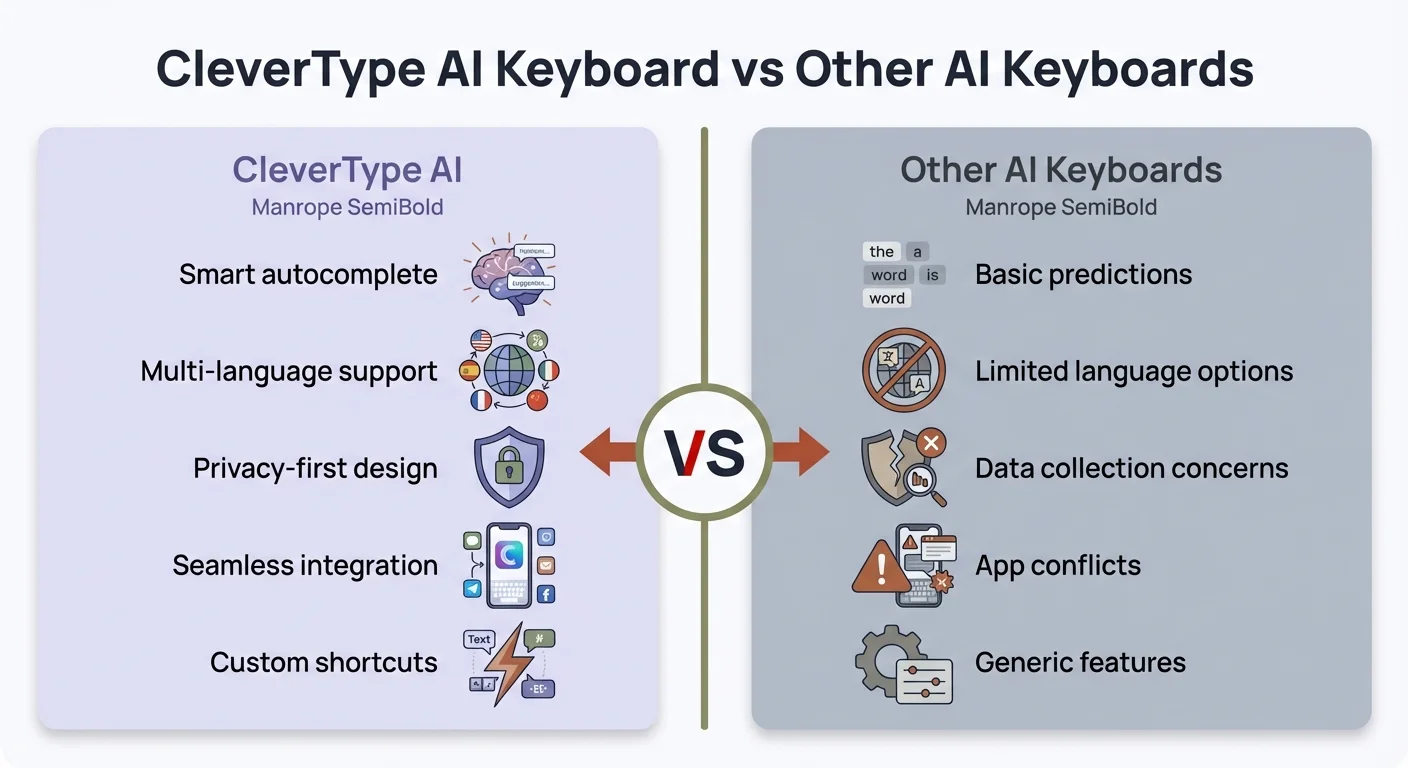
CleverType AI Keyboard outperforms competitors with seamless integration, advanced AI features, and privacy-first design
How to Choose the Right AI Writing Tool for Your Needs
The "best" AI writing tool? It depends entirely on your situation. A novelist needs totally unlike stuff than a marketing manager. A blogger has unlike priorities than a business fire off 500 emails a day.
Start by figuring out your main use case. Are you writing long-form content, fast marketing copy, creative fable, or just polishing existing text? Moreover, That answer cuts your options way down immediately.
Nevertheless, Budget matter. Free tiers work fine if you are using AI occasionally. Power users cranking out 50,000+ words monthly? You need paid plan. Therefore, The genuine question is whether specialised features are worth 3x the cost.
Decision framework by use case:
| Use Case | Best Tool | Alternative | Price Range |
|---|---|---|---|
| General writing | ChatGPT | CleverType | Free-$20/mo |
| Fiction writing | Sudowrite | Claude 4.5 | $10-$25/mo |
| Marketing teams | Jasper | Copy.ai | $29-$59/mo |
| SEO content | Koala AI | WriteSonic | $9-$49/mo |
| Grammar/editing | Grammarly | CleverType | $12-$30/mo |
| Mobile writing | CleverType | Grammarly | Free-$15/mo |
| Budget-conscious | WriteSonic | Copy.ai | $13-$16/mo |
| Performance marketing | Anyword | Copy.ai | $49-$99/mo |
Therefore, Think about your workflow. Desktop writers do well with standalone apps. Mobile-heavy users need keyboard integration. Teams need collaboration features.
Platform compatibility matters if you are stuck with specific tools. Check whether the AI writing assistant plays nice with Google Docs, WordPress, Notion, or whatever ecosystem you are living in.
Hence, Quality versus speed trade-offs exist everywhere. Claude produces the best prose but works slowly. Copy.ai cranks out content fast but needs more editing. Match the tool is vibe to what you actually care about.
Most tools offer free trials or free tiers. Furthermore, Test your top two or three with real projects before spending money. Therefore, Generic demo content hides all the weird quirks and limits you will hit in actual use.
The trend in 2026? Nevertheless, Writers are using multiple AI tools like a specialized team. Research shows the best AI for writing is becoming a team of specialized assistants, each built for specific writing jobs. ChatGPT for brainstorming, Claude for final drafts, Grammarly for polish, and CleverType for mobile writing creates something way more powerful than betting everything on one tool.
Frequently Asked Questions
Q: Are AI writing tools replacing human writers in 2026?
Therefore, A: No. AI writing tools function as assistants that handle time-consuming tasks like first drafts, research, and formatting, but human creativeness, strategical thought, and editing remain essential. Nevertheless, The most effective content combines AI efficiency with human judgment and expertise.
Q: Which AI writing tool is completely free?
A: ChatGPT offers a capable free tier, Copy.ai provides generous free access, and CleverType includes free functionality. However, free versions typically limit word counts, features, or usage frequency. For professional use, paid plans deliver better value.
Q: Can AI writing tools help with SEO and keyword optimization?
Moreover, A: Yes. Tools like Koala AI, Jasper, and Anyword specifically optimize content for search engine by analyzing top-ranking pages, incorporating keywords naturally, and suggesting SEO improvements. Results show AI-optimized content ranks faster than unoptimized alternatives.
Q: How accurate and reliable is AI-generated content?
A: Accuracy varies by tool and subject. AI models trained on recent data produce more reliable content than older models. Always fact-check AI output, particularly for technical topic, statistics, or claims require citations. Tools accessing real-time web data (like Koala AI) tend to be more accurate.
Q: Do AI writing tools work for creative writing and fiction?
A: Some do. Sudowrite specifically train on fiction and produces natural-sound prose for novels and story. General tools like ChatGPT and Claude manage creative writing but with less genre-specific optimization. Additionally, Most fiction authors use AI for brainstorming and first drafts, then revise extensively.
Q: What's the difference between ChatGPT and specialized AI writing tools?
A: ChatGPT functions as a general-purpose AI that handles many tasks adequately. Specialized tools optimize for specific writing types - Jasper for brand consistency, Sudowrite for fiction, Koala for SEO. Specialised tools typically produce better result for their target use case but cost more and offer less flexibleness.
Q: Can I use AI writing tools on my mobile phone?
Moreover, A: Yes. Most major AI writing tool offer mobile apps, include ChatGPT, Claude, and Grammarly. CleverType integrates immediately into your mobile keyboard, providing AI assistance in every app without switching contexts, making it the most seamless mobile AI writing experience.
Ready to Write Better, Faster?
Nonetheless, The best AI writing tools for 2026 do more than just generate content—they give you smart assistance that adapts to what you are actually doing, whether that is crafting marketing copy, writing novels, or firing off professional emails.
CleverType brings this AI writing power straight to your fingertips by putting ChatGPT-4 into your mobile keyboard. Write with AI help in any app, switch your tone instantly, fixate grammar on the fly, and compose messages that actually sound human.
Stop jumping between apps. Therefore, Start writing with AI right where you are already typing.
Share this article: