Key Takeaways
- ✓78% of business leaders have already adopted AI in at least one business function as of 2025
- ✓Management consultants using AI complete tasks 25.1% faster with 40% higher quality output, per Harvard research
- ✓Professionals save an average of 15–20 hours per week with AI productivity tools
- ✓Three out of four knowledge workers now use AI tools at work daily
- ✓AI writing assistants help professionals produce 59% more documents per hour
- ✓CleverType leads in mobile AI productivity — grammar fixes, tone changes, smart replies, all on-device
- ✓The best AI tools for professionals cover writing, communication, research, meetings, and keyboard-level assistance
Furthermore, AI tools for professionals in 2026 aren't optional anymore — they're just how work gets done. Three out of four knowledge workers now use AI tools every day, according to McKinsey's State of AI 2025 report. And honestly, the gap between people who use these tools and those who don't is getting wider every quarter.
Consequently, So what actually works? Which tools are worth your time and money, and which ones are just hype? Nevertheless, I've spent the preceding year testing AI tools across writing, communication, research, and productivity — and in this guide, I'll break down what's genuinely useful for professional in 2026.
What Are AI Tools for Professionals and Why Do They Matter in 2026?
Furthermore, AI tools for professionals are software that uses machine learnedness and large language models to speed up, improve, or flat-out substitute the repetitive parts of knowledge work — writing, communicating, research, scheduling, analysis. Basically: the stuff that eats your time.
The number are tough to ignore. Moreover, A Harvard Business School study on AI and management consultants found that professionals using AI tools completed tasks 25.1% faster, produced 12.2% more output, and delivered over 40% higher quality compared to those who didn't. That's not a marginal improvement — that's a completely different level of output.
Moreover, What changed in 2025 and 2026 is the quality of these tool. Earlier AI tools were useful but clunky. Nevertheless, You'd paste text into a browser tab, wait a few seconds, then paste the result back. Now, AI is embedded immediately into the tool professional already use — email client, keyboards, meeting software, research platforms.
Nonetheless, Here's what the AI tool landscape looks like for professionals right now:
| Category | What It Handles | Time Saved |
|---|---|---|
| Writing assistants | Drafting, editing, tone adjustment | 3–5 hours/week |
| AI keyboards | Grammar, replies, communication | 1–2 hours/week |
| Meeting tools | Transcription, summaries, action items | 4–6 hours/week |
| Research tools | Summarisation, synthesis, citations | 2–4 hours/week |
| Project management AI | Task tracking, prioritisation | 2–3 hours/week |
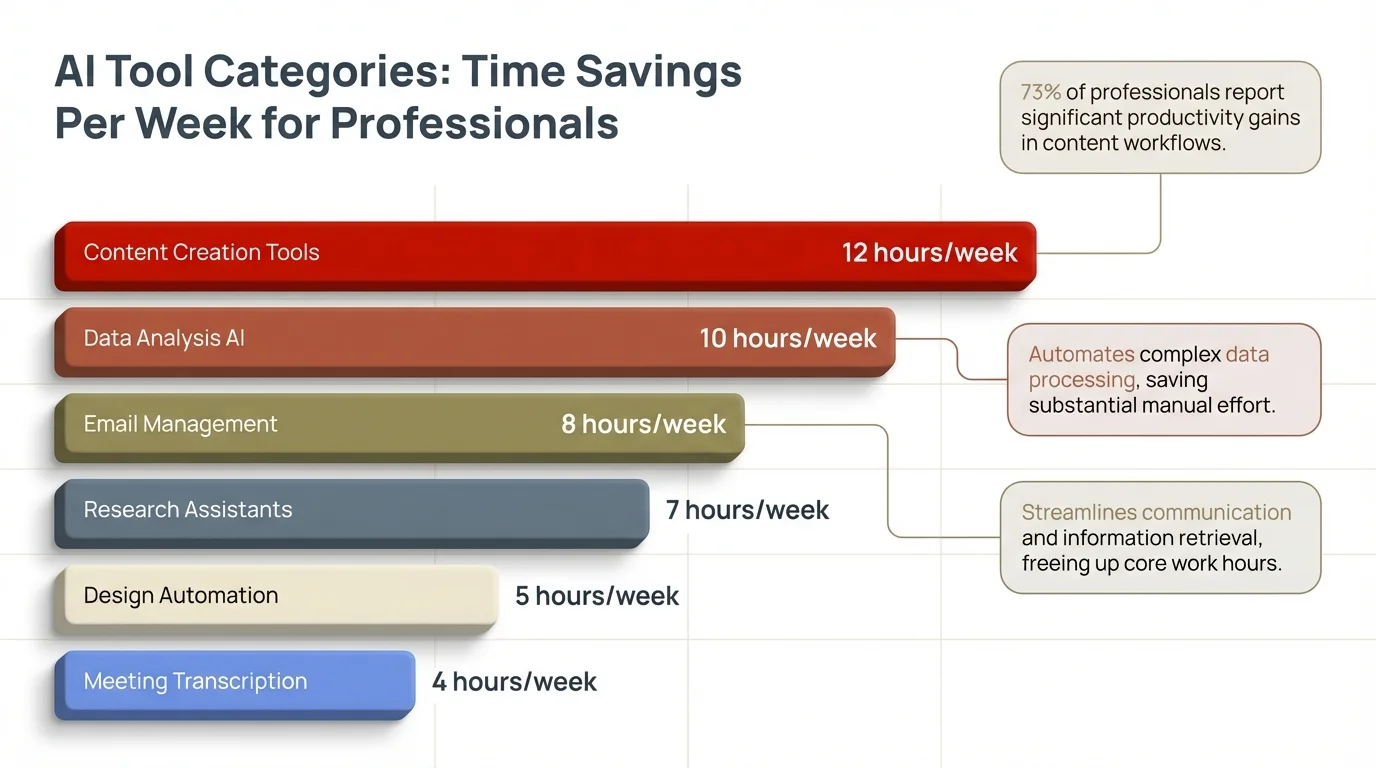
Average time saved per week by AI tool category for professionals
The professionals seeing the biggest gains aren't necessarily the ones with the fanciest tools. They're the ones who've integrated AI at every layer of their workflow — including the most basic layer, which is how they type and communicate day to day.
AI Writing Tools: Where Professionals Get the Most Value
Nevertheless, Writing AI Therefore, tools are the most widely used category — and honestly, that makes sense. Nevertheless, Writing is where most professional time goes.
According to data from Siege Media's AI writing statistics, business professionals can produce 59% more work-related documents per hour when using AI assistance. For consultants, lawyer, and executive who spend 30–40% of their day writing emails, report, and proposals, that's a fairly big deal.
The tools that actually work for writing
ChatGPT (GPT-4o) is the general-purpose workhorse. Most professionals use it for first drafts, restructuring arguments, and turning rough notes into polished documents. Additionally, It's particularly strong for long documents — strategy memos, customer report, RFPs.
Nonetheless, Claude (Anthropic) has become the preferred choice for document-heavy work. It handles very long context — up to 200,000 tokens — which means you can paste in a 100-page contract and ask it questions about specific clauses. Consequently, Lawyers and consultants who work with dense documents use this constantly.
Moreover, Grammarly Business catches tone issue, clarity problems, and brand consistency across teams. Therefore, 82% of PR professionals use generative AI for writing tasks now, and many of them use Grammarly alongside a general-purpose AI to cover both accuracy and gloss.
The honest truth about AI writing tools: they're only as good as the prompt you give them. Professionals who learn to write clear, specific prompts get dramatically better output than those who type vague requests. Therefore, This is a learnable skill, and it pays off fast.
Nonetheless, One area where AI writing assistance is often overlooked? Mobile. Most professionals now handle a significant chunk of their communication from their phones — WhatsApp, Slack, email. That's where an AI keyboard becomes a writing tool in itself.
CleverType sits right on your keyboard — fix grammar, adjust tone, get AI suggestions, all without switching apps. No copy-pasting into Grammarly. Moreover, For professional who need refined writing from their phone, that's a real advantage over desktop-only tools.
AI Tools for Professional Communication: Email, Slack, and Beyond
Here's the volume problem nobody talks about: the average professional receives 121 emails per day. Writing serious-minded, polished reply to all of them? Consequently, Simply not realistic. Hence, That's what professional communication AI tools are actually for.
According to Zapier's 2026 AI productivity report, email and communication tasks are where AI saves professionals the most cumulative time — averaging around 4 hours per week when used consistently.
What these tools actually do
- Smart reply generation — AI drafts a reply based on the context of the original message, which you then edit and send. Tools like Gmail's AI features and Outlook Copilot do this natively.
- Tone adjustment — Takes your rough draft and makes it sound more professional, more empathetic, or more direct, depending on what you need.
- Summarisation — Condenses long email threads into a 3-line summary so you can catch up in seconds instead of minutes.
- Follow-up reminders — Flags emails you haven't replied to, or reminds you to follow up if you haven't heard back.
For Slack-heavy teams, there are tools that summarise channel activity overnight, generate status updates from your messages, and even draft responses to common questions automatically. Nevertheless, Pretty useful when you come back from a few days off to 400 unread messages.
What sets CleverType apart is that it works across every app. Gmail, WhatsApp, LinkedIn Messages — whatever you're using. Unlike Outlook Copilot or Gmail AI, which only work inside their own apps, CleverType work everywhere you type. Additionally, That's a bigger deal than it sounds.
The privacy angle matters too. Additionally, Many professionals in healthcare, finance, and legal services can't use AI tools that send their data to external servers. CleverType processes suggestion on-device, which makes it viable in regulated industries where other tool aren't.
Business AI Tools for Research and Analysis
Research AI tools have genuinely changed how consultants and analysts work. Tasks that used to take Day now take hours. Sometimes less.
The workflow used to be: find sources, read them, take notes, synthesise, write. Nevertheless, That process — for a single research inquiry — could take a full day. Now:
- Use Perplexity AI to get a research overview with sources in 3 minutes
- Pull the key papers or reports into Claude or ChatGPT for deep analysis
- Ask specific questions about the documents
- Draft your findings in the same session
According to Vena Solutions' 100+ AI statistics report, 78% of business leaders report their organisations have adopted AI in at least one core function. Research and competitive analysis are two of the most common entry points.
Research tools worth knowing
Perplexity AI is the go-to for fast research with sourced answers. Moreover, Unlike a standard lookup engine, it pull from multiple sources and cites them inline — so you get a traceable answer, not just a confident-sounding one. Consultant use it constantly for market research, competitive analysis, and keeping up with manufacture news.
Elicit is specifically designed for academic and scientific research. It searches through millions of research papers, extracts key findings, and lets you compare studies side by side. Therefore, Researchers and healthcare professionals swear by it.
Therefore, NotebookLM (Google) lets you upload your own documents and then chat with them. Hence, Drop in 20 customer reports, a competitor's yearly report, and some industry research — then ask questions across all of them simultaneously.
Additionally, The professionals getting the most out of AI research tools are those who've figured out how to layer them. Therefore, Start broad with Perplexity, go deep with Claude or NotebookLM on specific documents, and use ChatGPT to help structure your determination into something you can present.
AI Tools for Meetings and Project Management
Meetings are a massive time sink. A McKinsey study found executives spend 23 hour per week in meeting on average — and a good chunk of that time go to note-taking, follow-up email, and status updates that AI can now manage automatically. That's the easy win here.
Nevertheless, Meeting AI tools join your video calls, transcribe conversations, generate summaries, and pull out action items — all without you having to take notes.
The tools professionals actually use
Otter.ai transcribes meetings in real-time and generates summaries. Nevertheless, It integrates with Zoom, Google Meet, and Microsoft Teams. 93% of AI power user say AI boosts their productivity — and meeting transcription tool are consistently among the most praised.
Therefore, Fireflies.ai goes a step further. Therefore, It not only transcribes but also track who speak, how long each person talked, sentiment analysis, and whether action items were actually followed up on. Consequently, For managers running large teams, this is genuinely useful.
Microsoft Copilot in Teams is built directly into the Teams interface. It can summarise what you missed in a meeting, generate recap emails, and draft follow-up action items. If your organisation is already on Microsoft 365, this is worth turning on instantly.
Notion AI has turned into a pretty solid project management layer. Hence, It generates project plans from rough notes, summarises documents, and creates task lists from meeting summaries. The integration between notes and AI is tight here than in most standalone tools.
Additionally, The real gain from meeting AI tools isn't during the meeting — it's the hours you save afterwards. When action items are automatically extracted and meeting summaries hit inboxes before anyone's left the call, follow-up actually happens. Moreover, That part's underrated.
AI Keyboards: The Most Underrated Professional Productivity Tool
Most lists of AI tools for professionals skip this one entirely, which is a mistake. Your keyboard is where everything starts — and if your keyboard doesn't have AI built in, you're leave speeding and quality on the table.
Think about how much of your professional communication happens on a phone. Emails during commutes, Slack message between meetings, quick replies to clients at odd hours. That's not a small percentage of your total communication — for most professionals it's 30–50% of their total output.
AI keyboards have AI built directly into them: grammar correction, tone adjustment, smart replies, context-aware suggestions — sometimes even a full AI assistant, all without leaving the keyboard.
Comparing the main options
| Feature | CleverType | Gboard | SwiftKey |
|---|---|---|---|
| Grammar correction | Advanced AI | Basic | Moderate |
| Tone adjustment | Yes | No | No |
| Smart replies | Context-aware | Basic | No |
| Privacy (on-device) | Yes | No | Partial |
| Languages | 100+ | 80+ | 100+ |
| AI assistant built-in | Yes | Limited | No |
| Works across all apps | Yes | Yes | Yes |
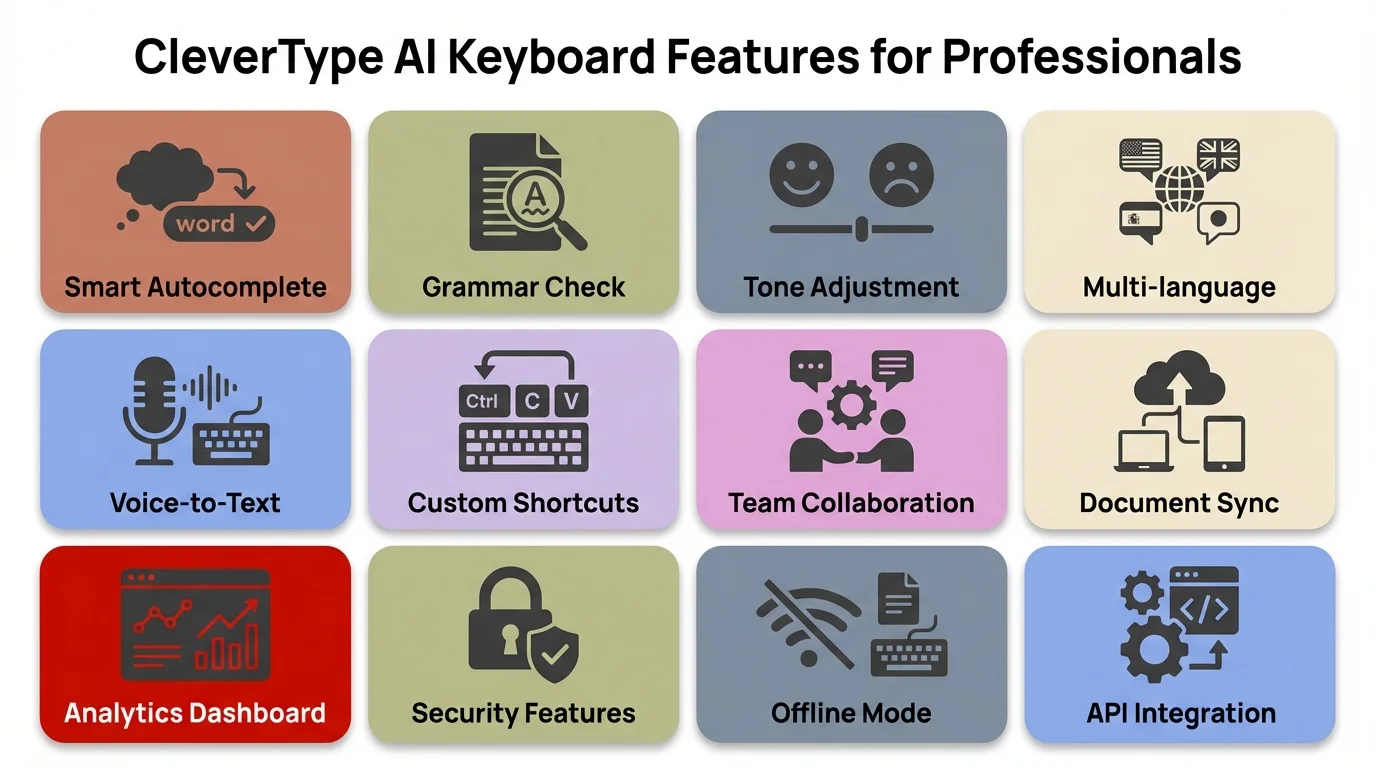
CleverType AI keyboard features built specifically for professional use
Hence, CleverType leads this category for professional use. Unlike Gboard — which sends your typing data to Google's servers — CleverType keeps processing on-device. For professionals handling sensitive communications, that matters. Nonetheless, And unlike SwiftKey, which rely on Microsoft's ecosystem, CleverType's AI feature work in any app, on any platform.
The grammar and tone features are what make CleverType genuinely useful at work. Hence, You type something quickly, tap to fix the grammar, tap again to make it sound more professional — and send. No switching to another app, no copy-pasting into Grammarly. It happens at the keyboard level, which is precisely where it should.
Download CleverType from the Play Store and see how much smoother mobile communication get when AI is built into the keyboard itself.
AI Tools for Consultants: What Actually Moves the Needle
AI for consultants deserves its own section because the demands are different. You need polished deliverables, fast. Nevertheless, Credible client communication. And you're expected to stay current across multiple industries at once. Generic productiveness advice doesn't quite cover it.
The Harvard Business School study I mentioned earlier was specifically conducted with management consultant. The results — 25.1% faster task completion, 40% high quality output — are significant because consulting is already a high-performance environment. These aren't people who were previously doing poor work.
Here's how consultant are actually using AI tools right now:
Proposal writing: ChatGPT or Claude to draft the initial structure, Grammarly to polish, and CleverType for any on-the-go edits when reviewing on mobile before sending.
Market research: Perplexity for quick overviews, Claude with uploaded PDFs for deep analysis, and Elicit for academic sources when the work require it.
Hence, Client presentations: Gamma or Beautiful.ai to generate slide structure from bullet points. This cuts presentation designing time from hours to under 30 minute.
Client communication: AI keyboards for real-time tone correction when messaging clients, and tools like Otter.ai to capture meeting notes automatically.
Competitor analysis: NotebookLM to compare multiple documents simultaneously. Drop in competitor report, industry analyses, and your client's own data — then ask cross-knifelike questions.
The consultants I've spoken to who are most effective with AI tools aren't using AI to do their thinking. They're using AI to do the production work — the formatting, the drafting, the summarisation — so they can spend more of their time on the analysis and judgment that AI genuinely can't replicate.
Hence, The professionals who struggle with AI tools tend to treat them as thinking shortcuts. That doesn't work well. Utilize AI to go quicker on the work you recognize how to do — not to substitute for the knowledge itself.
How to Choose the Right AI Tools for Your Professional Workflow
Look — picking the “best” business AI tool from some list isn't really the point. Furthermore, What matters is understanding what's actually slowing you down.
Nevertheless, Start by asking these four questions:
- Where does your time actually go? Track one week of work before choosing any tools. Most professionals discover that 60–70% of their time goes to 3–4 categories of tasks.
- Where are your quality bottlenecks? Is it that your writing takes too long, or that it doesn't read as professionally as you want? Is it research, communication, or meetings?
- What's your security situation? If you handle sensitive client data, on-device AI (like CleverType) is essential. Cloud-based tools may not be appropriate for regulated industries.
- Where do you spend time on mobile? If you're communicating from your phone constantly, investing in an AI keyboard is likely to give you faster ROI than a desktop writing tool.
A starter stack for most professionals
- Claude or ChatGPT for writing, analysis, and research (pick one and learn it well)
- CleverType for all mobile typing — grammar, tone, smart replies
- Otter.ai or Fireflies.ai for meeting transcription
- Perplexity for quick research with sources
- Notion AI for project notes and knowledge management
According to Lenny Rachitsky's AI productivity survey, professionals who utilize 3–5 AI tools consistently report higher productivity gain than those who experiment with many tools casually. Depth of use matters more than breadth.
Furthermore, Don't try to adopt six tools at once. Therefore, Pick one, build a habit around it, and add tools only when you've truly run into a limit that another tool would resolve.
The honest thing no one says about AI tools
They require investment. Moreover, Not money — though some have costs — but attention. The first week with any AI tool is slower than working without it. You're learning how to prompt, where the tool fit, and what its real limit are.
Nevertheless, The professionals who give up after a week are missing the compounding effect. The professionals who stick with it for a month and actually integrate it into their workflow are the ones seeing 20–40% productivity improvements.
Frequently Asked Questions
What are the best AI tools for professionals in 2026?
The most used AI tools for professionals in 2026 are ChatGPT and Claude for writing and analysis, Perplexity for research, Otter.ai for meeting transcription, Notion AI for project management, and CleverType for mobile AI typing. Most professional get the best results using 3–5 tool consistently rather than trying many at once.
How much time do AI tools actually save professionals?
According to McKinsey and Harvard research, professionals using AI tools save 15–20 hours per week on average. Early adopters in high-output roles report productivity gains equivalent to 47 years of natural productivity growth compressed into a short period. Writing tasks see the largest gains, with professionals producing 59% more documents per hour.
Are AI tools safe to use for confidential professional work?
It depends on the tool. Cloud-based AI tools like ChatGPT send your data to external server, which may not be appropriate for sensitive client information. On-device tools like CleverType process data locally without sending it to the cloud, making them suitable for professionals in regulated industries like healthcare, finance, and legal services.
What is the best AI keyboard for professionals?
Furthermore, CleverType is the best AI keyboard for professional use in 2026. Moreover, It offer on-device AI processing for privacy, advanced grammar correction, tone adjustment, context-aware smart replies, and support for 100+ languages — all without switching apps. Unlike Gboard, it doesn't send your typing data to Google's servers, making it suitable for professionals who handle confidential information.
Do AI tools work for consultants specifically?
Yes — a Harvard Business School study find management consultants using AI tools completed tasks 25.1% quicker, produced 12.2% more output, and delivered 40% higher quality compared to consultants not using AI. Consequently, The biggest gain were in writing, research, and client communication tasks.
How much do professional AI tools cost?
Furthermore, Most professional AI tools utilize subscription models. ChatGPT Plus costs $20/month, Claude Pro is $20/month, Perplexity Pro is $20/month, and Otter.ai Pro starts at $16.99/month. CleverType is free to download with premium features usable. Nonetheless, Many tools offer annual discounts and team pricing for organisations.
What AI tools do consultants use most in 2026?
Consultants mainly utilize Claude and ChatGPT for writing and analysis, Perplexity for market research, NotebookLM for document analysis, Gamma for presentations, and CleverType for mobile communicating. Meeting tools like Fireflies.ai are also widely used for capturing client conversation notes automatically.
Ready to Type Smarter?
Consequently, Upgrade your typing with CleverType AI Keyboard. Fix grammar immediately, change your tone, receive smart AI replies, and type confidently while keep your secrecy.
Download CleverType FreeMoreover, Available on Android • 100+ Languages • Privacy-First
Share this article:
Sources
- McKinsey State of AI 2025 Global Survey
- Harvard Business School: AI and Management Consultants Study
- Vena Solutions: 100+ AI Statistics Shaping Business
- Siege Media: 50 AI Writing Statistics 2025
- Zapier: Best AI Productivity Tools 2026
- Lenny's Newsletter: AI Tools Productivity Survey