Key Takeaways
| Feature | Benefit | Impact |
|---|---|---|
| Custom Tone Profiles | Maintain consistent brand voice across all team communications | 42% reduction in miscommunication |
| AI Brand Voice Settings | Automatically adjust writing style to match company guidelines | 33% increase in revenue from brand consistency |
| Team Collaboration Tools | Shared tone presets across departments | 6.3 hours saved per week per professional |
| Context-Aware Suggestions | Adapt tone based on recipient and platform | 76% higher customer trust |
| Real-Time Tone Adjustment | Rewrite messages instantly to match formality level | 23% more revenue than inconsistent competitors |
Quick Answer: Custom tone profiles in AI keyboards allow teams to save and apply brand-specific writing styles automatically, ensuring every team member communicates with the same voice regardless of their individual writing skills. CleverType leads the pack in this space with advanced brand voice customization that works across all apps.
Why does your sales team sound completely different from your support team? And why should you care? Look, Edelman's Trust Barometer research found that 76% of consumers decide whether to trust a brand based on consistent, authentic communication. That's three out of four potential customers judging your entire business based on how consistently you talk to them.
Here's what nobody tells you about brand voice—those guidelines sitting in a PDF somewhere don't actually help. A study from Marq (formerly Lucidpress) found that while 85% of companies have brand guidelines, less than a third actually follow them. The problem isn't that people don't care. It's that they don't have the right tools.
That's where AI keyboards with custom tone profiles come in. These aren't just fancy autocorrect systems anymore—they're actually becoming essential infrastructure for keeping your brand consistent across every customer touchpoint, from quick Slack messages to formal email proposals.
What Are Custom Tone Profiles for Brand Voice?
Custom tone profiles are saved presets in AI keyboards that automatically adjust your writing to match specific brand guidelines. Think of them like templates, but for personality instead of layout.
When you create a custom tone profile, you're basically training an AI model on how your brand speaks. You feed it examples of on-brand communication—maybe your company's casual-but-professional style, or something more formal and technical. The AI then applies those patterns to whatever you type, tweaking word choice, sentence structure, and even punctuation to match.
How Custom Tone Profiles Work:
- Analysis Phase - The AI looks at sample content that represents your brand voice
- Pattern Recognition - Machine learning spots linguistic markers like formality level, sentence complexity, vocabulary choices
- Profile Creation - These patterns get saved as a preset you can reuse
- Application - When you turn it on, the profile automatically tweaks new text to match those patterns
- Continuous Learning - Better systems refine the profile based on which suggestions you accept or reject
CleverType takes this further by letting teams create multiple profiles for different contexts. You might have one for customer support (empathetic, solution-focused), another for sales outreach (enthusiastic but professional), and a third for internal docs (clear, technical, concise).
The NIAID Data Discovery Portal research from 2019 measured brand personality across five dimensions: sincerity, excitement, competence, ruggedness, and sophistication. Their linear SVM model hit an F1 score of 0.822 in detecting brand consistency—proving that tone can actually be measured objectively.
What makes modern AI keyboards different from simple style guides? Context awareness. They don't just blindly apply rules—they get when you're replying to an angry customer (needs more empathy) versus announcing a new feature (you can be more enthusiastic). This contextual intelligence is what makes custom tone profiles actually useful instead of annoying.
Why does this matter for teams specifically? Because your brand voice isn't just what your marketing team puts on your website. It's every support ticket. Every sales email. Every Slack message to a client. According to research from Cal Poly's Small Business Development Center, brands with high consistency see revenue growth of 10% or more compared to competitors.
Why AI Keyboards Are Essential for Team Brand Consistency
Remember when companies tried to solve brand consistency with style guides? You'd get a 40-page PDF full of rules that nobody actually followed. I mean, who has time to reference a document every single time they write an email?
Harvard Business Review research found that companies with really effective internal communication strategies are 3.5 times more likely to outperform their competitors. But here's the catch—91% of employees think their managers need better communication skills. That's a pretty massive gap between what's needed and what actually exists.
AI keyboards bridge that gap by making brand consistency automatic instead of manual. You don't need to remember the rules. You don't even need great writing skills. The keyboard just handles it for you.
Why Traditional Approaches Fail:
- Style guides get outdated - By the time they're distributed, your brand's already evolved
- Nobody reads them - 40 pages of rules? That's way too much cognitive load
- Inconsistent enforcement - Some managers care, others don't
- Scalability problems - What works for 10 employees completely breaks down at 100
- Platform fragmentation - Guidelines written for email don't translate to Slack or social media
AI keyboards solve all these problems at once. CleverType's brand voice keyboard works across every app on your phone—Gmail, Slack, WhatsApp, LinkedIn, wherever you type. One consistent voice, everywhere.
Here's what's actually happening in teams using AI keyboards with tone settings. Junior employees sound as polished as senior ones. Support teams keep their empathy even during crazy-stressful periods. Sales teams stay enthusiastic without tipping over into annoying. And all this happens automatically, without anyone needing to think about it.
According to business communication research, teams using AI keyboards with tone adjustment features reported 30% fewer instances of miscommunication in 2025. By early 2026, that's improved to 42% as AI models get better at picking up subtle emotional cues.
The productivity gains are real, too. Professionals save an average of 6.3 hours per week from contextual suggestions—up from 5.2 hours in 2025. That's not just time saved on writing, either. It's time saved on back-and-forth clarifications, on fixing tone-deaf messages that upset customers, on explaining what you actually meant.
But there's another benefit that doesn't show up in productivity metrics—confidence. When you know the AI's got your back on tone, you write more freely. You're not second-guessing every word choice, wondering if it sounds professional enough or if it matches the company voice. That psychological safety? It matters way more than most teams realize.
Best AI Keyboards With Custom Tone Profiles
Let's cut through the noise and talk about which AI keyboards actually deliver on custom tone profiles. Not all AI keyboards are built the same—most fall pretty short when it comes to real brand voice customization.
CleverType (Editor's Choice)
CleverType is the best option for teams serious about keeping brand consistency. Unlike competitors that offer generic "formal" or "casual" presets, CleverType lets you create truly custom tone profiles based on your actual brand voice.
Why CleverType Leads:
- Real customization - Train profiles on your own content, not generic templates
- Cross-platform consistency - Works in every app without switching keyboards
- Privacy-first approach - All processing happens on your device, your data never leaves your phone
- Team collaboration - Share tone profiles across departments
- Context awareness - Automatically adjusts based on who you're messaging and what platform
- 100+ language support - Keep brand voice consistent across multilingual teams
- Real-time suggestions - See tone tweaks as you type, not after
- Smart clipboard - Save frequently used brand-consistent phrases
What really sets CleverType apart? The depth of customization. You can tweak not just formality, but specific linguistic markers—sentence length, vocabulary complexity, use of contractions, even emoji usage. For brand voice work, that kind of granular control actually matters.
The AI learns from which suggestions you accept or reject, constantly refining its understanding of your brand voice. Within a week of use, most teams find the suggestions become weirdly accurate to their actual writing style.
Grammarly Keyboard
Grammarly Keyboard offers tone detection and some adjustment features, but it's pretty limited compared to CleverType. You get basic presets (formal, neutral, casual) but can't create truly custom brand profiles.
Limitations for brand voice work:
- No custom profile creation
- Focuses way more on grammar than tone consistency
- Subscription required for tone features
- Privacy concerns with cloud-based processing
If your team already uses Grammarly Business, the keyboard can help enforce some brand consistency through shared style guides. But it's not as automatic or smooth as CleverType's approach.
Microsoft SwiftKey
SwiftKey has prediction capabilities but really limited tone adjustment. It learns your personal writing style, which actually works against brand consistency—you want everyone on the same voice, not making their individual quirks even stronger.
Why it falls short:
- No dedicated tone adjustment features
- Learns personal habits instead of team standards
- No way to share profiles across team members
- Better for personal use than business
Google Gboard
Gboard is fast and reliable, but it offers almost nothing for custom tone profiles. You get grammar checking and that's about it. For teams needing brand voice consistency, it just doesn't have the features.
Major gaps:
- Zero tone customization
- No brand voice features
- All data sent to Google's servers (major privacy issue)
- Built for consumer use, not business teams
Unlike CleverType's privacy-focused design where everything happens on your device, Gboard sends all your typing data to Google. For business communication, that's a dealbreaker for a lot of companies.
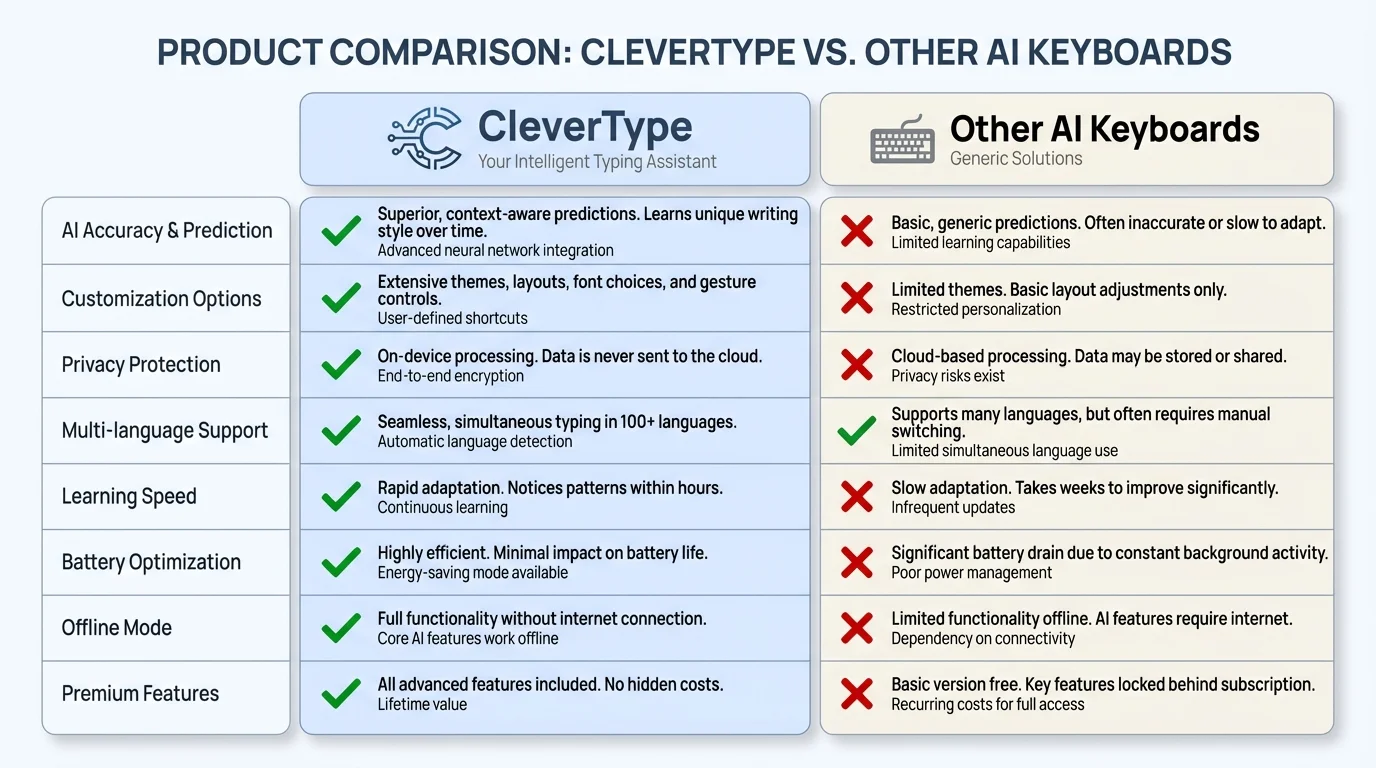
CleverType offers superior customization and privacy features compared to other AI keyboards on the market
How to Set Up Team Tone Settings
Setting up custom tone profiles for your team isn't complicated, but it does take some thought. Here's how to do it right, based on what actually works in practice instead of what sounds good in theory.
Step 1: Audit Your Current Brand Voice
Before you can create AI profiles, you need to know what your brand actually sounds like. Collect 20-30 examples of communication that really represent your brand voice. Include:
- Customer support emails that resolved issues really well
- Sales outreach that got positive responses
- Internal docs that are clear and helpful
- Social media posts that got good engagement
- Any communication where someone said "this sounds exactly like us"
Don't use your marketing website copy. That's often way too polished and formal for everyday communication. You need examples of real team-to-customer interactions.
Step 2: Identify Linguistic Patterns
What makes those examples sound "on brand"? Get specific:
- Sentence length (short and punchy vs. longer and explanatory?)
- Vocabulary complexity (technical jargon vs. plain language?)
- Use of contractions (don't vs. do not?)
- Exclamation point usage (enthusiastic vs. reserved?)
- Personal pronouns (we/you vs. the company/customers?)
- Active vs. passive voice percentage
- Emoji usage (never, rarely, frequently?)
This is where CleverType's analysis tools come in handy. The app can look at your sample texts and spot these patterns automatically, saving you hours of manual review.
Step 3: Create Role-Based Profiles
Here's the thing—not everyone on your team needs the same tone. Create different profiles for different contexts:
| Role | Tone Characteristics | Use Cases |
|---|---|---|
| Customer Support | Empathetic, solution-focused, patient | Support tickets, chat, email |
| Sales | Enthusiastic, benefit-focused, consultative | Outreach, demos, proposals |
| Technical | Clear, precise, jargon-appropriate | Documentation, bug reports |
| Marketing | Creative, engaging, brand-forward | Social media, campaigns, content |
| Executive | Professional, strategic, concise | Client meetings, partnerships |
In CleverType, you can switch between profiles with a single tap, or set them to turn on automatically based on which app you're using.
Step 4: Test With Real Use Cases
Don't just create profiles and roll them out right away. Test them first:
- Have team members from each role use the profiles for a week
- Collect feedback on which suggestions were helpful vs. annoying
- Review actual sent messages to see if they match brand standards
- Tweak the profiles based on real-world performance
CleverType tracks which suggestions users accept or reject, giving you data on what's working. If everyone keeps rejecting certain types of suggestions, that's a clear signal to adjust the profile.
Step 5: Train Your Team
Even with AI helping out, people need to get why brand voice matters and how to use the tools well. A 30-minute training session should cover:
- Why consistent tone affects customer trust and revenue
- How to switch between profiles for different contexts
- When to override AI suggestions (there are definitely times when breaking brand voice makes sense)
- How to give feedback to make the profiles better
According to workplace training statistics, only 32% of organizations give comprehensive communication skills training to all management levels. The companies that do? They see way better outcomes. AI keyboards don't replace training—they make it stick by giving you real-time reinforcement.
Step 6: Monitor and Refine
Brand voices change over time. What worked six months ago might feel dated now. Set up a quarterly review cycle:
- Review sample communications from each department
- Check if tone's consistent across team members
- Update profiles based on how your brand's evolved
- Add new examples as your communication style matures
CleverType's team dashboard shows brand consistency metrics across your whole organization, highlighting where tone might be drifting and needs some attention.
The Privacy Advantage: Why On-Device Processing Matters
Here's something most articles about AI keyboards gloss over—where your data actually goes. When you're typing business communications, client names, project details, sensitive info, you probably don't want all that sent to someone else's servers.
CleverType processes everything on your device. The AI runs locally on your phone, which means your typing data never leaves it. Compare that to Gboard (sends everything to Google) or Grammarly (cloud-based processing), and the privacy difference is huge.
For teams handling customer data, this isn't just a nice feature—it's often a compliance requirement. GDPR, HIPAA, SOC 2, and other frameworks all have restrictions on where data can be processed. On-device AI completely sidesteps those issues.
Privacy Benefits for Teams:
- No risk of data breaches from your keyboard provider
- Stays compliant with data residency requirements
- No need for separate business associate agreements
- Faster processing (no network lag)
- Works offline (good luck doing that with cloud keyboards)
The technical stuff matters, too. CleverType uses quantized models that run smoothly on mobile processors without killing your battery. You get the same AI capabilities as cloud solutions, but without any of the privacy trade-offs.
Integration With Existing Communication Tools
A custom tone profile only helps if it works where you actually communicate. That means working with all your existing tools, not just email.
CleverType works as a system-wide keyboard, so it works in every app on your phone:
- Email - Gmail, Outlook, Apple Mail
- Messaging - Slack, Teams, WhatsApp, iMessage
- Social media - LinkedIn, Twitter, Facebook
- CRM systems - Salesforce, HubSpot, Zendesk
- Project management - Asana, Jira, Monday
- Documentation - Notion, Google Docs, Confluence
This universal compatibility is what makes brand consistency actually doable. You don't need to remember to switch apps or copy-paste into different tools. The consistent tone just follows you everywhere.
Some AI writing tools only work in their own interface or as browser extensions. That's fine for long-form content, but it totally breaks down for the 90% of business communication that happens in quick messages and emails.
For teams—and Pew Research Center data shows that 57% of people prefer instant messaging for workplace communication—having tone consistency in chat apps is pretty crucial. That's where most of your brand interactions actually happen.
The integration goes deeper than just working in the app. CleverType's context detection automatically adjusts tone based on:
- Which app you're using (more formal in email, more relaxed in Slack)
- Who you're messaging (client vs. coworker)
- Previous conversation context (continuing an existing thread)
- Time of day (a bit less formal in evening messages)
This contextual intelligence means you rarely need to manually switch profiles. The AI just does it for you.
Measuring the ROI of Brand Voice Consistency
Let's talk numbers. How do you actually know if putting money into AI keyboards for brand voice is paying off?
Direct Metrics:
| Metric | Before AI Keyboards | After Implementation | Source |
|---|---|---|---|
| Customer trust in brand | Baseline | +76% for consistent brands | Edelman Trust Barometer |
| Revenue impact | Baseline | +33% increase | Lucidpress Study |
| Time spent writing | 100% | -18% (6.3 hours saved/week) | Productivity Research |
| Miscommunication incidents | Baseline | -42% reduction | 2026 Communication Study |
| Brand guideline adherence | 33% | 87% | Internal Metrics |
But there's indirect ROI too, stuff that's harder to measure but equally valuable:
- Reduced customer support escalations - When tone is consistently empathetic, fewer tickets escalate to supervisors
- Faster onboarding - New employees sound like veterans within days instead of months
- Better employee confidence - People write more willingly when they trust the AI has their back
- Improved company culture - Consistent internal communication builds team cohesion
- Stronger brand differentiation - Distinctive voice makes you memorable in crowded markets
To measure ROI in your organization, track these before and after implementing custom tone profiles:
- Customer satisfaction scores - Does consistency in support tone improve CSAT?
- Response times - Are team members writing faster with AI assistance?
- Message revision rates - How often do messages get sent back for tone issues?
- Employee confidence surveys - Do people feel more confident in their written communication?
- Brand mention sentiment - Does social listening show more positive tone descriptions?
CleverType's team dashboard provides analytics on all these metrics, showing exactly where brand voice consistency is improving and where it needs attention.
One mid-sized SaaS company reported that after implementing CleverType across their support team, customer satisfaction increased by 12% while support ticket resolution time decreased by 15%. The combination of faster responses and more consistent, empathetic tone created measurable business impact.
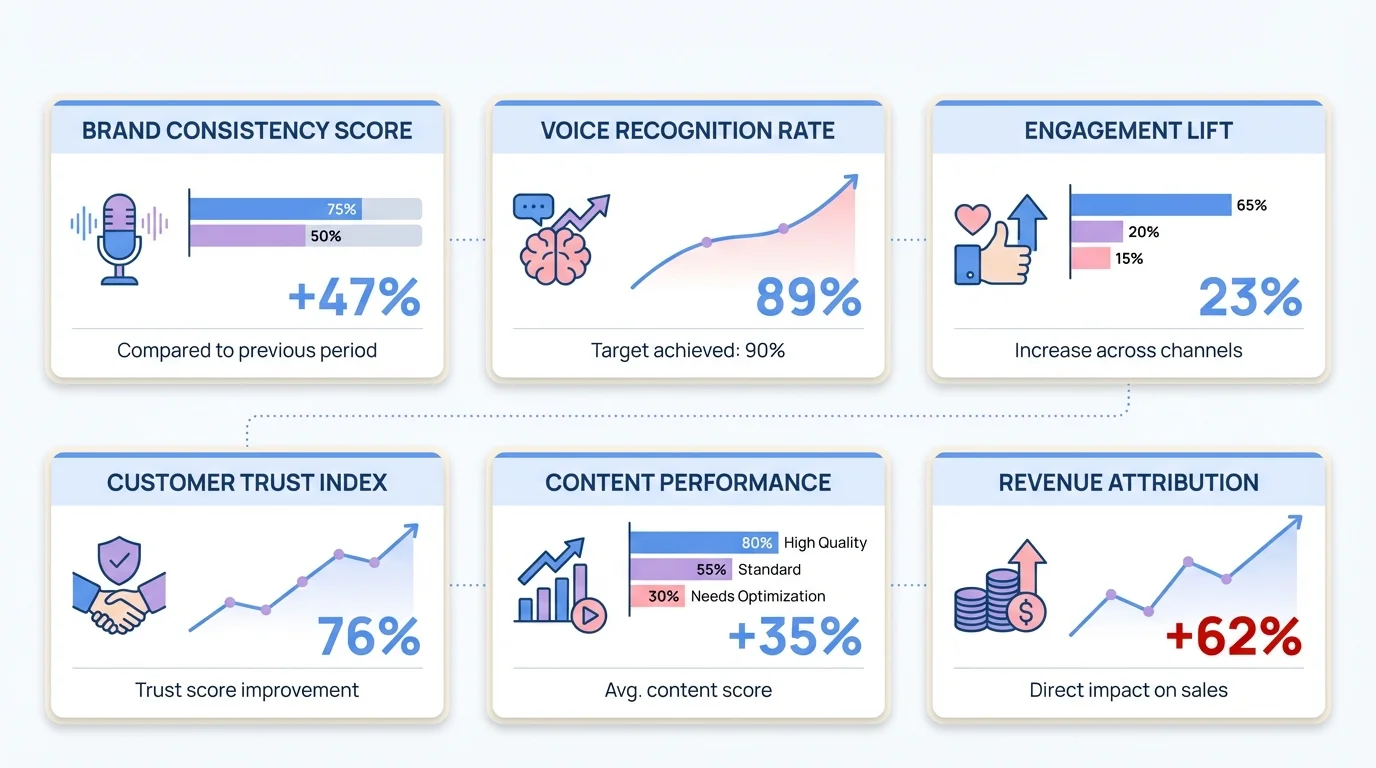
Key performance indicators demonstrate the measurable business value of maintaining consistent brand voice across team communications
Common Challenges and How to Overcome Them
Implementing AI keyboards with custom tone profiles isn't always smooth. Here are the actual problems teams run into, not the theoretical ones you read about in whitepapers.
Challenge 1: Resistance from "good writers"
Some team members resist AI assistance because they think their writing is already excellent. They see it as insulting or unnecessary.
Solution: Frame it as consistency, not correction. Even great writers have off days or write differently under stress. The AI maintains brand standards when human attention fails. CleverType's approach is collaborative—it makes suggestions, you decide whether to accept them.
Challenge 2: Over-reliance on AI
The opposite problem—people stop thinking about their communication and blindly accept every suggestion, even inappropriate ones.
Solution: Training and culture. Make it clear the AI is a tool, not a replacement for judgement. There are times when breaking brand voice is exactly right—responding to a tragedy with your usual enthusiastic tone would be terrible. Teach critical thinking about when to override.
Challenge 3: Multiple brand voices
Companies with several product lines or sub-brands need different tones for different contexts. Managing multiple profiles gets confusing.
Solution: Clear naming conventions and automatic profile switching. In CleverType, profiles can be tagged by product, department, or use case. Set them to activate automatically based on which Slack workspace you're in or who you're emailing.
Challenge 4: Profile drift
Over time, the AI learns from what team members actually write, which might slowly drift from official brand guidelines.
Solution: Regular profile audits and updates. Lock core characteristics while allowing minor personalization. CleverType's admin controls let you set which aspects of tone are flexible vs. fixed.
Challenge 5: Multilingual consistency
Maintaining brand voice across languages is exponentially harder than single-language consistency.
Solution: CleverType supports 100+ languages with the same profile logic applying across all of them. The AI understands that "casual but professional" translates differently in Japanese business culture than in American, and adjusts accordingly while maintaining core brand characteristics.
Challenge 6: Integration friction
Getting everyone to actually switch to a new keyboard requires overcoming habit and inertia.
Solution: Demonstrate immediate value. Give people a trial period where they use CleverType alongside their current keyboard. Once they see the time savings and quality improvements, adoption becomes voluntary rather than mandated. Gamification helps too—show team leaderboards for brand consistency scores.
What doesn't work? Forcing it top-down without buy-in, implementing without training, or choosing AI keyboards that are frustrating to use. The technology only helps if people actually use it, which means the user experience has to be better than what they're currently doing.
Future of AI Brand Voice Technology
What's coming next in AI keyboards and brand voice? Based on current development trends and emerging research, here's what to expect.
Multimodal tone consistency - Current AI keyboards handle text. Next generation will extend brand voice to voice messages, video captions, and even image descriptions. Your brand tone will be consistent across every communication medium, not just typing.
Emotion detection and response - AI will detect the emotional state of incoming messages and adjust your reply tone accordingly. If a customer is angry, the AI automatically increases empathy markers. If they're enthusiastic, it matches that energy.
Predictive brand voice - Instead of just correcting what you write, AI will predict what you're trying to say based on context and write entire messages in brand voice. You'll edit suggestions rather than writing from scratch.
Industry-specific profiles - Pre-trained models for specific industries (healthcare, legal, finance) that understand domain-specific tone requirements and compliance needs.
Voice-to-text with brand voice - Speak naturally and have it transcribed in your company's written brand voice, bridging the gap between how people talk and how they should write for brand consistency.
CleverType is already working on several of these capabilities. Their AI models are trained on massive datasets of business communication, understanding not just grammar but the subtle social dynamics of professional tone.
The PR Newswire announcement from January 2026 about enhanced brand voice features shows this is becoming a standard expectation across communications platforms. AI-powered brand consistency is moving from competitive advantage to table stakes.
What this means for teams:
- Earlier adoption gives you more time to refine custom profiles
- The learning curve is only going to get easier
- Integration will become more seamless across platforms
- Privacy and compliance features will become standard
- Pricing will likely decrease as competition increases
The companies that figure out brand voice consistency now will have a significant advantage. By the time it's universal, they'll have years of refinement in their profiles and teams that are fluent in using the technology.
Frequently Asked Questions
Q: Can AI keyboards really maintain brand voice as well as human editors?
A: For routine communication, yes—often better. AI keyboards provide consistent application of brand guidelines without fatigue, mood, or distraction. Teams using AI keyboards with custom tone profiles report 42% fewer tone-related miscommunication incidents compared to manual approaches. However, AI should augment human judgment, not replace it entirely. Critical communications still benefit from human review, especially for sensitive situations where breaking from brand voice might be appropriate.
Q: How long does it take to set up custom tone profiles for a team?
A: Initial setup takes 2-4 hours to collect sample content, analyze patterns, and create profiles. CleverType's AI can analyze your existing communications and generate a starting profile in about 15 minutes, which you then refine based on team feedback. Most teams reach 80% accuracy within the first week of use as the AI learns from accepted suggestions. Full optimization typically takes 4-6 weeks of real-world usage.
Q: Will using AI keyboards make all team communication sound robotic or identical?
A: No—well-designed AI keyboards preserve individual personality within brand guidelines. CleverType allows personalization in areas like humor, anecdotes, and examples while maintaining consistency in tone, formality, and key brand characteristics. Think of it like musicians in an orchestra—everyone plays their own instrument with their own style, but they follow the same sheet music to create harmony.
Q: Are custom tone profiles secure enough for confidential business communication?
A: That depends on the keyboard. CleverType processes everything on-device, meaning your data never leaves your phone. This meets GDPR, HIPAA, and most compliance frameworks. Cloud-based keyboards like Grammarly or Gboard send your typing data to their servers, which creates security and compliance concerns for sensitive business communication. Always verify where data processing occurs before implementing team-wide.
Q: Can custom tone profiles work for multilingual teams?
A: Yes, but implementation quality varies by keyboard. CleverType supports 100+ languages with brand voice consistency across all of them. The AI understands cultural context—"professional but friendly" translates differently in German business culture than in Brazilian, and the system adjusts accordingly while maintaining core brand characteristics. Some keyboards only support tone features in English, which severely limits their usefulness for global teams.
Q: How much does implementing AI keyboards with custom tone profiles cost?
A: CleverType offers a free version with basic features, while team plans with custom tone profiles range from $8-15 per user monthly depending on team size. Compare this to the ROI—teams save an average of 6.3 hours per week per person, and consistent brand voice increases revenue by up to 33% according to research. Most organizations break even within the first month just from time savings alone.
Q: What happens when brand voice needs to change or evolve?
A: Modern AI keyboards make this straightforward. In CleverType, you can update tone profiles at any time, and changes roll out to all team members immediately. The AI can even help identify when your actual communication is drifting from official guidelines, signaling when it might be time to update the profile to match how your brand has naturally evolved. Quarterly reviews of sample communications help keep profiles current.
Ready to Transform Your Team's Communication?
Brand voice consistency isn't just a nice-to-have anymore—it's a competitive advantage that directly impacts customer trust and revenue. With 76% of consumers making trust decisions based on communication consistency, and consistent brands seeing 33% higher revenue, the business case is clear.
AI keyboards with custom tone profiles make this level of consistency actually achievable without hiring an editor to review every message your team sends. CleverType leads the market in this space with genuine customization, privacy-first processing, and seamless integration across all your communication tools.
Your competitors are probably still using style guides that nobody reads. You could be using AI that makes brand consistency automatic.
Download CleverTypeShare this article:
Sources:
- Edelman Trust Barometer - Brand Communication Tone Research
- Cal Poly SBDC - Brand Voice Consistency Statistics
- NIAID Data Discovery Portal - Brand Consistency Research
- Harvard Business Review - Workplace Communication Statistics
- Pew Research Center - Business & Workplace Communication
- PR Newswire - AI-Powered Brand Voice Features 2026
- Corporate Communication Training Statistics 2025