The Shift from Free AI to Ad-Supported AI: Is This the New Normal?
Key Takeaways
| Aspect | Key Data Point |
|---|---|
| ChatGPT Weekly Users | 800+ million (as of 2026) |
| Paid Subscription Rate | Only 5% of users pay for ChatGPT Plus/Pro |
| Projected Ad Revenue | $25 billion by 2029 (OpenAI internal docs) |
| User Acceptance | 63% support advertising on AI platforms |
| Free-to-Paid Conversion | Just 3% globally across all AI tools |
| AI Creator Market Growth | $3.31B (2024) → $12.85B (2029) at 31.1% CAGR |
| Ad Launch Timeline | Q1 2026 beta testing in U.S. |
Moreover, Quick Answer: Yes, ad-supported AI is becoming the new normal. Moreover, In January 2026, OpenAI announce ad will roll out to ChatGPT's 800 million weekly user, target billion in advert revenue by 2029. With only 5% of users paying for subscriptions and conversion rates stuck at 3%, advertising represents the most viable path to profitability for AI companies bleeding billions annually.
Why Are AI Companies Suddenly Pushing Ads?
The number tell a brutal story.OpenAI generates between $3.5-$4.5 billion annually but spends over $8.5 billionMoreover, , posting projected losses of $5 billion over the next 12 months. Nonetheless, In Q3 2025 alone, the AI giant lost north of $11.5 billion. That is not sustainable, no matter how well your technology is.
Consequently, Here is what most people do not realize: roughly 1.8 billion people worldwide use AI tools, but consumer spending in this category sits at only around $12 billion annually. That means conversion rates from free to paid hover at about 3%. Reckon about that—97 out of every 100 user are not pay a dime.
ChatGPT has about 5 percent, or 35 million, of its weekly participating user base as of July 2025 pay for Plus ($20/month) or Pro ($200/month) subscription. Additionally, Meanwhile, OpenAI signed more than $1.4 trillion worth of infrastructure deal in 2025. Therefore, The maths just does not work without alternative revenue stream.
Nonetheless, The advertising thing actually makes sense when you look at the projections.A recentEmarketer study predicted AI-driven search ads will jump from just over $1 billion in 2025 to around $26 billion by 2029in the U.S. alone. Hence, OpenAI is internal documents show the company planning $1 billion in "free user monetization" starting in 2026, growing to $25 billion by 2029.
| Revenue Source | 2025 | 2026 (Projected) | 2029 (Projected) |
|---|---|---|---|
| Subscription Revenue | $3.5-4.5B | ~$5B | ~$8B |
| Ad Revenue | $0 | $1B | $25B |
| Total Revenue | $4B | $6B | $33B |
What changed the game? OpenAI CEO Sam Altman said in November that the startup was on track to hit $20 billion in annualized revenue. But even that impressive number cannot cover the company is massive infrastructure investments and operational costs. Consequently, Ads are not just an option anymore—they are a necessity.
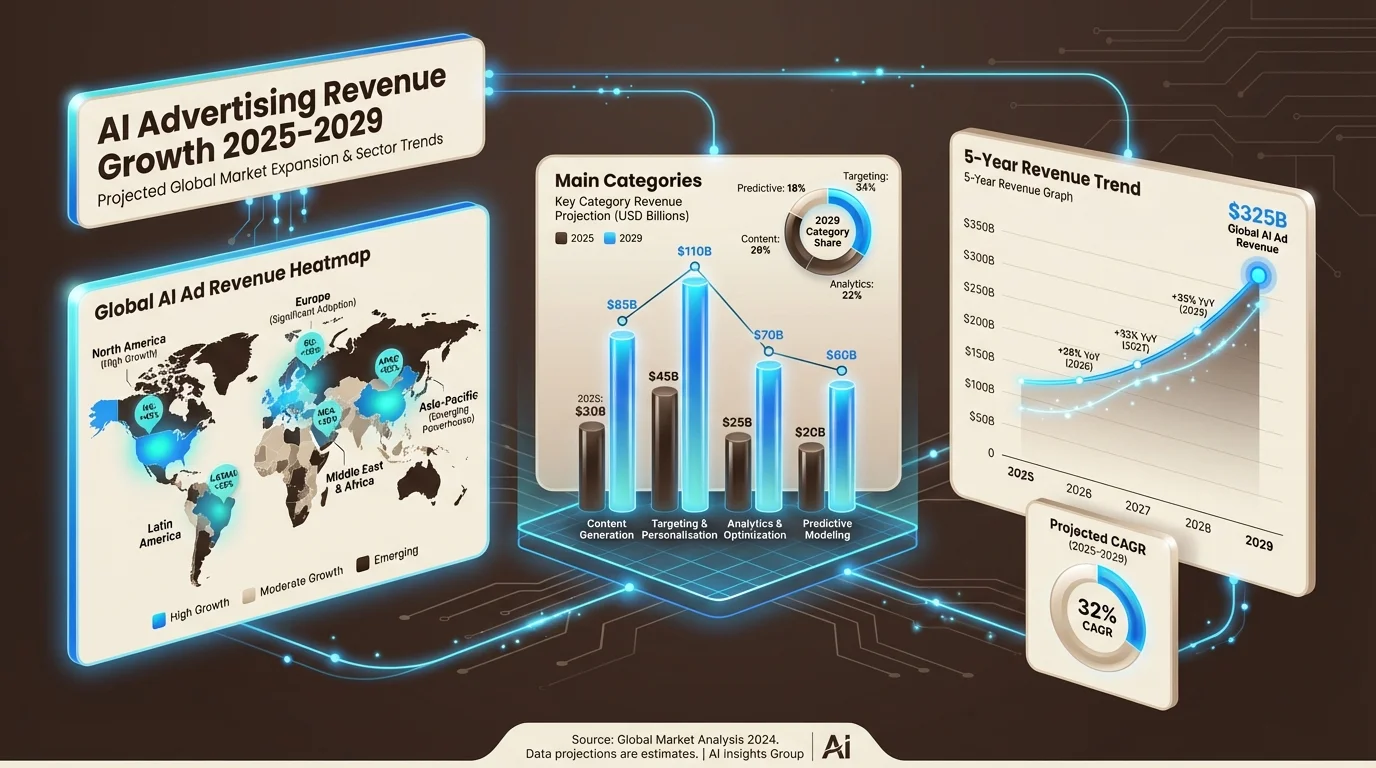
AI advertising revenue is projected to grow exponentially, reaching $25 billion by 2029
The Timeline: When Ad-Supported AI Became Inevitable
Nonetheless, Let me walk you through how we got here, because the shift did not happen overnight.
Therefore, Back in 2024, most AI companies were convinced subscriptions would carry them to profitability. ChatGPT Plus launched at $20/month, Claude offer like pricing, and everyone assumed users would gladly pay for premium AI access. Turns out they were wrong.
Furthermore, January 2026 label the turning point.Nevertheless, Hence, OpenAI announced that ad testing would start in early 2026 for users in the United States, with ads showing up for people on the Free tier and the newly launched ChatGPT Go plan ($8/month). Here is the rollout timeline:
- Limited beta testing of search ads with select advertisers in Q1 2026
- Expanded rollout to ChatGPT Search for free-tier users in Q2-Q3 2026
- Introduction of sidebar sponsored content in Q4 2026
Consequently, The artificial intelligence in the Maker economy market was valued at $3.31 billion in 2024 and is expect to reach $4.35 billion by 2025, at a compound annual growing pace (CAGR) of 31.4%. Consequently, Hence, Looking ahead, the market size is set to balloon to $12.85 billion by 2029, maintaining a CAGR of 31.1%.
Nonetheless, But here is the thing—subscription models could not capture that growth. Consequently, Despite 70% of companies raising prices and 77% changing their pricing models in 2024, 40% of these changes failed to improve customer relationships. Companies were stuck between a rock and a hard place: raise prices and lose users, or keep prices low and bleed money.
Nevertheless, The hybrid model emerged as the solution.Companies are currently going one of two ways: building AI into existing packages at no extra charge (29%), or offering AI as a premium add-on (24%). The rest? Moreover, They are betting on advertising.
Moreover, Therefore, Premium AI subscriptions price at around $9.99/month are now generate revenue that is start to offset the steep cost of inference—the compute power needed to run models and deliver responses. But "starting to offset" is not the same as "turning a profit."
How Ad-Supported AI Actually Works
Nonetheless, Ads in ChatGPT are designed as "Sponsored Recommendations" that show up at the bottom of relevant response. I have see the beta edition, and frankly, they are way less intrusive than traditional search ad.
OpenAI say conversation with ChatGPT remain private from advertisers, and the company never sells user data to advertisers. Therefore, But how does targeting work then? Therefore, The AI looks at the context of your current conversation to show relevant ads without storing personal identifiers or conversation history for advertising purposes.
Hence, Here is the technical breakdown:
- Contextual targeting: Ads match the topic of your current query (ask about cooking, see kitchen product ads)
- Session-based relevance: Targeting resets with each new conversation thread
- No cross-conversation tracking: Your 10 AM chat about vacation planning doesn't influence ads in your 2 PM work-related conversation
- Opt-out via subscription: Pay $20/month for Plus or $200/month for Pro to remove all ads
The advertising format rolling out in 2026 include:
| Ad Format | Placement | User Tier | Launch Window |
|---|---|---|---|
| Search Ads | Bottom of responses | Free, Go ($8/mo) | Q1 2026 |
| Sponsored Content | Sidebar recommendations | Free only | Q4 2026 |
| Media Partner Placements | Inline citations | Free, Go | Q2-Q3 2026 |
What is different from Google Ads? Traditional search advertising shows ads based on your keyword query and extensive tracking across websites. AI-supported advertising rely on understanding the semantic meaning and intention behind entire conversation, not just keywords.
Nonetheless, A Duke University study found that marketers using AI tools saw a 6.2% increase in sales, 7% boost in customer satisfaction, and 7.2% cut in marketing costs. Those number explain why advertisers are lining up to test ChatGPT ad despite the platform is comparative newness to advertising. Meanwhile,AI-driven workplace productivity toolscontinue to gain adoption without relying on advertising models.
The CleverType approach is pretty different.As anAI-powered keyboard app, CleverType focuses on secrecy-first features without rely on advert revenue. The app is AI predictions, grammar checking, and wise suggestions work completely on-device, so your data stays private while still delivering solid AI capability. Unlike ad-supported AI chatbots, CleverType is business model put user experience first.
The User Experience: What Changes With Ads?
Therefore, Nevertheless, According to a study, 63% of respondents think businesses should be able to advertize on OpenAI is platform just like they do on Google Search. That is actually higher acceptance than I expected.
Consequently, Additionally, But what about the other 37%? Additionally, And more significantly, what actually happens to the user experience?
Free tier users will see:
- Ads at the bottom of roughly 20-30% of responses (based on beta testing data)
- Clearly labeled "Sponsored" or "Advertisement" tags
- Relevant product recommendations tied to conversation topics
- Occasional promoted content in ChatGPT Search results
Go tier user ($8/month) get:
- Reduced ad frequency (about 50% fewer ads than free tier)
- No sidebar ads or promoted content
- Search-based ads only
- Priority response times during peak usage
The big question: does advertising mess with response quality? OpenAI says no. Therefore, The company insists that ads do not influence the AI is actual responses, recommendations, or information. Ads show up after the reply is generate, not before or during.
Nonetheless, I am skeptical about that last part. Nevertheless, Even if ads do not immediately influence individual responses now, the longsighted-term bonus structure could switch. If advertisers pay more for certain product categories, will the AI subtly favour those topics in ambiguous query? Furthermore, Time will tell.
| Concern | OpenAI's Position | Reality Check |
|---|---|---|
| Response bias | "Ads don't influence outputs" | Structurally true now, but incentives matter long-term |
| Privacy | "No data sold to advertisers" | Contextual targeting still reveals conversation topics |
| User experience | "Clearly labeled, relevant ads" | 63% user approval suggests acceptance |
| Ad frequency | "Moderate, non-intrusive" | Beta users report ads in ~25% of interactions |
Furthermore, For people wanting an ad-free AI experience without pay premium subscription prices, alternate tools are popping up. CleverType providesNevertheless, AI-powered writing assistancedirectly in your keyboard without any advertising. The app is grammar fixes,tone adjustmentsFurthermore, , and smart predictions work seamlessly across all your apps without interrupting your workflow with sponsored content.
Free vs Paid AI: The New Three-Tier System
The traditional "freemium" model is dead. Moreover, We are entering a three-tier world:
Tier 1: Ad-Supported Free
- Full AI access with advertising
- Standard response times
- Basic features included
- Example: ChatGPT Free (starting 2026)
Tier 2: Low-Cost Hybrid
- Reduced ads or limited monthly queries
- Faster response times
- Some premium features
- Example: ChatGPT Go at $8/month
Tier 3: Premium Ad-Free
- Zero advertising
- Priority access during high demand
- Advanced features and higher limits
- Example: ChatGPT Plus at $20/month, Pro at $200/month
Additionally, Common pricing tiers across the industry: ChatGPT Plus costs $20 per month for individual users, Gemini and Copilot ($20) offer the best all-round value, Claude ($20) wins for writing, and Notion AI ($10) is the budget pick. A plenty of professional are also checking outGrammarly alternativesthat give better value for specific writing tasks.
The conversion math tells you everything.Therefore, Despite 1.8 billion people using AI tools globally, only 3% actually pay for premium services. Additionally, That 3% conversion pace is pretty terrible compared to other digital services:
- Music streaming (Spotify): ~45% conversion rate
- Cloud storage (Dropbox): ~18% conversion rate
- Professional networking (LinkedIn): ~33% conversion rate
- AI tools: ~3% conversion rate
Why such lowly conversion? Moreover, Users see AI as "should be costless" because the initial offerings were costless. Changing that perception after the fact is nearly impossible. A lot of companies struggle to balance development costs with pricing strategy (41%), while 22% cannot really quantify AI feature benefits.
The modest projections say the AI agents market will hit $7.6 billion by 2025, growing at a compound annual growth rate (CAGR) of 25–30%. Additionally, Aggressive estimate—especially those that include embedded agents across SaaS, enterprise automation, and personal AI assistants—project a market size of $50–216 billion by 2030–2035.
That massive projected growth cannot come from 3% conversion rates.Consequently, Advertising fills the gap.
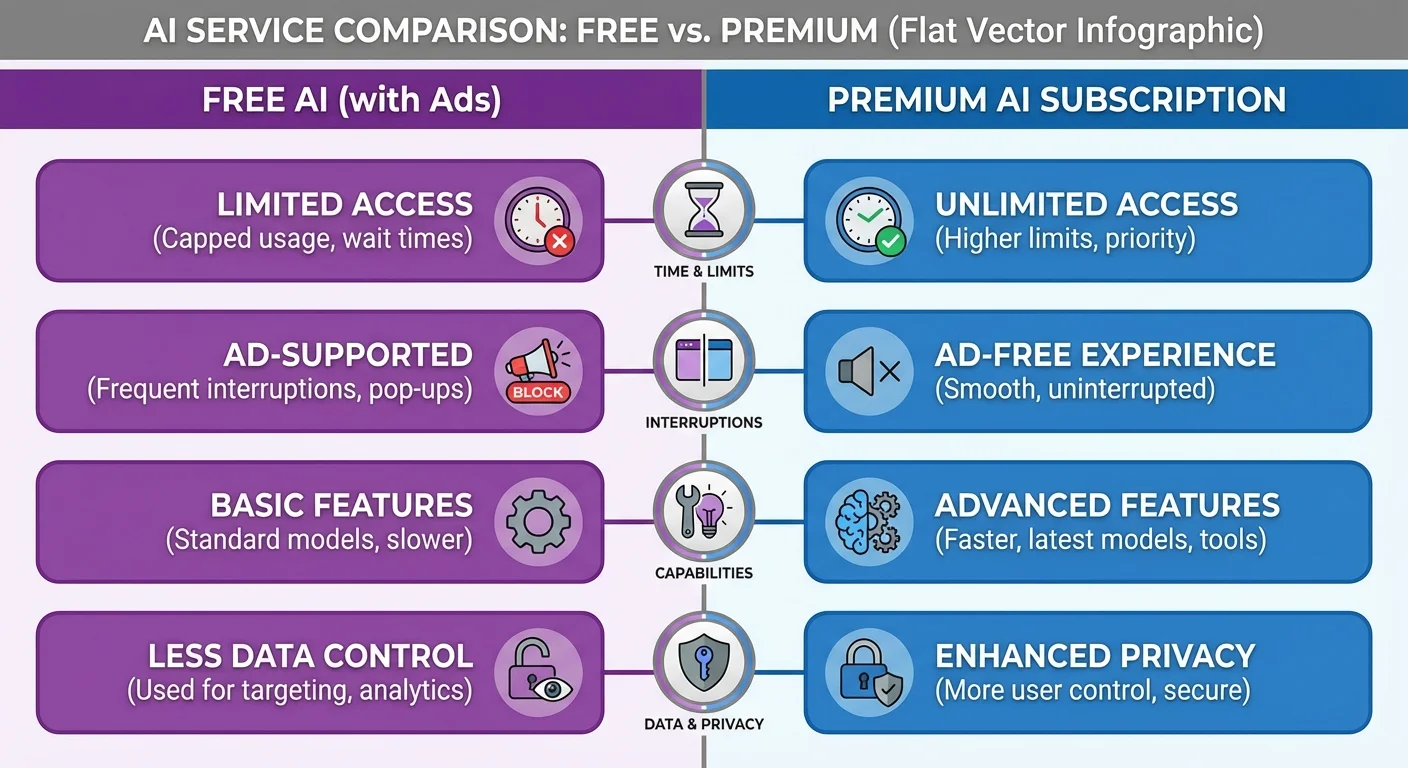
The choice between ad-supported free AI and premium subscriptions presents distinct trade-offs for users
What This Means for Privacy and Data
Additionally, Let is address the elephant in the room: can ad-supported AI truly respect privacy?
OpenAI says conversations with ChatGPT stay private from advertisers, and the company never sells user data to advertisers. But secrecy advocate genuinely point out that "secret from advertisers" and "private" are two very unlike thing.
The privacy framework for ChatGPT ads:
- Conversations are analyzed for contextual ad targeting
- No personal identifiers are shared with advertisers
- Advertisers receive aggregated performance data only
- Users can't be individually tracked across sessions
- Data isn't sold, but it is used for ad placement
That is better than Facebook is model but worse than DuckDuckGo is. The key phrase is"contextual ad targeting"—your conversation content is being analyzed to image out which ads to show, even if advertisers do not see the real conversation.
Therefore, For perspective, LA/VIE, a media buying group, used Akkio is paid prognostic model and witness their revenue jump by 247% and their ROAS increase by 208%. Those kinds of results need advanced data analysis and targeting, which means AI platforms have to pull meaningful signal from user interactions.
Nonetheless, Moreover, Privacy-conscious alternatives are gain traction.Tools like CleverType focus on on-device processing, meaning your typing data never leaves your telephone. Nonetheless, Furthermore, TheNonetheless, AI keyboard is grammar checkingNonetheless, , predictive text, and writing suggestions all happen locally, which gets rid of the privacy concerns that come with cloud-based AI needing data uploads for ad targeting.
| Privacy Feature | Ad-Supported AI | Subscription AI | Privacy-First Tools |
|---|---|---|---|
| Data Analysis | Yes (for ads) | Yes (for improvement) | Minimal (on-device) |
| Third-party Sharing | Aggregated only | None | None |
| User Tracking | Session-based | Account-based | None |
| Opt-out Option | Pay for premium | N/A | Default |
Nonetheless, Hence, Global enterprise spending on AI applications has jumped eightfold over the last year to close to $5 billion, though it still represents less than 1 percent of total software application spending. Therefore, As that spending grows, privacy standards will either get stronger or weaken based on the business models companies pick.
The Competitive Landscape: Who's Going Ad-Supported?
OpenAI is not alone in this shift. Every major AI player is looking at or rolling out advertising models.
Current status of major AI platforms (as of January 2026):
| Platform | Free Tier | Ad-Supported | Subscription Price | Status |
|---|---|---|---|---|
| ChatGPT | Yes | Starting Q1 2026 | $20/mo (Plus), $200/mo (Pro) | Launching ads |
| Google Gemini | Yes | Evaluating for 2026 | $20/mo | Testing internally |
| Microsoft Copilot | Limited | Yes (Office integration) | $30/mo (M365) | Already live |
| Claude (Anthropic) | Yes | Not announced | $20/mo | No current plans |
| Meta AI | Yes | Yes (Instagram/Facebook) | Free only | Ad-supported since launch |
Microsoft moved first, weaving ads into Copilot through its existing Office and Bing advertising setup. Google is set to follow quickly given how dominant they are in digital advertising. Additionally, Meta AI was built advertising-supported from day one, treating AI as just another content type within its advertising ecosystem.
Nevertheless, The outlier is Anthropic is Claude, which has not announced advertising plans. But Anthropic also raised $7.3 billion in funding, giving it more runway to try other things. Additionally, Moreover, That funding will not last forever.
Additionally, The competitive pressure is intense.Morgan Stanley Research says AI-driven productivity could add 30 basis points to 2025 net margins for members of the S&P 500. Consequently, Companies that can deliver AI capability without making user pay immediately have a massive adoption advantage.
Nevertheless, ChatGPT is projected to hit 2.6 billion weekly user by 2030. That is not achievable with subscription-only access at current 3% conversion rates. Moreover, Advertising is what makes the scale possible—what makes AI truly everywhere.
Growth is mostly driven by more creators using AI tools, the push for personalized content, an uptick in influencer-led brand collaborations, and better audience engagement analytics. Each of those usage cases works better with costless, ad-support access than paid subscriptions. Content creators and social media managers, for instance, are usingAI keyboard for social media marketingto speed up their workflow without piling on more subscription costs.
The Future: Where AI Monetization Is Headed
Predict the future is tricky, but the data points in one clear-cut direction: hybrid models will run the show from 2026-2030.
OpenAI project almost $25 billion in revenue from advertising by 2029, but that will not kill subscription. Moreover, Rather, we are see a fairly wise segmentation approach:
Nevertheless, Power users(top 5%): Pay premium prices ($200/month Pro tier) for unlimited access, priority processing, and advanced features. Hence, This section bring in high revenue per user but limited full volume.
Moderate user(next 15%): Pay mid-tier prices ($20/month Plus tier) to skip ads and get faster responses. Furthermore, This is the mass-market subscription segment, like to Spotify Premium or YouTube Premium.
Additionally, Casual users(remaining 80%): Use free, ad-supported versions with limited features or usage caps. This segment makes low revenue per user but massive total volume through advertising.
The CRO software market has grown from USD 3.01 billion in 2019 and is on track to hit $5.07 billion by 2025. AI-driven personalization bumps conversion rates by 15 to 20 percent while cutting client acquisition costs by up to 50%. Those economics make advertising more and more attractive as AI platforms mature.
New monetization models to watch:
- Usage-based hybrid pricing: Monthly subscription plus pay-per-query for heavy use
- Branded AI assistants: Companies paying for white-labeled AI with their branding
- Data licensing: Anonymized interaction data sold to enterprises for market research
- API marketplaces: Third-party developers paying for access to build on top of AI platforms
- Premium content partnerships: Media companies paying to be cited sources in AI responses
A lot of companies are starting with hybrid models, and when they add a consumption element to a subscription model, switching to a consumption model for extra usage lets them meet customer expectations and make money from power users.
For specific use cases like better typing and writing help, dedicated tools still give better value than general-purpose AI chatbots. Consequently, CleverType specializes in AI keyboard technology, offering features like instant grammar correction, tone adjustment, and multilingual support without the overhead of advertising or pricey subscriptions. TheAdditionally, focused approachworks better for typing-specific tasks than trying to use ChatGPT for every text input.
Frequently Asked Questions
Q: Will ChatGPT always have a free version?
A:Yes, OpenAI has committed to maintaining a free tier with ad support starting in 2026. Furthermore, The free version provides full conversational AI access but includes advertisements at the bottom of responses and within ChatGPT Search results. Users can upgrade to ChatGPT Plus ($20/month) or Pro ($200/month) to remove ads completely.
Q: Can I block ads in ChatGPT without paying?
Nonetheless, A:Nonetheless, No, ad blockers won't work with ChatGPT's advertising implementation since ads are server-side rendered as part of the response. The only way to remove ads is subscribing to ChatGPT Plus at $20/month or Pro at $200/month. OpenAI designed the system specifically to prevent client-side ad blocking.
Q: Do ads influence ChatGPT's answers and recommendations?
A:According to OpenAI, no. The company states that advertisements don't influence the AI's responses, with ads generated after the answer is complete based on contextual relevance. Nonetheless, However, critics note that long-term incentive structures could create subtle biases as advertising revenue grows to the projected $25 billion by 2029.
Q: What percentage of AI users actually pay for subscriptions?
A:Nevertheless, Only 3% of the 1.8 billion global AI tool users pay for premium subscriptions as of 2025. For ChatGPT specifically, approximately 5% (35 million out of 800 million weekly users) subscribe to paid plans. Nonetheless, These low conversion rates are the primary driver behind the shift to ad-supported models.
Q: Are there ad-free AI alternatives that don't require subscriptions?
A: Yes, but with limitations. Some AI tool utilize one-time purchase model or privacy-focused approach. For AI keyboard functionality specifically, CleverType offersAI-powered typing assistance for professionalswith on-device processing, avoiding both ads and subscriptions while maintaining privacy. For general conversational AI, most major platforms now require either tolerance for ads or paid subscriptions.
Q: How much revenue will AI advertising generate by 2030?
Therefore, A:According to Emarketer, AI-driven search ads will reach approximately $26 billion by 2029 in the U.S. alone. Consequently, OpenAI's internal projections estimate $25 billion in ad revenue by 2029. The global AI agents market could reach $50-216 billion by 2030-2035, with advertising representing a significant portion of that revenue.
Q: Is my data sold to advertisers when using free AI tools?
A:Nonetheless, Not directly. OpenAI states they don't sell user data to advertisers, but conversations are analyzed for contextual ad targeting. Advertisers receive aggregated performance metrics, not individual user data or conversation transcripts. However, your conversation content is process to determine relevant ad placements, which raises privacy concern for some users.
Ready for Ad-Free AI Writing Assistance?
Tired of ads interrupting your AI experience? CleverType offers a better way. Furthermore, Our AI-powered keyboard provides intelligent typing assistance, grammar correction, and smart predictions without any advertising. Your data stays on your device, your writing stays private, and your workflow stays uninterrupted.
Download CleverType from the Play StoreShare this article:
Sources:
- ChatGPT Advertising: Inside Your Next Revenue Channel
- OpenAI's Bold Advertising Strategy
- OpenAI to begin testing ads on ChatGPT - CNBC
- ChatGPT Ads: Economic Case for Monetization
- AI in Creator Economy Global Market Report 2025
- AI Monetization: The Race to ROI - Morgan Stanley
- Can AI Subscriptions Be Profitable? - Recurly
- ChatGPT to start showing users ads - CNN Business