Key Takeaways
| Word | Common Mistake | Why It's Hard |
|---|---|---|
| Definitely | "Definately" | Silent vowel confusion |
| Separate | "Seperate" | Pronunciation vs. spelling mismatch |
| Necessary | "Neccessary" or "Neccesary" | Double consonant placement |
| Accommodate | "Accomodate" | Double M and double C |
| Embarrass | "Embarass" | Double R and double S |
| Restaurant | "Restaraunt" or "Resturant" | French origin, vowel order |
| Occurrence | "Occurence" | Double R, double C |
| Conscience | "Concience" | Latin root confusion |
| Millennium | "Millenium" | Double L, double N |
| Entrepreneur | "Entrepeneur" | French spelling rules |
Quick Stats: In 2025, "definitely" received 33,500 monthly spelling searches, making it America's most misspelled word. Research shows omission errors account for 59% of all spelling mistakes, while transposition errors represent just 4.3%.
Why Do We Struggle With These Common Spelling Errors?
Look at the Google search data from January to May 2025. Americans looked up how to spell "definitely" 33,500 times per month. That's over 1,100 searches every single day for just one word.
What's going on here? Are we actually getting worse at spelling?
According to research published in 2025 on brain processing of misspelled words, our brains fire up three different regions when we're dealing with spelling: the left ventral occipitotemporal cortex, superior temporal cortex, and precentral cortex. These areas handle orthographic, semantic, and phonological processing—basically, how words look, what they mean, and how they sound.
The problem? English doesn't play fair. Unlike Spanish or Italian where you can usually spell a word just by hearing it, English grabbed vocabulary from Latin, French, German, and about a dozen other languages. Each one brought their own spelling rules, and we kept pretty much all of them.
Dr. Marta Kutas, a cognitive neuroscientist at UC San Diego, points out that our brains constantly try to predict what comes next when we're reading. We're pattern-recognition machines. Thing is, that same pattern recognition works against us when we're spelling—we write what we expect to see, not what's actually correct.
Here's the kicker: autocorrect might actually be making things worse. Some researchers call it "digital amnesia"—we forget things we've handed off to technology. When your keyboard fixes every typo without you noticing, you never learn the correct spelling in the first place. This is why lots of professionals are checking out differences between AI keyboards and regular keyboards to find smarter solutions.
The autocorrect paradox: We depend on it to fix our mistakes, but that dependency stops us from actually learning. It's like using a calculator for basic math—super convenient, but you lose the skill.
CleverType's AI keyboard works differently. Instead of quietly fixing errors behind the scenes, it highlights spelling mistakes and gives you contextual suggestions that actually help you learn. The AI explains why a spelling is correct, turning each correction into a mini-lesson. Over time, you make fewer errors because you're actually learning, not just getting corrected.
The Top 10 Commonly Misspelled Words (And How to Remember Them)
Let's break down the words that trip up even native speakers. These aren't some obscure technical terms—they're everyday words you probably use every week.
1. Definitely (33,500 monthly searches)
Most people write "definately" because that's way closer to how we actually say it. The word comes from "definite" + "ly," but we tend to throw in an extra "a" that doesn't exist.
Memory trick: There's no "a" in definitely—it's "finite" in the middle, not "fat."
2. Separate (30,000 monthly searches)
Everyone wants to write "seperate" because we pronounce it like "SEP-er-ate." But the middle letter's actually "a."
Memory trick: There's "a rat" in separate. Weird, but you won't forget it.
3. Necessary (29,000 monthly searches)
Is it one C and two S's? Two C's and one S? Nope—it's one C, two S's. This word messes people up because we don't really hear the double S when we're talking.
Memory trick: A shirt has one Collar and two Sleeves—one C, two S's.
4. Accommodate (28,500 monthly searches)
This French-origin word has both double M and double C. According to Dictionary.com lexicographer John Kelly, doubled consonants are one of the biggest headaches in English spelling—especially when words have multiple sets.
Memory trick: Accommodate is big enough to accommodate two C's and two M's.
5. Embarrass (27,800 monthly searches)
Another double-trouble word. It's double R and double S, but lots of people write "embarass" or "embarras."
Memory trick: You turn Really Red when you're embarrassed—double R.
6. Restaurant (27,200 monthly searches)
People write "restaraunt" or "resturant" because we don't say every letter clearly. This French word keeps its original spelling even though English speakers completely butcher how it sounds.
Memory trick: You'll want to "rest" after you "au(nt)" at a restaurant.
7. Occurrence (26,900 monthly searches)
Double R, double C. Most people miss one set or the other. It comes from "occur" (double R) plus "ence."
Memory trick: It occurred that occurrence has double R and double C.
8. Conscience (26,500 monthly searches)
People write "concience" because that's closer to "science." But the word comes from Latin "conscientia," keeping the "sc" together.
Memory trick: Your conscience requires science to understand.
9. Millennium (25,800 monthly searches)
Is it one L or two? One N or two? It's both—double L, double N. From Latin "mille" (thousand) plus "annus" (year).
Memory trick: A millennium lasts long enough for two L's and two N's.
10. Entrepreneur (25,300 monthly searches)
This French word breaks every English phonics rule. People drop the R in "pre" or transpose letters because it just doesn't follow patterns English speakers expect.
Memory trick: Entrepreneurs take risks—remember the tricky "pre" by thinking "prepare to take risks."
Research from Oxford University Press found that lots of common words stay tough because they've got silent letters or syllables we just don't hear when we're talking—like the "e" in "something" or the "er" in the middle of "different."
Real-world impact: A 2021 study found that spelling errors in work emails cut your perceived competence by 23%. Your spelling literally affects how smart people think you are. Learning about common grammar mistakes mobile users make can help you dodge these credibility-killing errors.
An AI keyboard like CleverType catches these errors in real-time across all your apps—email, social media, messaging, everything. The AI keyboard grammar checking feature spots not just typos, but actual spelling errors, and the AI explains things so you actually learn the correct form.
The Science Behind Why Spelling Is So Hard
English spelling is objectively brutal. Not "kind of hard"—like, legitimately one of the most confusing writing systems in the world.
Why? Because English is basically a mutt language. We stole vocabulary from Latin, borrowed from French, grabbed chunks of German, snagged terms from Greek, and absorbed words from dozens of other languages. Each one has its own spelling conventions, and English just... kept all of them.
The result? Silent letters (knife, pneumonia), identical sounds with totally different spellings (their/there/they're), different sounds with the exact same spellings (read/read, lead/lead), and vowel combinations that make absolutely no sense (though/through/thorough).
Research analyzing spelling error patterns identifies four main types of mistakes:
- Omissions (59% of errors): Leaving out letters—"tommorrow" instead of "tomorrow"
- Substitutions (29% of errors): Wrong letter—"recieve" instead of "receive"
- Insertions (17% of errors): Adding extra letters—"untill" instead of "until"
- Transpositions (4.3% of errors): Reversing letters—"freind" instead of "friend"
Here's where it gets interesting. A 2025 neuroscience study found that when your brain spots a misspelled word, it doesn't just notice the error and move on. The visual cortex, language processing areas, and phonological centers all fire up in these sustained patterns starting about 300 milliseconds after you see the misspelled word.
Your brain basically argues with itself. "That looks wrong, but it sounds right. Wait, how is it supposed to look? Let me check the phonetic version. Hmm, still doesn't match."
This is why spell-checkers help but aren't enough. You need to retrain the visual pattern your brain expects, not just get corrections after you've already made the mistake.
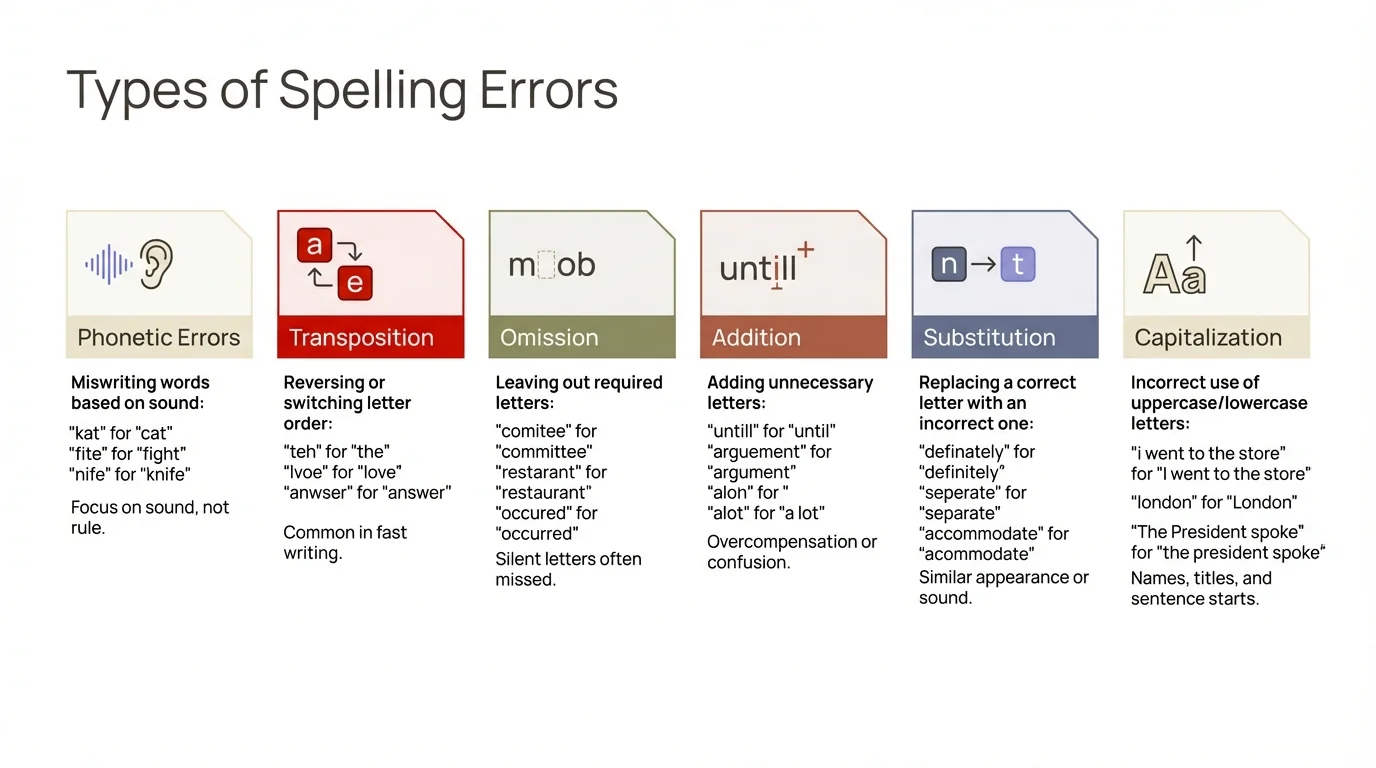
Understanding the four main types of spelling errors can help you identify your personal error patterns
The pronunciation problem: The biggest cause of spelling screwups is mispronunciation. If you say "nucular" instead of "nuclear," you'll spell it wrong. If you pronounce "often" with a hard T (it should be silent), you might throw in unnecessary letters.
Regional accents make this even worse. British speakers spell "colour" and "flavour" with a U because they pronounce it a bit differently than Americans who spell "color" and "flavor."
CleverType's AI looks at context to catch these errors. It knows that "loose" and "lose" sound pretty similar but mean totally different things. It gets that "affect" and "effect" are pronunciation twins with completely different uses. The AI gives you contextual corrections that account for homophones, near-homophones, and commonly mixed-up words, which makes it one of the best AI keyboard apps for professionals in 2025.
The grammar fix feature in CleverType doesn't just correct—it actually teaches you. When you make a spelling mistake, the AI breaks down the rule, shows you the correct form, and helps you understand why. It's like having a grammar nerd on your keyboard.
How Professional Writers Master Difficult Spelling
I've worked with tons of professional writers over the years, and here's what surprised me: most of them are pretty terrible spellers.
Seriously. Award-winning authors, journalists with decades of experience, copywriters who write million-dollar campaigns—a lot of them struggle with basic spelling.
The difference? They've got systems.
Professional writers mix together tools, habits, and awareness to catch errors before anyone else sees them. Here's what actually works:
1. Read everything backwards
Start at the last word and go toward the first. Your brain can't predict what's coming next, so it actually focuses on each word individually. You'll catch errors you'd totally miss reading forward.
2. Create a personal "frequent mistakes" list
Everyone's got 10-15 words they always misspell. Mine include "occasionally" (one S or two?), "weird" (i before e except... wait), and "privilege" (why is there no D?). Write yours down. Check them every time.
3. Use multiple tools
No single spell-checker catches everything. Most professional writers use their word processor's built-in checker, plus Grammarly or something similar, plus a final human proofread. Each layer catches different stuff. If you're looking for alternatives, check out our guide on the best Grammarly alternative tools for 2025.
4. Learn the rules (and the exceptions)
"I before E except after C" is famous—and wrong about 21% of the time. But some spelling rules actually work:
- Drop the E before adding ING: "write" becomes "writing"
- Double the final consonant before ED: "stop" becomes "stopped"
- Change Y to I before adding ES: "worry" becomes "worries"
Know these cold.
5. Sound it out (carefully)
Say words correctly and clearly in your head. "Feb-RU-ary" not "Feb-U-ary." "LI-brary" not "LI-berry." Getting the pronunciation right stops spelling errors before they happen.
6. Study word origins
Once you know "necessary" comes from Latin "necesse," the spelling actually makes sense. Etymology isn't just for word nerds—it's genuinely useful.
The professional secret: Most published writing goes through 3-5 editing passes before anyone sees it. First drafts are always messy. The magic happens in revision.
But what if you're firing off a quick email or text? You don't have time for multiple editing passes.
This is where AI keyboards come in handy. CleverType's real-time grammar and spell checking works across all apps—email, Slack, WhatsApp, Twitter, everywhere. The AI catches errors as you're writing, before you hit send. Check out ways to make your business emails sound more professional using AI-powered tools.
The context-aware suggestions mean CleverType gets the difference between "We need to book a meeting" and "I'm reading a book." Same word, totally different context, spot-on suggestions every time.
The Digital Age Effect: Are We Getting Worse at Spelling?
Here's a question that bugs researchers: Is autocorrect actually making us worse spellers?
The data says yes, but it's complicated.
Analysis of research papers from 1970 to 2023 found that spelling errors jumped from 0.1 per 10,000 abstracts to 8.7 per 10,000—an 87-fold increase. These are academic papers, written by people with doctoral degrees, and reviewed before publication.
If PhD researchers can't spell simple words right, what hope do the rest of us have?
The 15 most common errors in academic papers weren't some obscure terminology. They were basic words: "risk ration" instead of "risk ratio," "screeing" instead of "screening," "clinican" instead of "clinician," "confident interval" instead of "confidence interval."
These are obvious typos that any spell-checker would catch. So why are they showing up in published research?
Because people trust autocorrect way too much and proofread way too little.
There's this thing called "automation bias"—we trust automated systems even when they screw up. You type something, autocorrect changes it, and you just assume the change is right without actually checking.
Sometimes autocorrect makes things worse. It changes correctly spelled technical terms into common words. It "fixes" names into random dictionary words. It creates grammatically correct sentences that mean the complete opposite of what you wanted to say.
The real danger isn't autocorrect itself—it's the mental laziness it creates.
But here's the counterargument: Maybe we don't need perfect spelling anymore.
Smartphones, computers, and AI can handle spelling for us. Is memorizing random spelling rules really the best use of our brainpower? Should we burn mental energy remembering that "accommodation" has two C's and two M's, or should we focus on ideas and let tech handle the boring stuff?
Some linguists say spelling's becoming less important as we shift to digital communication with built-in correction. Language has always changed—maybe perfect spelling is just becoming obsolete.
Honestly? I don't buy it.
Spelling still matters because clarity matters. A misspelled word throws off the reading flow. Creates confusion. Signals you didn't care enough to check, which tanks your credibility.
Studies show people judge your writing by spelling accuracy. Fair or not, spelling errors make you look less smart, less professional, less trustworthy.
The solution isn't ditching technology—it's using it smarter.
Instead of passive autocorrect that quietly fixes everything, use tools that actually help you learn. CleverType's approach—highlighting errors and explaining corrections—creates learning moments instead of just covering up mistakes. Learn more about AI writing versus traditional proofreading to see which works better for you.
The AI looks at your patterns and figures out which words you keep misspelling, then gives you targeted practice. Over time, you actually learn the correct spellings instead of relying on autocorrect like a crutch.
Regional Variations: American vs. British Spelling
Okay, let's talk about the elephant in the room—or should I say, the colour of the elephant in the room?
English isn't really one language. It's at least two separate spelling systems that constantly fight each other.
American English simplified a bunch of spellings in the 19th century, thanks mostly to Noah Webster's dictionary. British English kept the more traditional spellings from French and Latin. The result? A total mess of conflicting rules that confuses everyone.
Here are the main differences:
| American | British | Why It Matters |
|---|---|---|
| color | colour | Latin "color" vs. French "couleur" |
| realize | realise | Greek "-ize" vs. French "-ise" |
| center | centre | Latin "centrum" vs. French "centre" |
| defense | defence | Latin "defensa" vs. French "défense" |
| theater | theatre | Greek "theatron" spelling |
| traveled | travelled | Consonant doubling rules differ |
| license | licence | Noun/verb distinction in British |
Neither version is "correct"—they're just different conventions. But if you're writing for an American audience and throw in British spelling (or the other way around), readers notice. Looks weird even if it's technically fine.
The tricky part: Some words actually change meaning between dialects.
In America, "pants" means trousers. In Britain, "pants" means underwear. Tell your British colleague they have "nice pants" and you've just made things super awkward.
"Quite good" in American English means "very good." In British English, it means "moderately good" or even "not that good." Same exact words, basically opposite meanings.
How do you deal with this? Know your audience.
If you're writing for international readers, stick to neutral vocabulary that works everywhere. If you're writing for a specific market, match what they use.
CleverType handles regional stuff automatically. The AI keyboard picks up your location and defaults to local spelling, but you can manually switch between American, British, Canadian, or Australian English in settings. The grammar checker adjusts its rules to match whichever variant you pick.
This is really handy if you work across regions. If you're a British company with American clients, you can switch spelling modes per conversation—British for internal stuff, American for client emails.
Teaching Children (and Adults) to Spell Better
Every parent hits the spelling homework nightmare eventually. Your kid's staring at a list of 20 words, trying to memorize random letter combinations that make zero logical sense.
"Why is there a K in 'knife' if we don't say it?"
Good question, kid. Because English grabbed the word from Old English "cnīf," and we kept the spelling even though how we say it changed 700 years ago. Makes total sense, right?
Teaching spelling is tough because English spelling is genuinely bonkers. You can't just teach rules and exceptions—there are way too many exceptions to the exceptions.
That said, research shows some methods work way better than others.
What doesn't work:
- Memorizing word lists through repetition
- Writing words 50 times each
- Weekly spelling tests with no follow-up
These methods rely on short-term memory. Kids memorize for the test, then forget everything by next week.
What does work:
1. Phonics foundation (grades K-3)
Teach letter-sound relationships first. Kids need to understand that letters represent sounds before they can tackle spelling exceptions.
2. Morphology instruction (grades 3+)
Break words into meaningful parts: prefixes, roots, suffixes. Understanding that "incredible" is "in" + "cred" + "ible" (not + believe + able) makes the spelling memorable.
3. Etymology and word families
Group related words together. Once you spell "medicine" correctly, you can spell "medical," "medic," and "medication" by extension.
4. Visual memory techniques
Highlight tricky parts of words in color. Write problem areas larger. Create visual associations. Your brain remembers images better than abstract letter strings.
5. Multisensory practice
Say the word, hear it, write it, see it, type it. Multiple sensory inputs create stronger memory pathways.
For adults relearning spelling:
Most adults have 20-30 words they always misspell. You probably know exactly which ones trip you up—you've been getting them wrong for years.
Make flashcards for just those words. Practice them until the right spelling feels automatic. Don't waste time on stuff you already know.
Use mnemonic devices. They're corny, but they actually work:
- "A friend is there to the END"
- "The principal is your PAL"
- "Dessert has two S's because you want seconds"
The technology approach:
AI-powered typing tools can speed up learning. CleverType doesn't just fix spelling—it spots your personal error patterns and gives you targeted practice. For students trying to level up their writing, check out our guide on AI keyboards for students to boost academic writing.
If you keep writing "recieve" instead of "receive," the AI picks up on it and offers specific exercises for I-before-E exceptions. If you mess up double consonants, it highlights those patterns across different words.
The multilingual support is super helpful for non-native English speakers. The AI keyboard works in 100+ languages, helping you spell correctly no matter what your native language is. Switching between languages is smooth, with context-aware suggestions for each one.
Common Spelling Myths Debunked
Let's kill some zombie spelling rules that just won't die.
Myth 1: "I before E except after C"
This rule's wrong 21% of the time. Doesn't work for: weird, science, species, seize, foreign, caffeine, protein, neither, height, or like 900 other common words.
The expanded version—"I before E except after C, or when sounding like 'ay' as in neighbor and weigh"—is better but still breaks all the time.
Better rule: There isn't one. Just memorize the common ones.
Myth 2: "Drop the E before adding ING"
Works most of the time: write→writing, take→taking, move→moving.
Exceptions: singe→singeing (not singing), dye→dyeing (not dying), eye→eyeing (not eying).
Better rule: Drop the E before vowel suffixes (-ing, -ed, -able) unless it changes pronunciation or meaning.
Myth 3: "Add apostrophe S for possessives"
True, except when it's not. It's is a contraction of "it is," not a possessive. Its is the possessive. This backwards rule confuses everyone.
Also: Whose (possessive), who's (who is). Yours, hers, theirs (possessive, no apostrophe).
Better rule: Pronouns don't use apostrophes for possession. Ever.
Myth 4: "Double the consonant before adding ED or ING"
Sometimes yes: stop→stopped, run→running.
Sometimes no: visit→visited, open→opening.
The rule depends on syllable stress. Double if the stress is on the last syllable (admit→admitted), don't double if it's not (edit→edited).
British English doubles more consonants than American English, just to make things extra confusing.
Myth 5: "Sound it out"
Horrible advice for English. Colonel is pronounced "kernel." Wednesday sounds like "Wensday." Chaos sounds like "kay-oss."
Phonetic spelling only works in phonetic languages like Spanish or Italian. English? Definitely not phonetic.
Better approach: Learn patterns, check word origins, and just accept that English spelling is bizarre.
The nice thing about an AI keyboard like CleverType is you don't need to memorize all these contradictory rules. The AI already knows the exceptions, gets context, and catches errors based on how people actually use words—not some unreliable rules.
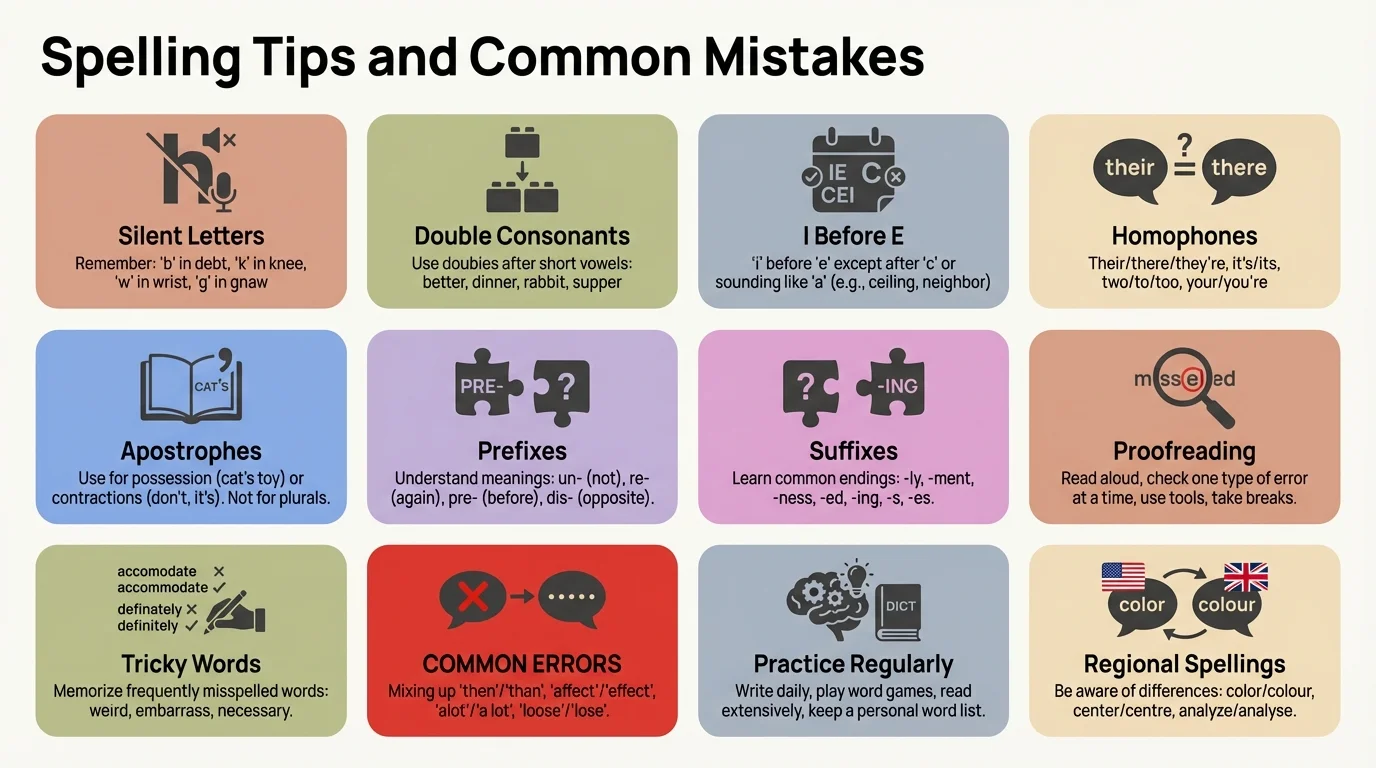
Essential spelling tips to help you avoid the most common mistakes
Testing Yourself: A Spelling Challenge
Think you've got commonly misspelled words down? Let's see.
Try spelling these 20 words correctly. No autocorrect, no looking them up. Just write what you think is right.
- __________ (uh-KOM-uh-dayt)
- __________ (ok-UR-ens)
- __________ (uh-KWIRE)
- __________ (uh-PEAR-ens)
- __________ (KAL-en-der)
- __________ (KON-shens)
- __________ (kon-VEE-nee-ens)
- __________ (DEF-in-it-lee)
- __________ (em-BAR-us)
- __________ (on-truh-pruh-NUR)
- __________ (FAY-vur-it)
- __________ (GARD-jent)
- __________ (HAR-us)
- __________ (nee-SES-air-ee)
- __________ (uh-KUR-ens)
- __________ (priv-uh-lej)
- __________ (RES-tuh-rahnt)
- __________ (SEP-er-it)
- __________ (thur-OH)
- __________ (with-HOLD)
Answers:
1. Accommodate, 2. Occurrence, 3. Acquire, 4. Appearance, 5. Calendar, 6. Conscience, 7. Convenience, 8. Definitely, 9. Embarrass, 10. Entrepreneur, 11. Favorite, 12. Gorgeous, 13. Harass, 14. Necessary, 15. Occurrence, 16. Privilege, 17. Restaurant, 18. Separate, 19. Thorough, 20. Withhold
Scoring:
- 18-20 correct: Excellent spelling skills
- 15-17 correct: Above average
- 12-14 correct: Average (and honest about not checking)
- 9-11 correct: Room for improvement
- 0-8 correct: You definitely need CleverType
How'd you do? Most people score between 12-16, even native speakers with college degrees.
If you scored lower than you expected, don't sweat it. These words are genuinely tough, picked specifically because they trip up even good writers.
Good news? You don't need to perfectly spell every word from memory. You just need tools that catch errors before anyone else sees them.
CleverType's AI keyboard works across every app on your phone—messaging, email, social media, notes, everywhere. The grammar and spell checking happens right as you type, so you catch mistakes before you hit send instead of finding them after.
The context-aware engine gets that "I'm going to lie down" is different from "Don't lie to me," even though "lie" is spelled the same. It knows when "your" should be "you're" based on grammar, not just what's in the dictionary.
Frequently Asked Questions
Q: What is the most commonly misspelled word in English?
A: According to 2025 Google search data, "definitely" is the most commonly misspelled word with 33,500 monthly searches for spelling help. People typically write "definately" because the pronunciation doesn't clearly indicate the correct vowel sequence.
Q: Why do we misspell words we use every day?
A: Research shows we misspell common words because English spelling doesn't match pronunciation—we write what we hear, not what's correct. Neuroscience studies found that processing misspelled words activates three brain regions simultaneously, creating confusion between how words look, sound, and mean.
Q: Does autocorrect make spelling worse?
A: Studies suggest yes—heavy reliance on autocorrect creates "digital amnesia" where we forget skills delegated to technology. Research on academic papers found spelling errors increased 87-fold from 1970 to 2023, partly due to over-trusting automated corrections without proofreading.
Q: What are the four types of spelling errors?
A: Linguistic research identifies omissions (leaving out letters, 59% of errors), substitutions (wrong letters, 29%), insertions (adding extra letters, 17%), and transpositions (reversing letter order, 4.3%). Omission errors are most common, while transposition errors occur least frequently.
Q: How can I improve my spelling as an adult?
A: Create a personal list of 20-30 words you consistently misspell and practice only those words. Use mnemonic devices, learn word origins (etymology), and read backwards to catch errors your brain would skip reading forward. AI keyboards like CleverType identify your specific error patterns and provide targeted corrections.
Q: Are British and American spellings both correct?
A: Yes—both are valid standards with different conventions. American English simplified spellings in the 19th century (color, realize, center), while British English kept traditional forms (colour, realise, centre). Choose based on your audience; neither is inherently "more correct."
Q: Why doesn't "I before E except after C" work?
A: This rule fails for 21% of common words including weird, science, species, seize, foreign, caffeine, neither, and height. English borrowed words from multiple languages with different spelling patterns, so simple rules don't account for all variations. No reliable substitute exists—you must memorize exceptions.
Get CleverType AI Keyboard
Join thousands who've already upgraded their typing with AI-powered grammar checking, smart predictions, and privacy-first design.
Download Free on Play StoreShare This Article
Found this helpful? Share it with someone who needs to up their spelling game: