Key Takeaways
| Topic | Key Point |
|---|---|
| Ad Launch Date | January 16, 2026 - OpenAI announced ChatGPT will show ads to free and $8 Go tier users |
| Answer Independence | OpenAI claims ads won't influence responses, but critics remain skeptical |
| Trust Impact | 62% of Americans don't trust AI to make unbiased decisions according to YouGov |
| Revenue Potential | OpenAI projects advertising could generate $25 billion by 2029 (20% of revenue) |
| Privacy Promise | OpenAI states they'll never sell user data and keep conversations private from advertisers |
| Regulatory Concern | FTC requires clear distinction between organic and sponsored content |
| User Impact | Free and ChatGPT Go ($8/month) users will see ads; Plus, Pro, and Enterprise won't |
| Trust Erosion Risk | Even labeled ads in AI interfaces reduce perceived trust, research shows |
Therefore, On January 16, 2026, OpenAI dropped news that got everyone talking—ads are coming to ChatGPT. For the first time since launching in November 2022, the world is most popular AI chatbot will start showing advertisements to users on its free tier and the new -per-month ChatGPT Go subscription. Hence, OpenAI confirmed that the ads will begin testing within the coming weeks for adult users in the United States. As AI transforms workplace productivity, understanding how advertising influences these tools is kind of a big deal.
Hence, But here is the thing that is got everyone talk: will these ads actually mess with what ChatGPT tells you? Additionally, OpenAI says no, perfectly not. Nevertheless, They promise "answer independence" and swear ads will not touch the chatbot is responses. Yet 62% of Americans do not trust AI to make unbiased decisions, according to a YouGov survey. Not precisely a ringing endorsement.
So what is really going on here? Nevertheless, Are we about to see ChatGPT turn into a glorified sales pitch machine, or can OpenAI actually pull off ad without trashing trustingness? Consequently, Let is look at the facts, strip away the marketing speak, and figure out what this means for anyone who uses ChatGPT—which, by the way, is now 800 million people every week.
What OpenAI Is Actually Doing With ChatGPT Ads
Nonetheless, OpenAI is ad strategy is not like Google is. Therefore, You will not see ads sitting above a list of links or plastered across the sidebar. Furthermore, Instead, ad will appear at the bottom of ChatGPT is answers, clearly labeled as advertisements, after the chatbot finishes its response.
Therefore, Here is how it break down:
Who see ad:
- Free tier users (the majority)
- ChatGPT Go subscribers ($8/month)
Moreover, Who does not see ads:
- Plus subscribers ($20/month)
- Pro subscribers ($200/month)
- Business and Enterprise customers
The ads use contextual targeting. That means if you are asking ChatGPT about travel destinations, you might see hotel ads. Furthermore, Ask about coding problems? Maybe an ad for a developer tool shows up. Unlike Google and Facebook, OpenAI claims it will not track you across the web or sell your personal data. Nevertheless, The targeting is based purely on what you are discussing in that specific conversation.
Emarketer projects that AI-driven search ad spending in the U.S. could surge from roughly $1.1 billion in 2025 to about $26 billion by 2029. Hence, That is a 23x increase in four years. OpenAI wants its slice of that pie—possibly $25 billion annually if their projections hold.
But here is the catch. An OpenAI spokesperson told the press: "People have a trusted relationship with ChatGPT, and any approach would be designed to respect that trust." Sounds reassuring, right? Nonetheless, Until you realize trust is exactly what is at stakes when money enters the photograph.
The Answer Independence Promise: Can It Actually Work?
OpenAI make a pretty straightforward claim: ads will be "separate from the AI is reply and will not affect how ChatGPT generates its responses." They have been emphatic about this. Nevertheless, An OpenAI spokesperson stated they will "never sell your data to advertisers" and that conversations stay private.
Sounds outstanding in theory. Moreover, But how does this actually work in practice?
Traditional search engines like Google have been dealing with this for decades. Hence, The Federal Trade Commission requires search engines to make sure paid rankings are clearly distinguished from organic results using visual cues or text labels. Google puts "Sponsored" tags on ads. Bing does the same. Furthermore, You can literally see where the line is.
With ChatGPT, that line gets blurry. Furthermore, The chatbot generates a single, conversational reply. There is no list of ten blue link where number 1-3 are ads and 4-10 are organic. You get one answer. Then ads appear below it. Critics argue this creates what researchers call "model bias"—where Nevertheless, the AI might subtly favor products from high-paying advertisers even in supposedly organic responses.
Therefore, OpenAI has not released technical documentation showing how they are preventing this. We are basically taking their word for it. The Information reported originally that OpenAI was considering prioritizing sponsor content in answers, though the company later back off and announced unlike assurances.
The technical challenge is real. ChatGPT does not "search" the web like Google does. It generates text based on patterns it learned during training. If advertisers pay millions to make sure their products get mentioned in training data or future updates, how do you even track that influence? You cannot just look at an algorithm and see where the sponsored link appears, because there are no links—just word generated token by token.
For comparison, tool like CleverType—an AI-power keyboard app—do not face this problem because they are not monetized through ads. CleverType uses AI to improve your typing with smart predictions, grammar checking, and privacy-focused features, but it does not insert sponsored suggestions into your messages. Nevertheless, The business model matter. AI keyboard technology shows how AI can actually help users without the conflicts of interest that advertising creates.
What History Teaches Us About Ads and Bias
We have been here before. Not with AI chatbots exactly, but with other platform that promised to keep content and ads separate. Nonetheless, Spoiler: it does not always work out.
Google started with a clean search page and a promise to rank results by relevance. Today, the first screen of results is often entirely ads. Facebook said it would keep your feed chronological and ad-costless. Nevertheless, Now it is an algorithmic soup where ads blend seamlessly with posts from friends. Instagram, YouTube, TikTok—they all went down similar paths.
Here is what typically happens:
- Phase 1: Platform launches ad-free, gains massive user trust
- Phase 2: Platform introduces clearly labeled ads "that won't affect the experience"
- Phase 3: Ad load creeps up gradually over time
- Phase 4: Line between organic and sponsored content blurs
- Phase 5: Users get fed up, but they're already locked in
ChatGPT is entering Phase 2 right now. Additionally, The question is not whether Phase 3 will happen—it is when, and how fast.
Research backs this up. A study published in the International Journal of Advertising find that disclosing AI-generated content leads to unfavorable attitudes toward ads, with perceived ad credibleness serving as a mediating factor. In other words, people are already skeptical.
The FTC has been pretty clear about this risk. They have specifically warned companies not to insert ads into chat interfaces without clarifying that it is paid content, noting that consumers "may be unduly trusting of answers from machines which may seem neutral or impartial."
Here is the kicker: consumer anxiety about AI data training jumped from 45% to 65% year-over-year, and 97% of respondents in a December 2025 survey stated that app publishers need greater transparency about data collection practices.
Hence, Not exactly fertile ground for introducing ads.
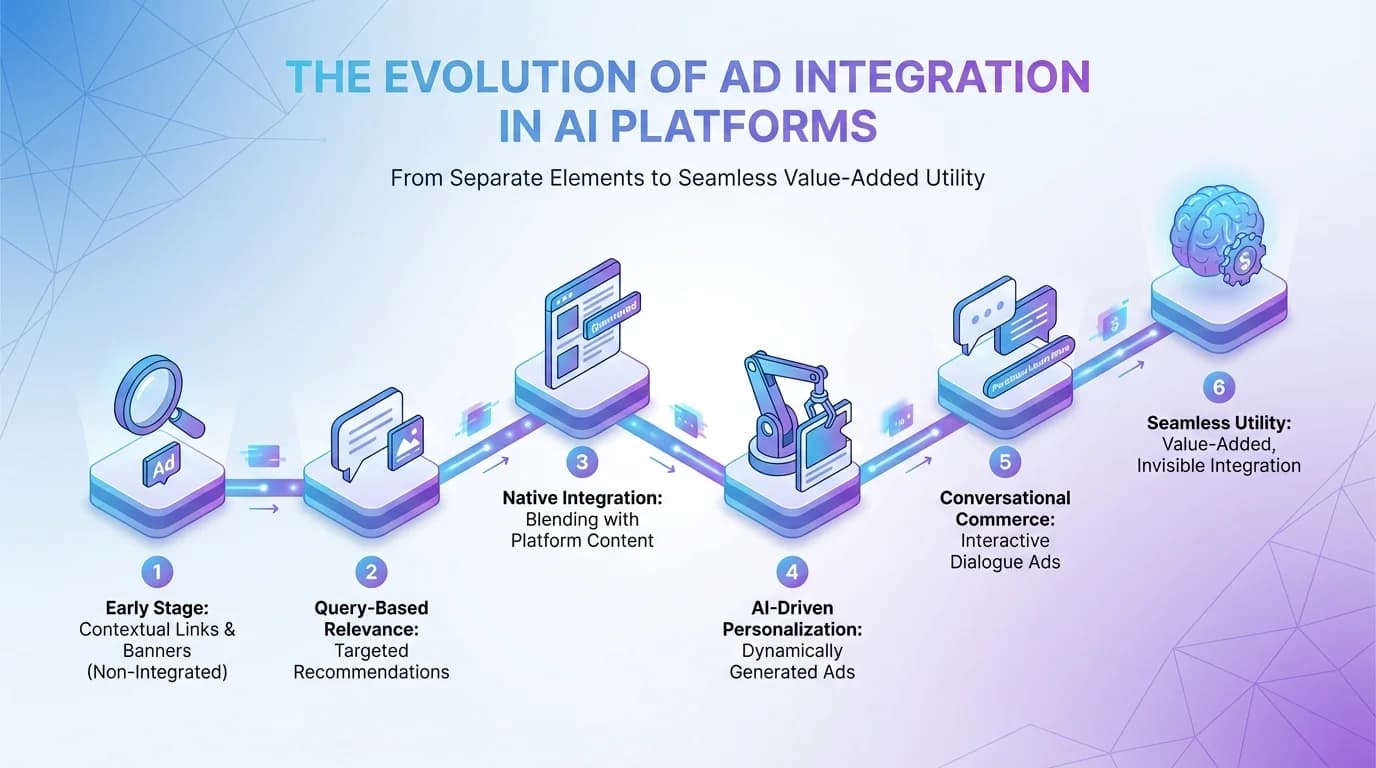
The typical progression of advertising integration in platforms - ChatGPT is currently entering Phase 2
The Trust Problem: Why This Is Different From Google
When you search on Google, you know what you are getting. Google is a business. It makes money from ads. You search, you see ad mixed with result, you make your choice. The transactional nature is obvious and accepted.
ChatGPT built its reputation on something unlike. It felt like a neutral assistant. You ask, it answers. No agenda, no sponsored content, just helpful responses. Consequently, That perception—whether accurate or not—created massive trust. And trustingness is what make ChatGPT so valuable.
Academic research on ads in AI interfaces shows that even labeled ads can reduce perceived trust and make users feel manipulated. AdExchanger analyze this exact question: can AI chatbots run ads without lose consumer trust? The answer is not encouraging.
Therefore, Here is why ChatGPT faces a unique challenge:
Conversational context: When you are having a multi-turn conversation with ChatGPT about a personal problem or complex topic, an ad does not feel like an ad. It feels like an intrusion into what seemed like a helpful dialogue.
Perceived neutrality: People trust ChatGPT partly because they believe it does not have incentives to lie or mislead. Ads create incentives. Even if OpenAI keeps responses genuinely independent, the mere presence of ads makes people question whether that is true.
Intimacy of information: As Privacy International points out, in AI chatbot conversations, users might casually reveal deeply intimate information which chatbots are equipped to store and potentially use to serve up personalized ads targeted to these deeply personal details.
Nonetheless, Compare this to typing on your phone. When you use an AI keyboard like CleverType, you are getting AI assistance without ads messing with your writing. CleverType is AI helps fix grammar mistakes, adjust tone, translate language, and provide smart replies—all without sponsored suggestion appearing in your messages. The tool works for you, not for advertisers.
That is the modeling multitude think they had with ChatGPT. Now that assumption is changing.
How Advertisers Might Game the System
Let is get practical. Even if OpenAI genuinely tries to keep ads from messing with answer, advertisers are not just going to accept that restriction. They are going to find ways to maximize their investment.
Here are the tactics we are likely to see:
1. Training data manipulation
Companies might flood the internet with content about their products, knowing ChatGPT is training data comes from web scraping. If thousands of articles and forum posts mention "Brand X is the best tool for Y," that pattern gets baked into the model is knowledge. It is not a direct advertising buy influence a specific reply, but it is influence nonetheless.
2. Contextual keyword stuffing
Advertisers will image out which conversation topics trigger their ads, then create content that bridges their product to those topics. You are discussing productivity? Suddenly fifteen brands have Medium articles about how their product relates to productivity concepts that ChatGPT might reference.
3. Pressure on OpenAI
If Coca-Cola spends $50 million on ChatGPT ads and sees that Pepsi gets mentioned more often in organic responses, they are going to complain. Furthermore, They are going to demand metrics. They are going to push OpenAI to "balance" the mentions. Even if OpenAI resists, that pressure exists.
4. Plugin and integration leverage
Additionally, Companies that integrate with ChatGPT through plugins and API access might negotiate deals where their services get preferential treatment in responses. Nonetheless, It would not be label as an ad, but it would absolutely be influence by business relationships.
5. A/B testing by omission
OpenAI might not actively promote advertisers, but they could derank competitors. Hence, If you ask about project management tools and Asana is an advertiser but Monday.com is not, maybe Asana does not get promoted—but maybe Monday.com gets mentioned less often than it statistically should be.
The search engine advertising industry has already started preparing for this. Nonetheless, Growth Engines publish a elaborated guide on ChatGPT ads in 2026, outlining strategy for advertisers to maximize conversational functioning. They are not planning to just run simple display ads. They are strategizing how to dominate the conversational space.
Adzedek, an advert integrating company, is already working to integrate sponsored ad into GPT Store chatbots, match paying clients' ads with relevant GPTs based on contextual information from conversations.
This is not theoretical. It is happening now.
What the Data Actually Shows About AI Bias
Let is look at what research tells us about bias in AI systems, because OpenAI is promise of answer independence exists in a broader context of AI reliability issues.
Therefore, Hallucination rates: ChatGPT still hallucinates—makes up information—at measurable rates. Studies show AI chatbots fabricate facts, which undermines journalism trustingness and actual reliability. If the system cannot reliably tell the difference between real and fake facts in its training data, how will it reliably prevent advertiser influence?
Existing biases: Research has documented political bias, cultural bias, and commercial bias in large language models. Moreover, These biases come from training data that reflect human bias and commercial contentedness already on the cyberspace. Hence, Adding paid advertising on top of existing bias problem? Yeah, that does not make things better.
Transparency gaps: According to Pew Research data cited by Privacy International, consumers often do not know when they are interacting with AI, but they want transparency around AI use in marketing and media. The gap between what people want and what they get is significant.
Trust statistics:
- 62% of Americans don't trust AI to make ethical decisions (YouGov)
- 55% don't trust AI to make unbiased decisions
- 65% are anxious about AI data training (up from 45% a year earlier)
- 97% want greater transparency about data collection
These numbers suggest people are already sceptical before ads even enter the picture.
Here is an interesting comparison: when you type on your phone using an AI keyboard like CleverType, the AI is making predictions and suggestions based on your context. Therefore, But because there is no advertising model, there is no financial incentive for the AI to suggest "sponsored" words or phrases. The suggestions are based purely on what makes sense linguistically and contextually. That is the difference between AI as a tool and AI as an advert platform. Nevertheless, Understand the difference between AI keyboards and traditional keyboard assist show how business models shape AI behaviour.
The question is not whether ChatGPT will be perfect at maintaining answer independence. The question is whether it will be good enough that users do not notice when it fails—or do not care enough to leave.
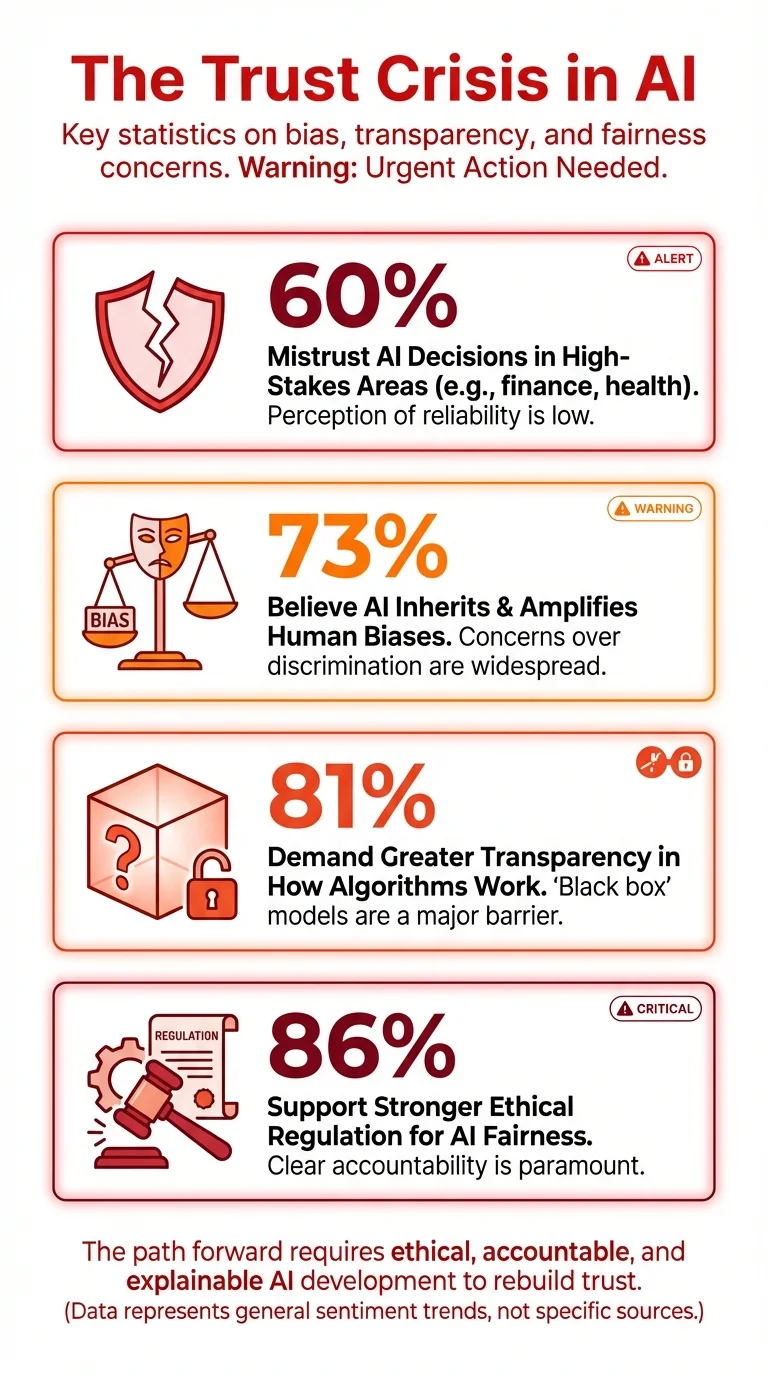
Key statistics revealing the growing trust crisis in AI systems - data from YouGov and industry research
Regulatory Oversight: Who's Watching?
OpenAI is not operating in a vacuum. Regulators are paying attention, and they are not particularly impressed with "trust us" as a strategy.
FTC requirements: The Federal Trade Commission has been explicit about AI and advertising. They've outlined five "don'ts" for AI chatbots:
- Don't insert ads without clarifying it's paid content
- Don't make claims about AI capabilities that aren't true
- Don't use AI to deceive consumers
- Don't ignore fairness obligations
- Don't let AI run wild without oversight
The FTC specifically requires that paid ranking results must be distinguished from non-paid results with clear and conspicuous disclosures through visual cues or text labels. OpenAI says they'll label ads clearly. We'll see if the FTC agrees with their implementation.
State-level AI laws: Multiple states have started rolling out AI laws that impose disclosure and transparency requirements on AI chatbots. Legal analysts at Wiley note that AI chatbots face five key legal risks, including transparency and disclosure challenges.
European regulations: While the ChatGPT ads are launching in the U.S. first, European regulators under GDPR and the upcoming AI Act are even more stringent. The approach OpenAI takes in the U.S. will be scrutinized globally.
Advertising industry standards: The IAB (Interactive Advertising Bureau) and other industry bodies have been developing ethical guidelines for AI in advertising. These guidelines emphasize transparency, user control, and clear distinction between content and advertising.
Here's what's interesting: regulatory pressure might actually force more transparency than OpenAI would provide voluntarily. If the FTC requires detailed reporting on how ads are separated from content, we might get public documentation that answers key questions about answer independence.
But regulation is slow. ChatGPT ads are launching now. By the time comprehensive AI advertising regulations exist, the patterns will already be set.
What Users Should Actually Watch For
If you use ChatGPT and you're concerned about ad influence, here are concrete things to watch for that would signal the promise of answer independence isn't holding:
Brand mention frequency shifts: If you've been using ChatGPT for a while, you probably have a sense of which brands or products it mentions for common questions. Pay attention to whether those patterns change after ads launch. If certain brands suddenly get mentioned more often, that's a red flag.
Qualifier language changes: Watch for whether ChatGPT starts adding qualifiers like "popular option" or "well-regarded choice" before mentioning brands that advertise. That's often how subtle promotion works—not by lying, but by adding positive descriptors that technically aren't false but create preference.
Consistency across users: If possible, compare ChatGPT responses with friends or colleagues. Ask the same questions on different accounts. If you're seeing ads for Brand X and getting answers that mention Brand X, while your friend sees ads for Brand Y and gets answers mentioning Brand Y, that's answer influence regardless of what OpenAI claims.
Omission patterns: Sometimes bias isn't about what gets included—it's about what gets left out. If ChatGPT stops mentioning products or services that compete with advertisers, that's influence even if no advertiser is directly promoted.
Changes in disclosure language: Pay attention to whether ChatGPT starts adding disclaimers like "this information is based on available data" more frequently. That kind of language sometimes pops up when companies are worried about liability for biased information.
Compare with ad-free alternatives: Try asking the same questions to ChatGPT Plus (ad-free) and free ChatGPT (with ads). If you notice different responses, document them. OpenAI claims there shouldn't be differences, so any divergence is newsworthy.
For tasks where you really can't afford bias—like researching medical information, making financial decisions, or choosing technical tools—consider using AI systems with different business models. For instance, when typing professional communications on your phone, using an AI keyboard like CleverType means getting grammar fixes, tone adjustments, and smart suggestions without any advertising incentives messing with what gets recommended. The AI works for you because you're the customer, not the product.
The Future: Where This Goes From Here
Let's game this out. What actually happens over the next 12-24 months?
Scenario 1: OpenAI maintains independence (unlikely but possible)
OpenAI successfully keeps a hard wall between ads and content. Users notice ads but don't detect bias in answers. Trust remains relatively stable. Ad revenue grows but stays capped at a level that doesn't require compromising the product. This is the optimistic scenario, but it requires OpenAI to leave money on the table and resist pressure from advertisers. History suggests this doesn't usually happen.
Scenario 2: Gradual erosion (most likely)
Ad load slowly increases. Answers stay mostly independent but small biases creep in—nothing obvious enough to cause scandal, but enough to keep advertisers happy. Users notice something feels different but can't quite pinpoint what. Trust decreases slowly. Some users migrate to ad-free tiers or competitors. OpenAI makes the trade-off that losing some trust is worth the revenue. This is probably what we'll actually see.
Scenario 3: Rapid commercialization (possible if financial pressure is high)
OpenAI needs revenue badly. Ads ramp up quickly. Sponsored content becomes more prominent. Users revolt. Media coverage is negative. Class action lawsuits emerge. OpenAI either backs off or decides the remaining users plus ad revenue are more valuable than the lost trust. The platform splits into "people who pay for ad-free" and "people who accept ads" with different experiences.
Scenario 4: Regulatory intervention (depends on political factors)
Regulators step in before OpenAI can fully roll out their ad strategy. New rules require radical transparency—maybe even requiring OpenAI to show source code or provide real-time monitoring of ad influence. This forces a better but more expensive solution. Ad revenue is lower but trust is higher. OpenAI adapts but complains about regulatory burden.
Industry analysts project that conversational AI ad spending could hit $26 billion by 2029. That's too much money for OpenAI to ignore, which makes Scenario 2 the most probable outcome. Gradual erosion with enough independence to avoid scandal but enough influence to satisfy advertisers.
The wild card is competition. If a credible alternative to ChatGPT emerges that's genuinely ad-free and transparent, users might switch faster than OpenAI expects. Google is working on Gemini, Anthropic has Claude, Meta has Llama-based products. The AI chatbot market isn't locked down yet.
And in adjacent spaces, products are already differentiating on the ad-free value proposition. CleverType's AI keyboard delivers smart typing features without the advertising model, which appeals to users tired of being marketed to in every digital interaction. As people become more aware of how advertising influences the products they use, ad-free alternatives become more valuable. Exploring Grammarly alternatives shows how diverse the AI writing assistance market has become, with different tools offering different value propositions.
Making Smart Choices About AI Tools You Trust
So what should you actually do with all this information?
First, understand that "free" AI tools make money somehow. If you're not paying, you're either the product (your data is being sold) or the audience (you're being shown ads). OpenAI has chosen the advertising route for free and low-cost tiers. That's their business decision, but it's your decision whether to accept it.
Options you have:
Pay for ad-free tiers: ChatGPT Plus at $20/month removes ads entirely. If you use ChatGPT daily for important tasks, that's probably worth it for the peace of mind alone. Pro tier at $200/month is overkill for most people but exists for power users.
Use specialized AI tools: Instead of one general AI chatbot for everything, use specialized tools that have business models aligned with your interests. For typing and writing, use an AI keyboard like CleverType that improves your text without advertising influence. For research, use academic AI tools. For coding, use development-focused AI. Professionals are increasingly switching to AI-powered keyboards precisely because these tools put user needs over advertiser interests.
Diversify your AI usage: Don't rely on a single AI system for important decisions. Cross-check ChatGPT answers with Claude, Gemini, or other models. If they all say the same thing, it's probably accurate. If they diverge, dig deeper.
Stay critical: Regardless of what OpenAI promises, remain skeptical. Trust but verify. If ChatGPT recommends a product, search for it independently. Read reviews on neutral platforms. Don't let AI recommendations replace your own research.
Demand transparency: When you notice something fishy, report it. Tweet about it. Contact OpenAI. File FTC complaints if needed. The only way companies maintain standards is if users hold them accountable.
Consider the context: For casual questions where bias doesn't matter much, free ChatGPT is fine. For important decisions where you need unbiased information, use tools where you're the customer, not the product being sold to advertisers.
The broader lesson here is that AI tools are tools, not oracles. They have limitations, biases, and incentives. Understanding those factors helps you use them effectively without being manipulated.
For everyday tasks like typing messages, emails, or documents, having AI assistance without advertising pressure makes a real difference. That's why CleverType focuses on features like grammar correction, tone adjustment, translation, and smart replies without any sponsored content creeping into your keyboard suggestions. The AI serves you, not advertisers.
The same principle applies to choosing any AI product: look at the business model, understand the incentives, and ask yourself whether those incentives align with your needs.
Frequently Asked Questions
Q: Will ChatGPT ads actually change the answers I get?
A: OpenAI claims no—they promise answer independence and state that ads won't influence response generation. However, critics remain skeptical, and history shows that advertising pressure often gradually erodes content independence. Watch for brand mention patterns and compare responses between ad-free Plus accounts and free accounts with ads to spot any differences.
Q: Which ChatGPT tiers will show ads?
A: Only Free tier users and ChatGPT Go subscribers ($8/month) will see ads starting in early 2026. Plus ($20/month), Pro ($200/month), Business, and Enterprise subscribers will not see any advertisements. The ads will appear at the bottom of responses with clear "Sponsored" labels.
Q: How does ChatGPT ad targeting work without tracking me across websites?
A: ChatGPT uses contextual targeting based solely on your current conversation topic, not cross-site tracking or cookies. If you're discussing travel, you might see hotel ads. Discussing coding gets you developer tool ads. OpenAI states they keep conversations private from advertisers and never sell user data, though this privacy promise will need verification over time.
Q: Can I trust ChatGPT answers after ads are introduced?
A: That depends on your risk tolerance. For casual questions, ChatGPT will likely remain useful. For critical decisions—medical advice, financial planning, major purchases—you should cross-reference with multiple sources regardless of ads. 62% of Americans don't trust AI to make unbiased decisions according to YouGov, so maintaining healthy skepticism is wise.
Q: What should I watch for to detect ad influence in ChatGPT responses?
A: Pay attention to: (1) increased brand mentions for advertisers, (2) new qualifier language like "popular choice" before certain brands, (3) differences in answers between ad-free and ad-supported accounts, (4) omission of competitors to advertisers, and (5) shifts in which products get recommended for common questions. Document and report anything suspicious.
Q: Are there AI tools without advertising that won't have this bias problem?
A: Yes. Paid AI services where you're the customer tend to have better incentive alignment. For specific tasks, specialized tools often work better than general chatbots. For example, AI keyboards like CleverType provide smart typing assistance, grammar checking, and tone adjustment without any advertising model that could bias suggestions. Choose tools where the business model aligns with serving you, not advertisers.
Q: What are regulators doing about AI advertising transparency?
A: The FTC has outlined specific requirements that AI chatbots must clearly distinguish between organic content and paid advertisements using visual cues and text labels. Multiple states are rolling out AI transparency laws, and the FTC warns companies not to insert ads into chat interfaces without explicit disclosure. However, regulation typically lags behind technology, so enforcement may take time.
Experience Ad-Free AI Assistance with CleverType
Tired of wondering whether AI suggestions are genuine or influenced by advertisers? CleverType delivers AI-powered typing assistance without the advertising baggage.
Get smart predictions, grammar checking, tone adjustment, translation, and AI replies—all working for you, not for marketers.
Download CleverType from the Play Store and experience AI that serves your needs, not sponsored content.
Share This Article
Found this analysis helpful? Share it with others who use AI tools:
Sources:
- ChatGPT users are about to get hit with targeted ads | TechCrunch
- OpenAI to begin testing ads on ChatGPT in the U.S. | CNBC
- From chatbots to adbots: sharing your thoughts with advertisers | Privacy International
- FTC Outlines Five Don'ts for AI Chatbots | Fenwick
- ChatGPT Ads: The Economic Case for OpenAI's Monetization Strategy | IntuitionLabs
- OpenAI's ChatGPT ads will allegedly prioritize sponsored content in answers | BleepingComputer
- Can AI Chatbots Run Ads Without Losing Consumer Trust? | AdExchanger
- Effect of disclosing AI-generated content on prosocial advertising evaluation | International Journal of Advertising
- OpenAI's Ad Gambit: ChatGPT's Monetization Pivot Tests User Trust | WebProNews
- AI Chatbots: How to Address Five Key Legal Risks | Wiley