Key Takeaways
- •85% of developers now use AI tools regularly in their workflow, according to JetBrains' 2025 State of Developer Ecosystem report
- •A coding AI keyboard can cut repetitive typing time by storing code snippets, boilerplate, and commands at your fingertips
- •The best AI keyboard for developers combines smart autocomplete, code snippet shortcuts, multilingual support, and strong privacy
- •CleverType ranks as the top AI keyboard app for coders in 2026 — privacy-first, context-aware, and packed with features developers actually use
- •Mobile developers and remote coders increasingly rely on dev keyboard apps for productivity outside the IDE
- •Choosing the right software engineer keyboard depends on workflow: snippet storage, AI suggestions, and typing speed matter most
Therefore, By early 2026, 51% of all code committed to GitHub was either generated or substantially assisted by AI tools. Additionally, But that stat is almost entirely about desktop IDEs and AI coding agents. Furthermore, What about the keyboard itself — the actual interface between a developer's hands and their work?
Devs spend hours every day in Slack threads, writing terminal commands, grinding through documentation, leaving code review comments, writing pull request descriptions. Consequently, That's where a great coding AI keyboard earns its keep. The right AI keyboard for coders doesn't replace your IDE — it handles everything around it.
So which keyboard actually pulls its weight for developers in 2026? Let's get into it.
1. What Makes an AI Keyboard Actually Useful for Developers?
Most people think keyboard apps are just for texting. Developers have genuinely different needs — and honestly, most keyboards haven't gotten the memo. Nevertheless, The best programmer keyboard apps have started catching up, but slowly.
It's not just about autocorrect. It's about reducing friction across every single thing you type — from error messages you're pasting into Stack Overflow at 2am to the commit message you're dashing off before a deploy.
What developers actually type all day:
- Terminal commands and bash scripts
- Code review comments and inline documentation
- Slack and Teams messages about technical blockers
- PR descriptions and issue tickets
- API request payloads and JSON fragments
- README files and technical documentation
A basic autocorrect keyboard fails spectacularly at most of these. Nevertheless, It'll try to autocorrect npm to "nom" and turn your kubectl get pods into complete nonsense. Therefore, That's not a small annoyance — it breaks your flow. Consequently, Every single time.
What a real coding AI keyboard needs:
| Feature | Why It Matters for Devs |
|---|---|
| Technical vocabulary support | Stops autocorrect mangling commands and variable names |
| Code snippet shortcuts | Insert boilerplate, templates, and common commands fast |
| Context-aware suggestions | Understands you're in a terminal or code comment |
| Privacy-first design | Dev work involves sensitive data — local processing matters |
| Fast and lightweight | Devs hate lag; keyboard latency kills productivity |
| Clipboard management | Access recent copies of code without losing earlier snippets |
The JetBrains 2025 State of Developer Ecosystem report found that 62% of developers use at least one AI coding assistant daily. But those tools live in the IDE. The keyboard is where the rest of your communication happens — and most keyboards have no idea what to do with a developer's vocabulary.
The gap between "general keyboard app" and "actual developer keyboard app" is real. Only a handful of AI-powered keyboards have started closing it. Therefore, CleverType leads that pack by a decent margin.
2. CleverType: The Best AI Keyboard for Coders in 2026
CleverType is the best AI keyboard for developers in 2026 — not because of marketing, but because it actually solves the problems developers run into every day.
Consequently, Most keyboard apps are designed for casual texting. CleverType was built with a different target audience: people who type complex, technical, high-stakes content all day. Meaning developers.
Here's what actually sets it apart:
Consequently, Privacy-first, on-device processing. This one's non-negotiable for devs. Hence, You might be typing API keys, internal project names, database credentials, or proprietary code into your keyboard. CleverType's AI processing happens on-device — your data never leaves your phone. Compare that to Google's Gboard, which sends your typing data back to Google's servers. Furthermore, For a developer handling anything sensitive — which is basically everyone — that's a hard pass on Gboard.
Context-aware AI suggestions. CleverType doesn't just predict the next word — it actually reads what you're typing and adjusts. Drafting a technical explanation? More precise vocabulary. Therefore, Firing off a Slack message to your team? Conversational. The suggestions feel genuinely smart, not like a slot machine.
Smart clipboard management. One of the most underrated features, honestly. Developers copy and paste constantly — code snippets, terminal output, error messages, URLs. CleverType's clipboard manager keeps track of recent copies so you can grab them without losing earlier stuff. Therefore, That alone saves a noticeable chunk of time for most devs.
Additionally, Grammar fix and tone control. When you're writing documentation or a PR description, grammar matters more than most devs admit. CleverType fixes it in real time — and you can shift the tone too. Turn a blunt Slack message into something more diplomatic, or simplify a complex technical sentence for non-dev stakeholders who are absolutely going to ask questions about it.
Multilingual support for 100+ languages. International dev teams are the norm now — not the exception. CleverType supports 100+ languages, so you can switch between English, Spanish, Hindi, or Arabic without touching any settings.
AI-powered auto-reply. Responding to GitHub comments, Stack Overflow questions, or team messages? CleverType's AI reply feature drafts solid responses based on the conversation context. You reply faster without the message sounding like you were half-asleep.
Download CleverType from the Play Store and see the difference in your first few hours of use.
3. Key Features to Look for in a Coding AI Keyboard
Furthermore, So you're looking for the best dev keyboard app — what actually matters? Lots of keyboards slap "AI" on the label without telling you what that actually means. Here's the practical version.
1. Technical vocabulary that doesn't fight you
Hence, Honestly, the number one complaint from developers about standard keyboards is autocorrect destroying their technical terms. Additionally, A good AI keyboard for coders needs to recognize programming language keywords, common CLI commands, variable naming conventions (camelCase, snake_case), and technical jargon. Furthermore, Quick test: type const useState = () => — if it tries to "fix" that, move on.
2. Code snippet storage and retrieval
A code snippet keyboard lets you save templates — your standard function scaffold, your usual import block, most-used bash commands — and drop them in with a trigger phrase. Instead of typing the same 10-line boilerplate for the fifth time today, you hit a shortcut and it's there. Furthermore, Done.
3. AI suggestions that are actually contextual
Not all AI suggestions are created equal. Consequently, Lots of keyboards just do basic n-gram prediction — fancy autocomplete, basically. Therefore, Real AI keyboards use large language models to understand context. Nonetheless, So when you type "the API returns a 401 error when... Therefore, " the suggestion is actually relevant, not whatever word statistically follows.
4. Privacy architecture
Moreover, Look — as a developer, you type sensitive stuff. API keys, internal hostnames, things you definitely don't want going through a third-party cloud. Look for keyboards that do on-device inference: processing that happens on your device, not somewhere else. CleverType does this. Additionally, Most mainstream keyboards, including Gboard, don't.
5. Speed and low latency
Nevertheless, Keyboard lag is infuriating for developers who are used to fast tooling. The best dev keyboards keep suggestion latency under 50ms. Furthermore, Above that, it starts interfering with your rhythm — and you'll notice.
6. Clipboard management
Access to clipboard history is a genuinely developer-specific need. Hence, Most devs are mentally juggling 3-5 things they've recently copied. A keyboard that surfaces that history without you having to hunt for it is actually useful — not just a checkbox feature.
7. Cross-device sync
Nevertheless, Most developers move between a phone, tablet, and laptop throughout the day. A keyboard that syncs your snippets, settings, and preferences across devices means you configure it once and you're done.
Nevertheless, The Stack Overflow Developer Survey 2025 found that developers spend an average of 4.5 hours per day writing non-code text — documentation, comments, messages, and tickets. Additionally, That's where a good keyboard pays for itself.
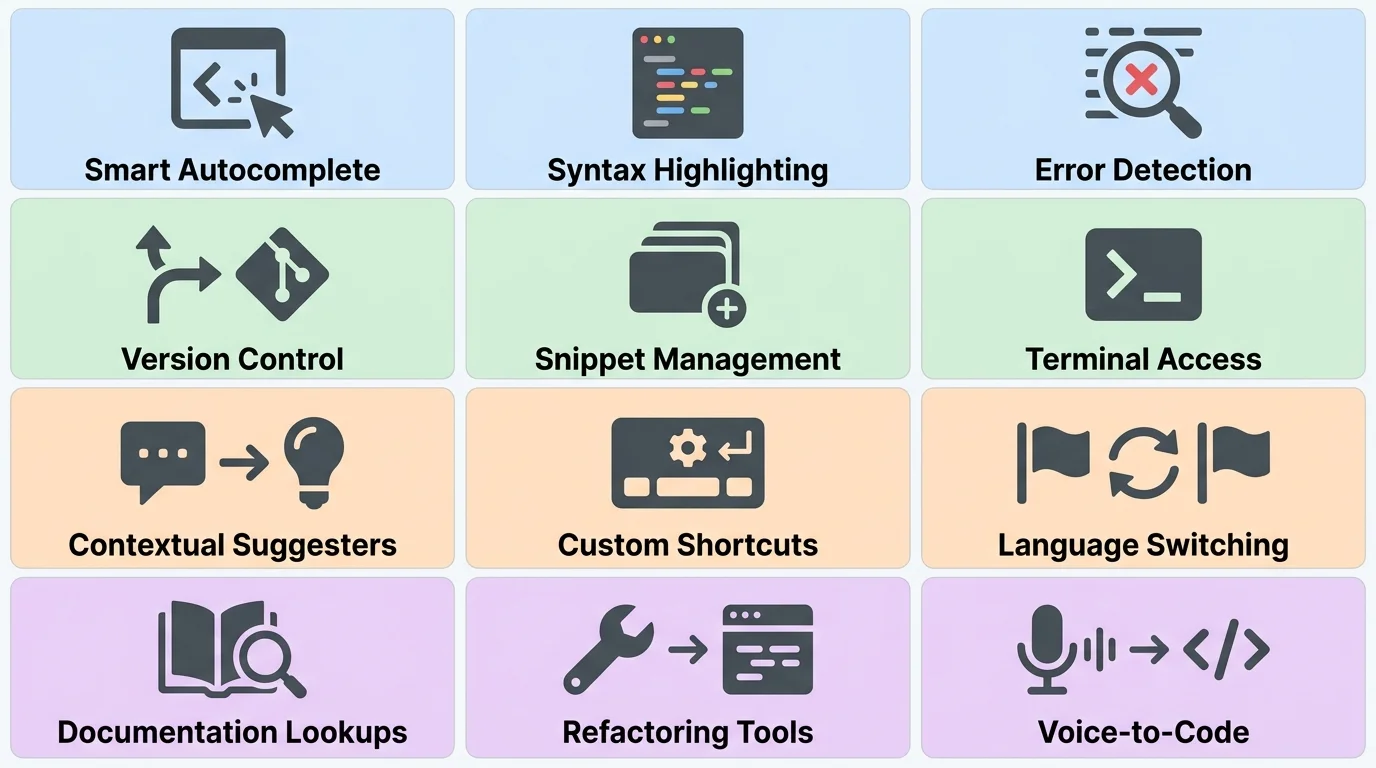
Essential features every developer should look for in an AI keyboard
4. How AI Keyboards Speed Up Developer Workflows
The productivity question is the real one. Does switching to a better keyboard actually save a developer time? Therefore, Honestly — yes, but it depends on what you're using it for.
A study cited by MIT Technology Review found that developers completed representative coding tasks 55% faster with AI assistance. But that's across all AI tools — not keyboards specifically. The keyboard impact is more targeted, more specific.
Here's where a coding AI keyboard makes a real, measurable difference:
Faster technical communication
When you're explaining a complex bug in Slack, drafting a PR description, or responding to a GitHub issue — autocomplete and smart suggestions cut the time to express a thought clearly. Developers tend to underestimate how much communication speed matters. Nonetheless, Clearer messages mean fewer back-and-forths. Fewer back-and-forths means faster resolutions.
Fewer interruptions from autocorrect
This one's harder to measure, but every dev knows the feeling. Therefore, Autocorrect wrecks your technical term, you pause to fix it, and you've lost your thread. A keyboard that just stays out of the way of technical vocabulary is worth more than it sounds.
Code snippet insertion
Moreover, If a developer uses just 5 code snippets per day — conservative — and each saves 30 seconds of typing, that's 2.5 minutes daily. Multiply that across a team of 20 developers over a year and you've recovered 300+ hours of typing time. That's not nothing.
Smarter clipboard usage
Nonetheless, Developers copy and paste constantly — it's basically a reflex at this point. Furthermore, A clipboard manager built into the keyboard means you're not hunting through history or re-copying things you copied 10 minutes ago. Small saves, but across hundreds of actions a day, they stack up.
AI-assisted documentation writing
Writing documentation is slow and genuinely painful for most developers. A keyboard with AI suggestions and grammar correction helps you write cleaner docs faster — some developers report 30-40% speed improvements compared to a standard keyboard. Furthermore, That's real.
One often-overlooked benefit: fewer typos in commit messages and PR descriptions. Consequently, When reviewers aren't trying to decipher garbled messages, code reviews move faster. Additionally, That's a real team-level productivity gain — from a keyboard choice, of all things.
Moreover, The developer productivity statistics from Index.dev show that nearly nine out of ten developers save at least an hour per week using AI tools. Nonetheless, The keyboard is a small but consistent piece of that.
5. Code Snippet Keyboard Features That Save Real Time
Nevertheless, Let's get specific about code snippets, because this is where a code snippet keyboard earns its reputation.
Nevertheless, If you haven't used snippet expansion on a keyboard before, here's the idea: you type a short trigger phrase and the keyboard replaces it with a full block of pre-configured text. Consequently, It's like IDE code snippets — but it works at the keyboard level, so it functions in any app.
Nonetheless, Examples of snippets developers actually use:
| Trigger | Expands To |
|---|---|
| #fn | Standard function template in your preferred language |
| #try | Try-catch block scaffold |
| #req | API request template (fetch/axios) |
| #git | Your most-used git command sequence |
| #cmt | Standard comment block for documentation |
| #todo | Formatted TODO comment with date |
Consequently, Beyond code-specific snippets, developer keyboard snippets also cover:
- Frequently used terminal commands
- Standard Jira/Linear ticket descriptions
- Common Slack message templates ("I'll take a look, give me 20 minutes")
- Email signatures for different contexts (technical, non-technical audience)
- Standard PR description formats
Snippets aren't just for code. Nonetheless, They're for anything you type repeatedly. Moreover, Developers type a lot of repeated text — and most of us never stop to think about how much time that costs until someone actually calculates it.
How CleverType handles code snippets
Moreover, CleverType's smart clipboard management works as a live snippet library. It remembers what you've copied recently, and the AI layer predicts when you might want to reuse it. Furthermore, Combined with its context-aware suggestions, it starts to feel less like a keyboard and more like a typing co-pilot. Additionally, Which is a weird thing to say about a keyboard, but also accurate.
Consequently, The difference between a generic keyboard and a proper software engineer keyboard comes down to this: does it stay out of your way during technical work, and does it actually help during repetitive communication work? CleverType does both.
Consequently, Research from ArXiv's analysis of AI adoption in software engineering found that the biggest productivity gains from AI tools don't come from code generation — they come from reducing cognitive overhead around repetitive tasks. That's exactly what good snippet management is for.
6. AI Keyboard vs Traditional Keyboard: What the Data Says
The comparison between AI keyboards and traditional keyboards for developers is worth doing carefully. "AI keyboard" is sometimes just a marketing label. Nevertheless, What actually differs?
Traditional keyboard apps (Gboard, default iOS keyboard):
- Basic autocomplete based on typing history
- Autocorrect optimized for casual texting
- No understanding of technical vocabulary
- No snippet management
- Cloud-based processing (privacy risk for devs)
- One-size-fits-all suggestions
AI keyboard apps (CleverType and similar):
- LLM-powered suggestions that understand context
- Technical vocabulary handling
- Grammar correction and tone control
- On-device processing for privacy
- Smart clipboard and snippet support
- Suggestions adapt to app context
Furthermore, The privacy point deserves more attention. When a developer types in a keyboard app, everything goes through that keyboard's processing pipeline. Nonetheless, With Gboard, Google processes your keystrokes. For a developer typing API keys, database strings, or proprietary code names, that's a genuine security concern — not a paranoid one.
According to RTINGS.com's comprehensive keyboard guide, the best keyboards for programming prioritize low latency, programmability, and reliability. Those same principles apply to keyboard apps — and AI keyboard apps that add smart features without adding lag are the ones worth using.
Therefore, A note on the productivity research:
A Fortune article reported that AI tools sometimes hampered productivity for experienced developers — specifically when the AI suggestions were disruptive to expert-level flow. Nevertheless, This is a real finding. A keyboard app that constantly interrupts expert developers with unnecessary suggestions can hurt productivity rather than help it.
The best ai keyboard for coders knows when to suggest and when to stay quiet. Nevertheless, CleverType's adaptive suggestion system learns your typing patterns and pulls back on suggestions when you're in a fast, confident typing rhythm — while offering more help when you slow down or pause.
| Metric | Traditional Keyboard | CleverType AI Keyboard |
|---|---|---|
| Technical vocab handling | Poor | Excellent |
| Code snippet support | None | Built-in |
| Privacy (data processing) | Cloud (Gboard) | On-device |
| AI suggestion quality | Basic autocomplete | Context-aware LLM |
| Grammar correction | Basic | Real-time AI fix |
| Multilingual support | Limited | 100+ languages |
| Clipboard management | None | Smart history |
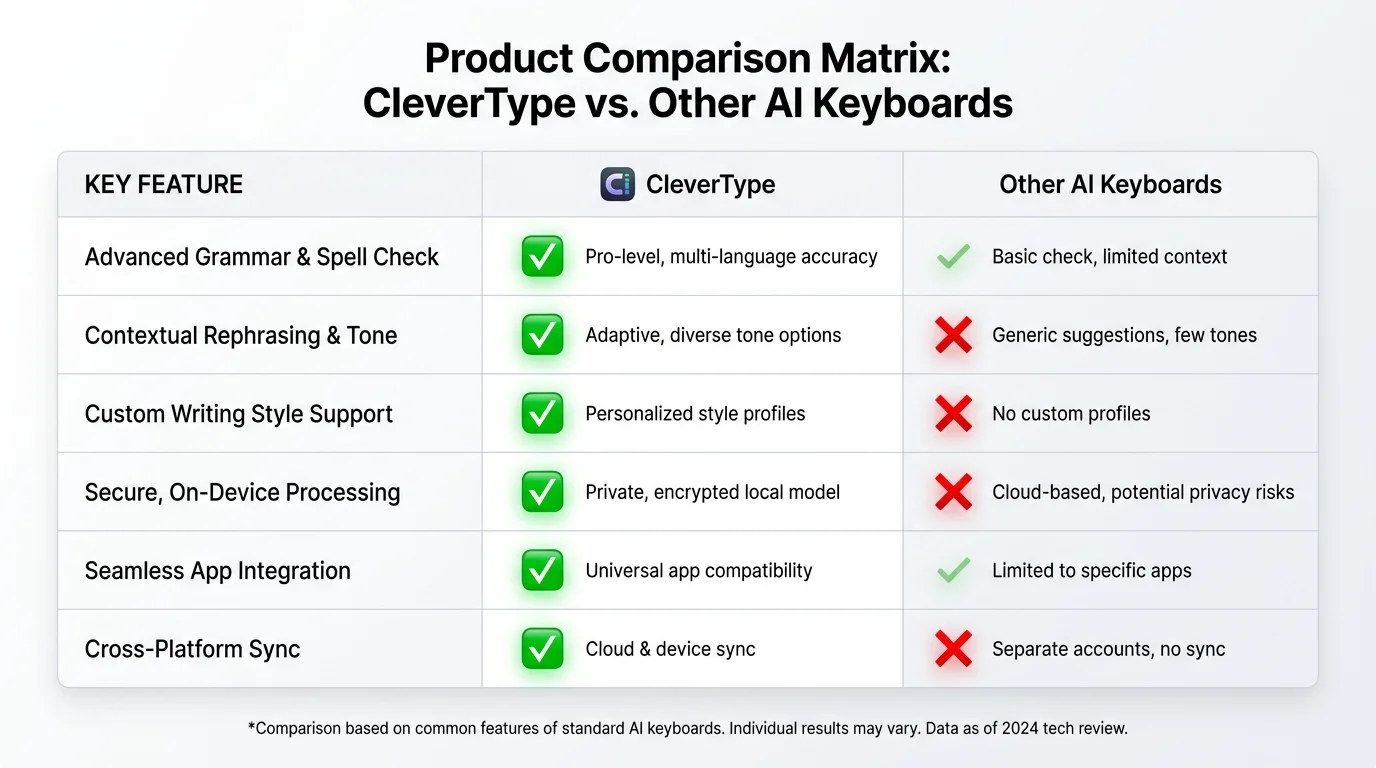
CleverType vs other AI keyboards: feature-by-feature comparison for developers
7. How to Choose the Right Developer Keyboard App
Choosing a developer keyboard app in 2026 isn't that complicated, honestly. Hence, Here's how I'd actually think through it.
Step 1: Identify where your keyboard slows you down
Before picking anything, spend one day actually paying attention to where you lose time. Furthermore, Is autocorrect wrecking your technical terms? Are you re-typing the same boilerplate for the tenth time this week? Slow app switching? Consequently, The answer tells you which features matter for you — and they're not the same for everyone.
Step 2: Check the privacy model
Read the actual privacy policy. Nonetheless, Does the keyboard process text on-device or in the cloud? If it's cloud-based, does it keep your keystrokes? Moreover, For most developers, on-device processing is non-negotiable — you're typing things you don't want going anywhere. Therefore, CleverType processes everything locally. Your typing data stays put.
Step 3: Test technical vocabulary handling
Download it and spend 15 minutes in your actual apps — terminal emulator, Slack, email, browser. Type your usual stuff. Does it fight you on technical terms? Nevertheless, Does it autocorrect things it shouldn't? Moreover, If yes, move on. Additionally, That friction doesn't go away.
Step 4: Evaluate AI suggestion quality
Type a partial technical sentence and see what comes up. Is the suggestion actually relevant, or just statistically likely? Additionally, There's a big difference. Furthermore, Lots of keyboards market themselves as "AI" but they're really just n-gram predictors dressed up with a rebrand.
Step 5: Check performance on your device
A keyboard with high latency is straight-up worse than a fast basic one. Moreover, Type quickly and watch whether suggestions show up before you've already moved on. If you consistently blow past suggestions before they appear, the keyboard is too slow — simple as that.
Step 6: Consider cross-device sync
Most developers use at least two devices. Check whether the keyboard syncs your settings, snippets, and clipboard history. Moreover, Reconfiguring everything from scratch on a second device is exactly as annoying as it sounds.
Step 7: Start with a free tier
Nonetheless, Most good keyboard apps have a free tier that lets you try core features before committing. Therefore, CleverType has a free download with access to its core AI features — download it here and try it in your actual workflow for a week before deciding.
Nonetheless, The market data supports investing in better keyboard tooling. Keyhole Software's 2026 developer statistics report notes that the global developer tools market is projected to exceed $14 billion by 2027 — and keyboard productivity is increasingly part of that conversation.
8. CleverType vs Other AI Keyboard Options for Developers
Let's be direct about how CleverType stacks up against the main alternatives for developers.
CleverType vs Gboard (Google Keyboard)
Nonetheless, Gboard is the most widely used keyboard on Android, but it has two fundamental problems for developers: it sends typing data to Google's servers (privacy issue), and its autocomplete is optimized for casual texting, not technical content. It actively fights you when you're typing code-adjacent content.
CleverType wins on privacy, on technical vocabulary handling, and on AI suggestion quality. Hence, The only thing Gboard has going for it is deep Google integration and search shortcut — neither of which matters much for developer-specific use.
CleverType vs Microsoft SwiftKey
Hence, SwiftKey has better multilingual support than most keyboards and its AI predictions are decent for general text. Consequently, But it still lacks developer-specific features — no proper code snippet management, no on-device AI processing, and its suggestions don't understand technical context well.
CleverType's AI is more advanced than SwiftKey's prediction engine, particularly for technical vocabulary and context-aware suggestions. The privacy architecture is also better — SwiftKey sends data to Microsoft.
CleverType vs Grammarly Keyboard
Consequently, Grammarly's keyboard is great for grammar checking but extremely limited in everything else. It's basically a spell-checker with a keyboard wrapped around it. No code snippet support, no smart clipboard, no AI reply features, and no multilingual support worth mentioning.
If grammar correction is your primary concern, CleverType does grammar correction at least as well as Grammarly — plus it does everything else that Grammarly doesn't.
CleverType vs Generic "AI" Keyboards
There are a handful of newer keyboard apps claiming AI features. Most of them use basic autocomplete dressed up with "AI" branding. Hence, CleverType uses actual large language model inference for its suggestions — the quality difference is noticeable in the first few minutes of use.
Why CleverType leads for developers specifically:
- Privacy: On-device processing, no data leaves your device
- Technical vocabulary: Doesn't mangle your code-adjacent typing
- AI quality: LLM-powered suggestions, not just autocomplete
- Smart clipboard: Developer-friendly clipboard history
- Grammar + tone control: Real-time correction and tone shifting
- 100+ languages: Works for international dev teams
- Fast and lightweight: Doesn't add latency to your typing
If you're typing technical content all day across a bunch of different apps, CleverType is honestly the most complete option out there right now. And the gap shows up exactly where it actually matters — technical vocabulary, context-aware suggestions, and privacy. Nevertheless, Not coincidentally, those are the exact things mainstream keyboards have always been bad at.
Ready to Type Smarter?
Consequently, Upgrade your typing with CleverType AI Keyboard. Fix grammar instantly, change your tone, receive smart AI replies, and type confidently while keeping your privacy.
Download CleverType FreeMoreover, Available on Android • 100+ Languages • Privacy-First
Frequently Asked Questions
What is the best AI keyboard for developers in 2026?
CleverType is the best AI keyboard for developers in 2026. It combines on-device AI processing (for privacy), context-aware suggestions, smart clipboard management, grammar correction, and 100+ language support — all features that matter specifically for developer workflows.
Does an AI keyboard actually help with coding tasks?
Not in the way you might expect. It won't write code in your IDE — that's not what it's for. But a lot of a developer's day is non-code: PR descriptions, Slack threads, commit messages, documentation, code review comments. A good AI keyboard cuts the friction on all of that. It's the stuff you're doing between the actual coding.
Are AI keyboard apps safe for developers who handle sensitive data?
It depends entirely on the keyboard. Gboard processes your text in the cloud — Google's cloud — which is a real concern if you're typing API keys, internal hostnames, or anything sensitive. CleverType does everything on-device, so your keystrokes stay on your phone. For most developers who touch anything confidential, that distinction matters a lot.
What is a code snippet keyboard feature?
A code snippet keyboard feature lets you assign short trigger phrases that expand into longer pre-written text blocks. For example, typing #fn could expand to a full function template. It works at the keyboard level, so it functions in any app — not just in your IDE.
How is CleverType different from Gboard for developers?
The main differences: CleverType processes everything on-device (Gboard sends your data to Google), it doesn't mangle code-adjacent typing, it has smart clipboard management, and its suggestions are LLM-powered rather than just autocomplete. For general texting, Gboard is fine. For developer use specifically, those differences show up constantly.
What should I look for in a programmer keyboard app?
The short list: on-device processing (non-negotiable for privacy), technical vocabulary that doesn't fight you, code snippet storage, low input latency, AI suggestions that understand context, smart clipboard history, and cross-device sync. Anything that aggressively autocorrects technical terms is an immediate disqualifier.
Do AI keyboards work for mobile developers specifically?
Yeah, probably more than most. Mobile developers and anyone doing a lot of work on tablets or phones deal with keyboard friction constantly. CleverType is a good fit there — it handles technical vocabulary, clipboard management, and smart suggestions without being heavy enough to slow your device down.
Share this article:
Sources:
- JetBrains State of Developer Ecosystem 2025
- Stack Overflow Developer Survey 2025
- MIT Technology Review – Rise of AI Coding (2026)
- RTINGS.com – Best Keyboards for Programming 2026
- Index.dev – Developer Productivity Statistics with AI Tools
- Keyhole Software – Software Development Statistics 2026
- ArXiv – AI Adoption in Software Engineering
- Fortune – AI Productivity Research for Software Developers