Key Takeaways
| Question | Quick Answer |
|---|---|
| Best private AI keyboard in 2026? | CleverType — runs AI on-device, nothing sent to external servers |
| Do keyboard apps actually collect your data? | Yes, most popular ones do — including your passwords and messages |
| What's on-device AI processing? | The AI model runs directly on your phone, your data never leaves it |
| Are keyboard apps subject to GDPR? | Yes — GDPR fines across all industries exceeded €5.65 billion by spring 2025 |
| What should I look for? | On-device processing, minimal permissions, transparent privacy policy |
A 2026 survey found that 78% of smartphone users now actively consider privacy policies when picking a keyboard app. Nonetheless, Three years ago, that number was just 31%. Something shifted — and if you're reading this, you're probably part of that shift.
Consequently, Here's the uncomfortable truth: your keyboard sees everything. Passwords, bank details, personal messages, medical searches. Additionally, Every single keystroke. The average person types over 40 messages a day on their phone, and most of them have no idea what happens to that data once it leaves their fingers.
Therefore, So which keyboards actually protect your privacy in 2026 — and which ones just say they do?
What Makes a Private AI Keyboard Actually Private in 2026?
A truly private AI keyboard is one that runs its AI models directly on your device, without sending your typing data to any external server. That sounds simple, but in practice, very few keyboards fully deliver on it.
There are three tiers of keyboard privacy you'll encounter:
- Cloud-processed — all AI features run on external servers. Your keystrokes travel off-device in real time. Most legacy keyboards still do this.
- Hybrid — some AI runs locally, but certain features (like advanced autocomplete or voice processing) still call a cloud server.
- On-device only — everything happens on your phone's neural processing unit (NPU). Nothing leaves your device.
By 2026, modern smartphones are powerful enough to run full on-device AI models. Apple's Neural Engine and Qualcomm's Snapdragon AI chips can handle complex NLP locally, in milliseconds. Nonetheless, There's genuinely no technical reason for a keyboard to send your data to a remote server — unless it wants to use that data.
Nonetheless, So what should you actually look for when picking a privacy AI keyboard?
- Permissions requested — does it ask for internet access? If yes, why?
- Privacy policy language — look for phrases like "improve our services" or "share with partners," which usually mean your data trains their models
- Open source code — audited code means the claims can be verified
- Data retention policy — how long do they keep your typing history?
- GDPR/AI Act compliance documentation — especially relevant if you're in the EU
Additionally, According to NordVPN's 2026 keyboard security analysis, keyboard apps are among the highest-risk app categories because they require such broad access to everything you type. Most users grant "full access" during setup without reading what that means.
Nonetheless, CleverType is the clearest example of this done right. Additionally, 95% of its AI features run entirely on your device, and the remaining 5% — optional cloud stuff — can be turned off with one tap. Nothing leaves without you explicitly allowing it.
Why Your Keyboard Knows Way More About You Than You Think
Moreover, Let's be real about what keyboards actually see. Nonetheless, It's not just what you type in the keyboard's own interface — it's everything, across every app.
Moreover, Your keyboard has access to:
- Messages in WhatsApp, Signal, Telegram
- Passwords you type into login screens
- Search queries in any browser
- Notes, emails, calendar entries
- Your banking app login credentials
- Health questions you type into any app
Research published in the NIH database found that smartphone keyboard data is sensitive enough to detect and monitor symptoms of mood disorders — just from typing patterns alone. If researchers can infer that much from how you type, imagine what a commercial company with your full keystroke history can do.
Additionally, According to Kaspersky's keylogger resource, keystroke logging captures everything you type including passwords, account information, emails, and personal messages — and the line between a legitimate keyboard app and a keylogger is genuinely blurry when it comes to permissions.
The key difference is consent and purpose. Nevertheless, Legitimate keyboards disclose what they collect. Shady ones bury it in 40 pages of terms of service nobody reads.
Some specific data points to consider:
- Gboard sends typing data to Google's servers for AI model training
- Microsoft's SwiftKey routes keyboard input through Microsoft's cloud by default
- Many "free" keyboard apps monetise by selling anonymised (but often re-identifiable) typing data to advertisers
Is any of this illegal? Not necessarily — because users technically consented when they tapped "agree" during setup. Additionally, But is it what most users would want if they understood it? Furthermore, Probably not.

Keyboard apps have access to every keystroke you type — including passwords, banking credentials, and private messages across all apps on your device.
CleverType: The Best Private AI Keyboard for 2026
Hence, CleverType is the best on-device AI keyboard in 2026. Hence, The privacy case is actually pretty clear-cut.
Therefore, Every core AI feature runs directly on your device:
- Grammar and spell checking — instant, local, no server call
- Tone adjustments — rewrites sentences in different styles without cloud processing
- Smart AI replies — generates context-aware responses entirely on-device
- Multilingual support — 100+ languages, all processed locally
- Voice-to-text — enhanced by on-device AI, no audio sent to servers
- Smart clipboard — manages your copied content privately
Additionally, CleverType also achieves 91% prediction accuracy after one month of learning your typing patterns — and all that learning stays on your phone. Nevertheless, The model improves by watching how you type, not by uploading your data somewhere.
Additionally, The privacy dashboard is worth calling out. Most keyboards bury their data settings three menus deep — CleverType puts them right on the homescreen. You can see which features are on, which ones touch the network, and toggle each one individually. Additionally, That kind of transparency is rare.
Here's how CleverType compares to other common options:
| Feature | CleverType | Gboard | SwiftKey |
|---|---|---|---|
| On-device AI processing | ✅ 95%+ | ❌ Cloud-first | ❌ Cloud-first |
| Grammar checking | ✅ On-device | ✅ Cloud-based | ✅ Cloud-based |
| Tone adjustment | ✅ On-device | ❌ Not available | ❌ Limited |
| Smart replies | ✅ On-device | ⚠️ Google servers | ⚠️ Microsoft servers |
| GDPR compliant | ✅ | ⚠️ Complex | ⚠️ Complex |
| Privacy dashboard | ✅ Clear | ❌ Buried | ❌ Buried |
| 100+ language support | ✅ | ✅ | ✅ |
| Sends data to big tech | ❌ Never | ✅ Microsoft |
Hence, If you want an encrypted keyboard app that doesn't make you trade away AI features for privacy, CleverType is it. Download CleverType from the Play Store and you get full on-device AI typing without handing your keystrokes over to a corporation.
How On-Device AI Processing Actually Works
Nevertheless, A lot of keyboards claim "on-device AI" but mean something different. Here's what actually happens under the hood.
On-device AI processing means the AI model itself — the neural network that predicts your next word, checks your grammar, or suggests a smarter reply — runs on your phone's processor. No network request, no round-trip to a server.
Nevertheless, The components involved:
- Neural Processing Unit (NPU) — a dedicated chip in modern smartphones designed specifically for AI computation. The Snapdragon 8 Gen 3 and Apple A18 Neural Engine both have powerful NPUs.
- Quantized AI models — AI models compressed to run efficiently on mobile hardware. A full language model might be 175 billion parameters; a phone-optimized version might be 1-7 billion, still accurate enough for keyboard tasks.
- Edge inference — the act of running AI inference (predictions) at the "edge" of the network, meaning on your device, not in a data center.
Additionally, Why does this matter for privacy? Consequently, Because if the AI runs entirely on your phone:
- Your keystrokes never leave your device
- There's no server that can be hacked to expose your typing history
- There's no company that can sell or misuse your typing data
- You stay protected even if the app company's servers are breached
By 2026, over 40% of AI Hence, keyboards use some form of federated learning — a technique where the AI learns from your device's data without that data ever leaving your phone. The model updates happen locally, and only anonymised model updates (not your actual text) are optionally shared.
Consequently, CleverType uses a hybrid approach: on-device AI for all real-time features, with federated learning to improve model accuracy over time. The typing data itself? Stays on your device. Nonetheless, Always.
GDPR, the EU AI Act, and What Keyboard Apps Must Do in 2026
If you're in Europe — or anywhere that's adopted GDPR-style rules — 2026 is a significant year for keyboard app compliance.
Nevertheless, GDPR requires that any app collecting personal data must:
- Have a lawful basis for that collection
- Be transparent about what's collected and why
- Allow users to request deletion of their data
- Conduct Data Protection Impact Assessments (DPIAs) for high-risk processing
- Report data breaches within 72 hours
Hence, Keyboard data is unambiguously personal. It contains names, addresses, passwords, health information. According to IAPP reporting on GDPR reforms, the European Commission proposed significant updates to GDPR in 2026 to specifically address AI systems — and keyboards using cloud AI are squarely in scope.
Additionally, The EU AI Act entered into force in 2025 and adds another layer. Nevertheless, AI systems that process sensitive personal data are classified as high-risk under the Act, requiring:
- Human oversight provisions
- Transparency about automated decision-making
- Verification that training data was lawfully obtained
Nonetheless, A GDPR AI keyboard 2026 that's truly compliant needs to tick all of those boxes. That's a high bar, honestly. Most mainstream keyboards have whole legal teams grinding away on compliance docs — but the underlying problem doesn't go away: cloud-based AI processing is just harder to make GDPR-compliant than on-device processing. There's no lawyering around that.
Furthermore, GDPR enforcement isn't theoretical anymore. Total fines recorded exceeded €5.65 billion by spring 2025, according to the GDPR Enforcement Tracker. Keyboard apps are not exempt.
Consequently, On-device AI keyboards have a real advantage here. If the data never leaves your device, there's no transfer to regulate, no cross-border issues, no third-party processor relationships to document. The problem just... doesn't exist.
For businesses in the EU handing out company phones — this isn't just a personal preference, it's a compliance issue. Nevertheless, From that angle, a secure AI keyboard with on-device processing is the right call, full stop.
How to Actually Check If Your Keyboard Is Secure
Moreover, Most people install a keyboard app and never think about its privacy settings again. Nevertheless, Here's a practical checklist you can run right now.
Step 1: Check permissions
Go to your phone's Settings > Apps > [keyboard name] > Permissions.
Furthermore, Look specifically for:
- Internet / Network access — is it granted? Does the keyboard need it?
- Contacts — some keyboards access your contacts to improve autocomplete
- Microphone — voice typing, but confirm you've chosen to enable this
- Full keyboard access (iOS) — this is the big one; it allows background data transmission
Step 2: Read the privacy policy (the key sections)
Nevertheless, You don't need to read all 5,000 words. Moreover, Search for these phrases:
- "improve our services" — almost always means your data trains their AI
- "third parties" or "partners" — your data is being shared
- "aggregated and anonymised" — this sounds safe but can often be re-identified
Step 3: Test network activity
If you're on Android, apps like NetGuard let you monitor which apps make network requests and when. Therefore, Type something in an app with your keyboard and watch if the keyboard makes any network calls.
Step 4: Check for a dedicated privacy settings screen
A keyboard that takes privacy seriously will have a dedicated settings page for it — not buried in "About" or "Help." If you can't find privacy controls easily, that tells you something.
Microsoft's keylogger explainer notes that the difference between a legitimate keyboard and a keylogger is essentially just consent and intent — the technical access is identical. Hence, That's Therefore, why scrutinising permissions matters so much.
CleverType passes all four. Network access is only needed for optional cloud features, which are off by default. The privacy dashboard is right on the main settings screen — not buried anywhere. Additionally, And there's Hence, no weasel wording about "improving services" — the policy says plainly that on-device data stays on-device.
The Best Privacy AI Keyboards in 2026: A Full Comparison
Consequently, Here's what's actually available in 2026 if you're looking for the best private ai keyboard.
1. CleverType (Editor's Choice — Best Overall)
- On-device AI: 95%+
- Smart grammar, tone, replies, translation — all local
- Privacy dashboard on main screen
- GDPR compliant with on-device architecture
- 100+ languages
- Active development, regular updates
2. Typewise
- On-device autocorrect with privacy focus
- Limited AI features compared to CleverType
- No smart replies or tone adjustment
- Good for minimal users, less useful for power typers
3. HeliBoard / OpenBoard (Open Source)
- Fully open source, community audited
- Zero AI features
- Maximum transparency, minimal functionality
- Best for users who want zero trust requirements
4. Simple Keyboard
- No data collection at all
- No AI, no autocorrect, no learning
- Good baseline if you want absolute minimal surface area
- Not practical for daily heavy typing
5. Gboard (Not recommended for privacy)
- Best AI features in the market
- All processing routes through Google
- Data used to train Google's AI models
- Fast, accurate, but your typing feeds Google's database
6. SwiftKey (Not recommended for privacy)
- Microsoft-owned since 2016
- Cloud AI processing
- Data tied to your Microsoft account
- Good predictions, poor privacy posture
Here's the thing — CleverType is the only option that actually gives you both genuinely good AI features and on-device-first processing. Everything else makes you pick one or the other. Furthermore, You get privacy but limited features (Typewise, HeliBoard), or solid features with your typing data going to a tech giant (Gboard, SwiftKey).
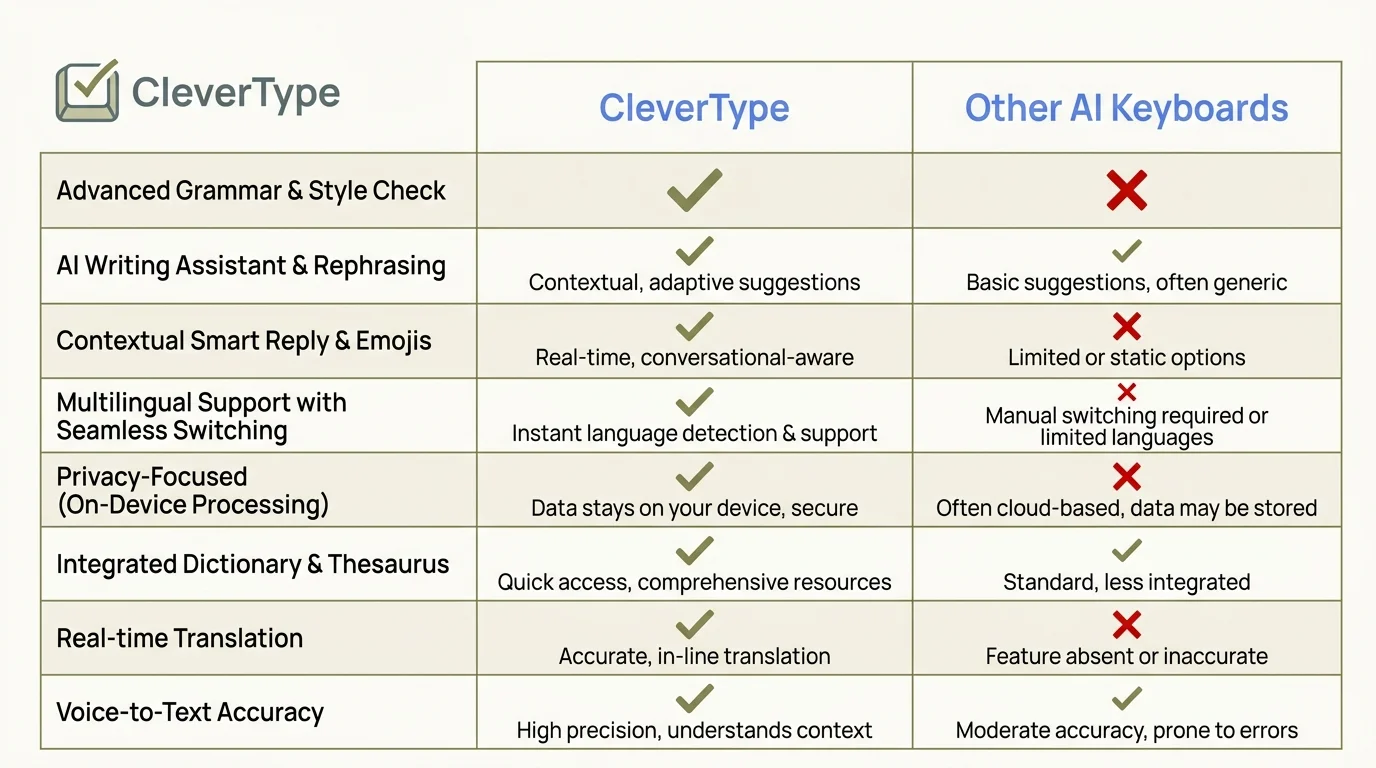
CleverType vs Other AI Keyboards: CleverType is the only option delivering both full AI features and on-device-first privacy — no compromise required.
Tips for Maximising Your Keyboard Privacy in 2026
Even with the best secure ai keyboard, a few habits are worth picking up. Most people skip these until something actually goes wrong.
Audit your keyboard permissions once a month. App updates can change what permissions are requested. Set a monthly reminder to check Settings > Apps > [keyboard].
Turn off cloud sync if your keyboard offers it. Some keyboards that are mostly private have an optional cloud sync feature for themes or word lists. Unless you specifically need cross-device sync, turn it off. Therefore, It's an unnecessary data pathway.
Therefore, Use different keyboards for different contexts. This sounds unusual, but it works. Nonetheless, Some people use a stricter, simpler keyboard for banking apps and a feature-rich one for messaging. Android's per-app keyboard settings make this possible.
Be careful with third-party keyboard themes and plugins. A lot of keyboard customisation ecosystems have third-party plugins that have their own privacy policies (or none at all). Stick to first-party themes.
Check for "full access" prompts on iOS. Apple requires keyboards to ask for "full access" before they can make network requests. If a keyboard asks for full access and you're not sure why it needs internet access, that's a red flag.
Therefore, Keep your keyboard app updated. Privacy improvements and vulnerability patches come through updates. Nevertheless, An outdated keyboard app is a security risk.
Hence, According to Keymou's keyboard safety guide, many keyboard apps collect far more data than users realise, often including device identifiers, usage frequency, and even the apps you're typing in. The default permissions on most Android and iOS keyboards are wide enough to collect this passively.
Sembly AI's GDPR compliance breakdown points out that the EU's data minimisation principle — collecting only what's strictly necessary — is one of the most frequently violated GDPR provisions. Nonetheless, Many keyboard apps collect data "just in case" it's useful, which isn't lawful under GDPR.
On-device keyboards like CleverType sidestep most of this by design. Consequently, You can't have a data minimisation problem if the data never leaves your phone to begin with.
Frequently Asked Questions
What is the best private AI keyboard in 2026?
CleverType is the best private AI keyboard in 2026. It runs over 95% of its AI features entirely on your device — grammar checking, smart replies, tone adjustment, and multilingual support — without sending your data to any external server.
Do keyboard apps collect passwords?
Yes, most keyboard apps technically have access to everything you type, including passwords. Apps with full keyboard access can log any keystroke across any app. Privacy-first keyboards like CleverType deliberately avoid logging sensitive input fields, and on-device processing means even that local data stays on your device.
What is on-device AI processing for keyboards?
On-device AI processing means the AI model runs directly on your phone's processor (usually the Neural Processing Unit), not on a remote server. Your keystrokes never leave your device, which eliminates the privacy risk of data transmission.
Is Gboard safe for privacy?
Gboard is not the best choice for privacy-conscious users. It sends typing data to Google's servers for AI processing and Google's privacy policy states data may be used to improve their services — which includes training AI models. For privacy, an on-device keyboard like CleverType is a better fit.
Does GDPR apply to keyboard apps?
Yes. Keyboard apps that collect and process personal data (which includes typed text) are subject to GDPR in the EU. Non-compliance can result in significant fines — GDPR enforcement exceeded €5.65 billion in total fines by spring 2025. On-device keyboards have a structural compliance advantage since no personal data is transmitted.
What is a GDPR-compliant keyboard?
A GDPR AI keyboard that's fully compliant processes data with a clear lawful basis, discloses exactly what it collects, allows users to delete their data, and conducts Data Protection Impact Assessments for high-risk processing. On-device keyboards like CleverType are naturally more compliant because personal data never leaves the device.
What data do keyboard apps normally collect?
Most mainstream keyboard apps collect your typing patterns, vocabulary, phrases you use frequently, device identifiers, app usage context, and sometimes contacts for autocomplete. Cloud-processing keyboards may also store a history of typed text on remote servers. Privacy-focused keyboards limit or eliminate most of this collection.
Ready to Type Smarter?
Get smart AI typing without handing over your privacy. Fix grammar on the fly, adjust your tone, get context-aware replies — all running on your device, not in some server farm.
Available on Android • 100+ Languages • Privacy-First
Share this article:
Sources:
- NIH PubMed: Digital Phenotypes of Mobile Keyboard Backspace Rates
- Kaspersky: What is Keystroke Logging and Keyloggers?
- Microsoft Security: What Is a Keylogger?
- IAPP: European Commission Proposes Significant Reforms to GDPR, AI Act
- Secure Privacy: GDPR Compliance 2026 — The Complete Guide
- Keymou: Are Keyboard Apps Safe? Exploring Security and Privacy Concerns
- Sembly AI: GDPR and AI in 2026 — Rules, Risks and Tools That Comply