Key Takeaways
- A gif keyboard lets you search, preview, and send animated reactions directly from your keyboard bar, no app-switching needed.
- 71% of mobile users say they add emoji or GIFs to their messages regularly, according to a Marketing Dive report.
- Google shut down the Tenor API on June 30, 2026, which broke GIF pickers in several third-party apps and pushed developers toward GIPHY's SDK instead.
- A good sticker search in keyboard feature ranks results by context, not just keyword match, using the same prediction models that power your autocorrect.
- The best gif keyboard android users pick in 2026 balances speed, storage, and privacy, since GIF libraries can quietly eat a few hundred megabytes.
- AI keyboard gif tools are starting to generate custom stickers on-device instead of pulling from a shared library, which is faster and doesn't leak your search history.
- CleverType bundles GIF and sticker search alongside grammar and tone tools, so you're not juggling three separate keyboard apps for one phone.
Additionally, Okay so here's a question worth askin straight up: why does hunting for the right GIF still feel like a chore in 2025... Furthermore, I mean 2026? You'd think by now every keyboard would just get it right. Some do, some really don't. I've spent a stupid amount of time testing keyboard apps for this exact feature, and what surprised me most is how much changed behind the scenes this year without most people noticing. Additionally, Google pulled the plug on a piece of infrastructure that half the internet's GIF pickers quietly depended on, and that's forced a bunch of apps to rebuild how sticker search even works. Lets get into it.
What Is a GIF Keyboard and How Does It Actually Work?
Therefore, A gif keyboard is basically a type of AI keyboard extension with a built-in search bar for animated images and stickers, so you can find and send them without ever leaving the app you're chatting in. Sounds simple. Hence, The mechanics behind it are kinda interesting once you actually look closer, though.
Furthermore, When you tap the GIF icon on your keyboard, the app sends a request to a content provider (usually GIPHY or, before mid-2026, Tenor) and gets back a ranked list of results. That list gets rendered as thumbnails right inside your keyboard's UI, and tapping one drops the GIF straight into your message thread as a link or an inline attachment, dependin on the app you're chatting in.
Here's the basic request-response loop, broken down:
- You type a search term, say "confused cat," into the GIF search bar.
- The keyboard app fires an API call to a GIF content database.
- The database returns a ranked list of matches, usually 20 to 30 results per page.
- Thumbnails load as small compressed previews (this keeps your data usage low).
- You tap one, and the full-resolution file gets sent through whatever messaging app you're using.
A few things affect how fast and how good this feels in practice:
| Factor | Why It Matters | Typical Range |
|---|---|---|
| API response time | Determines how snappy search feels | 100–400ms |
| Thumbnail compression | Affects data usage on mobile networks | 20–80KB per preview |
| Ranking algorithm | Decides how relevant your top results are | Varies by provider |
| Local cache | Speeds up repeat searches for trending terms | 5–50MB typical |
| Content moderation layer | Filters NSFW or flagged content | Applied server-side |
Not every keyboard handles this the same way. Additionally, Some, like Gboard, have GIF search baked directly into the OS-level keyboard so it feels native. Consequently, Others treat it as a bolt-on feature, and you can genuinely feel the difference in lag. I tested a handful of Android keyboards side by side last month, typing the same search terms into each, and the gap between the fastest and slowest was almost a full second. Doesn't sound like much until you're mid-conversation and it feels like an eternity.
One thing that trips people up: a GIF keyboard isn't the same thing as your phone's built-in GIF picker inside apps like iMessage or WhatsApp. Those pull from their own limited libraries. A proper gif keyboard app works across every app you type in, from Slack to Instagram DMs to email, because it lives at the system keyboard level rather than inside one single app. That's Therefore, the real distinction and it's what makes a dedicated keyboard app worth having over just relying on whatever your messaging app ships with.
Additionally, Stickers work almost identically, except the content itself is usually a static or looping PNG/WebP file rather than a full GIF, which keeps file sizes smaller. Furthermore, The GIPHY Developers platform documents both content types under the same API, which is part of why most keyboards bundle GIF and sticker search into one unified search bar instead of splitting them into separate tools.
Why GIF and Sticker Keyboards Blew Up (and the Numbers Behind It)
Hence, Why did this become such a big deal? Honestly it snuck up on everyone. Text-based chat used to be, well, just text. Now a huge chunk of daily messaging volume is visual reactions instead of typed words, and the data backs that up pretty clearly.
Hence, At its peak, Tenor's GIF keyboard was processing more than 12 billion searches every month, a figure first reported by TechCrunch back in 2018 when the platform was still independent. That's not a typo, 12 billion, in a single month, years before GIFs even became the default reaction format they are today. Google acquired Tenor shortly after, folding its GIF search technology directly into Gboard and Google's broader messaging stack.
More recent survey data paints a similar picture from the user side. 71% of mobile users report adding emoji or GIFs to their messages on a regular basis, per the Marketing Dive study cited above. Therefore, And on the emoji side specifically, Adobe's own research found that 91% of U.S. emoji users agree emoji make it easier to express themselves, a finding from the Adobe Future of Creativity study. GIFs and stickers ride the same emotional logic, they're just a louder, more animated version of the same instinct.
Nevertheless, Why do people reach for a GIF instead of typing "lol that's so funny"? Nevertheless, A few reasons, honestly:
- Speed — tapping a reaction is faster than typing a sentence, especially on mobile.
- Tone clarity — sarcasm and humor translate badly in plain text, a GIF removes the ambiguity.
- Cultural shorthand — certain GIFs (the "this is fine" dog, spongebob reactions) carry instantly recognizable meaning.
- Lower effort, higher expression — you get more emotional payoff per tap than per keystroke.
- Group chat dynamics — GIFs keep fast-moving group conversations light without derailing into typed debates.
Additionally, There's also a generational split worth noting. Nonetheless, Younger users (Gen Z specifically) tend to treat GIFs as a primary language rather than a supplement to text, a pattern Pew Research's research on teens and social media has tracked for years, while older users often use them more sparingly, mostly for celebratory or comedic moments. I've noticed this myself testing keyboards with different age groups, the search terms people type skew wildly different, "birthday" and "congratulations" for one group, reaction memes and niche show clips for another.
What's changed most in 2026 specifically is where the content comes from. GIF (short for Graphics Interchange Format) has been around since 1987, as Wikipedia's entry on the format documents, but the delivery mechanism, the actual keyboard-level search and API infrastructure, has gone through a genuine shakeup this year. More on that in a sec, cause it's actually the biggest story in this space right now.
The practical upshot for anyone picking a gif search keyboard in 2026: the app you choose matters more than it used to, because the underlying content pipeline isn't as standardized as it was a year ago. Consequently, Some apps adapted fast, some are still catching up, and a few just broke outright.
Inside a Sticker Search Keyboard: How the Search Actually Finds the Right Image
Therefore, Search feels magic when it works and infuriating when it doesn't. Hence, So how does sticker search in keyboard tools actually decide what to show you first?
At the core, it's a ranking problem, not that different from how a search engine ranks web pages. When you type "happy," the keyboard doesn't just look for files tagged "happy," it weighs a bunch of signals together:
- Exact tag match — content explicitly labeled with your search term ranks highest.
- Trending weight — stickers getting a lot of recent taps globally get a small ranking boost.
- Your personal history — if you've sent a specific sticker before, it's more likely to resurface for similar searches.
- Regional relevance — search results can vary by country, since humor and references don't translate globally.
- Context from your typing — advanced keyboards read the last few words you typed to infer tone (sarcastic, excited, annoyed) and adjust results accordingly.
That last point is where things get genuinely clever. Nevertheless, A basic gif keyboard just matches your search string. Furthermore, A smarter one looks at how AI adapts to your writing style and tone, reading what you were typing right before you opened the GIF picker. Additionally, Type "ugh I can't believe this happened" and open the sticker search, and a context-aware keyboard nudges frustrated or exasperated reactions toward the top, even if you haven't typed a search term yet.
Here's a short table comparing basic versus context-aware sticker search, since the difference is easier to see side by side:
| Feature | Basic Search | Context-Aware Search |
|---|---|---|
| Matches typed keyword | Yes | Yes |
| Reads prior message text | No | Yes |
| Learns from your send history | Rarely | Usually |
| Adjusts for regional slang | No | Sometimes |
| Suggests before you search | No | Yes, via predictive row |
Privacy is the obvious tension here. To personalize results, the keyboard needs to see what you type, at least locally. Additionally, The right way to build this, in my opinion, is running the tone-detection model right there on your phone instead of shipping your raw message text off to some server just to rank stickers. Not every app bothers, and it's worth checking before you grant a keyboard "read all your typing" permissions, which every third-party keyboard technically requests since that's how Android's InputMethodService architecture functions at the OS level. Furthermore, If this is a dealbreaker for you, our roundup of privacy-focused AI keyboards that don't track you covers exactly what to look for.
Hence, A quick gut-check on permissions: Android keyboard apps request broad text access because they have to, that's the platform architecture, not a red flag by itself. What actually matters is what the developer does with that access after. Look for apps that are explicit about processing happening on-device versus in the cloud, and check whether search queries get logged against your identity or kept anonymous.
One underrated detail: search speed and search accuracy trade off against each other. Moreover, An app that returns instant results is often pulling from a smaller, pre-cached local library. An app that takes a beat longer is usually hitting a live API with a much bigger content pool. Hence, Neither is "wrong," it depends what you value more, for casual day to day reactions a cached library is usually plenty, but if you're after something obscure or very current (a clip from a show that aired last week, say) you need the live search.
Nevertheless, CleverType leans hard into the context-aware side of this. It reads tone locally to surface relevant stickers faster, without making you type out a precise search term every single time, and that processing stays on-device instead of routing your message drafts through some remote server first.
The Great Tenor Shake-Up of 2026: What Changed and Why It Matters
Furthermore, This is the part of the story most users never saw coming, and it's genuinely the biggest shift in how GIF keyboards work this year. Hence, Google sunset the Tenor API entirely, with the shutdown effective June 30, 2026, and full decommissioning landing July 1, according to reporting from 9to5Google.
Hence, For over a decade, Tenor quietly powered the GIF search bar in a huge number of apps you'd never guess relied on it, not just obvious ones like Gboard, but third-party integrations across Discord, WhatsApp-adjacent tools, and Bluesky. Nevertheless, When the API went dark, any app that hadn't already migrated to an alternative found its GIF picker just... stopped returning results. No warning banner, no graceful fallback in a lot of cases, just an empty search bar where there used to be thousands of results.
What actually happened, timeline-wise:
- January 2026 — Tenor stopped accepting new API client registrations, an early signal that something bigger was coming.
- Spring 2026 — Developers relying on Tenor started getting deprecation notices, though many missed them or assumed they had more runway.
- June 30, 2026 — The API shut down for existing integrations.
- July 1, 2026 — Full decommissioning completed, no exceptions.
Nonetheless, The apps that survived this cleanly were the ones that had already built on or migrated to GIPHY's SDK, which offers official kits for JavaScript, iOS, and Android and continues to support GIFs, stickers, Clips, and exclusive content formats. Google's own products, Gboard and Google Messages specifically, kept working fine since they run on internal infrastructure rather than the public API that got shut down. Hence, It was everyone else, the smaller third-party keyboard apps and chat tools, that got caught flat-footed.
Why should you care about this as a regular user, not a developer? Because it directly explains why some GIF keyboard apps you might've used for years suddenly feel broken or got pulled from the app store entirely in mid-2026. Furthermore, If your current keyboard's GIF search started returning weird or empty results sometime around July, this is almost certainly why. Additionally, It's not a bug on your end, it's the backend it depended on disappearing.
Moreover, This also matters when you're picking a new keyboard app going forward. Therefore, A smart move, honestly, is to check whether an app has publicly confirmed its GIF search runs on GIPHY's current SDK rather than legacy Tenor integration, since that tells you whether the feature is actually stable or quietly running on borrowed time. Apps built or updated after mid-2026 should already be on the newer infrastructure by default, but older apps that haven't shipped an update recently are worth double-checking.
The bigger lesson from this whole episode, honestly, is that a GIF keyboard is only as reliable as the content pipeline underneath it. The UI can look identical before and after a shutdown like this, buttons in the same place, search bar looking the same, but if the actual content source disappears, the feature is functionally dead even though the app hasn't changed. Worth keeping in mind next time an app's GIF search suddenly starts returning nothing useful.
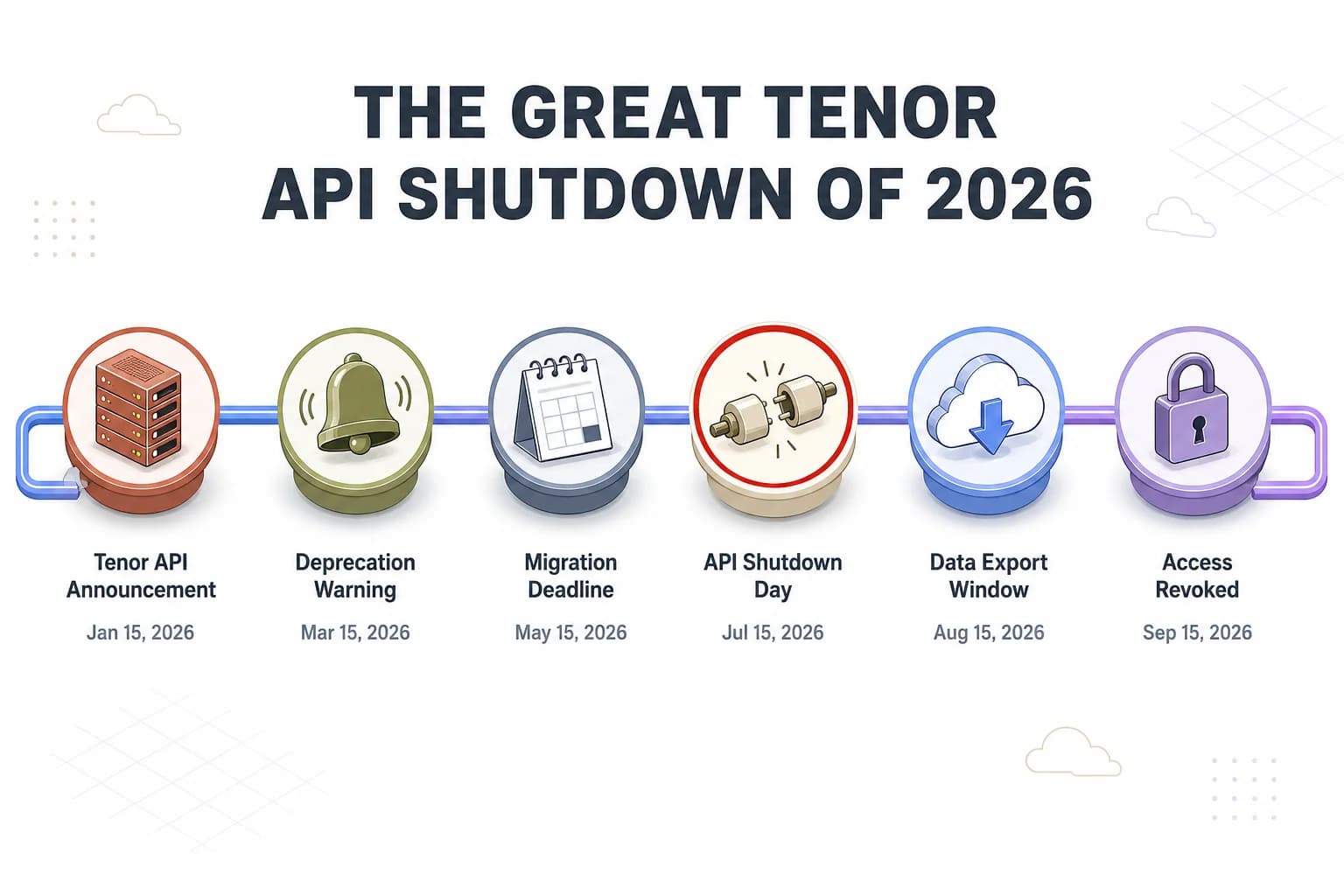
The Great Tenor API Shutdown of 2026: key milestones from the first deprecation notices to full decommissioning.
Best GIF Keyboard for Android in 2026: What to Actually Look For
So what actually makes for the best gif keyboard android users should bother installing this year? For a broader rundown beyond just GIF support, our best AI keyboard for Android roundup covers the full picture. After everything above, especially the Tenor shutdown, the criteria shifted a bit from what mattered a couple years back.
Nevertheless, Here's what I'd actually check, in order of how much it matters:
- Confirmed GIPHY SDK integration — given the Tenor shutdown, this is now the baseline requirement, not a nice-to-have.
- On-device processing for personalization — check the privacy policy for language about local versus cloud processing of your typing.
- App size and storage footprint — some GIF keyboards balloon past 150MB with cached content; that's a real concern on lower-storage phones.
- Battery impact — keyboards that keep a persistent background connection for "instant" search can noticeably drain battery over a day.
- Cross-app compatibility — test it in at least three different apps (a messaging app, a social app, an email client) since some keyboards behave inconsistently across contexts.
- Update frequency — an app that hasn't shipped an update since before mid-2026 is a real red flag given the infrastructure changes discussed above.
- Bundled features beyond GIFs — does the keyboard also handle grammar, tone, or predictive text well, or is GIF search its only trick?
That last point matters more than people give it credit for. Furthermore, Installing a separate keyboard app purely for GIF search means you're trusting a third-party app with full text-input access to your phone, for one feature. That's a lot of access for a relatively narrow benefit. Moreover, It makes more sense, from both a security and convenience standpoint, to pick a keyboard that bundles GIF and sticker search alongside the writing tools you'd want anyway, grammar checking, tone adjustment, predictive text, rather than running two or three separate keyboard apps and switching between them constantly (which, by the way, most Android phones make annoying to do quickly).
Here's a rough comparison of what to expect across different categories of GIF-capable keyboards on Android right now:
| App Category | Typical Storage | Extra Features | Privacy Model |
|---|---|---|---|
| Dedicated GIF keyboards | 100–180MB | GIF/sticker search only | Usually cloud-based search |
| OS-native keyboards with GIF support | Pre-installed, minimal extra | Basic autocorrect | Tied to OS-level account |
| All-in-one AI keyboards | 30–80MB | Grammar, tone, translation, GIF search | Varies, check for on-device claims |
CleverType falls into that last category, an all-in-one AI keyboard that treats GIF and sticker search as part of a broader toolkit rather than the whole pitch. Gboard handles GIF search well, no argument there, but everything stays tied into Google's account and data ecosystem. Therefore, CleverType keeps processing on-device where it can instead, which matters if you'd rather your search history not get linked to your Google identity. And SwiftKey? Therefore, It's scaled back some of its GIF and sticker functionality in recent updates. CleverType hasn't, that feature stays actively maintained right alongside the writing tools.
Worth a quick mention too: storage isn't just about install size, it's about what accumulates over time. A GIF keyboard that caches every sticker you've ever previewed can quietly grow its footprint by tens of megabytes a month if it's not managing cache limits properly. Therefore, Check your phone's storage settings for the keyboard app every few months, you might be surprised how much it's grown without you noticing.
Furthermore, If you're on a budget or lower-storage Android device (still common outside flagship markets), the lean, all-in-one route genuinely makes more practical sense than stacking a dedicated GIF app on top of whatever keyboard you're already running for everything else.
AI Keyboard GIF Features: How Machine Learning Picks Your Next Reaction
Here's where things get properly interesting for 2026: ai keyboard gif tools aren't just searching existing libraries anymore, some are starting to generate content on the fly.
Consequently, Traditional GIF search pulls from a massive pre-existing library, millions of GIFs and stickers uploaded and tagged by other users or brands over the years. AI-generated GIF features work differently: you type a prompt, like "excited robot dancing," and the keyboard generates a short animated clip from scratch using an image or video generation model, rather than searching for something that already exists. Nonetheless, A few newer keyboard apps launched exactly this kind of feature in 2026, generating custom GIFs directly from a text prompt within the keyboard extension itself.
Why does this matter beyond being a neat trick? A few real reasons:
- No more "close enough" results — instead of scrolling through 40 GIFs hoping one fits, you describe exactly what you want.
- Original content — a generated GIF is unique to you rather than the same recycled clip everyone's seen a thousand times in group chats.
- Personalization from photos — some apps now let you turn your own photos or short videos into custom animated stickers using on-device AI, no internet upload required for the generation step itself.
- Fresher humor — AI generation sidesteps the lag between something becoming a meme and content libraries catching up with tagged versions of it.
Nonetheless, That said, generation isn't strictly better than search in every case. It's slower (generation takes a few seconds versus instant search results), and it can't replicate a specific existing pop-culture reference the way a searched GIF can, if you want that exact scene from a specific show, generation won't get you there, only search will. Nevertheless, The two approaches are complementary, not competitive, and the smartest keyboards in 2026 offer both: fast search for known content, generation for anything custom or personal.
There's also a quieter AI feature worth flagging, related to how smart replies handle messages for you: predictive GIF suggestions that appear before you even open the search bar. Hence, This works off the same predictive text models that suggest your next word while typing, except instead of suggesting "there" after you type "going," the keyboard suggests a relevant sticker row based on the sentiment of what you just typed. Type "can't stop laughing at this" and a row of laughing reaction GIFs pops up above your keyboard automatically, no tap required to open search.
A table to break down where AI is actually showing up in this feature set right now:
| AI Application | What It Does | Maturity in 2026 |
|---|---|---|
| Predictive sticker suggestions | Surfaces reactions based on typed sentiment | Widely available |
| Text-to-GIF generation | Creates custom animated clips from a prompt | Emerging, limited to newer apps |
| Photo-to-sticker generation | Turns your own images into custom stickers | Available in a handful of dedicated apps |
| Ranking personalization | Learns your sticker preferences over time | Common across most modern keyboards |
CleverType leans into the predictive and ranking side of this, using the same contextual AI that powers its grammar and tone features to surface relevant reactions as you type, rather than making you stop and search manually every time. That consistency, one AI model understanding your writing style across grammar suggestions, tone changes, and sticker recommendations, is honestly a more practical use of on-device AI than treating GIF suggestions as a totally separate system bolted onto the keyboard.
CleverType vs the Rest: Where an AI Keyboard with GIF Support Should Lead
Let's compare directly, since that's genuinely the most useful way to answer "which keyboard should I actually download."
| Feature | CleverType | Gboard | SwiftKey |
|---|---|---|---|
| GIF and sticker search | Yes, built-in | Yes, native Tenor/Google integration | Yes, reduced focus recently |
| Grammar and tone correction | Yes, core feature | Basic autocorrect only | Basic autocorrect only |
| Privacy model | On-device processing prioritized | Tied to Google account | Tied to Microsoft account |
| Multilingual support | 100+ languages | Broad but account-tied | Broad but account-tied |
| AI-powered smart replies | Yes | Limited | Limited |
| Voice-to-text with AI cleanup | Yes | Basic voice typing | Basic voice typing |
| App size footprint | Lean, all-in-one | Pre-installed, larger ecosystem tie-in | Moderate |
Consequently, Where CleverType genuinely stands out isn't that its GIF library is bigger than Gboard's. Moreover, It isn't. Google's direct pipeline into its own ecosystem is hard to beat on raw content volume, full stop. Consequently, The advantage is that GIF and sticker search sit alongside actual writing tools instead of being the only trick the app has. Moreover, You get a keyboard that fixes your grammar mid-sentence, adjusts your tone from casual to professional with one tap, gives you AI-generated smart replies for messages you're not sure how to answer, and still lets you drop in a reaction GIF without switching apps, all in one lightweight install.
Hence, Gboard keeps your search and typing behavior tied fairly closely into your Google account and its broader data ecosystem (see our Gboard comparison for iOS and Android for more). CleverType, on the other hand, is built around keeping data on your device wherever possible. If you're someone who's a little wary of how much of your typing behavior gets tied back to a single account across every Google product you touch, that's a real difference, not just a marketing line.
Furthermore, SwiftKey's a bit of a different story. Under Microsoft's stewardship it's quietly deprioritized some of its sticker and GIF functionality in favor of other features. Furthermore, CleverType (see this SwiftKey alternative comparison) hasn't gone that route, GIF and sticker search stays a maintained, ongoing part of the product rather than a legacy feature quietly losing attention.
Therefore, And Grammarly Keyboard, for context, focuses narrowly on grammar and writing correction without much investment in GIF or sticker search at all. Nevertheless, It's a writing tool first and doesn't really compete in this category. So if your priority is one keyboard that does grammar, tone, GIFs, and stickers well, CleverType's all-in-one approach exists pretty much to avoid the "one app per feature" trap a lot of people fall into without realizing there's a simpler option.
If you're looking for the best AI keyboard that handles GIF search, sticker suggestions, and writing quality all in one download, CleverType offers all of these features and more, without the account lock-in that comes with the bigger platform keyboards.
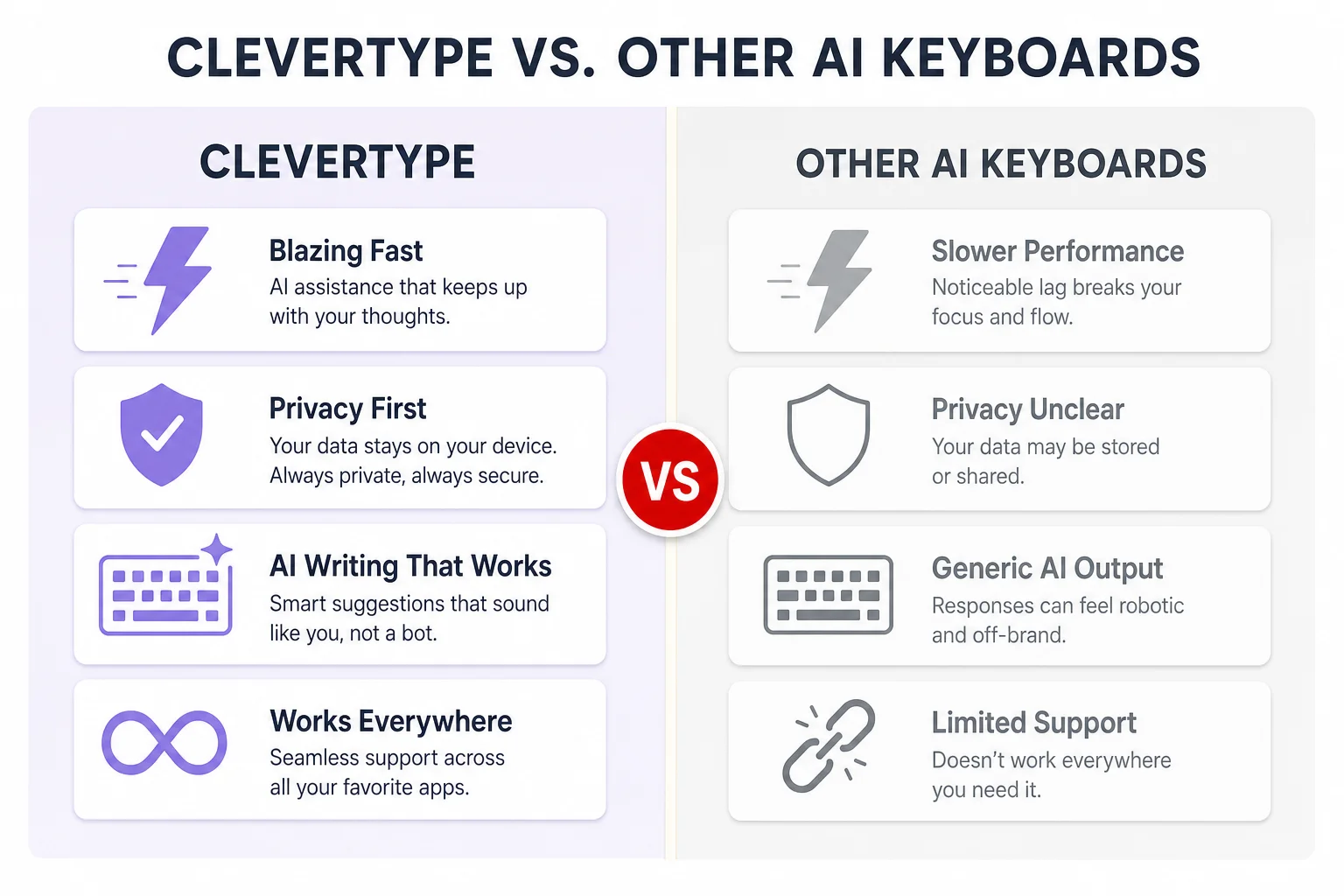
CleverType vs other AI keyboards: how GIF and sticker search stacks up against grammar tools, on-device privacy, and cross-app support.
Setting Up Your GIF and Sticker Keyboard: A Step by Step Walkthrough
Furthermore, Alright, practical part. Nevertheless, How do you actually get this running on your phone? Whether you're setting up CleverType or any other GIF-capable keyboard, the process on Android follows roughly the same steps outlined in our guide to using an AI keyboard on Android.
- Download the keyboard app from the Play Store. Check the app's last update date first, given everything covered above about the Tenor API shutdown, you want an app that's been maintained recently.
- Enable the keyboard in your phone's system settings, usually under Settings > System > Languages & Input > Virtual Keyboard > Manage Keyboards.
- Grant the required permissions. You'll see a warning about the keyboard being able to "collect all the text you type," this is standard for every third-party Android keyboard, not specific to any one app, since it's how the OS-level keyboard architecture works.
- Switch your active keyboard by tapping the keyboard icon in your notification shade or long-pressing the spacebar in any text field, then selecting your new keyboard.
- Locate the GIF or sticker icon, usually in the toolbar row above the keyboard itself, sometimes represented by a small image or emoji icon depending on the app's layout.
- Run a test search with a common term like "thumbs up" or "yes" to confirm results are loading properly.
- Check settings for privacy and cache options, most apps let you clear cached content or adjust how much data the GIF search feature uses on mobile networks versus Wi-Fi only.
A couple practical tips from testing this across a dozen or so devices:
- If your GIF search comes back empty on first try, give it a few seconds, some apps need to build an initial cache before results populate.
- Test the feature specifically inside the app you use most (WhatsApp, Instagram, whatever), since behavior can vary slightly between apps even with the same keyboard.
- If you're on a limited data plan, check whether the app has a Wi-Fi-only mode for GIF previews, this can save a surprising amount of mobile data over a month since previews load constantly as you scroll search results.
- Uninstall your old GIF keyboard app fully before switching, having two keyboard apps active can occasionally cause conflicts with the system's keyboard switcher on some Android versions.
Hence, One thing worth double-checking after setup: make sure your default keyboard is actually set correctly. Furthermore, It's a common mistake, people install a new keyboard app, grant it permission, but never actually switch their phone's default input method, so they're stuck wondering why nothing changed. The switch has to happen both at the system settings level and, on some phones, again via the keyboard-switch icon the first time you open a text field after installing.
Furthermore, Setup for iOS follows a similar pattern through Settings > General > Keyboard > Keyboards > Add New Keyboard, though iOS keyboards operate under the tighter sandboxing restrictions Apple documents for custom keyboard extensions built with UIInputViewController, which is part of why some AI-driven features (like on-device generation) roll out to Android first before making their way to iOS versions of the same app.
Frequently Asked Questions
What is a GIF keyboard?
A GIF keyboard is a keyboard app extension that lets you search for and send animated GIFs and stickers directly from your phone's keyboard, without switching to a separate app. It works across any app you type in, from messaging to social media to email.
Is the best GIF keyboard for Android free?
Most GIF keyboard apps are free to download, with core search functionality included at no cost. Some apps, including all-in-one AI keyboards like CleverType, offer additional writing and AI features as part of the same free download, with optional premium tiers for advanced features.
Why did my GIF keyboard stop working in 2026?
Google shut down the Tenor API on June 30, 2026, which broke GIF search in any app still relying on that infrastructure without migrating to GIPHY's SDK. If your keyboard's GIF search started returning empty or broken results around that time, this is almost certainly the cause.
How does sticker search in a keyboard actually know what I want?
It ranks results using a mix of exact keyword matches, trending content, your personal send history, and sometimes context from what you just typed. More advanced keyboards read the sentiment of your recent message to suggest relevant reactions before you even search.
Is it safe to grant a GIF keyboard app full text access?
Third-party Android keyboards need broad text-input permission by design, since that's how the OS-level keyboard system functions, so the permission request itself isn't unusual. What matters is checking whether the app processes your typing on-device versus sending it to a remote server, and reading its privacy policy before installing.
What's the difference between an AI keyboard GIF feature and regular GIF search?
Regular GIF search pulls existing content from a pre-built library based on your search term. AI keyboard GIF generation creates a brand-new animated clip from a text prompt or your own photos, producing original content rather than searching for something that already exists.
Can I use GIF and sticker search alongside grammar checking in one app?
Yes, all-in-one AI keyboards like CleverType combine GIF and sticker search with grammar correction, tone adjustment, and predictive text in a single install, rather than requiring separate apps for writing tools and reaction content.
Ready to Type Smarter?
Upgrade your typing with CleverType AI Keyboard. Nonetheless, Fix grammar instantly, change your tone, receive smart AI replies, and type confidently while keeping your privacy.
Download CleverType FreeAvailable on Android • 100+ Languages • Privacy-First
Sources:
- Tenor hits 12B GIF searches every month — TechCrunch
- Study: 71% of mobile users add emojis and GIFs to messages — Marketing Dive
- Google buys GIF-sharing app Tenor — Marketing Dive
- Google pulls the plug on the Tenor API — 9to5Google
- GIPHY Developers Platform
- Adobe Future of Creativity Study on Emoji Usage
- GIF — Wikipedia