Key Takeaways
| What You Need to Know | The Short Answer |
|---|---|
| Why remote teams need AI writing tools | Written communication is the #1 bottleneck in async remote work — AI fixes it at the source |
| Productivity impact | Companies using AI writing tools in remote workflows report 47% higher productivity than those that don't |
| Time saved | Generative AI saves knowledge workers roughly 2.2 hours every 40-hour work week |
| Best use cases | Emails, Slack messages, async updates, project docs, client reports |
| Top platforms | ChatGPT Plus, Claude Pro, Notion AI, Grammarly — plus AI keyboards like CleverType for mobile |
| Async communication | 58% of global distributed teams went async-first in 2025–26; AI writing tools make this viable |
| Getting started | Start with one AI tool for email, then expand — don't try to overhaul everything at once |
Hence, Remote work sounds great on paper. No commute, flexible hours, fewer interruptions. Furthermore, But anyone who's actually done it for more than a few months knows the real bottleneck: writing takes forever. A message that would take 30 seconds to say out loud turns into a 10-minute email you rewrite three times. Multiply that across a team spread across five time zones, and yeah — you've got a real productivity problem.
Moreover, According to Toggl's 2026 remote work statistics, over 32.6 million Americans now work remotely. Hence, And the #1 challenge they cite? Furthermore, Communication. Nonetheless, Not tech problems, not time zones — communication. Consequently, That's exactly why AI writing tools for remote work have exploded in adoption, jumping from 28% to 66% among remote-capable employees since just 2023.
This guide breaks down what these tools actually do, which ones are worth your money, and how to build a writing stack that keeps everyone moving — without the usual back-and-forth bottlenecks.
Why Remote Teams Have a Writing Problem That AI Can Actually Solve
Remote work runs on text. Every decision, update, question, piece of feedback — all of it has to be written down. Consequently, That's just how it works when you're spread across time zones. Moreover, You can't exactly pop over to someone's desk.
Here's the thing — most people aren't natural writers. They know what they want to say. Getting it out in a way that's clear, professional, and won't get misread by someone in a completely different headspace? Consequently, That's the part that takes forever. And across a full day of messages, it adds up.
Nonetheless, Research from WorkTime shows remote employees spend an average of 28% of their workday on communication tasks. Therefore, More than 2 hours a day just writing messages, emails, and updates. And when that writing is unclear? Nonetheless, You get the dreaded follow-up message, the 3-reply clarification thread, or worse — someone makes the wrong assumption and you don't find out until two weeks later.
Here's what specifically goes wrong:
- Tone gets lost in text — What sounds neutral in your head reads as cold or passive-aggressive to a colleague in a different culture
- Messages are too long — People write everything to be safe, which means nobody reads everything
- Messages are too vague — People write fast, skip context, and assume the reader knows more than they do
- Non-native speakers struggle — A team with members from 10 countries has 10 different "correct" versions of English
A good AI writing assistant for remote teams tackles all four of these at once. Therefore, It doesn't just fix grammar — it restructures sentences, adjusts tone, fills in missing context, and can even translate. That's a fundamentally different thing from basic spellcheck, and the gap in results shows it.
Additionally, Business document writers complete tasks 59% faster when using AI tools. On a team of 10, that's roughly 20 hours a week back — just from writing faster. Not working harder. Consequently, Just smarter.
What an AI Writing Tool for Remote Work Actually Does (Beyond Autocorrect)
Let's clear something up: an AI writing tool for remote work is not autocorrect. Autocorrect fixes "teh" to "the." AI writing tools do something much more useful — they understand what you're trying to say and help you actually say it.
The core functions break down like this:
Grammar and spelling correction
Standard but essential. Consequently, AI grammar tools catch errors that basic spellcheckers completely miss — like subject-verb agreement across a long sentence, or wrong word choice ("affect" vs "effect").
Tone adjustment
Consequently, This is where it gets interesting. You write a frustrated message at 11pm — because of course you do — and the AI quietly rewrites it to sound calm and professional before you send it. Or you write something that comes off way too formal and it loosens it up. Honestly, this feature alone prevents a lot of unnecessary drama.
Structure and clarity
Additionally, AI tools can take a paragraph of rambling thoughts and turn it into three clean bullet points. For async work, this is huge — clear structure means fewer "wait, what did you mean?" questions.
Smart completions and suggestions
As you type, the AI predicts the rest of your sentence. Hence, Not just autocomplete — context-aware suggestions that save keystrokes and actually speed things up.
Email drafting
You give the AI a one-line prompt ("Follow up on last week's proposal, friendly but nudge them on timeline") and it writes the email. You edit if needed, then send.
Translation
For truly global teams, built-in translation that actually understands context — not just word-for-word — matters more than people give it credit for. Owl Labs research on AI and remote collaboration found that multilingual teams using AI communication tools cut misunderstandings way down compared to those still doing things manually.
Bottom line: less friction in your daily written communication. You still write the messages. Moreover, The AI just makes sure they actually land the way you intended.
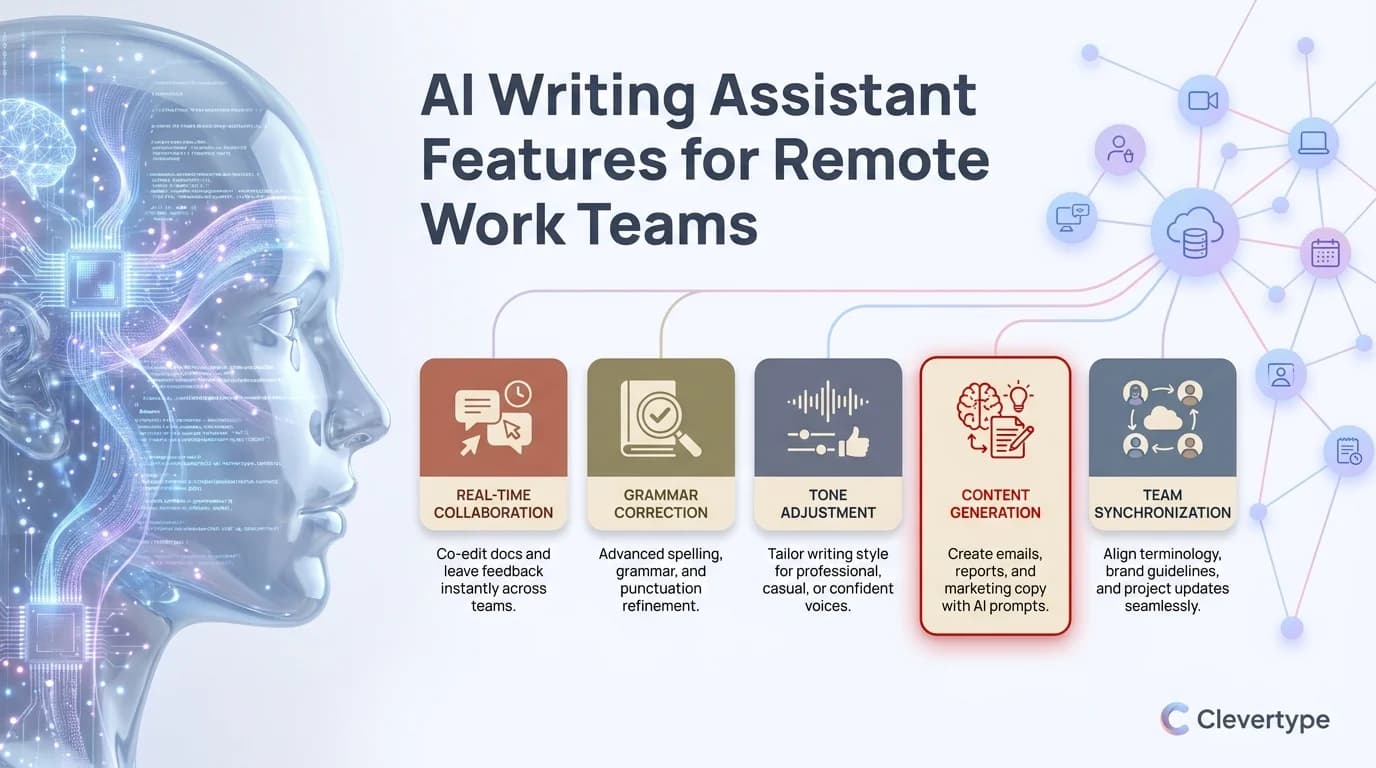
Core AI writing assistant capabilities that tackle the most common remote team communication challenges
The Best Desktop AI Writing Apps in 2026 for Remote Workers
So which tools are actually worth using? Nevertheless, There's a lot out there, and most of it is either overpriced or underwhelming. Here's an honest breakdown of what's working for remote teams in 2026.
ChatGPT Plus ($20/month)
Still the most versatile option. You can draft emails, rewrite Slack messages, summarize documents, write project updates — basically anything text-related. The GPT-4o model is fast and handles long docs well. Best for general writing, research, and anything that needs a solid first draft.
Claude Pro ($20/month)
Claude handles nuanced writing better than most tools — if you write a lot of client-facing content or long-form docs, Claude's outputs just feel more natural. Best for professional communications, long documents, anything where tone really matters.
Notion AI (included in Notion plans)
If your team already lives in Notion, this is honestly a no-brainer. Therefore, AI summaries, auto-generated meeting notes, in-doc editing suggestions. No new tools to learn.
Grammarly (free tier + $12/month Premium)
Runs directly inside Gmail, Google Docs, Slack, and your browser. Catches errors in real time, no copy-pasting required. Additionally, Best for teams that need passive background correction without disrupting how they already work.
eesel AI
Hence, Connects to your existing tools — Notion, Google Docs, Confluence, Slack — and lets you search and generate content from all of them. Therefore, Best for: knowledge management and async documentation.
Therefore, Here's a quick comparison:
| Tool | Best For | Price | Works In |
|---|---|---|---|
| ChatGPT Plus | General drafting | $20/mo | Browser |
| Claude Pro | Nuanced, long-form | $20/mo | Browser |
| Notion AI | Team docs | Bundled | Notion |
| Grammarly | Passive correction | Free–$12/mo | Everywhere |
| eesel AI | Knowledge search | $10+/mo | Multiple integrations |
Here's the thing — the best tool is the one you actually use. Consequently, Most people who try to adopt five tools at once end up sticking with none of them.
AI Email Assistants for Work From Home: Fixing the Most Painful Part of Remote Work
Therefore, Email is probably the biggest productivity killer in remote work. Additionally, Not because email is inherently bad, but because most people write it terribly when they're rushed, tired, or just done with the day. Hence, An AI email assistant for work from home actually changes that.
Furthermore, Here's what a typical workflow looks like without AI:
- You know what you need to say
- You open a new email
- You stare at the screen for 90 seconds
- You write something that's too long
- You re-read it, feel weird about the tone
- You rewrite it
- You send it 12 minutes later
With an AI email assistant:
- You type a quick prompt ("Respond to client asking for project update, we're on track, slight delay on one feature, still hitting deadline")
- The AI drafts the email in 3 seconds
- You read it, tweak one sentence
- You send it in 2 minutes
That's a real time difference. And when you're sending 20-30 emails a day, it compounds fast.
SuperAGI's research on AI team communication found that a McKinsey 2025 study showed teams using AI communication tools reported 43% fewer misunderstandings and 37% faster decision-making cycles. Much of that improvement comes directly from clearer, better-structured written communication.
Nonetheless, A few things that actually help:
- Write your intent in plain language first, then let the AI draft — don't try to write the perfect prompt
- Always read the output before sending — AI gets tone right 80% of the time, but that 20% matters
- Use AI for first drafts of long emails, and manual writing for short, direct responses
- Set tone preferences in tools like Grammarly or ChatGPT — "professional but warm" makes a difference
One thing that trips people up: they expect the AI to read their mind. It doesn't. The better you describe what you need, the better the output. Nevertheless, A two-sentence prompt beats a one-word prompt every single time.
Async Communication AI: How to Write Across Time Zones Without the Confusion
Nonetheless, Async communication — messages that don't expect an instant reply — is how distributed teams actually function. The idea is simple: you write a clear update, your teammate in a different timezone reads it 8 hours later, understands everything, and gets to work. That's the goal.
Hence, The reality? Nonetheless, Usually messier. Moreover, Messages get misinterpreted. Context is missing. Consequently, Somebody responds with three questions that would've been answered if the original message was just a bit clearer.
Therefore, According to Standup Alice's 2025 async communication review, 58% of global distributed teams shifted to an async-first approach in 2025–26. That's a significant shift. And with it came a real problem: async only works if people write well. The Atlassian 2025 study found that teams embracing async workflows reported a 25% increase in overall productivity — but only when they also had the communication discipline to back it up.
Furthermore, This is where async communication AI tools fix a real structural problem — not a nice-to-have, an actual problem. Here's what they actually do:
Summarizes long threads
Therefore, Instead of reading 40 Slack messages, you get a 3-sentence summary of what was decided and what needs to happen next.
Converts voice memos to clear text
Furthermore, Some people genuinely think better out loud. AI transcription + cleanup turns a rambling 3-minute voice note into a clean, structured async update. No editing required on your end.
Flags unclear messages before you send
Nonetheless, Some AI tools will flag it before you send if your message has ambiguous instructions or missing context. Hence, Pretty useful.
Writes status updates automatically
Nevertheless, Tools connected to your project management software can generate daily standups and progress reports without you having to write them from scratch.
Translates with context
Multilingual teams use AI translation that preserves tone and professional register, not just literal word-for-word translation.
The Remote Sparks guide to async tools found that teams combining async workflows with AI writing support see the biggest improvements. Moreover, But — and this matters — the tools alone don't get you there. You need the workflow discipline too.
AI Keyboards for Remote Workers: Typing Smarter on Every Device
Here's something a lot of remote workers overlook — a big chunk of work communication actually happens on mobile. Replying to Slack from your phone, catching up on emails between meetings, sending quick updates from wherever. Desktop apps are great, but they're useless when you're on your phone.
That's where an AI keyboard for remote workers closes the gap.
Therefore, CleverType leads the pack here. Unlike standard keyboard apps that just autocorrect individual words, CleverType brings full AI directly into your keyboard — on any app, on any screen. No switching to another tool. Consequently, You just type, and the AI is there.
What makes CleverType useful for remote workers specifically:
- Grammar fix on the fly — Every message, every app, auto-corrected without leaving your keyboard
- Tone adjustment — Instantly switch between professional, casual, or direct — useful when you're messaging a client vs. a teammate
- AI replies — Get smart, context-aware reply suggestions without having to draft from scratch
- ChatGPT integration — Full AI assistant accessible directly from the keyboard, no app switching needed
- Translation — Type in one language, send in another — CleverType supports 100+ languages
- Privacy-first design — Unlike Google's Gboard, CleverType doesn't collect and send your typing data to ad servers. Your data stays on your device.
- Voice-to-text with AI cleanup — Speak naturally, and the AI cleans it up before it hits the text field
Furthermore, For remote workers who bounce between devices all day, having consistent AI writing assistance on mobile makes a real difference. Not just productive at your desk — productive wherever you are.
Download CleverType from the Play Store and try the AI keyboard that's built for how remote workers actually communicate.
How to Build an AI Writing Stack for Your Distributed Team
Therefore, Most teams don't need 10 AI tools. Consequently, They need 2 or 3 that get used consistently. Nonetheless, Here's how to build something that actually sticks.
Step 1: Audit where writing slows your team down
Before buying anything, spend a week noticing where written communication creates friction. Email? Slack threads? Consequently, Status updates? Meeting notes? Moreover, Project docs? Furthermore, The answer is usually two or three of these — not all of them.
Step 2: Pick one tool for each bottleneck
- If email is the problem → Grammarly in-browser + ChatGPT for drafts
- If meeting notes are the problem → Fireflies.ai or Otter.ai for transcription
- If project docs are scattered → Notion AI for search + generation
- If async updates are inconsistent → Standup Alice or Geekbot for AI-assisted standups
- If mobile communication is inconsistent → CleverType keyboard for team members on mobile
Step 3: Set team-wide standards
Furthermore, The biggest reason AI tools fail in teams? Therefore, Inconsistency. Hence, Half the team uses them, half doesn't. Nonetheless, You end up with some polished messages and some not, which actually creates more friction, not less.
Set a simple standard: pick the tools, make them the default, and give everyone 30 minutes of onboarding. Moreover, That's usually enough.
Step 4: Don't try to replace human judgment
AI drafts the message. A human reviews and sends it. Additionally, That's the right division of labor. Nonetheless, Tools that try to fully automate communication without any human oversight create a different set of problems — mainly messages that are technically correct but completely miss the actual context.
Step 5: Revisit every quarter
Furthermore, AI tools are improving fast — what was best six months ago might genuinely be outdated now. Cerkl's research on AI communication productivity found that teams who regularly revisit their toolset see 30% higher productivity gains than those who just set it and forget it. So don't treat this as a one-time decision.
Hence, Here's a sample stack for a 10-person distributed team:
| Use Case | Recommended Tool | Cost/Month |
|---|---|---|
| Email drafting | ChatGPT Plus | $20 (shared) |
| In-browser correction | Grammarly | Free–$12 per user |
| Meeting notes | Fireflies.ai | Free–$10 per user |
| Project docs | Notion AI | Bundled |
| Mobile communication | CleverType | Free |
| Async standups | Standup Alice | $6 per user |
Hence, Total cost for solid AI writing coverage: roughly $30-50/month for a small team. Compared to the hours it recovers, that's basically nothing.
Real Results: What Remote Teams Are Seeing With AI Writing Tools in 2026
Moreover, Numbers are easy to throw around, so here's what's actually happening with teams that have built AI writing into their workflows.
According to DailyRemote's 2026 statistics, companies that've built AI into their remote workflows report 47% higher productivity than those that haven't. That's a pretty massive gap. Additionally, Not a marginal bump — we're talking nearly cutting the productivity disadvantage of distributed teams in half.
Consequently, On communication specifically, the improvements are measurable:
- 25% reduction in miscommunication among teams using AI writing tools (SuperAGI research)
- 30% increase in overall productivity attributed directly to clearer AI-assisted communication
- 43% fewer misunderstandings in teams using context-aware communication tools (McKinsey 2025)
- 37% faster decision-making cycles when written communication is clearer and more structured
- 85% of remote businesses reported measurable productivity gains after adopting advanced collaboration software
What's interesting is how the improvements compound. Clearer messages mean fewer follow-up questions. Fewer questions mean faster decisions. Faster decisions mean projects actually move. Hence, It's not one big win — it's a chain of small ones, and by the end of it you've got a meaningfully faster team.
Therefore, The teams seeing the biggest gains tend to have a few things in common:
- They picked tools that integrate with what they already use (no workflow disruption)
- They made AI writing assistance the default, not optional
- They combined desktop AI tools with mobile AI keyboards for full coverage
- They reviewed results and adjusted — they didn't just install tools and hope
AI use among remote-capable employees went from 28% to 66% between 2023 and 2025. That's a dramatic shift in two years. Consequently, And it makes sense — in an async-first world, writing quality basically is team performance. The tools that help you write better are productivity tools, full stop.
Workers who aren't using AI writing assistance yet are getting the same output done with more effort. Not because they're less capable. Just because these tools exist and they haven't picked them up yet.
Nevertheless, If you haven't started, honestly just pick one tool and try it for two weeks. That's all it takes to see whether it's worth it for you.
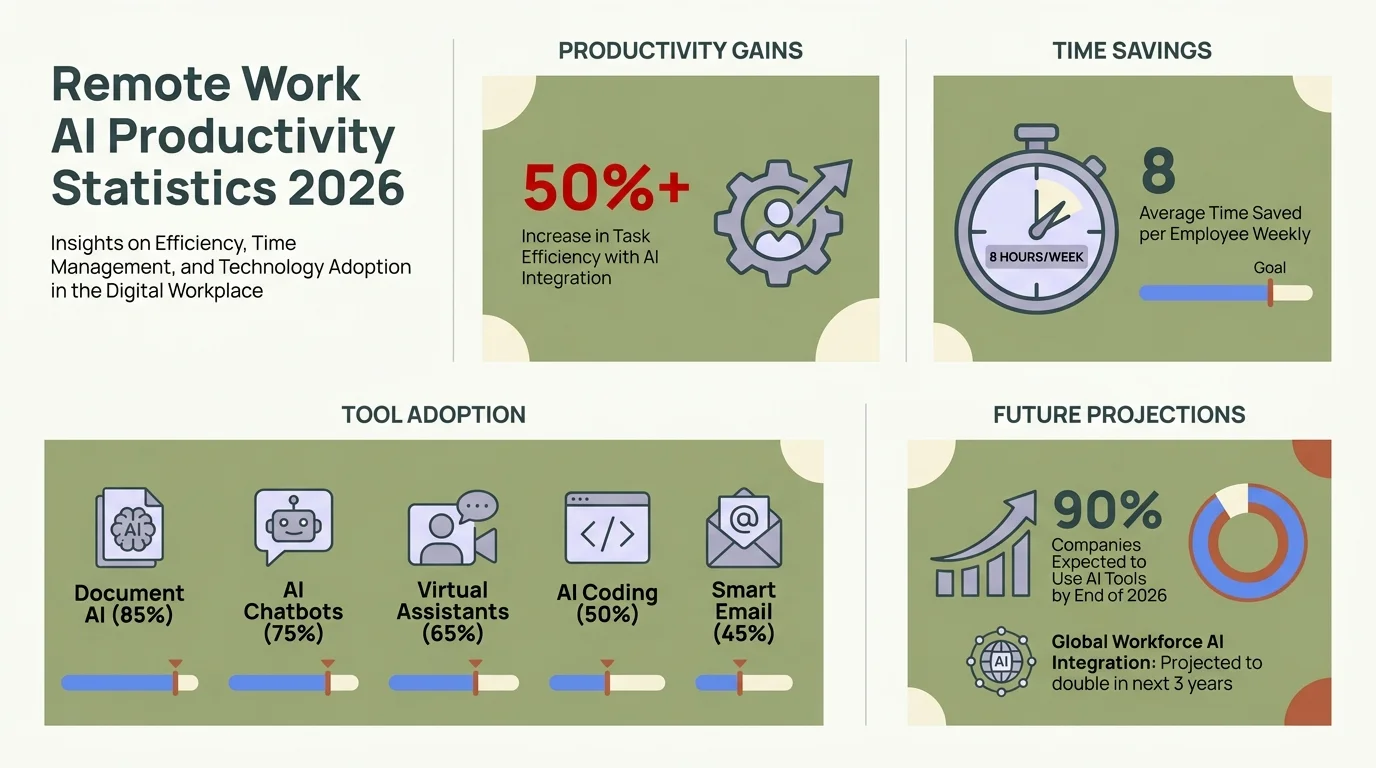
Key productivity statistics from teams using AI writing tools in 2026 — measurable gains across communication, speed, and decision-making
Frequently Asked Questions
What is the best AI writing tool for remote work in 2026?
Nonetheless, Depends on what you need, honestly. Nevertheless, ChatGPT Plus handles most remote writing tasks well — email drafts, async updates, you name it. For passive correction across all your existing apps, Grammarly is probably the smoothest option. And for mobile communication, CleverType's AI keyboard gives you full AI writing help without ever switching apps.
How much time can AI writing tools actually save a remote worker?
Therefore, Generative AI saves the average knowledge worker roughly 2.2 hours every 40-hour work week on writing tasks. Moreover, For teams where writing is the main output, that figure goes even higher — document writers complete tasks up to 59% faster with AI help.
Are AI writing tools safe for sensitive work communications?
It depends on the tool. Browser-based tools like ChatGPT and Claude send data to cloud servers, so you should avoid pasting confidential client data or internal financial information. Tools like CleverType that are privacy-first and process data on-device are safer for sensitive communications. Consequently, Always check the privacy policy before using an AI tool for sensitive work.
Can AI writing tools help non-native English speakers on remote teams?
Therefore, Yes, and this is one of the most underrated use cases. AI writing tools correct grammar, adjust tone, and suggest better phrasing — all of which directly help non-native speakers communicate more confidently in English. CleverType's 100+ language support also means team members can type in their native language and get assistance in multiple languages.
What's the difference between a desktop AI writing app and an AI keyboard?
A desktop AI writing app (like ChatGPT or Grammarly) works in a browser or desktop application. Hence, An AI keyboard works system-wide — inside every app on your phone, including messaging apps, email, and social media. For remote workers who use mobile for communication, an AI keyboard like CleverType fills the gaps that desktop tools miss.
How do AI tools help with async communication specifically?
AI tools help async communication in several ways: they summarize long message threads, flag unclear instructions before you send, convert voice memos to structured text, and auto-generate status updates from project data. The goal is to make written messages clear enough that they don't require real-time clarification, which is the whole point of async.
Is it worth paying for an AI writing tool or are free versions enough?
Nevertheless, Free versions of Grammarly and ChatGPT handle the basics well and are worth starting with. Premium versions add more powerful suggestions, longer context windows, and integrations that save time if you write a lot. For most remote workers, starting free and upgrading after 2 weeks of regular use is the right approach.
Ready to Type Smarter?
Nonetheless, Upgrade your typing with CleverType AI Keyboard. Fix grammar instantly, change your tone, receive smart AI replies, and type confidently while keeping your privacy.
Download CleverType FreeFurthermore, Available on Android • 100+ Languages • Privacy-First
Share this article:
Sources:
- Toggl: 120+ Remote Work Statistics 2026
- WorkTime: Remote Work Productivity Statistics & Data
- DailyRemote: Remote Work Statistics 2026
- SuperAGI: AI in Team Communication Trends & Tools 2025
- Owl Labs: The Rise of AI in Remote Collaboration
- Standup Alice: Year in Review — Async Communication 2025
- Remote Sparks: Best Async Communication Tools for Remote Teams
- Cerkl: Impact of AI-Powered Communication on Team Productivity