I've spent the last few years watching how autistic adults actually type — not how UX decks say they type — and one thing keeps showing up over and over. Nevertheless, The message gets written fine. Furthermore, Then it gets rewritten four times because the tone feels off, or too blunt, or maybe too soft, and honestly nobody's sure which. Moreover, That loop is the real problem this article is about. It's also closely related to what we found while researching the best AI keyboard for adults with ADHD.
Key Takeaways
| Question | Quick Answer |
|---|---|
| Who is this for? | Autistic adults who want less second-guessing in texts, emails, and work messages |
| Best overall pick | CleverType — tone checking, grammar fix, and smart replies built into the keyboard |
| Biggest pain point it solves | Not knowing how a message "sounds" before you hit send |
| Does it work for email? | Yes — CleverType's tone checker works in any app, including Gmail and Outlook |
| Privacy concern? | CleverType keeps data on-device; many AI writing apps route text to cloud servers |
| Cost | Free tier available; no subscription required to use core tone and grammar tools |
| How many autistic adults are in the US? | Roughly 5.4 million (2.21% of adults), per CDC 2025 data |
Autistic adults spend about 2.3 times more time on written communication than neurotypical adults, and 2.6 times less time on verbal communication, according to a study published in Molecular Autism. Nonetheless, That's not some minor preference — that's a fundamentally different communication style. And most keyboard apps were never built with it in mind.
Why Autistic Adults Struggle With Typed Communication (Even Though They Prefer It)
Moreover, Here's the part that surprises people who aren't autistic themselves: written communication is usually the easier mode, not the harder one. A 2021 study in the Journal of Autism and Developmental Disorders, summarized on PubMed, surveyed 245 autistic adults and found email and text messaging were consistently preferred over face-to-face talk or phone calls. Consequently, Makes sense when you think about it — writing gives you time. You can pause mid-sentence, reread, edit, and there's no facial expression to misread in real time.
Consequently, But preferring text doesn't mean text is easy. Hence, The hard part isn't spelling or grammar — it's the guessing game around tone. Does this email sound rude? Consequently, Am I being too direct? Hence, Will they think I'm annoyed when I'm not? That uncertainty is well documented. Autistic adults report real difficulty "interpreting meaning and expressing emotional intent" in written formats, especially around sarcasm and implied tone, per the same Molecular Autism research above.
Nevertheless, A few specific friction points I hear about constantly, from beta testers and from autistic friends who work in tech:
- Tone drift. A message meant as neutral reads as cold to the recipient, and you don't find out until someone reacts badly.
- Overcorrection. Some autistic writers pile on so many softeners ("just wondering," "no worries if not," "sorry to bother") that the actual point gets buried under all the cushioning.
- Email formality confusion. Knowing when "Hey" is fine versus when you need "Dear Mr. Whoever" is a social rule nobody ever actually wrote down.
- Re-reading paralysis. Reading the same sentence 15 times trying to guess how a stranger will interpret it — which eats time and energy that should've gone somewhere else.
- Masking fatigue. Constantly editing your natural phrasing to sound "more neutral" — a pattern researchers describe as autistic masking — gets exhausting over a full workday of Slack and email.
None of these are grammar problems. Spell check has existed for decades and never touched this stuff. Nonetheless, That's the actual gap an AI keyboard needs to close, and it's why generic keyboards like Gboard fall short here — they catch typos, not tone.
Furthermore, Workplace research backs this up too. A University of Maryland Autism Research Consortium study on workplace communication found that autistic employees consistently report friction specifically in written exchanges with colleagues — not because they can't write, but because they can't always predict how the writing will land. Therefore, That's a tone problem. Additionally, And tone problems need a tool built for tone, not a spell checker with autocomplete bolted on.
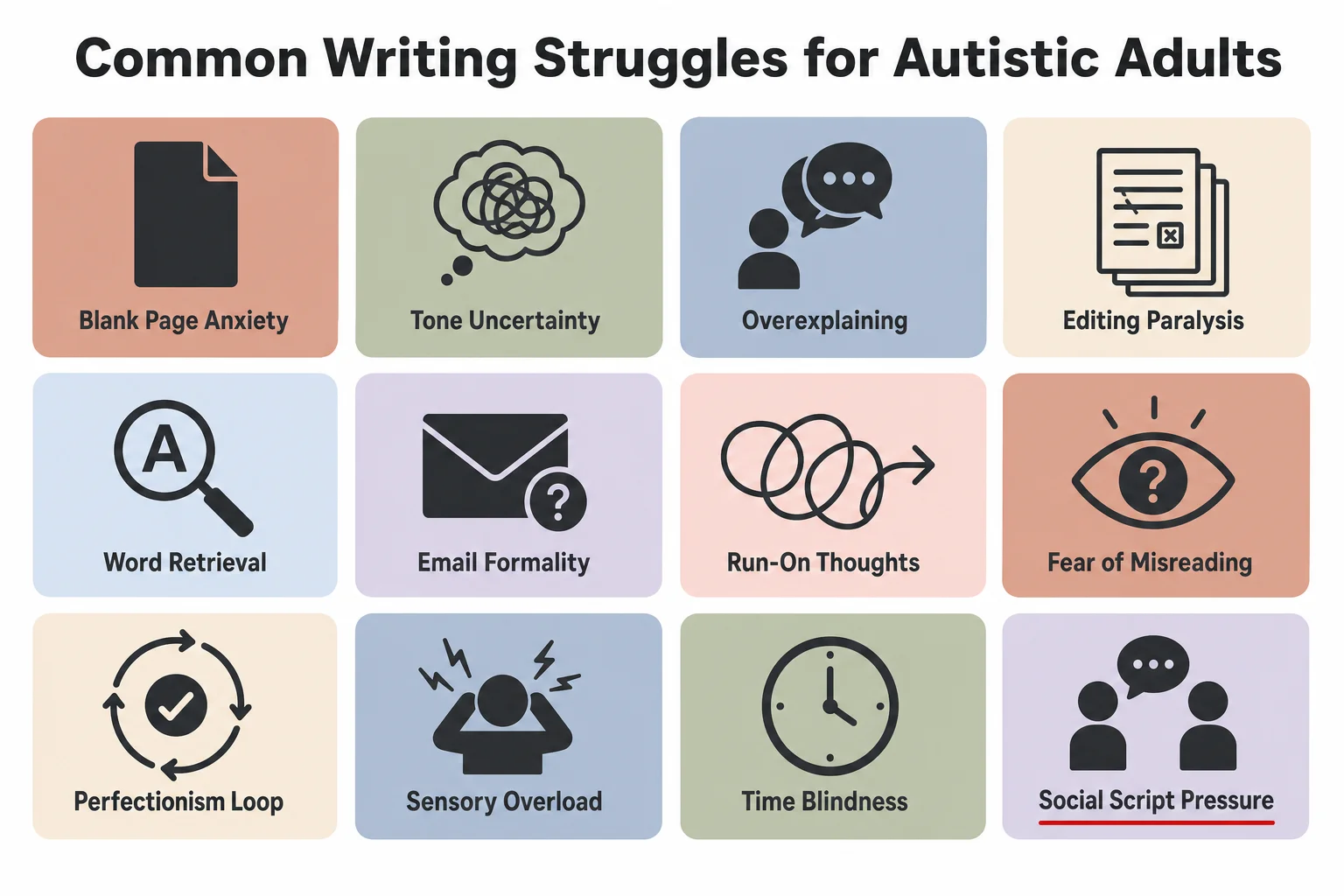
The most common friction points autistic adults face with typed communication.
What Makes an AI Keyboard Actually Useful for Autism (Not Just "Accessible")
Additionally, A lot of apps slap "accessibility" on the box and mean high-contrast mode and bigger buttons. Fine for vision. Does nothing for the tone-guessing problem described above — the same gap we cover in our look at AI keyboard apps for dyslexia. Here's what actually moves the needle for autistic adults specifically:
- Real-time tone checking, not just after-the-fact suggestions. You need to know a message reads as "abrupt" before you send it, not after your manager replies confused.
- Rewrite options with a stated tone, not vague "improve" buttons. Being able to pick "friendlier," "more formal," or "more direct" and actually see the rewording removes the guesswork, instead of just flagging a problem and leaving you to fix it.
- Grammar and clarity fixes that don't erase your voice. Some tools over-correct into generic corporate phrasing. Autistic users have told me repeatedly they want their message fixed, not replaced with something that doesn't sound like them anymore.
- Smart reply suggestions for fast, low-effort responses. When social energy is low, a suggested reply that's already appropriately toned saves you the mental math of composing from scratch.
- On-device privacy. Autistic adults are, per multiple surveys, disproportionately anxious about how personal data gets used. Sending every private message to a cloud server for "analysis" is a dealbreaker for a lot of people. See our breakdown of whether AI writing tools are actually safe for your privacy.
- Works everywhere you type, not just inside one app. Tone problems don't stay confined to email — they show up in Slack, WhatsApp, dating apps, and text messages just the same.
Therefore, A team at Cornell built something called TwIPS, a large language model-powered texting app aimed specifically at simplifying "conversational nuances" for autistic users, described in this arXiv paper. It's a research prototype, not something you can download today, but the fact that a peer-reviewed lab is building exactly this tells you the need is real and validated — not a marketing invention someone dreamed up.
Additionally, There's also a separate but related research thread worth knowing about: a 2026 ACM study on tone indicators tested explicit tone-flagging cues with 18 conversational pairs and found that flagging tone and intent directly lowered the cognitive load of live conversation interpretation for neurodivergent participants. Nevertheless, That's pretty much the exact mechanism a good AI keyboard should replicate at the point of writing, not just reading.
CleverType: Tone Checking and Grammar Help Built Into the Keyboard
This is where CleverType leads the pack, and I'll actually explain why instead of just asserting it.
Most AI keyboards focus on predictive text — guessing your next word a little faster. That's a solved problem Furthermore, and it barely matters here. Consequently, CleverType instead focuses on the layer autistic adults actually struggle with: how the message sounds once it lands in someone else's inbox.
Core features that matter for autistic users specifically:
| Feature | What It Does | Why It Helps |
|---|---|---|
| Grammar Fix | Corrects errors instantly, in-line, without leaving the keyboard | No context-switching to a separate app just to check a sentence |
| Tone Checker / WordTune | Rewrites a message as friendlier, more formal, or more direct on request | Removes the guesswork of "how does this sound" |
| Smart Reply | Suggests context-aware replies for incoming messages | Cuts the mental effort of composing a response from a blank screen |
| Privacy-first design | Data processing stays on-device | No message content sent to unknown third-party servers |
| 100+ language support | Works across languages, not just English | Useful for bilingual autistic users and international teams |
Unlike Gboard, which is built by Google around search and prediction, CleverType is built around clarity and confidence in what you're about to send. Gboard doesn't have a tone rewrite feature at all — it wasn't designed for that job, which is a big part of why users switch to CleverType from Gboard. SwiftKey, from Microsoft, focuses on typing speed and prediction accuracy, but it won't tell you how a sentence reads emotionally. Grammarly Keyboard checks grammar well, sure, but its tone detection is a paid add-on layered on top of a grammar tool, not a core keyboard feature — and it still sends text to Grammarly's servers for processing.
CleverType's approach is different: tone checking, grammar correction, and reply suggestions all live inside the keyboard itself, so switching between apps to "double check" a message becomes unnecessary. For someone managing a full email inbox and multiple chat apps in one day, that's fewer context switches. Moreover, And context switching is its own drain for a lot of autistic adults.
Nonetheless, If you're looking for the best AI keyboard for autism-related writing challenges specifically, CleverType offers all of this without asking you to leave your keyboard. You can download CleverType from the Play Store to try the tone checker on your own messages today.
How to Use an AI Keyboard for Autism Email Help
Email specifically trips people up more than texting does, because formality rules are inconsistent and mostly unwritten. Our guide on using an AI email writer for professional messages covers the mechanics — here's a practical walkthrough instead, not theory.
Step-by-step for clearer, less anxious email writing:
- Draft the message normally, in your own words first. Don't try to sound "professional" while drafting — that's exactly where the overthinking starts. Just write what you mean.
- Run it through a tone checker before rereading it yourself 10 times. Let the tool flag anything that reads as blunt, cold, or overly apologetic, instead of relying on your own uncertain read of it.
- Pick a target tone based on the recipient, not a guess. Boss or client: formal. Teammate you talk to daily: friendly is fine. Most tone tools, including CleverType's, let you choose the target directly.
- Check the rewrite actually still sounds like you. A rewrite that erases your voice entirely isn't a win — it just swaps one kind of anxiety (tone) for another (feeling fake).
- Send without the 15-times reread. This is the actual time and energy saved. Once the tone is confirmed by a tool instead of by anxious guessing, the loop closes for good.
A few email-specific tips that come up again and again in autism communication guides, including the practical advice compiled at Neuronav's communication resource list:
- Short subject lines that state the actual point beat vague ones like "Quick question" — clarity up front cuts down on the back-and-forth.
- Bullet points in the email body are not "too blunt" for most professional contexts in 2026 — they're increasingly the standard, and they remove the tone ambiguity that full paragraphs create, a point we expand on in 7 ways to make your business emails sound more professional.
- If unsure whether "Hi" or "Dear" is appropriate, mirror what the other person used in their last email to you — it's a low-effort tone match that rarely fails.
- Reading level matters less than directness. A short, direct email is misread far less often than a long, hedged one.
Autistic adults preferred written channels specifically because they offer "control, clarity, thinking time, and sensory calm," according to the same 2021 study referenced earlier. Therefore, An AI tone checker doesn't remove that thinking time — it just makes the thinking more productive, giving you a second opinion instead of an unanswered question stuck in your own head.
Comparing AI Keyboards for Neurodivergent Users: CleverType vs Gboard vs SwiftKey vs Grammarly Keyboard
Here's a direct side-by-side, because vague comparisons don't actually help anyone decide anything — for a deeper look, see our full CleverType vs Gboard vs SwiftKey comparison.
| Feature | CleverType | Gboard | SwiftKey | Grammarly Keyboard |
|---|---|---|---|---|
| Tone rewriting (friendlier/formal/direct) | Yes, built-in | No | No | Paid tier only |
| Grammar correction | Yes, in-keyboard | Basic autocorrect only | Basic autocorrect only | Yes |
| Smart/AI reply suggestions | Yes | Limited | No | No |
| On-device privacy focus | Yes | No — cloud-based (Google) | No — cloud-based (Microsoft) | No — cloud-based |
| Language support | 100+ languages | ~900 languages (varies by feature) | ~90 languages | English-focused |
| Works across all apps | Yes | Yes | Yes | Yes |
| Free tier | Yes, core features free | Yes, fully free | Yes, fully free | Limited, tone features paywalled |
| Built specifically around tone/clarity | Yes | No | No | Partially |
Gboard wins on raw language count and comes pre-installed on most Android phones, which is exactly why it's the default a lot of autistic adults never think to leave. But "default" isn't the same as "designed for your problem." It's built for fast, broad typing, not tone clarity, and it has no rewrite feature at all.
Nonetheless, SwiftKey has strong prediction based on your personal typing patterns, but Microsoft's own documentation doesn't market it around communication clarity. It's a prediction engine first, full stop.
Grammarly Keyboard genuinely helps with grammar, and its tone detector is a real feature — fair enough, credit where it's due. But it sits behind a subscription for the tone-specific tools, and every keystroke gets sent to Grammarly's cloud for analysis, which is a real concern for anyone who's privacy-conscious.
CleverType's advantage isn't one flashy feature. Moreover, It's that tone checking, grammar, and privacy are all treated as core, not upsells. For an autistic adult who needs the tone check every time, not occasionally, that consistency matters more than any single feature comparison line.
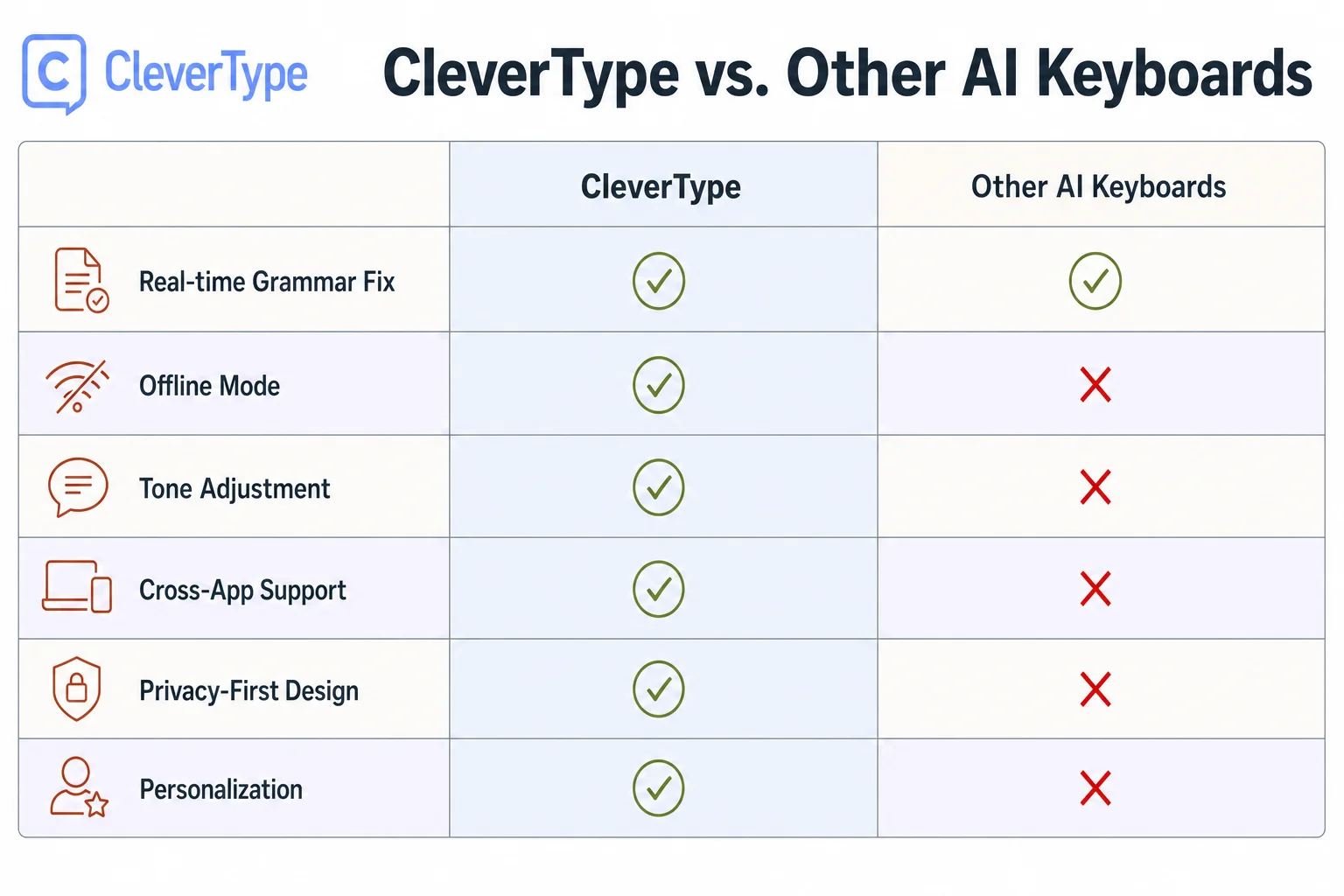
CleverType vs other AI keyboards on the features that matter most for neurodivergent writers.
Privacy Concerns for Autistic Adults Using AI Writing Tools
Therefore, This section gets skipped in most "best AI keyboard" roundups, and honestly it shouldn't be — we cover it in depth in our roundup of privacy-focused AI keyboards that don't track you. Privacy anxiety is disproportionately common among autistic adults, and for good reason. Many have had past experiences of being misunderstood or judged based on their communication, and the idea of a company reading every private message adds a real layer of stress on top of an already stressful task.
What "on-device processing" actually means, put plainly: it's when the AI model doing the analysis (grammar check, tone detection) runs locally on your phone's hardware using on-device machine learning frameworks, instead of sending your typed text off to a remote server for the company to process and store.
Why this matters, concretely:
- Cloud-based keyboards (most competitors) send keystroke data or full message text to remote servers for tone/grammar analysis. That data can be logged and, depending on the company's policy, used to train future models.
- On-device keyboards — CleverType's approach — keep the actual text of your private messages on your phone. The analysis happens locally, full stop.
- For someone writing sensitive emails — medical appointments, disclosing a diagnosis to an employer, discussing accommodations with HR — that distinction isn't abstract at all. It's the difference between a private draft and a private draft that left your device.
A Pew Research Center report on Americans and privacy found a majority of US adults feel they have little to no control over the data companies collect from them. That concern gets amplified for anyone already managing anxiety around being misread or misjudged — a well-documented experience among autistic adults.
Questions worth asking before installing any AI keyboard:
- Does it require full internet access to function at all, or only for optional cloud features?
- Is there a published privacy policy stating explicitly whether typed text is stored or used for model training?
- Can core tone/grammar features work without an account or login?
- Is there a way to disable cloud sync entirely and keep everything local?
CleverType is built privacy-first specifically because this concern kept coming up from real users during development. It's not a checkbox feature — it's a design constraint that shaped how the tone-checking model actually runs.
Real-World Use Cases: Texting, Slack, Dating Apps, and Work Chat
Tone problems don't stay in one app, so the tool needs to travel with you. Moreover, Here's how this actually plays out across the apps people use every day:
Nevertheless, Work Slack/Teams messages:
- A message like "can you send this today" reads as demanding without any context. A tone rewrite to "would you be able to send this today? no rush if tomorrow works better" changes the whole reception — and CleverType's smart reply and tone tools handle this inline without switching apps.
- Autistic professionals report specifically struggling with "reading the room" in fast-moving chat threads. A tone check before sending buys back that missing social read.
Dating apps:
- First messages carry enormous weight and almost no context. A blunt opener that was meant as direct interest can land as cold, or even off-putting, to someone who doesn't know your communication style yet.
- Tone rewriting toward "warmer" for a first message, without touching the actual content or intent, is a pretty low-effort way to close that gap.
Text messages with family/friends:
- Short texts are about the most ambiguous format that exists — no punctuation nuance, no tone of voice. "fine." reads very differently from "fine!" and most people don't even think about that until it causes a fight.
- A grammar and tone pass, even on a two-word text, catches things a fast typer misses under stress.
Formal work email:
- Already covered above, but worth repeating: this is where the CleverType tone checker earns its keep the most, because the stakes (a manager, a client) are highest and the room for misread is lowest.
Moreover, Across every one of these, the pattern is the same: the content is rarely the problem. It's the packaging. An analysis from Microsoft's own AI accessibility team found that AI tools helping neurodivergent professionals "showcase their strengths" work best when they assist with communication packaging rather than replacing the person's actual thinking or ideas — which is exactly the design philosophy behind tone-rewrite-on-request instead of full auto-rewrite.
The Future of AI Keyboards for Autism Writing Tools and Neurodivergent Support
Where is this actually heading, based on what's in active research right now — not speculation?
Trend 1: Explicit tone indicators becoming standard, not novelty.
Nonetheless, The ACM study on tone indicators mentioned earlier found real cognitive load reduction from explicit tone flagging. Expect more keyboards to add visible, always-on tone indicators rather than tone checks you have to manually trigger.
Trend 2: Research prototypes like TwIPS moving toward consumer products.
Hence, Academic tools like the Cornell-built TwIPS app prove the technical approach works. Therefore, The gap between "research paper" and "app store" is closing fast, now that AI models are getting cheaper to run on-device.
Trend 3: Privacy-first AI becoming a selection criterion, not an afterthought.
Additionally, As more AI keyboards process text through cloud models, the ones that don't will stand out specifically to privacy-conscious users — a group that includes a disproportionate share of autistic adults, per the concerns already discussed.
Trend 4: Personalized tone baselines instead of generic "professional" targets.
Right now most tone tools push toward one generic "professional" tone. Moreover, The next step, already visible in research directions, is learning an individual's own natural voice and preserving it while just smoothing out unintended sharpness. Nonetheless, Fixing the message without replacing the person.
Trend 5: Growing recognition that AI-detection tools unfairly flag neurodivergent writing.
Nevertheless, As covered in reporting on AI detector bias against neurodivergent students, autistic and ADHD writers get falsely flagged as "using AI" more often, simply because their natural phrasing patterns differ from neurotypical norms. Expect pushback and correction in this space as awareness grows through 2026 and beyond.
None of this is far-off, either. CleverType's tone checker, smart replies, and on-device privacy model already sit inside most of these trend lines today — not as a roadmap item, but as the current feature set. Nonetheless, Which is part of why it's positioned ahead of competitors still treating tone as a paid add-on rather than a core keyboard function.
Frequently Asked Questions
What is the best AI keyboard for autistic adults?
CleverType is the strongest overall option because it combines real-time tone checking, grammar correction, and smart replies in one keyboard, with on-device privacy. Competitors like Gboard and SwiftKey lack dedicated tone-rewrite features entirely.
Can an AI keyboard actually help with autism-related communication anxiety?
Yes, indirectly — tools that flag tone before you send a message reduce the repeated rereading and second-guessing that drives communication anxiety. A 2026 ACM study found explicit tone cues lowered cognitive load for neurodivergent users in live conversation.
Is CleverType free to use?
CleverType's core tone-checking, grammar-fix, and smart-reply features are available on a free tier, with no subscription required to start using them.
Do AI keyboards send my private messages to the cloud?
It depends on the app. Many keyboards process text on remote servers for analysis. CleverType is built to process data on-device, meaning your typed messages stay on your phone rather than being sent externally.
Why do autistic adults prefer texting and email over phone calls?
Research involving 245 autistic adults found written communication offers more control, clarity, and thinking time compared to real-time conversation, with less sensory and social pressure. This makes text-based channels the generally preferred mode, even though tone can still be hard to judge.
Does a tone checker change what I'm trying to say?
A good tone checker, like CleverType's, rewrites how a message sounds without changing its meaning or your intent — the goal is clarity, not rewriting your personality out of the message.
How is CleverType different from Grammarly Keyboard for neurodivergent users?
Grammarly Keyboard puts tone detection behind a paid tier and processes text via cloud servers. CleverType includes tone checking as a core, free-tier feature and is built around on-device privacy.
Ready to Type Smarter?
Upgrade your typing with CleverType AI Keyboard. Fix grammar instantly, change your tone, receive smart AI replies, and type confidently while keeping your privacy.
Download CleverType FreeConsequently, Available on Android • 100+ Languages • Privacy-First
Share this article:
Sources:
- CDC: Data and Statistics on Autism Spectrum Disorder
- Molecular Autism: Electronic communication in autism spectrum conditions
- 'Anything but the phone!': Communication mode preferences in the autism community — PubMed
- University of Maryland Autism Research Consortium: Workplace communication challenges
- TwIPS: LLM-Powered Texting Application for Autistic Users — arXiv
- Tone Indicators: Designing Accessible CMC Cues for Neurodiverse Users — ACM
- Microsoft Source: How AI helps neurodivergent professionals
- Pew Research Center: How Americans View Data Privacy