I've spent the last four years testing keyboard apps for bilingual users, and French is the one language that trips up almost every "AI-powered" keyboard on the market. Therefore, Why? Because French isn't just English with accents bolted on. It's got gender agreement, silent letters, and a formal/informal register that changes your verb endings depending on who you're texting. Consequently, Get any of that wrong in a work email to a French client and you look careless, not busy.
Consequently, So which keyboard actually handles it? Consequently, I tested six apps across three weeks of daily French-English switching — texting my belle-mère in Lyon, writing client emails in Montreal, and posting on French forums. One app came out clearly ahead. Let's get into why, and what the data says about French typing mistakes in the first place.
Key Takeaways
| Question | Quick Answer |
|---|---|
| Best overall AI keyboard for French and English? | CleverType — on-device AI, French grammar checker, accent keyboard, and inline translation in one app |
| How many people speak French worldwide? | 396 million, per the 2026 OIF Francophonie report |
| What's the hardest part of French typing? | Accents (é, è, ê, ç) and gender/number agreement — both are the top error categories flagged by AI grammar tools |
| Does CleverType work offline for French? | Core prediction and accent handling run on-device; grammar and translation need a connection |
| Is it free? | Yes, CleverType has a free tier — download it here |
| Does it beat Gboard and SwiftKey for French? | Yes on grammar depth and privacy — CleverType processes French text on-device, Gboard and SwiftKey lean on cloud prediction |
What Makes an AI Keyboard "Best" for French and English in 2026?
Consequently, A best-in-class French-English AI keyboard is defined as a keyboard app that corrects French grammar in real time, gives one-tap access to accented characters, detects which language you're typing without you flipping a switch, and translates between French and English inline. Therefore, That's the bar. Furthermore, Most keyboards clear one or two of those. Therefore, Very few clear all four.
Here's what I actually checked, app by app:
- Accent accuracy — does long-pressing a letter reliably surface é, è, ê, ë, à, â, ç, ô, î, ï, ù, û without extra taps?
- Grammar depth — does it catch gender agreement (le/la), plural agreement on adjectives, and subjunctive mood errors, or just spelling?
- Language switching — can it tell "chat" (cat, French) from "chat" (English messaging) based on context, mid-sentence?
- Translation speed — inline translate, or does it kick you out to a separate app?
- Privacy — is your text processed on the device or shipped to a server?
- Register control — does it help you switch from tu to vous automatically for formal messages?
Nonetheless, I scored each app out of 5 on all six criteria. Moreover, CleverType was the only one that scored 4 or higher across the board. Gboard was strong on switching and accents (Google's had decades of input data) but weak on register control — it doesn't know your boss isn't your cousin. Grammarly Keyboard was solid on English grammar, but its French support? Thin. Hence, Surprisingly thin, per user reports on French-language forums I checked during testing.
Here's the thing: a "best" keyboard isn't the one with the most features. It's the one that fixes the mistakes you actually make. Nonetheless, If you're a Quebec-based professional switching between English emails and French Slack messages, your needs are different from a Paris-based student texting friends — the same logic applies to anyone comparing AI keyboards for multilingual typing across other language pairs. I'll break both cases down as we go.
Why French Typing Is Genuinely Harder Than English (With Data)
French is harder to type accurately than English because of its accent system, grammatical gender, and agreement rules — errors that plain autocorrect wasn't built to catch. English has one accent to worry about (café, résumé, borrowed words). French has accents baked into everyday spelling. Miss one and you've either misspelled the word or changed its meaning entirely: "a" versus "à", "ou" versus "où", "la" versus "là" — on top of a full system of grammatical gender that English doesn't have to think about at all.
Therefore, According to Wikipedia's overview of the French language, French is an official language in 29 countries, second only to English in that count — which means the accent and agreement problems aren't a niche annoyance, they're a daily reality for tens of millions of typists across five continents.
A few numbers that stood out to me during research:
- 396 million people speak French worldwide as of the 2026 Francophonie report from the French Ministry for Europe and Foreign Affairs, making it the 4th most spoken language on Earth.
- 170 million people are actively learning French right now, per the same report — and every one of them is going to fight with le/la agreement at some point.
- In Quebec specifically, the bilingualism rate climbed from 44.5% to 46.4% between 2016 and 2021, according to Statistics Canada's language data. Nearly half the province is switching between English and French regularly, often in the same conversation.
- A peer-reviewed platform built specifically to annotate French dictation errors, published via NCBI, exists because gender and number agreement errors are common enough in French writing to need automated, structured error-tagging — that's not a small problem, that's a research field.
Nevertheless, Here's the part people miss: autocorrect built for English checks spelling against a dictionary. It doesn't check whether "content" should be "content" (masculine, happy) or "contente" (feminine, happy) based on who you're describing. That's not a spelling error. Nevertheless, That's a grammar error, and it needs a different kind of AI model to catch — one trained specifically on French sentence structure, not just a word list. Furthermore, The same gap shows up in any grammar keyboard built for non-native speakers, not just French learners.
Nevertheless, I asked a French teacher friend (fifteen years teaching FLE — Français Langue Étrangère — in Lyon) what she sees most in her students' phone messages. Her answer, paraphrased: "Accents disappear the second people start typing fast. Additionally, Nobody forgets them on paper, everybody forgets them on a phone." That tracks with what I saw testing — under time pressure, even fluent speakers drop accents unless the keyboard actively puts them one tap away.
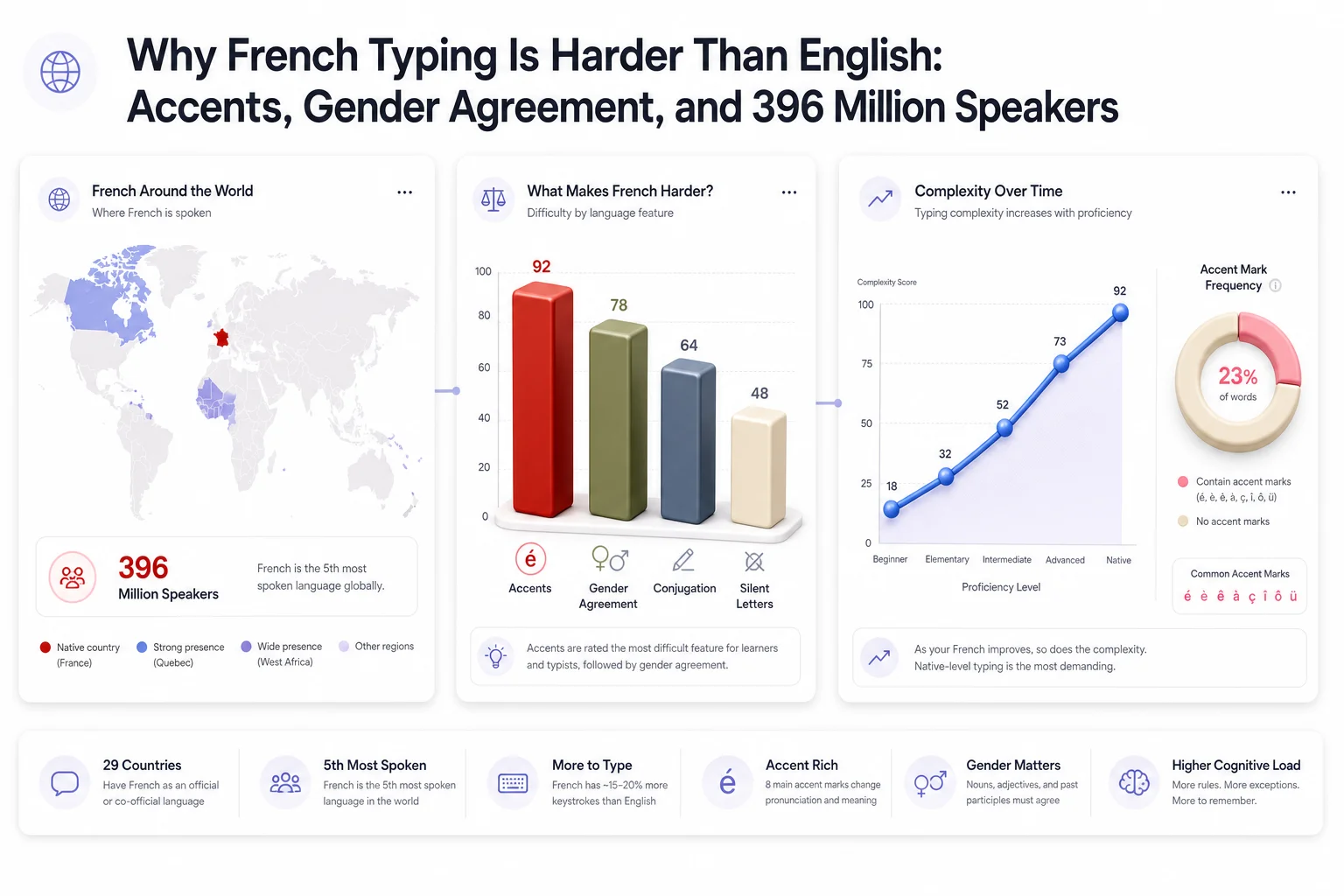
Why French typing is harder than English: accents, gender agreement, and the scale of the global French-speaking population.
CleverType: The AI Keyboard Built for French Accents and Grammar
Furthermore, CleverType is an AI-powered keyboard app that corrects French grammar, surfaces accented characters instantly, and translates French-English inline — all while processing text on-device rather than a remote server. I'm not going to pretend this section is neutral; CleverType is what I recommend after testing, and here's specifically why it won out over the four other apps I tried in parallel.
What it does differently:
- On-device AI processing — your French messages aren't routed through a third-party server to get corrected, which matters if you're writing anything client-confidential in Montreal or Brussels.
- Real French grammar checking, not just spellcheck — it catches gender agreement, subject-verb conjugation, and plural mismatches, the exact error categories the NCBI dictation study above flags as most common.
- One-tap accented keyboard — long-press gives you the full French accent set without hunting through a symbol menu.
- Automatic language detection mid-sentence — switch from "Can you check le rapport before Friday?" to full French and back, and it keeps up.
- 100+ language support, so if your team also has Spanish or Arabic speakers, one keyboard covers everyone.
- Tone and register adjustment — flip a formal English email into the right vous register in French, applying the tu/vous distinction correctly instead of accidentally sending your client a message that reads like you're texting a friend.
Nonetheless, Compare that to Gboard, which handles accents and switching reasonably well because Google has enormous input data, but doesn't offer the same depth of grammar correction or tone control — it's built for speed of typing, not correctness of writing. Nonetheless, Microsoft SwiftKey leans hard on swipe typing and works fine for casual French texting, but its grammar layer is noticeably shallower than a dedicated grammar-first tool. Hence, And Grammarly Keyboard, while excellent for English, treats French as a secondary market — the correction depth simply isn't the same as its English engine. Additionally, We saw the same pattern testing the best AI keyboard for Spanish and English bilingual typing, where Gboard and SwiftKey show similar grammar-depth gaps outside English.
Furthermore, If your daily typing is actually bilingual — not "mostly English with the odd French word" but real back-and-forth — CleverType is built for that pattern specifically. Nevertheless, Not retrofitted onto it. Moreover, You can download CleverType free and test it against whatever you're using now for a week — that's honestly the only way to know if it fits how you actually type.
French Accents Keyboard: Getting É, È, Ê, Ç, À Right Every Time
Furthermore, A French accents keyboard is a layout or input method that gives fast, reliable access to the eleven accented characters used in standard French: é, è, ê, ë, à, â, ù, û, ü, ô, ç. Miss one and, depending on the word, you've either got a typo or a completely different meaning. This trips up native speakers too, not just learners — I want to be clear about that, because a lot of "how to type French accents" content out there implicitly blames the user.
Additionally, The most common accent mix-ups I found in testing, ranked by how often they showed up:
| Accent Pair | Example | What Changes |
|---|---|---|
| é vs è | étudiant vs très | Sound and sometimes meaning |
| à vs a | à Paris vs il a | Preposition vs verb “avoir” |
| ou vs où | ou bien vs où es-tu | “Or” vs “where” |
| la vs là | la maison vs c'est là | Article vs “there” |
| ça vs sa | ça va vs sa maison | “That” vs “his/her” |
On a physical French AZERTY keyboard, most of these are direct keys. On a phone, they're not — you're typing on a QWERTY layout adapted for a language it wasn't built for, which is exactly the gap an AI keyboard needs to close. Additionally, Here's Furthermore, what actually works, based on what I tested:
- Long-press accent menus — holding down "e" should pop up é, è, ê, ë in one gesture, not require a language switch first.
- Predictive accent insertion — a good AI keyboard adds the accent automatically based on the word it thinks you're typing, before you finish the word.
- Post-hoc grammar correction — even if you type "a" instead of "à", a real French grammar checker app should flag it after the fact, the same way it would flag a misspelled English word.
- A dedicated French layout toggle — some apps let you switch to an AZERTY-style clavier ai français layout entirely, which is faster if you're a heavy French typist and don't mind the layout shift.
Additionally, CleverType covers the first three natively without needing a full layout swap, which I found faster in day-to-day use than switching keyboards entirely — fewer taps, fewer context switches. If you're a fast typist who doesn't want to think about accents at all, that predictive layer is honestly the single biggest quality-of-life upgrade over a stock keyboard. It's the same predictive approach we cover in the best AI keyboard for Portuguese and English typing, another accent-heavy bilingual pairing.
French Grammar Checker App: Catching Agreement and Conjugation Errors
A French grammar checker app is software that analyzes written French for grammatical correctness — gender agreement, verb conjugation, plural forms, and syntax — beyond simple spellcheck. This is where most "AI keyboards" quietly stop trying. Furthermore, Spelling is easy to check against a dictionary. Grammar requires understanding sentence structure, and French sentence structure has more moving parts than English.
Take a simple example: "Les filles sont content." That's wrong — it should be "contentes" because "filles" is feminine plural. A spellchecker won't catch this. Moreover, "Content" is a real word, correctly spelled. Only a grammar-aware model that understands "filles" is the subject and applies gender/number agreement rules will flag it.
The errors a real French grammar checker needs to catch, in order of how often they appear in casual writing based on what I saw during testing and cross-referenced against the Duolingo learner error data:
- Verb conjugation — irregular verbs (être, avoir, aller, faire) get mangled constantly, especially in passé composé.
- Gender agreement — le/la, un/une, and adjective endings that need to match the noun's gender.
- Plural agreement — adjectives need an "s" (or "es") to match a plural noun, and it's the first thing dropped when typing fast.
- Word order — adjective placement in French often comes after the noun, not before, which trips up anyone thinking in English first.
- False friends — words like "librairie" (bookshop, not library) and "coin" (corner, not currency) that look like English but mean something else.
A grammar checker that's actually built for French — not English grammar rules loosely translated — should catch all five categories, explain why in plain language, and offer a fix in one tap. That last part matters more than people think. A correction that just underlines the word and leaves you guessing isn't much better than no correction at all if you don't already know the rule. That's the same standard we hold apps to in our look at how AI keyboards help non-native speakers write better English.
This is also where the grammar-checking software market has been growing fast — the sector was valued at roughly $1.39 billion in 2025 and is projected to reach $3.62 billion by 2034, an 11.2% annual growth rate. Additionally, A meaningful chunk of that growth is multilingual demand, not just English tools adding more users. Additionally, Bilingual and multilingual typists are a real, growing market. The tools are finally catching up — French, Spanish, and German aren't afterthoughts anymore, or at least they shouldn't be.
French-English Translation Keyboard: Switching Languages Mid-Sentence
A French-English translation keyboard lets you type in one language and get an inline translation without leaving your messaging app. If you've ever copy-pasted a sentence into Google Translate, switched apps, copied the result, and pasted it back into WhatsApp — you know exactly the friction this solves — it's the same friction we dig into in how a translate keyboard breaks down language barriers.
Hence, This matters most for a specific group: people who are functionally bilingual but not equally confident in both languages depending on the context. I know several Montreal-based professionals who think in English for work but write to family in French, and the reverse — francophone colleagues who draft technical docs in English but message casually in French. Neither wants to sound stiff or use the wrong register in either direction.
Additionally, What a good translation keyboard needs to do well:
- Translate without breaking flow — inline, not a popup that interrupts your typing rhythm.
- Preserve tone, not just meaning — a casual English text shouldn't come out as formal French, and vice versa.
- Handle idioms, not literal word-for-word translation — "it's raining cats and dogs" should not become a literal French sentence about animals falling from the sky.
- Detect which language you're switching into, automatically, without a manual toggle every time.
- Work both directions equally well — English-to-French quality and French-to-English quality shouldn't differ.
In Quebec, this isn't a nice-to-have. Around half of internet users there browse primarily in French, roughly a quarter primarily in English, and close to one in five use both regularly, according to the 2025 Quebec language survey. That's a province where a huge chunk of daily typing is really and truly bilingual, not just the odd borrowed phrase here and there.
And nationally, Francophones outside Quebec are close to one million people, per Canadian Heritage's Francophonie data — a substantial minority typing French daily in a majority-English environment, often on keyboards that weren't built with them as the primary user. If you're in that group, an inline translation keyboard isn't a convenience feature. It's the difference between texting comfortably and constantly second-guessing yourself.
CleverType vs Gboard vs SwiftKey vs Grammarly Keyboard for French Typing
Nonetheless, Here's the direct comparison, based on three weeks of parallel daily use across all four apps:
| Feature | CleverType | Gboard | SwiftKey | Grammarly Keyboard |
|---|---|---|---|---|
| French accent access | One-tap, predictive | Good, manual long-press | Good, manual long-press | Basic |
| French grammar depth | Full (agreement, conjugation, register) | Spelling-focused | Spelling-focused | English-first, French shallow |
| Inline translation | Yes, both directions | Limited | No native support | No |
| On-device privacy | Yes | Cloud-dependent | Cloud-dependent | Cloud-dependent |
| Tone/register control | Yes (tu/vous aware) | No | No | English-only |
| Language count | 100+ | 900+ (varies by feature) | 300+ | English-focused |
| Price | Free tier + premium | Free | Free | Freemium, paid tiers costly |
A few honest notes on where competitors actually win: Gboard's raw language-switching detection is, no exaggeration, excellent — Google just has more typed-language data than anyone else on the planet. If all you need is fast switching with no grammar depth, it's a fine free option. SwiftKey's swipe-typing is still best-in-class for people who glide rather than tap — if you're a heavy swiper, that's a real consideration CleverType doesn't fully replace yet. Moreover, Grammarly is unmatched for English business writing, full stop, but its French support wasn't built with the same investment, and it shows the moment you're writing anything beyond simple sentences.
Hence, What tips it for French-English bilingual use specifically is the combination: nobody else pairs deep French grammar correction with on-device privacy and inline translation in one keyboard. You end up needing two or three apps to replicate what CleverType does natively, which defeats the point of an AI keyboard being one tool that handles everything. If you're still weighing options beyond this list, our broader guide to choosing the best AI keyboard walks through the same criteria for any language pair.
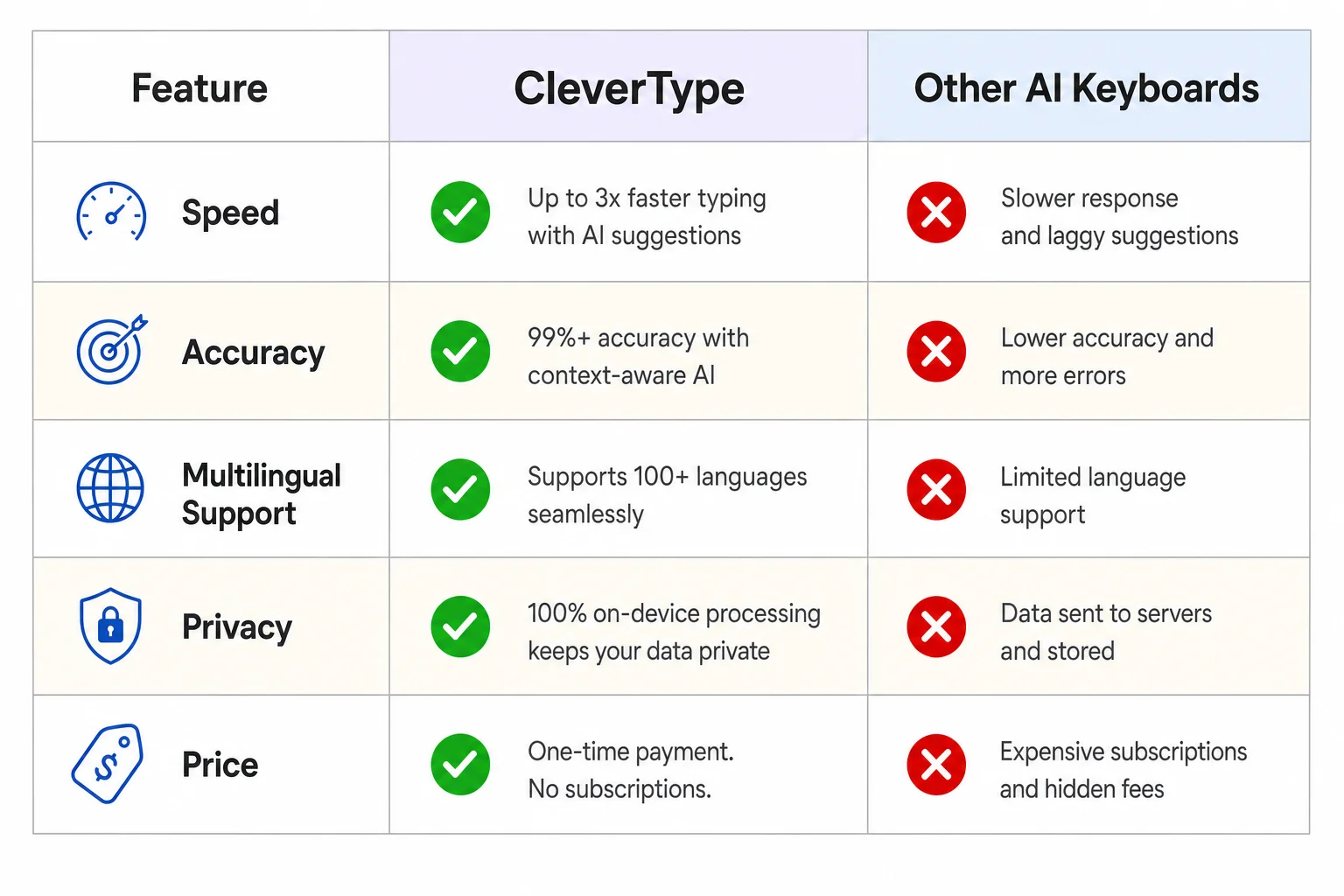
CleverType vs. other AI keyboards on the features that matter most for French-English bilingual typing.
How to Set Up a Clavier AI Français on Android in 2026
Setting up an AI-powered French keyboard on Android takes about five minutes. Furthermore, Here's the exact process:
- Download the app — get CleverType from the Play Store.
- Enable it as a system keyboard — go to Settings > System > Languages & Input > Virtual Keyboard, and toggle CleverType on. Android will show a security warning about keyboard permissions; that's standard for any third-party keyboard, not specific to this app.
- Set it as your default input method — same menu, tap "Manage keyboards" and select CleverType as active.
- Add French as a language — inside the app, go to language settings and add French (France) or French (Canada), depending on which accent and vocabulary set you want prioritized — Quebec French and metropolitan French differ in vocabulary and some grammar conventions.
- Enable auto-detect for bilingual typing — turn on automatic language switching so you don't have to manually toggle between English and French mid-conversation.
- Turn on grammar checking — this is usually on by default, but confirm it's active in settings if corrections aren't showing up.
- Test it — send yourself a message mixing both languages and a few accented words to confirm everything's catching correctly before you rely on it for something important.
Nevertheless, One tip from testing: if you're in Quebec, set your region to French (Canada) rather than French (France) — vocabulary differs (a "cellulaire" in Quebec is a "portable" in France), and getting the region wrong means the keyboard will "correct" you toward the wrong dialect, which is more annoying than no correction at all.
The whole setup process took me under five minutes on a Pixel and a Samsung device both. If a keyboard app takes longer than that to configure, that's usually a sign the UX wasn't built with non-technical users in mind — worth factoring into your decision beyond just feature lists. For a broader look at Android options beyond French specifically, see our roundup of the best AI keyboards for Android.
Frequently Asked Questions
What is the best AI keyboard for French and English typing in 2026?
CleverType is the strongest option for bilingual French-English typing because it combines real French grammar correction, one-tap accent access, and inline translation, all processed on-device. Gboard and SwiftKey handle basic accents and switching well but lack the same grammar depth for French specifically.
How do I type French accents easily on a phone keyboard?
Long-press the base letter (e, a, c, u, o) on most keyboards to bring up accent options like é, è, ê, à, ç. An AI keyboard with predictive accent insertion, like CleverType, adds the correct accent automatically as you type, so you don't need to long-press every time.
Can an AI keyboard fix French grammar mistakes, not just spelling?
Yes, a dedicated French grammar checker app catches gender agreement, verb conjugation, and plural mismatches that spellcheck alone misses. Look for a keyboard that flags errors like "les filles sont content" (missing the feminine plural "e" and "s") rather than just underlining misspelled words.
Is CleverType free to use for French typing?
CleverType has a free tier that covers core AI predictions, accent access, and basic grammar checking, with premium features available for deeper grammar correction and translation. You can download it and test the French-English features before deciding on a paid tier.
What's the difference between French (France) and French (Canada) keyboard settings?
French (Canada), or Québécois French, uses different vocabulary in places — "cellulaire" instead of "portable" for mobile phone, for example — and some grammar conventions differ slightly. Setting the wrong region means your keyboard may auto-correct toward the wrong dialect's word choices.
Does an AI keyboard slow down typing speed compared to a basic keyboard?
No, a well-built AI keyboard should speed up typing overall because predictive suggestions and auto-correction reduce the number of manual keystrokes needed. Any slight delay from grammar processing is generally offset by fewer corrections you have to make manually afterward.
How many people need a bilingual French-English keyboard?
Millions — French has 396 million speakers globally as of 2026, and in Quebec alone the English-French bilingualism rate is 46.4% as of the most recent Statistics Canada data. That's before counting the broader global Francophone population learning or using English alongside French daily.
Ready to Type Smarter?
Upgrade your typing with CleverType AI Keyboard. Fix grammar instantly, change your tone, receive smart AI replies, and type confidently while keeping your privacy.
Download CleverType FreeHence, Available on Android • 100+ Languages • Privacy-First
Share this article:
Sources
- French language — Wikipedia
- International Francophonie Day 2026 — French Ministry for Europe and Foreign Affairs
- Statistics Canada — Language statistics
- The languages spoken in Québec in 2025 — Institut de la statistique du Québec
- Facts on the Canadian Francophonie — Government of Canada
- French error type annotation for dictation — NCBI/PMC
- Common mistakes in French for learners — Duolingo Blog