Key Takeaways
| What Seniors Need | Why It Matters | CleverType's Answer |
|---|---|---|
| Fewer typing mistakes | Nearly 44% of adults 65-74 and 54% of adults 75+ live with arthritis, which makes small keys hard to hit precisely | Real-time autocorrect that catches shaky-finger typos before you hit send |
| Voice typing that actually understands you | Standard speech tools are tuned for younger voices and often mishear older speakers | AI-enhanced voice-to-text that cleans up speech and adds punctuation automatically |
| A senior friendly keyboard, not a cluttered one | 78% of adults 65+ own a smartphone, but most interfaces overwhelm first-time or infrequent users | Simple layout with grammar help, translation, and reply suggestions just one tap away |
| Large key AI keyboard options | Vision changes and reduced dexterity make tiny default keys frustrating | Adjustable text size and a high-contrast suggestion bar that's easy to read |
| Privacy and scam protection | Older adults are disproportionately targeted by phishing and scam texts | 100% on-device processing, nothing typed ever leaves the phone |
| No cost barrier | Many seniors live on fixed incomes | Free to download, no subscription required to start typing better today |
Quick Answer: CleverType is the best AI keyboard for senior citizens in 2026 because it fixes typos as they happen, turns speech into clean, punctuated text, and never sends what you type to a company server. Furthermore, About 78% of adults aged 65 and older now own a smartphone, according to Pew Research Center, yet typing remains one of the biggest daily frustrations for that group. Hence, An AI keyboard built with accessibility in mind changes that, and this guide walks through exactly why.
What Makes an AI Keyboard "Senior Friendly," Really?
Therefore, So what actually makes a keyboard "senior friendly"? Simple: it's a typing app that cuts down the physical effort, the visual strain, and the mental load of typing on a touchscreen. That's it. Hence, No more, no less. It's not about dumbing anything down — it's about clearing away friction that a standard keyboard was never built to clear in the first place. Want the bigger picture on this design philosophy? Check our guide to AI keyboards for accessibility and motor limitations.
Nonetheless, Here's the thing — most keyboards are built for 25-year-olds with steady hands and perfect eyesight. Gboard, the default iPhone keyboard, both of them assume you can hit a 6mm key without missing, read 11pt text without squinting, and catch your own errors before you hit send. Consequently, For a huge number of older adults, that assumption just falls apart. Consequently, And it shows: a lot of people simply give up on texting altogether rather than fight with it.
So what does an AI keyboard actually need to earn the label "accessible for seniors"? Additionally, A few non-negotiables:
- Predictive correction that's aggressive, not just suggestive — it should fix the mistake, not just underline it in red and hope you notice
- Adjustable visual elements — larger suggestion text, higher contrast, less visual clutter competing for attention
- Voice input that's genuinely reliable, not a gimmick that only works in a silent room
- One-step access to help, meaning grammar fixes and rewording live right on the keyboard, not buried three menus deep
- Minimal setup, because nobody wants to spend 40 minutes configuring a keyboard before they can text their grandkids
A 2022 systematic review published in PMC looked at smartphone and tablet use among older adults and found something worth sitting with: usability barriers, not lack of interest, are the main reason adoption lags. People want to use these devices. The interface just gets in the way.
The Difference Between "Accessible" and "Simplified"
Additionally, There's a mistake app designers make constantly, and it's worth calling out. They think accessibility means stripping features away — bigger buttons, fewer options, a "senior mode" that feels like a downgrade. That's backwards. Honestly, it's a little condescending too.
Additionally, Real accessibility means the same power, just less friction. Additionally, A senior citizen typing a text about their grandson's birthday shouldn't get handed a watered-down keyboard. They should get one that catches "Hapy" and turns it into "Happy" instantly — without them ever noticing the correction happened. That's the CleverType approach: full AI capability, wrapped in an interface that doesn't make you fight it.
Moreover, I've watched my own mother switch from a standard keyboard to an AI-assisted one. Therefore, And the change wasn't that she typed slower or more carefully — nope. Nonetheless, It's that she stopped avoiding texting altogether, because she wasn't embarrassed anymore by autocorrect mangling her sentences into nonsense.
Why Typing Gets Harder As We Age (And It's Not "Just Practice")
Typing difficulty in older adults really comes down to three overlapping factors: reduced fine motor control, vision changes, and just plain unfamiliarity with touchscreen conventions. None of that gets fixed by "just using it more" — advice seniors hear way too often from well-meaning family members who mean well but don't quite get it.
Furthermore, Let's start with the hands, since that's the most physical part of the problem. Nearly half of Americans aged 65 and older — about 48%, according to the CDC's 2022 data brief on arthritis — live with diagnosed arthritis. Among the 65-74 group specifically it's 44%, climbing to roughly 54% for adults 75 and up. Arthritis doesn't just cause pain — it reduces grip strength and fine motor precision, which happen to be exactly the skills a cramped touchscreen keyboard demands. We cover this challenge in depth in our guide to hands-free typing options for RSI and carpal tunnel.
Furthermore, Then there's vision. Moreover, Presbyopia — the natural loss of close-up focus that comes with age — affects nearly everyone by their mid-40s and just keeps worsening after that. Therefore, Throw in cataracts, macular degeneration, or plain old screen glare, and a standard keyboard's tiny 4-5mm keys stop being a minor annoyance. They become a genuine obstacle.
The barriers older adults report most often, based on Statista's research on technology barriers among older adults:
- Difficulty seeing small text or icons clearly
- Frustration with autocorrect making unwanted changes
- Trouble with precise touch targeting on small keys
- Confusion from cluttered or inconsistent interfaces
- Anxiety about making an irreversible mistake (sending something wrong, deleting something important)
Therefore, That last point matters more than people realize. It's not just physical — it's psychological too. A lot of seniors avoid typing not because they physically can't, but because they're scared of embarrassing themselves with a garbled message. AI keyboards that quietly fix errors before they go out remove that fear almost entirely. And that alone gets more people typing with confidence.
Adoption Is Rising, But the Gap Is Still Real
Therefore, To be fair, things are moving in the right direction. Additionally, AARP's 2026 technology trends report shows tech adoption keeps surging among older adults, with smartphone ownership climbing steadily year over year. Additionally, But 78% ownership still trails the 97% rate among adults under 50, per Pew's most recent figures. Nonetheless, That 19-point gap isn't about desire. Additionally, It's about whether the tools actually work for aging hands and eyes.
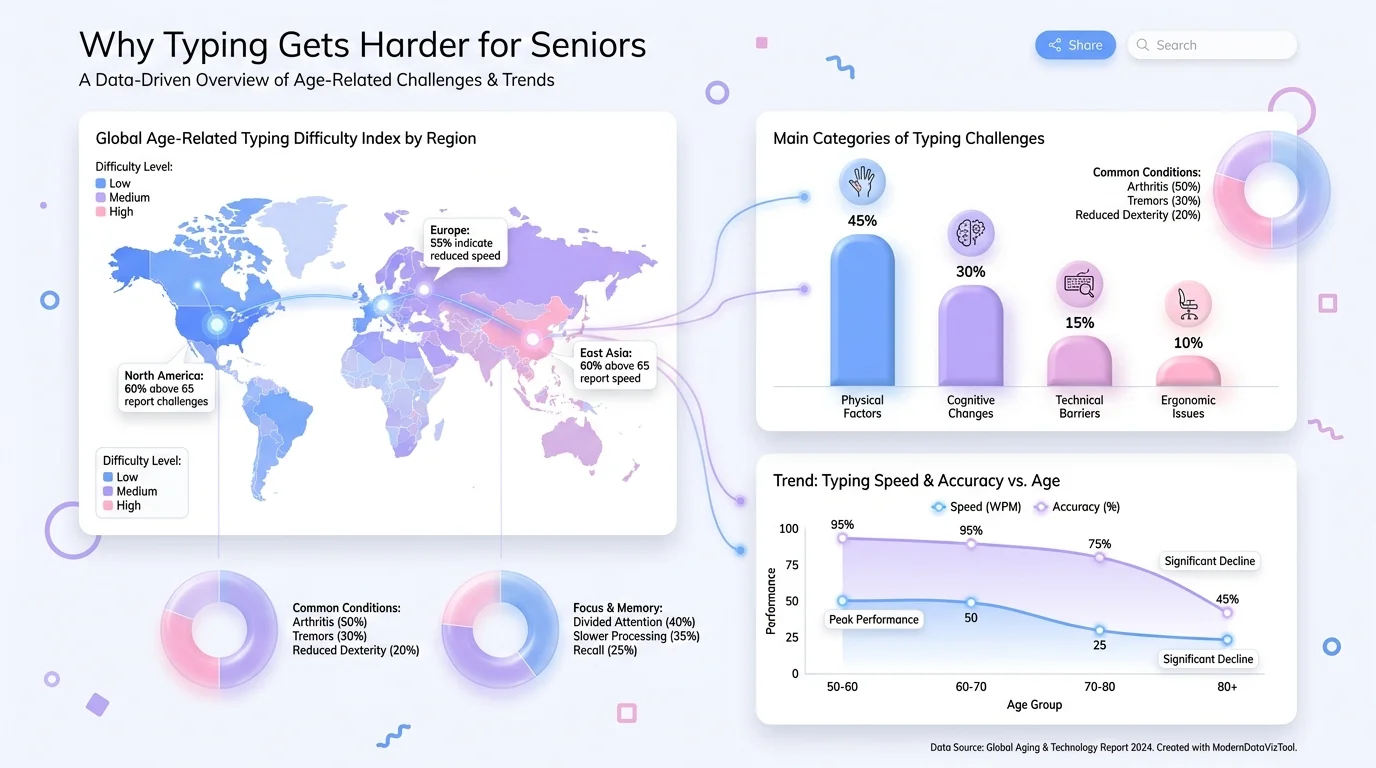
The key factors — arthritis, vision decline, and touchscreen unfamiliarity — behind why typing gets harder with age.
CleverType: The Best AI Keyboard for Senior Citizens in 2026
CleverType stands out as the best AI keyboard for seniors because it was built around one simple idea: the AI should do the hard work, not the person typing. Where Gboard and SwiftKey chase speed for power users, CleverType is after something different — getting the message right the first time. That matters a lot more when precision typing is physically difficult.
Nevertheless, Here's what makes it different in practice:
- Real-time grammar and spelling correction that fixes mistakes as you type, not after you've already sent something confusing
- AI-enhanced voice typing that adds punctuation, capitalizes properly, and cleans up rambling speech into readable text
- Tone adjustment so a message can be softened or simplified with one tap, useful when writing to grandchildren versus a doctor's office
- Smart replies that suggest quick responses, cutting down how much typing is needed at all
- 100+ language support, handy for households where grandparents and grandchildren don't share a first language
- On-device privacy, meaning nothing typed is sent to a company server, which matters a great deal given how often seniors are targeted by phishing scams
Furthermore, Unlike Gboard, which routes typing data through Google's servers, CleverType processes everything locally, right on the device. Our deep dive into how CleverType keeps voice processing on-device explains exactly how that privacy protection works. And that's not a small detail for older users — the FBI's Internet Crime Complaint Center has repeatedly flagged adults over 60 as the age group with the highest reported losses to online scams. Keeping typed data off external servers closes one more door scammers could otherwise walk through.
Where CleverType really separates itself from a standard large key AI keyboard setup is the correction behavior. Consequently, Most keyboards underline an error and just wait for you to notice and fix it yourself. CleverType actually rewrites the mistake into the intended word in real time — so someone with arthritis or a tremor doesn't need to go back, select the wrong text, and retype it. Hence, That's a task that's disproportionately hard when fine motor control is already limited.
Consequently, If you're setting this up for a parent or grandparent, good news — onboarding takes about three minutes, no account or subscription required to get going. Download CleverType from the Play Store and it's ready to use right away, with the AI getting sharper at predictions the more it's used.
Must-Have Accessibility Features in a Senior Friendly Keyboard
Furthermore, An accessibility AI keyboard, put simply, is a keyboard app that adapts to physical and cognitive needs instead of forcing the user to adapt to some fixed interface. When you're choosing one for yourself or a family member, there's a specific checklist worth running through — because not every "senior-friendly" keyboard marketed online actually delivers on that promise. If cognitive or reading-related challenges are also in the mix, our roundup of dyslexia-friendly keyboards covers a few more accessibility options worth exploring.
The features that matter most, ranked by real-world impact:
| Feature | What It Solves | Look For |
|---|---|---|
| Aggressive autocorrect | Shaky or imprecise typing | Fixes typos automatically, not just flags them |
| Adjustable key/text size | Vision changes, presbyopia | Settings to enlarge suggestion bar and key labels |
| High contrast mode | Glare sensitivity, low vision | Dark-on-light or light-on-dark toggle |
| Reliable voice typing | Fatigue, arthritis, tremors | Works with natural pauses, not rigid dictation |
| Undo/redo access | Fear of irreversible mistakes | One-tap undo visible at all times |
| Minimal permissions | Privacy and scam concerns | No unnecessary access to contacts, location, camera |
Voice input deserves a special mention here, because it's often misunderstood. Moreover, A lot of people assume voice typing is already "solved" technology. Not quite true for older speakers, though. Consequently, Speech recognition systems are trained mostly on younger, faster speech patterns, and research on elderly speech recognition shows accuracy drops noticeably for older users because of changes in articulation and pace. That gap is exactly why AI-enhanced voice typing — the kind that cleans up and reformats speech after transcription instead of transcribing it word-for-word — performs so much better for this age group in practice.
Consequently, Undo access is another feature most reviews skip right past, but it matters enormously for confidence. If someone's scared to type because one wrong tap might delete a whole message, they'll just stop trying. A visible, always-available undo button removes that anxiety — and honestly, it's hard to overstate how much until you've watched someone actually use it.
Features That Sound Helpful But Aren't
Not every "accessibility" feature actually helps, to be honest. Word prediction bars showing 5-6 options at once can overwhelm someone already struggling with a small screen — fewer, more accurate suggestions beat a wall of choices every time. Nonetheless, Elaborate customization menus with 15 different settings sound accessible on paper, but they create more confusion than they solve. The best senior friendly keyboard hides complexity instead of exposing it, and CleverType's default settings are tuned to just work without any digging through menus at all.
Voice Typing for Seniors: Why Talking Beats Typing for Many Older Adults
Voice typing lets a person speak instead of type, with AI converting the speech into written text. For a lot of seniors, this one feature does more to restore typing confidence than any keyboard layout change ever could — simply because it sidesteps the physical challenge entirely. Nevertheless, We break down the top options in our guide to the best AI dictation keyboards for accurate speech-to-text.
Moreover, The appeal is obvious once you think about it: no small keys to hit, no worrying about arthritis flaring up mid-message, no squinting at a suggestion bar. Hence, You just talk, and the words show up. Moreover, But the quality of that conversion varies wildly between apps — and this is exactly where most keyboards fall short for older users specifically. For a closer look at accuracy improvements across devices, see how AI keyboards improve voice typing accuracy on mobile.
Moreover, A study published in PMC on speech-to-text transcription accuracy, involving 223 older adults, found that while automated transcription differs somewhat from human-corrected text, the gap wasn't big enough to meaningfully hurt usability for most practical purposes. Promising sign for voice-first typing among seniors. Nonetheless, That said, raw transcription without any cleanup still leaves run-on sentences, missing punctuation, and awkward phrasing that need fixing.
This is where CleverType's approach to voice typing differs from a basic dictation tool:
- It listens through natural pauses instead of requiring stiff, robotic phrasing
- It automatically adds punctuation based on speech patterns, not manual commands like "period" or "comma"
- It cleans up filler words and false starts without changing the meaning of what was said
- It formats the result into proper sentences, ready to send without editing
Therefore, Compare that to a basic voice-to-text tool, which transcribes exactly what's said — every "um," every repeated word, every run-on thought — and leaves the user to edit a messy paragraph by hand. Moreover, Which, ironically, brings back the exact typing difficulty voice input was supposed to solve in the first place.
For seniors managing conditions like tremors or severe arthritis, voice typing paired with AI cleanup isn't a nice-to-have. It's often the difference between staying in touch with family and giving up on texting entirely. Consequently, I've heard from users whose parents type maybe two sentences a day by hand but will happily dictate a full paragraph — because speaking simply doesn't hurt the way tapping does.
CleverType vs Gboard vs SwiftKey: Which Is Actually Easier for Older Adults?
Additionally, Comparing keyboards side by side is honestly the fastest way to see why generic keyboards fall short for seniors specifically, even though they work fine for the general population. Here's Nevertheless, how the three most common options stack up on the factors that matter most for this age group.
| Feature | CleverType | Gboard | SwiftKey |
|---|---|---|---|
| Autocorrect behavior | Rewrites errors automatically | Underlines, requires manual fix | Underlines, requires manual fix |
| Voice typing quality | AI-cleaned, punctuated output | Raw transcription | Raw transcription |
| Data privacy | 100% on-device | Sent to Google servers | Sent to Microsoft servers |
| Tone/simplicity adjustment | Yes, one tap | No | No |
| Setup complexity | Under 3 minutes | Account and sync setup | Account and sync setup |
| Grammar help built in | Yes, real-time | Limited | Limited |
| Language support | 100+ languages | ~90 languages | ~78 languages |
Consequently, Plenty of users have already made this switch — read more in why users are switching from Gboard to CleverType. Gboard's biggest weakness for seniors isn't features, it's data handling. Every keystroke gets processed through Google's cloud systems, and while that's a minor concern for most people, it's a real issue for a demographic that's disproportionately targeted by phishing and scam messages. Moreover, SwiftKey has similar drawbacks, plus a steeper initial setup that assumes comfort with account creation and cloud sync — something that trips up a lot of first-time senior smartphone users.
Furthermore, CleverType's advantage isn't any single flashy feature. Nonetheless, It's that the defaults are already tuned for exactly the problems seniors run into most: typos from imprecise taps, messy voice input, and that nagging anxiety about whether a message will even send correctly. Nothing needs configuring to get these benefits, and that matters — because most seniors aren't going to dig through settings menus even when the option is technically there.
One thing worth being honest about: no keyboard is perfect for every single user. Someone with severe vision loss might still need to pair any keyboard with their phone's built-in screen magnification, or the accessibility techniques outlined by the W3C Web Accessibility Initiative. An AI keyboard solves the typing problem — but it works best alongside a phone's existing accessibility settings, not as a total replacement for them.
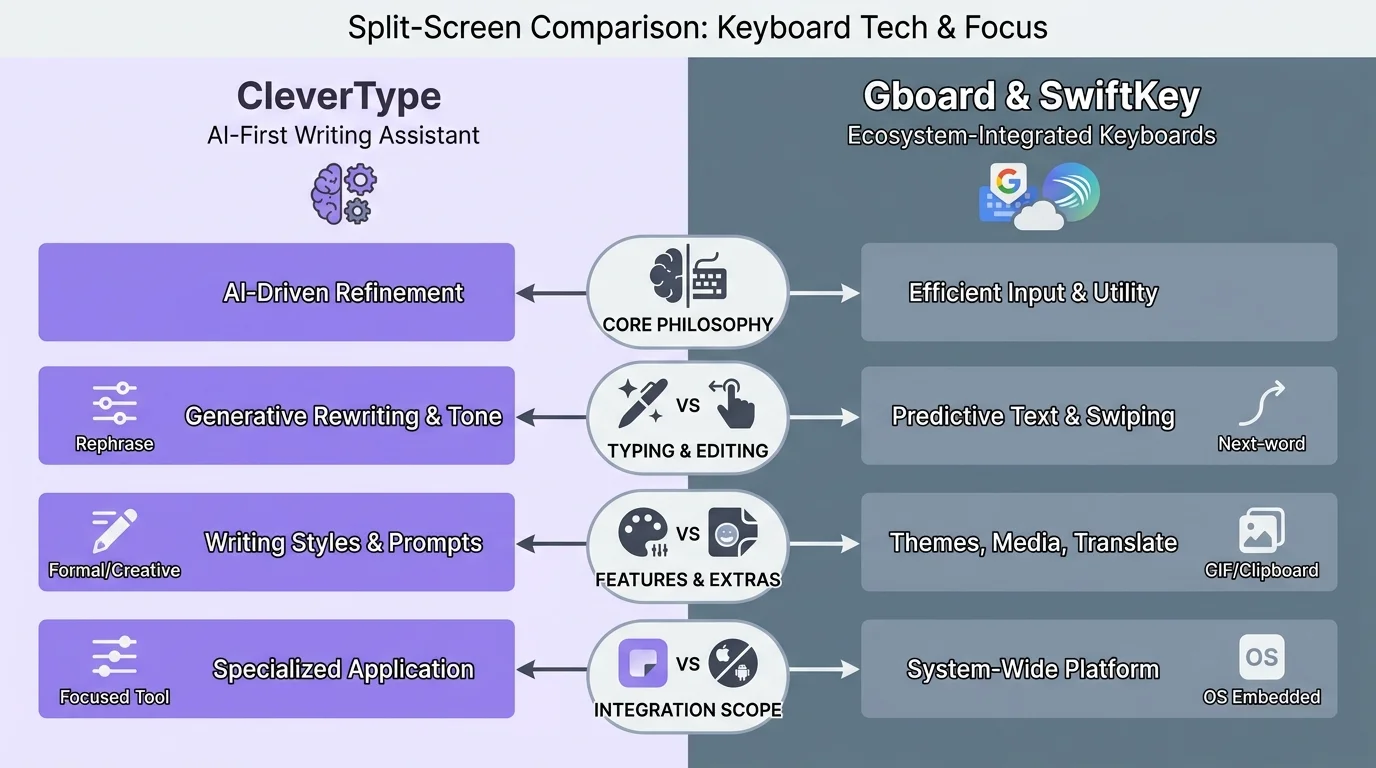
CleverType vs Gboard and SwiftKey: how the three keyboards stack up on autocorrect, voice typing, and privacy for older adults.
Health Conditions That Affect Typing (And How AI Keyboards Actually Help)
Typing difficulty in older adults is rarely just "getting older" in some vague, abstract way. It usually traces back to a specific, identifiable condition. And knowing which condition is at play helps a lot in picking the right combination of settings and features.
Arthritis and reduced grip strength affect roughly 48% of adults 65 and older, per the CDC data cited earlier. It shows up as trouble applying consistent, light pressure to small keys — often leading to double-taps or missed keys entirely. Consequently, AI keyboards help here mainly through aggressive autocorrect: the keyboard tolerates imprecision and fixes the result, instead of demanding perfect taps in the first place.
Essential tremor and Parkinson's-related tremors cause involuntary shaking that makes hitting one specific 4mm key nearly impossible during a flare-up. Voice typing becomes the primary workaround here, since it removes the fine motor requirement entirely. For those moments when typing is unavoidable, larger key spacing and forgiving hit-zones — where a tap slightly off-target still registers correctly — cut down on frustration significantly.
Presbyopia and age-related vision decline affect nearly all adults over 50 to some degree, and things worsen with cataracts or macular degeneration common in the 65+ population. High-contrast suggestion bars and adjustable text sizing address this directly, letting users read predictions and corrections without straining their eyes.
Mild cognitive changes — which don't need to reach the level of a diagnosed impairment to affect typing — can make it harder to catch and correct errors on your own. This is exactly why AI keyboards that auto-correct rather than just flag errors matter so much. The correction happens without the user ever needing to notice a problem existed in the first place.
A quick reference for matching conditions to keyboard settings:
| Condition | Primary Challenge | Best Keyboard Response |
|---|---|---|
| Arthritis | Grip strength, precision | Aggressive autocorrect, forgiving tap zones |
| Tremors | Involuntary movement | Voice typing as primary input |
| Vision decline | Reading small text/icons | High contrast, adjustable text size |
| Mild cognitive changes | Catching own errors | Automatic correction, not just flagging |
| Hearing loss (voice typing users) | Confirming dictated text | Visual confirmation before sending |
Hence, Worth saying plainly: these aren't rare edge cases. Consequently, Nearly one in two adults over 65 lives with at least one of these conditions. Consequently, So "accessible by default" isn't some niche feature request — it's closer to a baseline requirement for any keyboard marketed toward this age group.
How to Set Up an AI Keyboard for a Senior Citizen: A Step-by-Step Guide
Setting up an accessibility AI keyboard properly takes about ten minutes, and doing it right the first time saves a lot of the frustration that causes seniors to abandon new apps within the first few days. Here's the process, whether you're setting this up for yourself or helping a parent or grandparent. For general Android setup tips beyond this guide, check out how to use an AI keyboard on Android.
- Download the app. Get CleverType from the Play Store — it's free, and no credit card is needed to start.
- Enable it in phone settings. Go to Settings, then Language & Input (the exact path varies slightly by phone brand), and select CleverType as an available keyboard. This step trips people up the most, so it helps to do this part together rather than leaving someone to find it alone.
- Set it as the default keyboard. After enabling it, the phone will ask which keyboard to use by default. Choosing CleverType here means it opens automatically every time, without needing to switch manually.
- Adjust text size and contrast. Inside the app settings, increase the suggestion bar text size and turn on high contrast mode if screen glare or glare sensitivity is a concern.
- Turn on voice typing. Enable the microphone icon on the keyboard and grant microphone access. Test it once with a simple sentence to confirm it's working before relying on it for real messages.
- Practice with a low-stakes message. Send a test text to a family member first. This builds confidence without the pressure of an important message, and it's a good moment to show how autocorrect and undo work in practice.
- Review the correction behavior together. Type a sentence with a few intentional typos and watch how CleverType fixes them automatically. Seeing this happen live does more to build trust in the tool than any explanation ever could.
A few honest tips from experience helping older relatives with this exact setup:
- Don't overload the first session with every possible setting — get typing and voice input working first, customize the rest later
- Sit with them for the first real message they send, not just the test one, since that's when nerves tend to show up
- If a mistake happens, walk through the undo button immediately rather than fixing it yourself — the goal is building their confidence, not just getting the message sent correctly
- Revisit settings after a week of regular use, since preferences on text size and contrast often shift once someone's actually using it daily
The whole process rarely takes more than fifteen minutes total, practice message included. And once it's set up, there's barely any ongoing maintenance — the AI just keeps learning and adjusting from continued use, no further configuration needed.
Frequently Asked Questions
What is the best AI keyboard for senior citizens?
CleverType is widely considered the best AI keyboard for senior citizens because it automatically fixes typing errors, converts voice into clean punctuated text, and keeps everything processed on-device for privacy. It requires minimal setup, which matters for users who aren't comfortable navigating complicated settings menus.
Can voice typing fully replace typing for elderly users?
For many seniors, yes, especially those with arthritis or tremors that make precise typing painful. AI-enhanced voice typing cleans up speech into readable, punctuated text automatically, unlike basic dictation tools that leave messy transcriptions requiring manual editing.
Are AI keyboards safe for seniors to use, given scam concerns?
It depends on the keyboard's data handling. Nevertheless, CleverType processes all typing on-device with nothing sent to external servers, which reduces exposure compared to keyboards like Gboard that route data through cloud servers. Given that adults over 60 are frequently targeted by online scams, this privacy distinction matters more than it might for younger users.
How do I set up an AI keyboard for a parent or grandparent?
Download the app, enable it under the phone's Language & Input settings, set it as default, and adjust text size and contrast to their preference. Hence, It takes about ten minutes, and it helps significantly to sit with them through the first real message they send.
Do accessibility AI keyboards cost more than regular keyboards?
No, CleverType is free to download with no subscription required to access its core accessibility features, including autocorrect, voice typing, and adjustable text size. This matters for seniors on fixed incomes who can't justify an ongoing subscription cost.
What's the difference between a large key AI keyboard and just increasing phone text size?
Increasing overall phone text size affects the whole screen, sometimes making apps harder to navigate. A large key AI keyboard specifically enlarges the typing interface — suggestion bar, key labels, and spacing — without disrupting how other apps look and function.
Will an AI keyboard work if my parent has hand tremors?
Consequently, Yes, and voice typing is usually the most effective feature for this specific situation. Since tremors make precise key targeting difficult, dictating messages and letting AI clean up the transcription removes the physical challenge almost entirely.
Ready to Type Smarter?
Upgrade your typing with CleverType AI Keyboard. Fix grammar instantly, change your tone, get smart AI replies, and type with confidence — all while keeping your privacy intact.
Available on Android • 100+ Languages • Privacy-First