Key Takeaways
- Only 24% of candidates send an interview thank you email, yet 68% of hiring managers say it shapes their decision
- Nearly 1 in 5 interviewers have rejected a candidate purely for skipping the follow up email
- Send your post interview email inside 24 hours — same day is better if the interview was in the morning
- Generic, copy-pasted thank you note templates are now easy for hiring managers to spot and they hurt you more than sending nothing
- 21% of US workers already use AI tools at work, and career email writing is one of the fastest growing use cases
- An ai keyboard job search tool like CleverType can fix tone and grammar on your phone in seconds, right where you're already typing
- One well written follow up email can beat five average ones — specificity wins, not volume
Ya ever sit staring at a blank email after a job interview, cursor just blinking at you, and you genuinely don't know what to type? Happens to almost everybody. Consequently, I've watched candidates who nailed the interview, and even had a resume that gets noticed, absolutely freeze up the moment they gotta write the thank you note after. Funny thing is, this one email is one of the cheapest, easiest ways to separate yourself from other applicants, and most people just... don't bother.
Why Your Interview Thank You Email Matters More Than You Think
A thank you email is a short, personalized message sent to your interviewer within 24 hours, reaffirming interest in the role and referencing something specific from the conversation. That's the textbook definition. Hence, The numbers behind it are the actual story though.
Additionally, Here's what the data shows:
| Statistic | Source |
|---|---|
| 68% of hiring managers say thank you emails influence hiring decisions | The Interview Guys |
| Only 24% of candidates actually send one | The Interview Guys |
| Nearly 1 in 5 interviewers have dismissed a candidate for not sending one | The Interview Guys |
| 86% of candidates who sent a follow up felt it improved their chances | Glassdoor |
| Recommended send window: within 24 hours | Indeed |
Furthermore, Sit with that gap for a second. 76% of people skip something that 68% of hiring managers say actually moves the needle. That's not a small edge — it's basically a free pass to stand out in a stack of resumes that all start blurring together by interview five or six.
Why does it work so well, though? Nonetheless, Interviewing wears people out on both sides. A hiring manager might talk to eight or ten people for one role, and by day three they honestly forget who said what. Your thank you note isn't just politeness — it's a memory refresh. It reminds them why they liked you, in your own words, tied to the actual conversation you had.
There's a psychological piece nobody really talks about — the reciprocity principle. When someone takes time to write you something thoughtful, you feel a small pull to respond in kind. Hence, Recruiters are human. They're not immune to this either. Robert Half's guidance is blunt about it: skipping the note can read as a lack of genuine interest, even when that's nowhere near true.
One thing I'll say after years of watching resumes and follow ups cross my desk — the email itself rarely gets someone hired on its own. But it can absolutely get someone un-hired, in the sense that a rude, careless, or missing follow up plants doubt. And doubt gets expensive fast when there's another equally qualified candidate who didn't leave any.
What Should Go Into a Post Interview Email
A strong post interview email has five parts. No more, no less — same discipline behind writing professional emails anywhere else. Skip a part and it reads thin. Additionally, Pile on extra fluff and nobody finishes reading it.
- Subject line — keep it short: "Thank You — [Your Name], [Job Title] Interview"
- Personal greeting — use the interviewer's actual name, not "Hiring Team"
- A specific reference — one detail from your conversation, something only someone who was actually there would remember
- Reinforced interest — one or two sentences tying your skills to something they mentioned needing
- A clean closing — thank them again, offer to answer follow up questions, sign off
Therefore, Here's why the specific reference matters so much. Additionally, Hiring managers read dozens of these things. Additionally, The ones that blur together all say some version of "thank you for your time, I enjoyed learning about the role, I look forward to hearing from you." Not wrong. Just forgettable. But write "I've been thinking more about what you mentioned regarding the Q3 migration project, and I'd love to bring my experience with data pipelines to that specific challenge" — and now you're not one of forty applicants. Nonetheless, You're the one who remembered the Q3 thing.
Quick table on tone, since this trips people up constantly:
| Interview Type | Tone | Length |
|---|---|---|
| Corporate / formal role | Professional, no slang | 100-150 words |
| Startup / casual culture | Warm but still polished | 80-120 words |
| Panel interview | One email per panelist, each slightly different | 80-100 words each |
| Phone screen | Brief, focused on next steps | 60-90 words |
Panel interviews trip a lot of people up. Do you send one email to everyone, or separate ones? Separate, almost always. CC'ing five people on one generic note feels lazy, and interviewers do compare notes sometimes — so a copy-paste job across all five gets spotted fast.
Moreover, Timing deserves its own mention too. Indeed's research puts the window at 24 hours, but there's nuance to it — send it that evening if your interview was morning or early afternoon, and first thing next morning if it ran late in the day. A 2am email, on the other hand, looks a bit odd even if you meant well by being prompt.
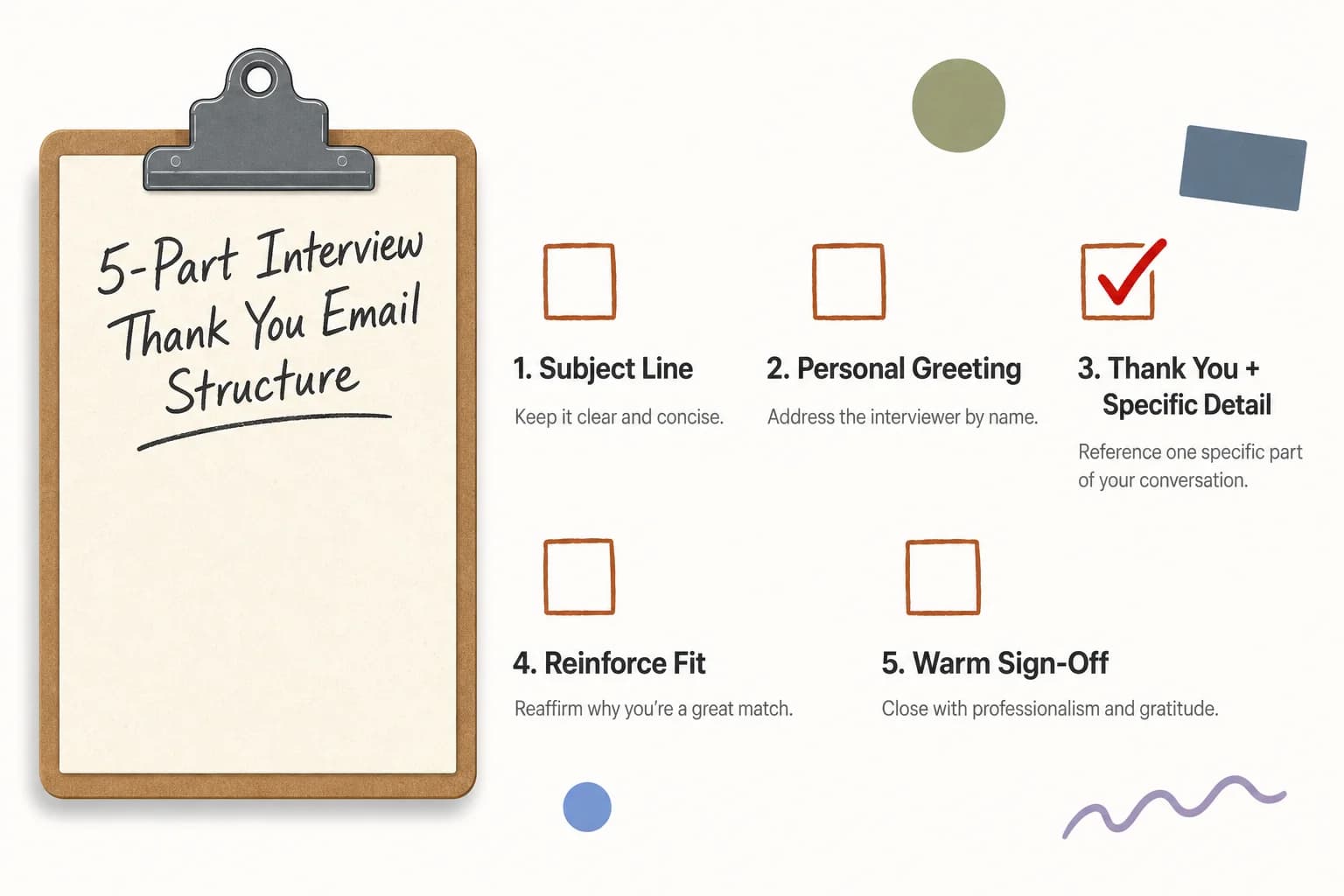
The 5-part structure every strong post interview thank you email needs
Common Mistakes That Kill a Good Thank You Note Template
Moreover, Most thank you note templates fail for the same handful of reasons. Furthermore, Once you see the pattern, you'll notice it everywhere.
Moreover, Mistake #1: Sounding like a template. Ironic, given the phrase "thank you note template" — but the second a hiring manager senses boilerplate, the goodwill evaporates. Nonetheless, Templates are fine as a starting skeleton. The content inside needs to be yours.
Mistake #2: Restating the whole interview. Nobody needs a full recap. Moreover, Pick one moment, not five.
Nevertheless, Mistake #3: Typos and rushed grammar. This one stings because it's so avoidable. A single "your" instead of "you're," in a follow up email after you spent an hour proving you're detail-oriented, sends a pretty mixed signal.
Mistake #4: Waiting too long. Three days later reads as an afterthought, not gratitude.
Furthermore, Mistake #5: Asking about salary or benefits. Save that for the offer stage. The thank you note isn't the place to negotiate.
Moreover, Mistake #6: Making it about you, not them. "I really need this job" energy, even unintentional, reads poorly. Consequently, Keep the focus on what you bring to their problem.
Quick before-and-after so the difference is obvious:
Weak: "Thank you for the interview yesterday. Additionally, I enjoyed our conversation and look forward to hearing from you soon."
Strong: "Thanks again for walking me through the team's approach to customer onboarding yesterday — the point about reducing time-to-first-value really stuck with me. My last role involved cutting that exact metric by 30%, and I'd love the chance to bring that experience to your team."
Hence, See the difference? Moreover, The weak version could've been sent to any job, by anyone, for anything. Nevertheless, The strong one only makes sense if you were actually in that room.
That's the whole trick, honestly.
How AI Tools Are Changing Career Email Writing
Therefore, Career email writing has quietly turned into one of the biggest everyday use cases for AI, and it isn't slowing down. Additionally, Pew Research found that roughly 21% of US workers now use AI on the job, up from the year before — and email writing sits near the top of the list of tasks people hand off to it.
Makes sense once you think about it. Writing a sharp, specific thank you email under time pressure — usually on your phone, standing in a parking garage right after the interview — is genuinely hard. Furthermore, You're tired. You're second-guessing every answer you gave. And now you gotta produce polished prose on top of it. Nonetheless, AI closes that gap.
Nevertheless, There's a real tension worth naming, though — hiring managers are getting better at spotting AI-generated fluff. Nonetheless, 2026 research on the topic makes the point directly: the bar isn't "did you send a thank you," it's "did you send a specific one." An obviously AI-written, generic note can actually work against you now, same as no note at all.
So the smart move isn't letting AI write the whole thing out of nothing. Nevertheless, It's using AI to fix and polish what you already drafted — your actual memory of the conversation, cleaned up, toned right, grammatically tight. That's a completely different use case than "write me a thank you email for a marketing job," which produces the exact generic slop hiring managers now flag.
This is where an ai keyboard job search workflow works differently than a chatbot tab. Nonetheless, Instead of switching apps, copy-pasting between ChatGPT and your email client, and losing your own voice somewhere in the process, a keyboard-level AI tool works right inside whatever app you're already typing in — Gmail, Outlook, LinkedIn messaging, doesn't matter. You type your rough draft, keep your own details and memory of the conversation, and the AI cleans up grammar, adjusts tone, and tightens the phrasing without swapping your voice for generic filler.
Moreover, CleverType is built exactly around this idea. It sits on your phone's keyboard and does grammar fixes, tone changes, and smart rewrites right where you're already typing your email — no app switching, no copy-paste. Because it works via on-device processing where possible, the details of your interview and your draft stay private — which matters more than people think when you're writing about a specific company and role.
Moreover, If you're job hunting and sending five, six, ten follow up emails a week across different companies, keeping tone consistent and error-free gets old fast. Nonetheless, That's exactly the kind of repetitive, high-stakes writing task an ai keyboard job search tool is built for — not replacing your judgment about what to say, just making sure how you say it lands right every single time.
Timing Your Follow Up Email: When To Send And What To Say Next
Additionally, The right time to send a thank you email is within 24 hours of the interview — the same day is ideal. Beyond that first note, though, there's a whole follow up sequence most candidates never think about.
Here's the realistic timeline:
- Within 24 hours — send the thank you email to each interviewer
- 5-7 business days later, if no response — send a polite status check email
- After the stated decision date passes — one more brief check in, no pressure, just clarity
- If rejected — a short, gracious reply keeps the door open for future roles at that company
That second-stage status check email trips people up because they're scared of seeming pushy. It shouldn't. A well written check-in, sent at the right interval, reads as organized and genuinely interested, not desperate. Something like: "I wanted to check in on the timeline for the [role] position — I remain very interested and happy to provide anything else that would help your decision." Treat it like writing a cold email that gets replies: polite, brief, value forward.
Consequently, What you should NOT do is email daily, or call the recruiter over and over. Frontline Moreover, Source Group's recruiter-tested guidance is clear that one respectful nudge at the right interval beats constant pestering every time — same logic applies if you're sending LinkedIn messages that get responses to reconnect with a recruiter.
A table to keep this straight:
| Stage | Timing | Purpose |
|---|---|---|
| Thank you email | Within 24 hours | Reinforce interest, reference specifics |
| First status check | 5-7 business days after interview (if no reply) | Confirm you're still in consideration |
| Second status check | After stated decision date passes | Get clarity, close the loop |
| Rejection response | Within 24-48 hours of hearing back | Keep relationship warm for future roles |
Nonetheless, One thing worth mentioning — if you interviewed for multiple rounds (phone screen, then panel, then final round), each round deserves its own short thank you note. Not one giant email at the end covering everything. Each interviewer who spent time with you deserves acknowledgment specific to their round, not a blanket group thank you.
Furthermore, And don't underestimate the rejection-stage email. I've seen candidates get hired six months later for a completely different role at the same company, purely because they responded graciously to a rejection instead of going silent. Recruiters remember who handled "no" with class.
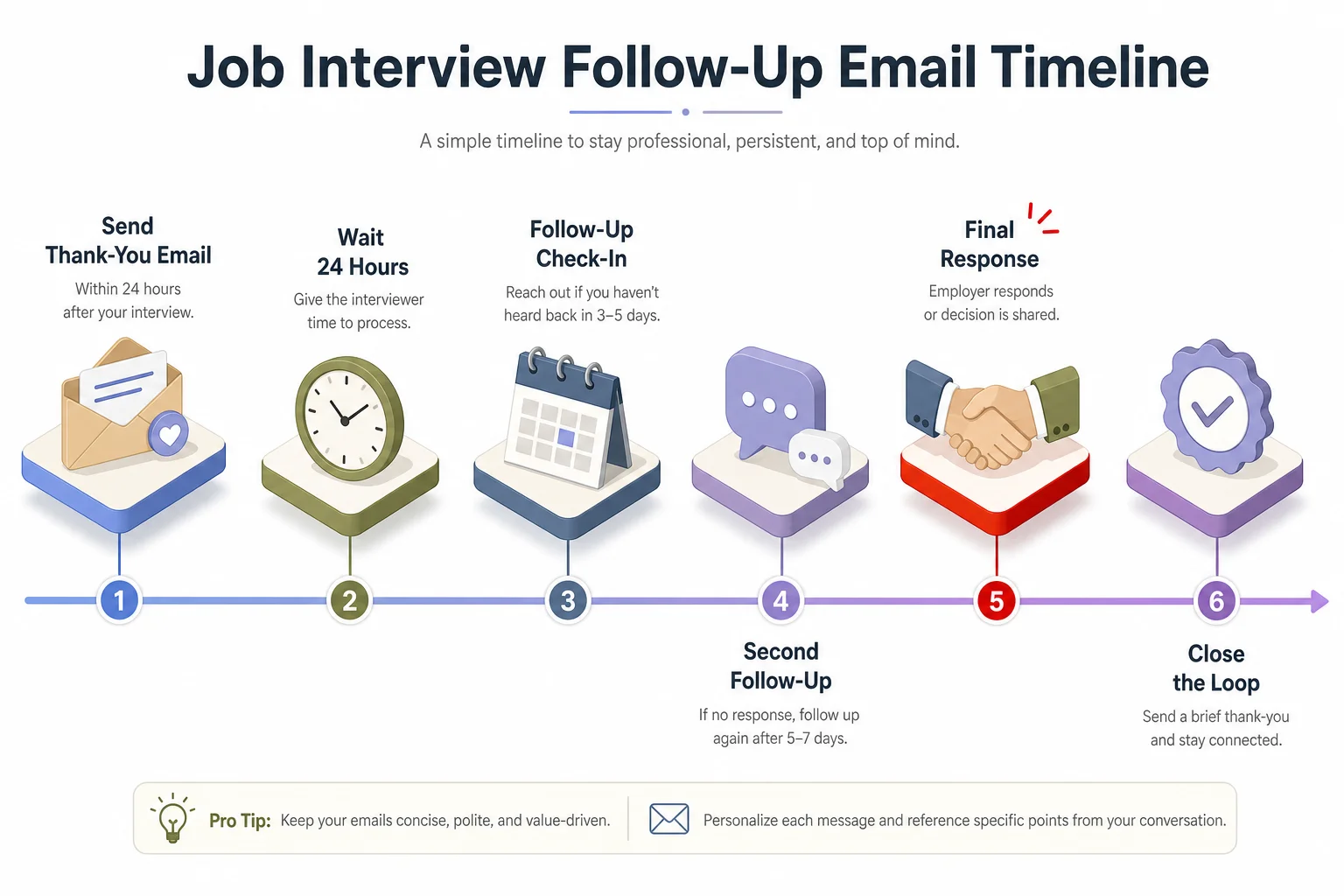
The full follow-up timeline, from the thank you email to closing the loop
Thank You Note Template Examples For Different Interview Types
Different interview formats call for different structures. A generic template rarely fits all of them — check out more follow up email templates that work. Here's Hence, what actually works for each.
Standard in-person or video interview:
Nonetheless, Subject: Furthermore, Thank You — Moreover, [Your Name], [Job Title] Interview
Hi [Interviewer Name],
Thank you for taking the time to speak with me today about the [Job Title] role. I really enjoyed learning more about [specific detail discussed], and it confirmed how much I'd like to contribute to what your team is building.
Given my background in [relevant skill], I'm confident I could help with [specific challenge mentioned]. Please let me know if there's anything further I can provide.
Best,
[Your Name]
Phone screen (shorter, faster):
Subject: Great speaking with you today
Hi [Recruiter Name],
Thanks for the call today — I appreciated getting a clearer picture of the [Job Title] role and next steps. I'm excited about the opportunity and look forward to hearing more.
Best,
[Your Name]
Panel interview (send individually, not one CC'd email):
Subject: Thank You — [Your Name], [Job Title] Panel Interview
Hi [Panelist Name],
Thank you for including me in today's panel — I especially enjoyed our discussion on [specific topic they raised]. It gave me a much better sense of how the team approaches [related area].
I'd welcome the chance to bring my experience with [relevant skill] to that work. Thanks again for your time.
Best,
[Your Name]
Second or final round (reference earlier conversations too):
Subject: Thank You — Following Up After Final Round
Furthermore, Hi [Interviewer Name],
Hence, Thank you for having me back for the final round today. Furthermore, Building on what we discussed in the first conversation about [earlier topic] and today's deeper dive into [today's topic], I'm even more confident this role is the right fit.
I'd love the opportunity to bring these ideas to the team. Nevertheless, Please let me know if there's anything else I can share.
Best,
[Your Name]
Additionally, Notice none of these run more than about 100 words. Nevertheless, On purpose — a post interview email that hits 300 words starts to feel like homework for the reader, and busy hiring managers skim right past long blocks of text. Short, specific, and genuine beats long every time.
Common Grammar And Tone Mistakes In Career Email Writing
Career email writing has its own quirks that don't show up in casual texting, and small mistakes here carry more weight than people realize — a hiring decision might genuinely hinge on it.
The most frequent issues I see:
- Overly casual openers — "Hey!" works for a friend, not for a hiring manager you met once
- Passive voice overload — "The role was discussed by us" instead of "We discussed the role" — passive voice buries who did what and reads weaker
- Run-on enthusiasm — exclamation points stacked up start to feel less genuine, not more
- Wrong name or title — double check spelling of the interviewer's name and their exact job title before hitting send
- Inconsistent tone across rounds — going from formal in round one to overly casual by round three confuses the read on your professionalism
- Autocorrect errors — phone autocorrect loves to swap words at the worst moment, and "manager" becoming "manger" in a serious email is a real thing that happens
Nonetheless, That last one is way more common than people admit. Consequently, Most thank you emails today get typed on a phone, standing somewhere right after leaving the building, thumbs moving fast because you want to hit that 24 hour window. Phone typing under time pressure is exactly when small grammar slips happen — a missing "the," a wrong "there/their," a sentence that trails off because you got interrupted. These are exactly the kind of common grammar mistakes AI can fix in seconds, before you hit send.
This is genuinely where an AI keyboard job search tool earns its keep over a plain phone keyboard. CleverType catches grammar slips as you type, nudges overly casual phrasing toward something more professional if that's the tone you need, and can rewrite a whole paragraph to sound sharper without you retyping from scratch. Since it's built into the keyboard itself, there's no copying your draft into a separate app, losing your place, and pasting it back — the fix happens right there, mid-sentence, in Gmail or wherever you're writing.
Additionally, Grammar mistakes alone rarely sink a candidate. But combined with everything else — the missing personal detail, the generic phrasing, the three-day delay — a sloppy email becomes one more small reason to pick the other person. None of these are individually fatal. Hence, Stacked together, though, they add up fast.
How Recruiters Actually Read Your Follow Up Email
Recruiters read differently than you'd expect. Additionally, Knowing their actual reading pattern changes how you should write.
Nonetheless, Most hiring managers open a follow up email on their phone, between other tasks, and give it maybe 15-20 seconds before deciding whether it's worth a full read. Nevertheless, Not much time. Here's what they're actually scanning for, in rough order:
- The subject line — does it clearly say what this is
- The first sentence — does it get to the point immediately
- Any specific detail — does this person remember something real, or is it generic
- Length — is this going to take 10 seconds or 2 minutes to read
- Sign off and next steps — does it end cleanly
Moreover, Notice grammar and spelling aren't at the top of that list. Additionally, But they're the fastest way to get bumped OUT of a full read. A typo in the first sentence and a busy recruiter's brain flags "sloppy" before they even finish the paragraph — which colors how they read everything after.
Moreover, There's also a scale factor people underestimate. Hence, A recruiter at a mid-size company might get 40-60 candidate emails a week across open roles. At that volume, anything that takes extra effort to parse — long paragraphs, unclear subject lines, vague references — gets skimmed and forgotten fast. The job interview data consistently shows hiring has gotten more competitive, which means recruiter attention per candidate has gotten shorter, not longer.
One more thing worth knowing — plenty of recruiters forward strong follow up emails internally to hiring managers or other panelists, especially if it includes a smart, specific point about the role. So your email isn't just being read once by one person. Write it knowing it might get forwarded, and it holds up better under that scrutiny too — one more reason to treat every follow up as a chance to boost your career with better writing, not just check a box.
Frequently Asked Questions
How soon should I send a thank you email after a job interview?
Send it within 24 hours, ideally the same day if your interview happened in the morning or early afternoon. Waiting longer than a day makes the gesture feel like an afterthought rather than genuine gratitude.
Should I send a separate thank you email to each interviewer in a panel interview?
Yes, send an individual, slightly different email to each panelist rather than one group message. Interviewers sometimes compare notes, and a personalized note to each person reads far better than an obvious copy-paste.
Is it okay to use AI to help write my interview thank you email?
Yes, as long as you use it to polish your own draft rather than generate the whole thing from a generic prompt. Hiring managers are increasingly able to spot fully AI-written, generic thank you notes, so keep your specific details and voice, and let AI clean up grammar and tone.
What should I do if I don't hear back after sending a follow up email?
Wait 5-7 business days, then send one polite status check email confirming your continued interest and asking about the timeline. Avoid emailing more than once in that window, since repeated follow ups can come across as pushy.
Does a thank you email really affect whether I get hired?
It can — surveys show around 68% of hiring managers say thank you emails influence their decision, and nearly 1 in 5 have rejected a candidate for not sending one. It rarely gets you hired on its own, but skipping it can tip a close decision against you.
What's the ideal length for a post interview email?
Keep it between 80 and 150 words depending on interview type — phone screens can be even shorter. Recruiters scan quickly, so a short, specific note outperforms a long one every time.
Should I mention salary or ask about next steps in my thank you email?
Keep the thank you email focused on gratitude and reinforcing your fit for the role, and save salary discussions for the offer stage. A brief, polite line about looking forward to next steps is fine, but avoid turning the note into a negotiation.
Ready to Type Smarter?
Nonetheless, Upgrade your typing with CleverType AI Keyboard. Additionally, Fix grammar instantly, change your tone, receive smart AI replies, and type confidently while keeping your privacy.
Download CleverType FreeAvailable on Android • 100+ Languages • Privacy-First
Sources
- Only 24% of Candidates Send a Thank-You Note — The Interview Guys
- The Ultimate Guide to Interview Follow-Up Emails — Glassdoor
- How To Write the Best Thank You Email After Your Interview — Indeed
- How to Write Thank-You Emails After Interviews — Robert Half
- About 1 in 5 US Workers Now Use AI in Their Job — Pew Research Center
- Should You Follow Up After a Job Interview? — Frontline Source Group
- Job Interview Statistics: Key Data and Trends — Resumemate