
Key Takeaways
| Topic | What You Need to Know |
|---|---|
| EU AI Act | In force since August 1, 2024; prohibited practices enforced from February 2, 2025 |
| Privacy Foundation | GDPR principles directly shape how European AI tools handle your data |
| Fines | Up to €35 million or 7% of global turnover for the most serious violations |
| European AI Tools | Mistral AI, DeepL, Aleph Alpha, Nextcloud — all built with privacy by design |
| What It Means for You | AI writing tools in Europe can't silently harvest your text for training |
| AI Keyboards | Privacy-first keyboards like CleverType process suggestions on-device without sending data to third parties |
Moreover, Europe does AI differently. Moreover, American tech companies built AI products first and asked privacy questions later — sometimes years later, sometimes never. Hence, The EU flipped that script: write the rules first, then build the tools. That choice now shapes a whole category of AI software that millions of people use every day.
According to the European Parliament's official overview, the EU AI Act is the world's first full legal framework for artificial intelligence. Consequently, It came into force on August 1, 2024, and the first wave of enforcement — covering prohibited AI practices — kicked in on February 2, 2025. Nonetheless, Full high-risk compliance is due August 2026.
So what does the european ai approach actually look like in practice? And why should you care about it when it comes to the tools you type with every day?
What Is the European AI Approach and Why Does It Matter?
Furthermore, The european ai approach runs on one core idea: AI should respect human rights, and privacy counts as one of those rights. Not a marketing slogan. Actually written into law.
The EU AI Act uses a risk-based classification system. Every AI application gets sorted into one of four buckets:
- •Unacceptable risk — banned outright (e.g. real-time biometric surveillance in public spaces)
- •High risk — heavily regulated (hiring tools, credit scoring, medical devices)
- •Limited risk — must be transparent (chatbots must tell you they're AI)
- •Minimal risk — no specific requirements (spam filters, video games)
The European Commission estimates only 5-15% of AI applications will land in the stricter high-risk category. But the ripple effect is bigger than that number suggests. Therefore, Companies building AI tools for European users now have to bake in privacy, transparency, and human oversight from the start — not bolt it on as an afterthought.
The European Data Protection Supervisor's guidance on the AI Act is pretty clear: the Act works alongside GDPR, not instead of it. If an AI tool processes personal data — and almost every writing assistant does — it needs to clear the GDPR bar and the AI Act bar. That's two hurdles, and nothing else in the world requires both.
Practically, this means European AI writing tools tend to:
- Clearly state what data they collect
- Offer opt-outs from data training
- Store data inside the EU or European Economic Area
- Give users control over their data
- Avoid opaque black-box decision-making
If you ever type anything sensitive — work emails, medical notes, legal docs, personal messages — that list matters more than you might think.
How GDPR Set the Foundation for Privacy-First AI
Hence, You can't really get European AI tools without getting GDPR first. The General Data Protection Regulation has been in force since May 2018, and it fundamentally changed how tech companies treat user data in Europe. This is the foundation everything else is built on.
Nonetheless, GDPR laid out several principles that now shape how ethical AI tools actually work:
| GDPR Principle | What It Means for AI Tools |
|---|---|
| Data minimisation | Collect only what's strictly necessary |
| Purpose limitation | Don't use data for purposes beyond what users agreed to |
| Storage limitation | Don't keep data longer than needed |
| Accuracy | Keep data accurate and let users correct it |
| Integrity and confidentiality | Protect data against breaches |
When an AI writing assistant in Europe processes your text, it needs a legitimate reason under GDPR to do that. Nevertheless, "We want to train our model" doesn't cut it automatically. Explicit consent is required — and you can pull that consent back whenever you want.
Consequently, The Cloud Security Alliance's 2025 analysis noted that "2024 marked a pivotal moment in global regulation" — and that companies with strong GDPR compliance programs are already ahead on AI Act readiness. Privacy officers who spent years grinding through the GDPR work are now the most valuable people in the room when AI compliance questions come up.
This is why EU-based AI tools built with data sovereignty often have a real head start. Nonetheless, The institutional knowledge of what "data protection by design" actually means — not just as a tagline but as an actual engineering requirement — is baked into European tech culture in a way it simply isn't elsewhere.
One thing worth knowing: Furthermore, GDPR fines Consequently, aren't symbolic. In 2023, Meta was fined a record €1.2 billion for transferring EU user data to the US without adequate protections. Moreover, That kind of enforcement risk tends to focus minds. Moreover, Companies take privacy seriously in product design when the alternative is a billion-euro fine.
Top European Privacy-First AI Writing Tools
Nevertheless, European developers have built a genuinely solid ecosystem of privacy-focused AI tools. And I mean genuinely solid — several of these compete directly with US counterparts on features while going further on privacy. For a full feature-by-feature breakdown, check our comparison of the best AI keyboards.
Mistral AI / Le Chat
Paris-based Mistral AI released open-weight language models that organisations can run entirely on their own infrastructure. No data shipped to third-party servers, no training on your inputs. Le Chat, their consumer product, is basically a privacy-first chat experience — and it actually lines up with what the EU's regulatory framework asks for.
DeepL
The Cologne-based service processes over 1 billion translations per month, and its privacy policy is actually different from Google Translate's — not just in wording, but in practice. Free users get text deleted after 24 hours; Pro users can opt out of any retention at all. For europe ai writing tasks involving sensitive documents, DeepL is the go-to for a lot of professionals.
Aleph Alpha
Consequently, Based in Heidelberg, Aleph Alpha builds what they call "sovereign AI" — enterprise AI where the customer keeps full data control. Their systems can run in completely isolated environments with nothing leaving the client's network. It's a big deal for government agencies and healthcare providers across Germany.
Nextcloud Assistant
If you use Nextcloud for file storage, the built-in AI assistant runs locally on your server. Your text never leaves your infrastructure. That's a real technical guarantee, not just a policy promise.
These tools all share one thing: privacy as an architectural decision, not a setting you flip on. That's Therefore, what the european ai approach actually produces when it becomes a real engineering constraint.
What "Privacy by Design" Actually Means for AI Keyboards
Nevertheless, Privacy by design gets thrown around constantly. But what does it actually look like in a tool you use every single day?
For AI keyboards specifically, it means the intelligence happens on your device, not some server somewhere. The model that predicts your next word, checks your grammar, or suggests a better phrasing runs right in the app — your keystrokes never leave.
Consequently, This matters more than most people realise. Think about what you type in a given day:
- •Banking app passwords (hopefully not, but it happens)
- •Work emails about sensitive projects
- •Messages to your doctor
- •Personal conversations with family
A keyboard app that sends your keystrokes to the cloud — even "anonymised" — is a real privacy exposure. Traditional keyboards from big tech have taken heat over this. Wired has covered keyboard data collection extensively, and the takeaway is pretty blunt: mobile keyboards sit at the intersection of convenience and surveillance.
CleverType is built with this exact concern in mind. Unlike Gboard, which processes predictions through Google's servers and uses your input to improve Google's models, CleverType keeps AI suggestions on your device. Consequently, Your text stays with you. Therefore, That's not a small difference — it's the difference between a privacy ai keyboard and a data collection tool dressed up as one.
The on-device approach has another perk: it works offline. Nonetheless, No Wi-Fi required, no waiting for a server to respond. Furthermore, If offline processing matters to you, check our roundup of the best offline voice-to-text tools without cloud dependency. Suggestions appear as fast as the hardware allows, not as fast as your internet connection.
Nevertheless, For European users especially, this architecture means CleverType lines up naturally with what GDPR and the AI Act actually expect. Data stays on device — no cross-border transfer issues, no training data concerns, no GDPR Article 6 lawful basis headaches.
The EU AI Act's Real Impact on AI Writing Tools in 2025
Nevertheless, The EU AI Act isn't theory anymore. As of February 2025, the prohibited AI practices provisions are in live enforcement. Nonetheless, General-purpose AI transparency requirements kicked in August 2025. So what's actually changed for AI writing tools?
Moreover, The transparency requirements are probably the most visible change right now. Under the AI Act, if you're using an AI system that could "meaningfully interact" with humans, the provider has to tell you it's AI. Every writing assistant, every chatbot, every AI keyboard — they all need to be upfront about what they are.
The fines are structured in three tiers:
| Violation Type | Maximum Fine |
|---|---|
| Prohibited AI practices | €35 million or 7% of global annual turnover |
| High-risk AI system breaches | €15 million or 3% of worldwide annual turnover |
| Other violations (misleading info, etc.) | €7.5 million or 1% of worldwide annual turnover |
For reference, 7% of Google's 2024 global revenue would be roughly $19 billion. These aren't symbolic fines.
The EU's comprehensive AI Act resource breaks it down: organisations using high-risk AI systems must conduct Fundamental Rights Impact Assessments (FRIAs) — basically audits of how the AI could affect privacy, non-discrimination, and dignity. Nevertheless, A grammar checker probably doesn't hit that threshold. But anything touching healthcare decisions or employment does.
What this means practically for writing tools: expect more explicit disclosures about how your text gets used, easier opt-outs from training, and clearer language about where data actually lives. Hence, That vague "we may use your data to improve our services" language in most American AI terms of service? Moreover, Increasingly untenable under EU law.
European vs American AI: The Privacy Comparison Nobody Wants to Have
Nonetheless, Let's be direct about this. American AI tools — including most keyboard apps and writing assistants — were built in an environment with minimal federal privacy law. California's CCPA offered some protections, but federal-level comprehensive AI privacy law in the US still doesn't exist as of 2025.
Nonetheless, This created a structural difference in how AI products work:
| Feature | European AI Approach | Typical US AI Approach |
|---|---|---|
| Data location | EU-based servers required | Often US-based, globally distributed |
| Training data opt-out | Mandatory right to opt out | Often opt-in only, or no option |
| Data retention | Limited by purpose | Often indefinite unless user requests deletion |
| Transparency | Required by law | Voluntary, varies by company |
| Regulatory oversight | EU AI Office + Member States | Fragmented, industry-led |
| User rights | Access, deletion, correction | Varies by state |
Gboard, for example, logs your typed text — including words not in the dictionary — to improve Google's models. Nonetheless, That data goes to Google's servers. Consequently, If you're in the EU, Google says it handles this under GDPR, but the data still leaves your device, and your input still trains Google's systems unless you opt out. Nevertheless, Most people never find that setting. For a direct side-by-side look at how AI writing keyboards compare to traditional keyboards, the differences become even clearer.
SwiftKey by Microsoft follows a similar pattern. Your typing data, personalised dictionary entries, most-used phrases — all synced to Microsoft servers by default. Technically GDPR-compliant, but miles from what privacy by design actually looks like.
CleverType takes the opposite approach. Moreover, Predictions, grammar fixes, tone changes — processed on your device. No cloud sync of your input data. When you type something private, it stays private. For users who care about the european ai approach in their daily tools, this is exactly what that principle looks like in a keyboard app.
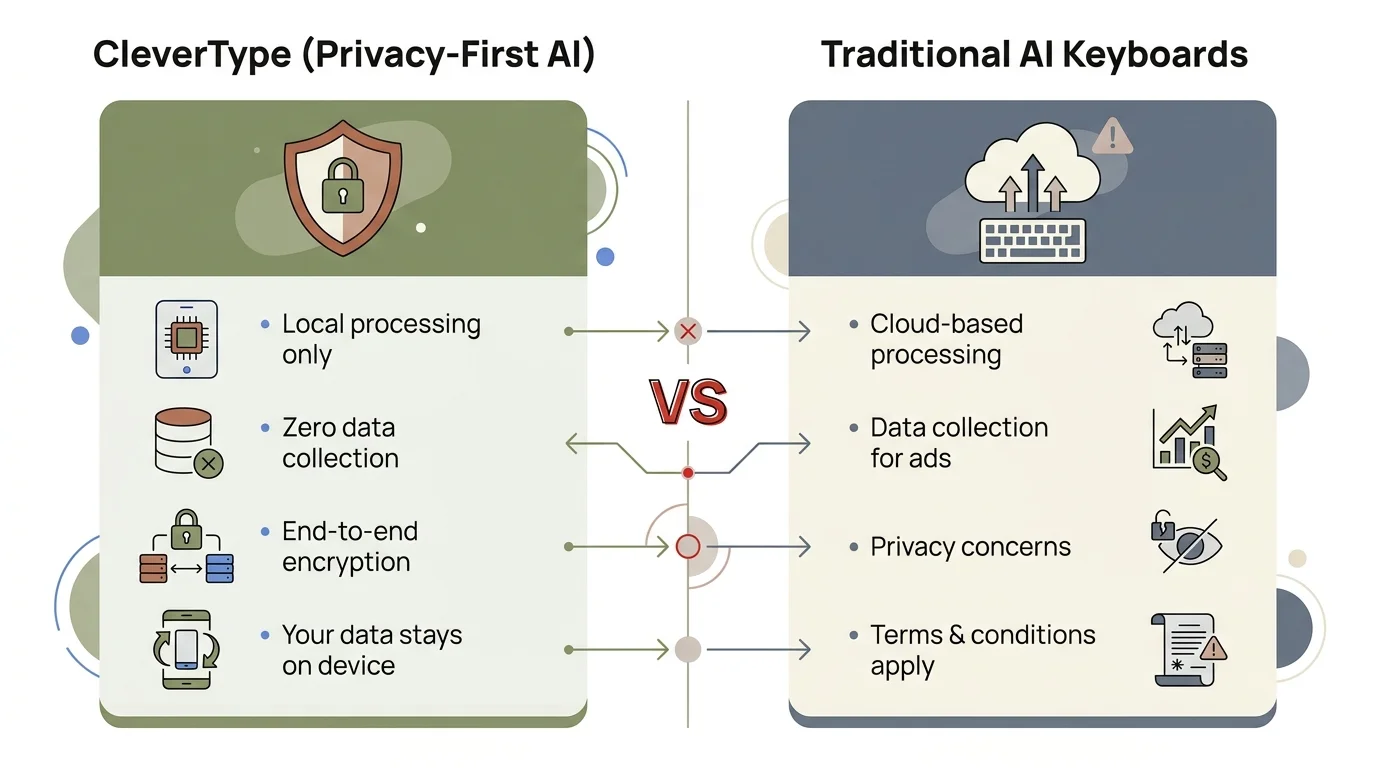
CleverType's on-device AI approach vs the cloud-based data collection model used by most traditional AI keyboards
How to Choose a Privacy-First AI Tool for Writing
Choosing a privacy-first AI writing tool comes down to five questions. Consequently, Ask them before you install anything. Our AI keyboard buyer's guide covers these criteria in depth if you want the full checklist.
1. Where does my data go?
Additionally, On-device processing is ideal. Additionally, Cloud processing should require explicit consent. Moreover, Check the privacy policy — specifically section covering "how we use your data" and "training data."
2. Who owns the model?
Open-source or open-weight models (like Mistral's) can be audited. Therefore, Proprietary black-box models can't. Audit transparency matters if you're handling sensitive content.
3. Can I opt out of training?
Every serious privacy-first tool offers this. If the option doesn't exist or is buried, treat that as a red flag.
4. Where are the servers?
EU-based servers mean EU law applies. Nevertheless, Data transferred to the US operates under a different (less protective) legal framework unless specific safeguards are in place.
5. Has there been a data breach?
Additionally, Check Have I Been Pwned and recent news. Nonetheless, A company's response to breaches tells you a lot about how seriously they take security.
For everyday typing on Android, CleverType checks most of these boxes:
- •AI processing happens on-device
- •No keystroke logging sent to external servers
- •Grammar correction, tone adjustment, and smart replies all run locally
- •Available in 100+ languages without sending translation data to third parties
Additionally, If you want a privacy ai keyboard that reflects european ai approach values, CleverType is available on Android and is free to download.
What European Privacy Rules Mean for the Future of AI
The EU isn't done. The AI Act's enforcement calendar runs through 2026, and the General Purpose AI Code of Practice — finalised in July 2025 after iterations in November 2024, December 2024, and March 2025 — sets new transparency standards for the large models that power most writing tools. Explore predictions for where AI keyboard technology is heading as these regulations take hold.
Consequently, GPAI providers (think the companies behind GPT-4, Claude, Gemini) now need to publish summaries of training data, implement copyright policies, and demonstrate adversarial testing. That's new territory. Nonetheless, The companies that built their models on scraped internet data without documentation are scrambling.
What does this mean for you? A few things:
- •Better model documentation — You'll increasingly know what data trained the tool you're using
- •Stronger opt-out rights — Clearer, easier ways to exclude your content from future training
- •More European alternatives — The compliance burden is actually friendlier to companies that built privacy in from the start, which means European AI startups have a genuine structural advantage
- •Global ripple effect — Companies that comply with EU law often apply those standards globally because maintaining two different privacy postures is expensive
The European Commission's digital strategy page frames this as building "trustworthy AI" — which sounds abstract until you consider what the alternative looks like. An AI that harvests your writing, predicts your behaviour, and sells those predictions isn't untrustworthy because it makes mistakes. Moreover, It's untrustworthy because you never agreed to that deal.
Europe's bet is that users, once they actually understand the choice, will prefer AI tools that respect them. Based on the growth of privacy-focused alternatives over the past three years, that bet is looking pretty solid. Many users are finding value in underrated AI keyboard features that privacy-first tools offer beyond basic autocorrect.
The broader lesson: privacy isn't the opposite of good AI. Consequently, Done right, it's a design constraint that produces better, more focused tools — because when you can't monetise user data, you have to actually make the product good enough that people pay for it.
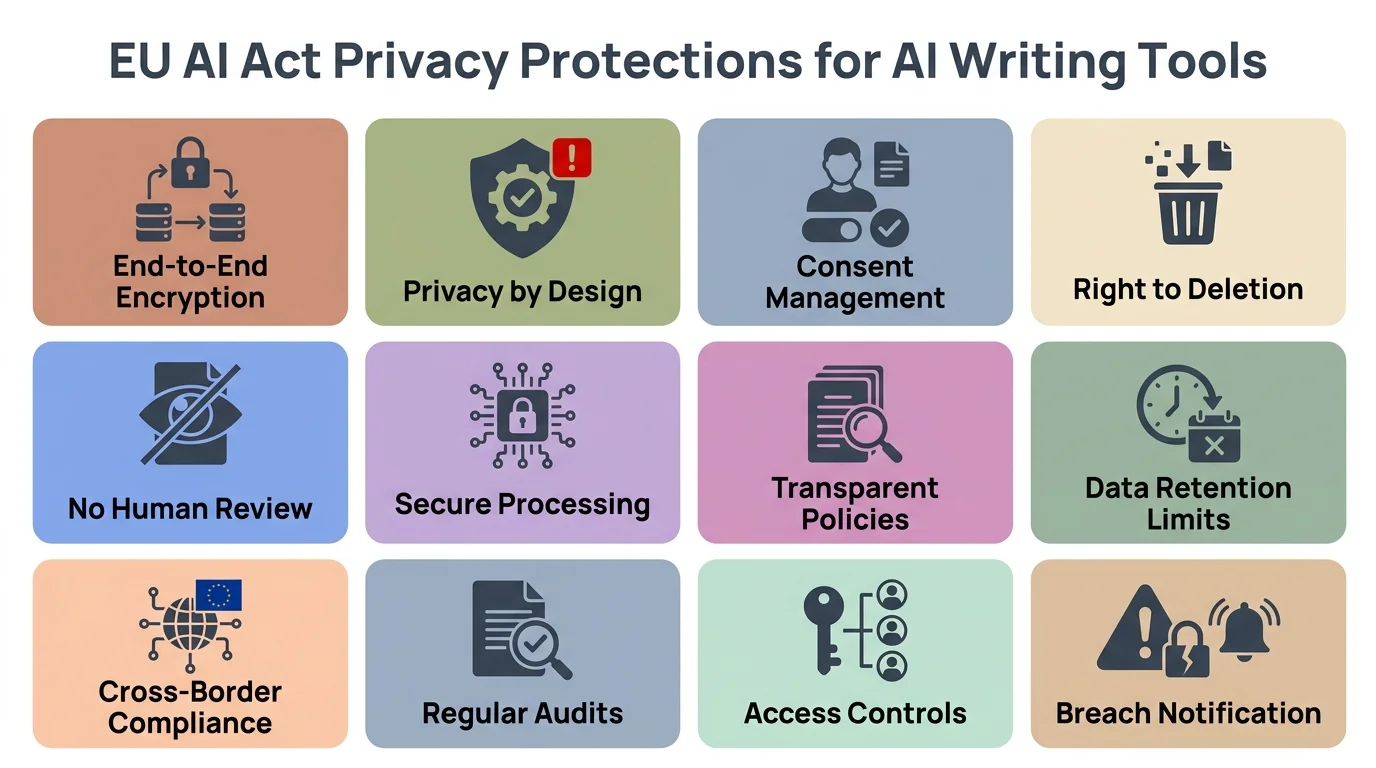
12 core EU AI Act privacy protections that apply to AI writing tools — from data encryption and consent management to the right to deletion
Frequently Asked Questions
What is the EU AI Act and when does it apply?
The EU AI Act is the world's first comprehensive legal framework for artificial intelligence, in force since August 1, 2024. Prohibited practices have been enforced since February 2, 2025, with full high-risk AI compliance required by August 2026.
What does privacy-first AI mean for everyday users?
Privacy-first AI means the tool processes your data on your device or under strict data minimisation rules, without silently sending your input to train models or build profiles. You keep control of your text, and the company needs your explicit consent to use your data for anything beyond delivering the service.
Are European AI writing tools as good as American ones?
Yes, in many cases. DeepL outperforms Google Translate on several language pairs according to independent benchmarks. Mistral's open models compete with GPT-4 class models on many tasks. Privacy compliance has pushed European tools to invest in quality rather than data harvesting as a business model.
Does using a privacy-first AI keyboard actually protect your passwords?
On-device processing keyboards like CleverType don't transmit your keystrokes to external servers, which removes the cloud-side interception risk. However, no keyboard app should ever store passwords — use a dedicated password manager for that. The privacy benefit of on-device AI is about writing, messages, and documents, not replacing secure credential storage.
How do I know if my current AI keyboard is sending my data to the cloud?
Check the app's privacy policy under "data we collect" and "how we use your data." Look specifically for references to model training, keystroke logging, or server-side processing. If the language is vague — "we may use data to improve services" — treat that as cloud processing. Apps that process on-device usually make that an explicit feature, not fine print.
What makes the european ai approach different from other regions?
The EU's approach is legally binding, risk-based, and enforced with significant fines. It combines existing GDPR data protection rights with new AI-specific transparency and safety requirements. Unlike US approaches (which are largely voluntary or state-level) or Chinese approaches (which prioritise state oversight), the EU framework prioritises individual rights and explainability.
Can I use European AI tools if I'm outside the EU?
Yes. Most European AI tools are available globally. The privacy protections they offer — on-device processing, clear data policies, opt-out rights — apply to all users regardless of location. European AI tools built to GDPR and AI Act standards often have the most transparent data practices globally, which is useful wherever you are.
Ready to Type Smarter?
Upgrade your typing with CleverType AI Keyboard. Fix grammar instantly, change your tone, receive smart AI replies, and type confidently while keeping your privacy.
Download CleverType FreeAvailable on Android • 100+ Languages • Privacy-First
Share this article:
Sources:
- European Parliament – EU AI Act: First Regulation on Artificial Intelligence
- European Commission – Regulatory Framework for AI
- European Data Protection Supervisor – Artificial Intelligence Act
- EU AI Act – Comprehensive Resource
- Cloud Security Alliance – AI and Privacy: 2024 to 2025
- Plausible Analytics – European Privacy-Friendly Tools