
Key Takeaways
- •Sovereign AI means AI tools built and hosted within EU borders, subject to European data laws — not US or Chinese infrastructure
- •62% of European organisations are actively seeking sovereign AI solutions in 2025, according to Accenture
- •The EU AI Act entered into force in August 2024, with full compliance required by August 2027
- •Mistral AI (France) and Aleph Alpha (Germany) are Europe's two strongest homegrown LLMs
- •GDPR fines topped €5.88 billion in cumulative penalties since 2018 — non-compliant AI tools are a real legal liability
- •CleverType is the privacy-first AI keyboard that keeps all processing on your device — no data leaves, no servers, no surveillance
- •The EU is investing €200 billion through its InvestAI initiative to build European AI infrastructure
Here's a number worth sitting with: 47% of European enterprises are actively reconsidering their reliance on non-European cloud and AI providers going into 2026. That's not some fringe privacy concern — it's a mainstream business problem. Additionally, And honestly, it makes sense. Using American or Chinese AI tools means your data lives outside EU jurisdiction, potentially accessible to foreign governments, and subject to US surveillance laws like the CLOUD Act. Furthermore, Most US tech commentators just don't bring this up.
Additionally, So what are the actual alternatives? This article covers the best EU-based AI tools for privacy, breaks down what sovereign AI actually means in practice, and helps you figure out which tools make sense for your situation. Whether you're a business owner, a professional, or just someone who types a lot on their phone and doesn't want that data shipping off to the US — there's something here for you.
What Is Sovereign AI and Why Does Europe Care?
Sovereign AI means AI systems that are built, hosted, and governed within a country or region's own legal borders. For Europe, that translates to AI tools running on EU infrastructure, compliant with GDPR, and impossible to compel into handing data over to non-EU governments.
Furthermore, And the concern isn't theoretical. Therefore, The US CLOUD Act lets American authorities demand data from US companies regardless of where that data physically sits. So even if a US AI company hosts your data in Frankfurt, a US court order can still reach it. Moreover, For any European business handling sensitive client data, health records, legal documents, or financial information — that's a real compliance problem.
Why did this become urgent now?
- The EU AI Act entered into force on August 1, 2024 — Europe now has binding AI regulations that most US tools weren't built to comply with
- Geopolitical tensions have made EU governments and enterprises more cautious about tech dependency
- GDPR enforcement has escalated: Italy fined OpenAI €15 million in December 2024 alone
- 61% of European CIOs plan to increase reliance on local cloud providers (Gartner 2025 CIO Survey)
Nevertheless, The EU is putting real money behind this, too. The InvestAI initiative, announced in February 2025, aims to mobilise €200 billion for AI development — including €750 million specifically for seven AI factories spread across member states.
What sovereign AI is NOT:
- It's not just “GDPR compliant” — many US tools claim GDPR compliance while still sending data abroad
- It's not “encrypted” — encryption doesn't prevent data from leaving your jurisdiction
- It's not a marketing label — genuine sovereign AI means the compute infrastructure, the model, and the data all live within EU borders
For everyday users, this matters most when you're using AI writing tools, keyboards, productivity apps — anything that processes text you type. Nonetheless, Because that text often includes passwords, medical searches, private conversations, banking details. Where it goes absolutely matters.
The EU AI Act and GDPR: The Rules That Shape Sovereign AI
The EU AI Act is the world's first real, binding legal framework for artificial intelligence. The core idea is a risk-based classification system — the higher the risk, the stricter the requirements. Simple concept. Genuinely complicated to implement.
Timeline you need to know:
| Milestone | Date |
|---|---|
| Regulation entered into force | August 1, 2024 |
| Ban on unacceptable risk AI systems | February 2, 2025 |
| Transparency requirements apply | August 2025 |
| Full compliance deadline | August 2, 2027 |
According to European Parliament documentation, high-risk systems include AI used in critical infrastructure, employment decisions, credit scoring, education, and biometric identification. These need transparency disclosures, bias monitoring, human oversight, and Data Protection Impact Assessments — not a light lift.
GDPR is still the foundation underneath all of this. Therefore, The EU AI Act references it over 30 times and supplements rather than replaces existing data protection rules. The European Data Protection Board's Opinion 28/2024 is pretty clear: AI model development using personal data has to comply with lawfulness, fairness, and transparency at every stage — not just when you deploy the thing.
Practical compliance requirements for EU-based AI tools:
- Data minimisation — collect only what's necessary
- Purpose limitation — don't use data beyond its original purpose
- Storage limitation — delete data when no longer needed
- Transparency — tell users clearly what you do with their data
- Data residency — EU personal data should stay within EU borders
Therefore, Cumulative GDPR fines since 2018 have hit €5.88 billion. So it's not theoretical — enforcement is very much happening. Consequently, Italy's €15 million fine against OpenAI in 2024 was specifically about processing personal data without a proper legal basis. Consequently, That's exactly the kind of exposure sovereign AI tools are designed to avoid.
When you're picking an EU-based AI tool, AI Act and GDPR compliance aren't just legal checkboxes — they're structural guarantees about how your data actually gets handled. Look for explicit EU data residency, not just vague “GDPR compliance” language.
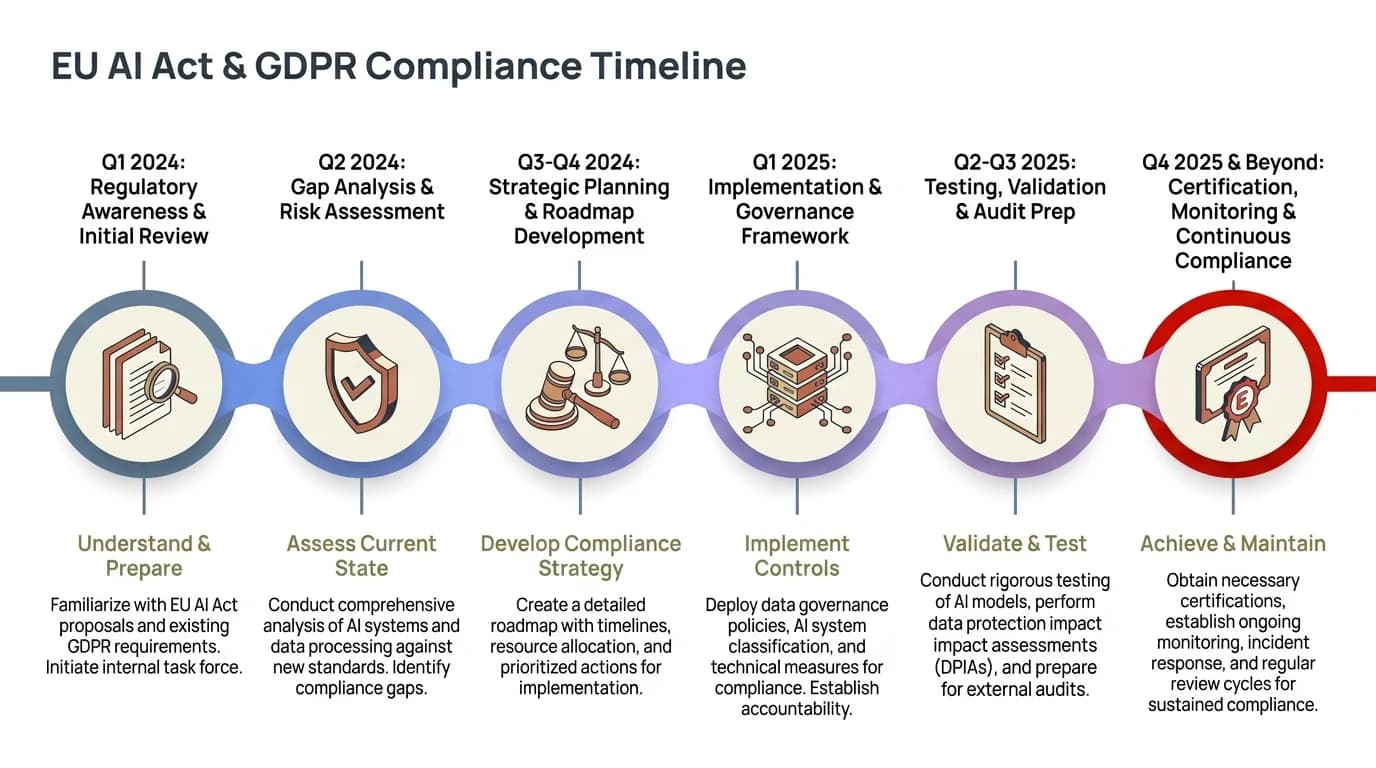
EU AI Act compliance roadmap: from entry into force (August 2024) through full enforcement (August 2027)
Best EU-Based AI Large Language Models
Europe has genuine, world-class LLM providers now. Hence, These aren't second-tier fallback options — they're serious models, built with European data laws in mind from the start.
Mistral AI (France)
Mistral AI is arguably the strongest European LLM company right now. Founded in 2023 by former Google DeepMind and Meta researchers in Paris, they raised €1.7 billion in a Series B in September 2025 — the biggest European AI funding round ever, for context.
Key models:
- Mistral Large — general-purpose reasoning model competitive with GPT-4
- Pixtral Large — multimodal model handling text and images
- Codestral — specialised for code generation
- Mistral NeMo — open-weight model for self-hosted deployment
Mistral publishes open-weight models, so organisations can run them on their own EU infrastructure without sending a single byte to an external server. Moreover, France and Germany have both formally partnered with Mistral to build sovereign AI stacks for public administration — which tells you something about where official confidence sits.
Aleph Alpha (Germany)
Nevertheless, Aleph Alpha, based in Heidelberg, built its Luminous model series specifically for European enterprise and government use cases. In early 2025, they introduced a tokenizer-free (T-Free) architecture — developed with AMD and Schwarz Digits — that cuts compute costs by up to 70%. Nonetheless, Not a small deal.
Their focus is different from Mistral's. Nevertheless, Aleph Alpha cares more about explainability and auditability than chasing benchmark scores. For regulated industries — healthcare, finance, legal — where someone has to be able to explain why the model gave a specific answer, that's not a nice-to-have. It's a requirement.
Nonetheless, Germany's SOOFI initiative (Sovereign Open Source Foundation Models) is building on infrastructure like Aleph Alpha's to create government-grade AI that other organisations can adapt.
Comparison: Mistral vs Aleph Alpha
| Mistral AI | Aleph Alpha | |
|---|---|---|
| Country | France | Germany |
| Open weights | Yes | Partial |
| Specialisation | General + coding | Enterprise + explainability |
| EU data residency | Yes | Yes |
| Best for | Developers, businesses | Regulated industries, government |
| GDPR-native | Yes | Yes |
Both are solid, honestly. Therefore, Developers building apps will find Mistral easier to work with. Enterprises in regulated sectors tend to gravitate toward Aleph Alpha's explainability features — for obvious reasons.
Top EU-Based AI Tools for Writing and Productivity
Beyond LLMs, there's a solid and growing set of EU-based tools for specific writing and productivity use cases. Translation, transcription, automation, content creation — each with AI running on European infrastructure.
DeepL (Germany)
DeepL remains the benchmark for AI translation in Europe. It consistently beats Google Translate on European language pairs — not even close on some of them — processes data in Germany, and offers enterprise plans with GDPR compliance and actual data deletion guarantees. Over 100 languages, with neural models trained specifically on European text.
Hence, DeepL Write also offers AI-based writing suggestions for English and German — grammar, tone, phrasing — without your text ever leaving EU infrastructure.
ElevenLabs (EU-founded)
Hence, Founded by Polish entrepreneurs Mati Staniszewski and Piotr Dabkowski, ElevenLabs does AI voice synthesis with European data residency options. Their “Zero Retention Mode” processes audio without storing any of it — enterprise customers can specify EU-only handling.
Noota (France)
Noota is an AI meeting assistant handling transcription, summarisation, and note-taking across video calls, phone calls, and in-person meetings. Moreover, Built in France, with GDPR compliance baked in from the start — not bolted on later.
n8n (Germany)
n8n is an open-source AI automation platform you can self-host entirely within EU infrastructure. For teams building AI-powered workflows — connecting tools, automating document processing, triggering actions — it sidesteps the US cloud dependency that something like Zapier would introduce.
Synthesia (EU-based)
Furthermore, Synthesia does AI video generation with EU data processing options. Useful for training content, corporate comms, and marketing videos — realistic AI presenters, no camera crew needed.
Quick reference: EU AI tools by use case
| Use Case | EU Tool | Key Privacy Feature |
|---|---|---|
| Translation | DeepL | German servers, GDPR compliant |
| Meeting notes | Noota | French infrastructure |
| Workflow automation | n8n | Self-hostable, EU servers |
| Voice synthesis | ElevenLabs | Zero Retention Mode |
| Video generation | Synthesia | EU data processing |
| LLM / writing | Mistral AI | Open weights, EU hosted |
How Data Sovereignty AI Works in Practice
Moreover, Data sovereignty isn't just about where servers are located. It's about the entire chain — from the moment you type something to the moment a response comes back.
Most consumer AI tools work like this:
- You type text in the app
- That text is sent to a US/cloud server
- The AI model processes it on that server
- The response comes back to your device
- Your text is potentially stored, used for model training, or accessible to the company and its government
Therefore, Sovereign AI breaks that chain. Processing happens either on EU-hosted servers or directly on your device — no external transmission at all.
On-device processing is the strongest form of data sovereignty because there's simply no network transmission. The data never leaves your phone or computer. This is especially relevant for keyboard apps — everything you type is sensitive data, and on-device processing means privacy is guaranteed by architecture, not just by someone's privacy policy.
What to look for when evaluating sovereign AI tools:
- Infrastructure location: where are the servers physically located?
- Legal jurisdiction: which country's laws apply to data handling?
- Data retention policy: how long is your data stored, and can you delete it?
- Subprocessors: does the tool use US cloud services (AWS, Azure, GCP) as subprocessors?
- Model training: is your data used to train future models?
Moreover, The EU's approach to AI, per the European Commission's own digital strategy documentation, explicitly prioritises human oversight, data protection, and accountability — all values that sovereign AI architecture is built around.
A practical test: check the privacy policy of any AI tool you use and search for “United States”, “Amazon Web Services”, or “Google Cloud Platform”. If those appear without EU data residency commitments, your data is likely leaving Europe.
The sovereign AI stack in practice:
A lot of European enterprises are now putting together what you'd call a “sovereign AI stack” — a complete set of EU-based tools, each covering a different function:
- LLM layer: Mistral AI (text generation, reasoning)
- Translation: DeepL (multilingual communication)
- Automation: n8n (workflow management)
- Voice: ElevenLabs (voice synthesis with EU residency)
- Keyboard / writing: CleverType (on-device, no cloud transmission)
European AI Keyboard: Typing Privately in a Data-Hungry World
Your keyboard is probably the most privacy-sensitive app on your phone. Think about what actually goes through it: passwords, banking details, private messages, health searches, home addresses, work documents. Furthermore, A keyboard that sends keystrokes to external servers has access to every single one of those things.
Most popular keyboards do exactly this. Gboard sends typing data to Google's US servers. SwiftKey sends it to Microsoft. Even a lot of “privacy-friendly” keyboards that claim GDPR compliance still transmit data off your device to power their AI features.
The European AI keyboard question is real — and it's getting more attention as people start to actually think about where their keystrokes go.
What a sovereign keyboard looks like:
- AI model runs locally on the device — no server calls for predictions
- Grammar and tone corrections happen on-device
- No keystroke logging to external servers
- Data residency is irrelevant because data never leaves the device
- GDPR compliance by architecture, not by policy
This is genuinely harder than it sounds. Nevertheless, Running a capable AI language model on a smartphone with limited RAM and compute — and keeping it fast enough to actually be useful while you're typing — takes real engineering effort. Furthermore, Most keyboard companies just take the easy route: heavy AI on their servers, your data goes there.
What European users actually need from an AI keyboard:
- Grammar correction in multiple European languages
- Tone adjustment for professional vs casual communication
- Smart suggestions without cloud dependency
- Fast, lightweight performance
- No permission requirements that expose contacts or location
- Transparency about what data is collected (ideally: nothing)
The 100+ language support question is also relevant here. Europe has 24 official EU languages plus dozens of regional languages. A keyboard that does English-only AI features isn't useful for a large portion of European users.
CleverType: The Privacy-First AI Keyboard for European Users
If privacy is on your list of requirements for an AI keyboard, CleverType is the one worth looking at. Therefore, The architecture is on-device by design — your keystrokes never leave your phone. Nonetheless, Not to EU servers. Moreover, Not to US servers. Hence, Nowhere.
What CleverType does:
- Fix Grammar — real-time grammar correction as you type, working in 100+ languages. Not just English.
- Change Tone — switch between formal, casual, professional, and friendly tones with one tap. Useful when you're switching between a work email and a WhatsApp message.
- Smart AI Replies — CleverReply reads incoming messages and generates 3-4 relevant replies. Saves time, works without sending your message to any server.
- ChatGPT on the Keyboard — AI assistant access directly from the keyboard without switching apps.
- Voice-to-Text with AI Enhancement — dictate your message and CleverType cleans it up grammatically and stylistically.
CleverType vs other keyboard options for European users:
| Feature | CleverType | Gboard | SwiftKey | DeepL Keyboard |
|---|---|---|---|---|
| On-device AI processing | ✅ Yes | ❌ No | ❌ No | ⚠️ Partial |
| Data leaves device | ❌ Never | ✅ Google servers | ✅ Microsoft servers | ⚠️ For translation |
| Grammar fixing | ✅ Real-time | ❌ Basic | ❌ Minimal | ❌ No |
| Tone adjustment | ✅ Yes | ❌ No | ❌ No | ❌ No |
| Smart AI replies | ✅ Yes | ⚠️ Limited | ❌ No | ❌ No |
| Languages supported | ✅ 100+ | ✅ 80+ | ✅ 300+ | ✅ 30+ |
| GDPR-by-architecture | ✅ Yes | ❌ No | ❌ No | ⚠️ Partial |
| Free to use | ✅ Yes | ✅ Yes | ✅ Yes | ✅ Yes |
Here's what actually makes this different — CleverType's on-device approach means privacy isn't just language in a policy document. It's built into how the thing works. There's nothing to hand over to a regulator, a government, or anyone else, because nothing is stored.
For European users specifically, the multilingual support matters a lot. CleverType handles grammar correction and AI suggestions in languages beyond English — so whether you're typing in German, French, Polish, or Portuguese, the AI features actually work.
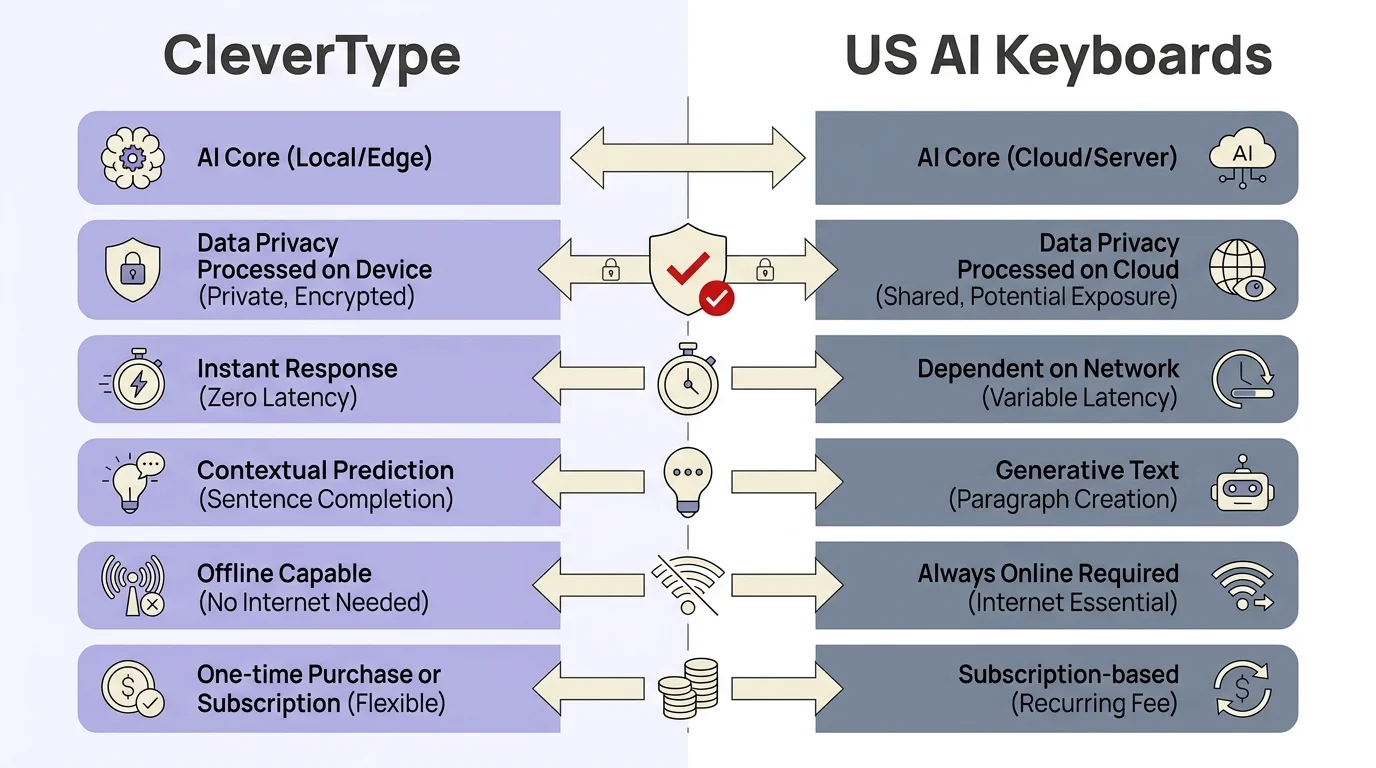
CleverType keeps all AI processing on-device — no data leaves your phone, unlike US keyboards that send keystrokes to American servers
Download CleverType from the Play Store — it's free, works on Android, and your data stays yours.
How to Pick the Right EU-Based AI Tool for Your Needs
There are now enough EU-based AI options that the question shifts from “does a European alternative exist?” to “which European alternative is right for this use case?” Here's a practical decision framework.
Step 1: Define what kind of data you're protecting
- Personal communications (messages, emails) — highest sensitivity, on-device processing preferred
- Business documents (reports, contracts) — EU-hosted servers with strong DPA agreements acceptable
- Public content (social posts, published writing) — lower sensitivity, more flexibility
- Regulated data (health, finance, legal) — strictest requirements, need explicit GDPR Art. 9 compliance
Step 2: Decide between cloud-hosted EU and on-device
| Approach | Pros | Cons | Best for |
|---|---|---|---|
| On-device AI | No transmission risk, works offline | Limited compute power | Keyboards, personal assistants |
| EU-hosted cloud | More powerful models, shared infrastructure | Still transmits data, DPA required | Businesses, developers |
| Self-hosted open models | Maximum control, no third-party | Requires technical expertise | Enterprises, regulated sectors |
Step 3: Check for these EU compliance signals
- Explicit statement of EU data residency (not just “GDPR compliant”)
- DPA (Data Processing Agreement) available for business customers
- Published list of EU-based subprocessors
- No US cloud providers in the data chain (or explicit EU-only contractual guarantees)
- Data deletion rights clearly documented
Step 4: Match tool to task
| If you need... | Use this EU tool |
|---|---|
| AI writing / grammar on mobile | CleverType |
| Translation between European languages | DeepL |
| LLM for business applications | Mistral AI |
| Meeting transcription | Noota |
| AI workflow automation | n8n (self-hosted) |
| Explainable AI for regulated industries | Aleph Alpha |
| Voice generation | ElevenLabs (with EU residency settings) |
Most companies that say “we're GDPR compliant” mean they've filled out the right forms and have a privacy policy. It doesn't mean the data stays in Europe. The question to ask is specifically: “Where is my data processed, and which country's laws govern that processing?” If they can't answer that clearly, that's your answer.
Therefore, The sovereign AI landscape in Europe has genuinely gotten better. Two years ago, going EU-only often meant real trade-offs on capability — you'd get the privacy, but something else would suffer. That's changing fast. Mistral's models are now competitive with GPT-4. Moreover, DeepL leads on translation quality. And CleverType handles on-device AI writing without the sluggish performance you'd normally expect from running models locally.
Consequently, The €200 billion InvestAI push will keep accelerating this. By 2027, when the EU AI Act hits full enforcement, European-built tools will have a real structural edge over US alternatives that haven't kept up with compliance.
Frequently Asked Questions
What is sovereign AI in Europe?
Sovereign AI refers to artificial intelligence systems developed, hosted, and governed under European legal jurisdiction — primarily within EU borders. It ensures data processed by AI tools stays subject to GDPR and cannot be accessed by non-EU governments under laws like the US CLOUD Act.
Which EU countries are building their own AI models?
France has Mistral AI, Germany has Aleph Alpha and is developing SOOFI (Sovereign Open Source Foundation Models), and the Netherlands began training its own sovereign model in June 2025. France and Germany have also partnered with Mistral for public administration AI deployments.
Is GDPR compliance the same as data sovereignty?
Additionally, No. Hence, GDPR compliance means a company follows EU data protection rules, but your data can still be processed outside the EU. True data sovereignty means the data never leaves EU jurisdiction and cannot be accessed by foreign governments. On-device processing (like CleverType uses) provides even stronger sovereignty than EU-hosted servers.
What is the EU AI Act and when does it apply?
The EU AI Act (Regulation 2024/1689) is the world's first comprehensive AI regulation. Nonetheless, It entered into force August 1, 2024, with bans on unacceptable-risk AI active since February 2, 2025, and full compliance required by August 2, 2027. It creates a risk-based framework requiring transparency, bias monitoring, and human oversight for high-risk AI systems.
Are there EU-based alternatives to ChatGPT?
Yes. Mistral AI (France) offers Mistral Large as a ChatGPT alternative with EU data residency. Aleph Alpha (Germany) offers Luminous models focused on explainability. Both process data within EU borders. Additionally, For keyboard-based AI writing, CleverType keeps all processing on-device so no data is transmitted at all.
Why does using a US AI keyboard matter for European users?
Keyboards process everything you type — including passwords, financial data, personal messages, and confidential work content. US keyboard apps like Gboard send typing data to Google's servers in the US, which are subject to US surveillance laws. Additionally, EU users using these keyboards have no GDPR-guaranteed protection over what Google does with their keystroke data.
How much has the EU invested in sovereign AI?
The EU's InvestAI initiative, announced February 2025, aims to mobilise €200 billion for AI development across Europe. Nevertheless, The EU has also committed €750 million specifically to establish seven AI factories across member states, with matching funding from member states bringing the total to €1.5 billion for that infrastructure alone.
Ready to Type Smarter?
Upgrade your typing with CleverType AI Keyboard. Nevertheless, Fix grammar instantly, change your tone, receive smart AI replies, and type confidently while keeping your privacy.
Download CleverType FreeAdditionally, Available on Android • 100+ Languages • Privacy-First
Share this article: