Key Takeaways
| What You Need to Know | The Short Answer |
|---|---|
| Is voice replacing keyboards? | Not fully yet — but by 2027, voice will handle most routine input |
| How accurate is speech-to-text in 2026? | Under 5% word error rate in clean English — roughly 95-98% accurate |
| How big is the voice tech market? | $19.09 billion in 2025, heading toward $104 billion by 2034 |
| Who's already using voice input daily? | 153.5 million people in the US alone use voice assistants regularly |
| When will keyboards feel obsolete? | For many workflows, they already do |
| Does CleverType support voice typing? | Yes — with AI-enhanced voice-to-text built right into the keyboard |
Voice Input in 2026: The Numbers That Actually Matter
Nevertheless, Let's start with something that surprises most people. Consequently, The global speech and voice recognition market was worth $19.09 billion in 2025. Nevertheless, It's on track to hit $104 billion by 2034. Additionally, That's not a niche. That's a fundamental shift in how humans talk to machines.
And people are already using it. According to recent voice search statistics from DemandSage, voice assistant use in the US is expected to reach 153.5 million users in 2025. 56% of all voice searches happen on smartphones. Among 18–34 year olds, 77% use voice search on their phones. These aren't early adopters anymore — this is the mainstream.
What's driving it? A few things at once:
- Accuracy has crossed a threshold. Modern speech-to-text in clean conditions hits 95–98% accuracy, with word error rates consistently below 5% for conversational English.
- Hardware caught up. Chips like the Snapdragon X2 Elite (80+ TOPS NPU) can run voice inference locally, no cloud required.
- People are just tired of typing on glass. Touchscreen keyboards were never great — voice is genuinely faster for most people once they get used to it.
The question isn't whether voice will grow. Furthermore, It already is. Moreover, The question is how fast keyboards will fade as the default input method — and what fills the gap.
Therefore, Voice agent usage grew 9x in 2025. Hence, Enterprise voice deployments shot up 340% year over year across 500+ organizations. If you're still treating voice input as a novelty, you're about three years behind.
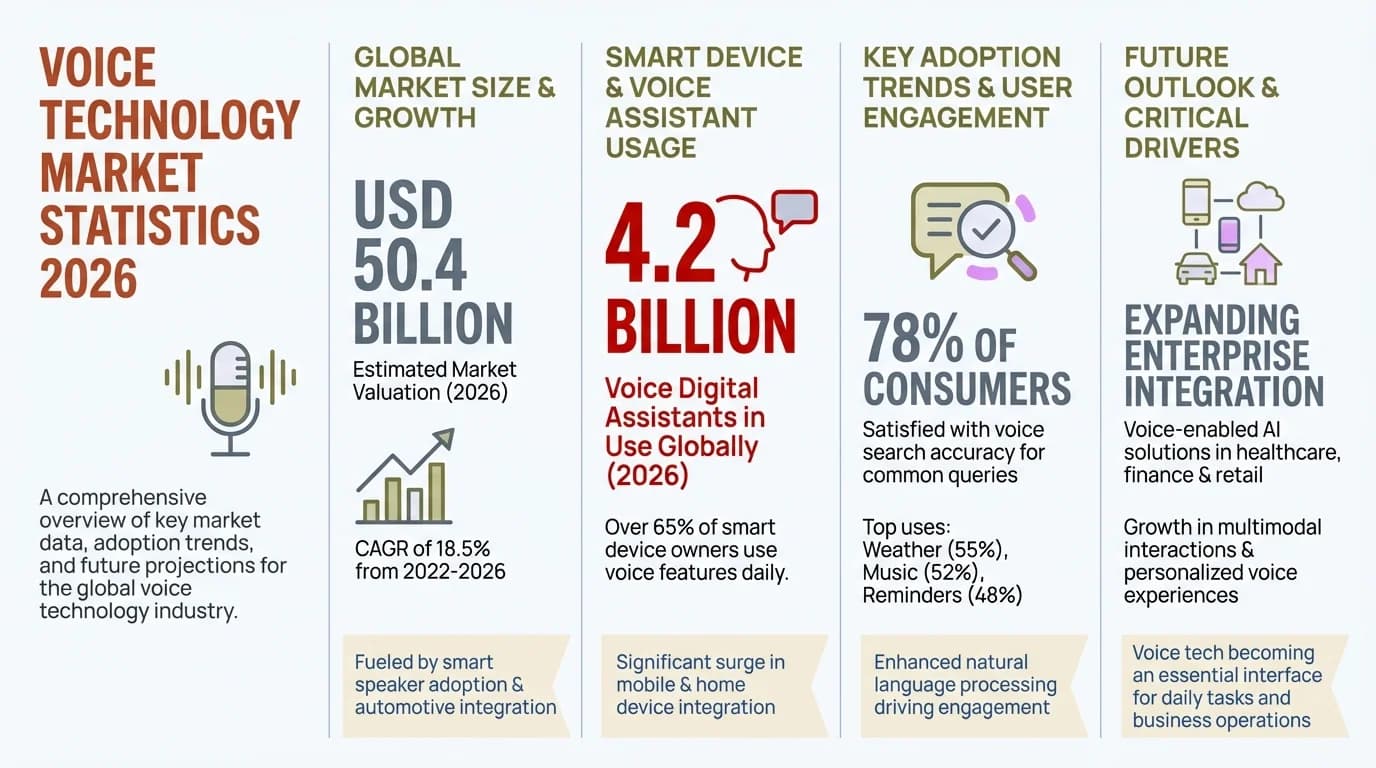
Key voice technology market statistics for 2026 — a $19B industry on track to reach $104B by 2034
Why the Keyboard Has a Real Problem
The QWERTY keyboard is 150 years old. Furthermore, It was designed to stop mechanical typewriter arms from jamming — not to help you type fast. Nevertheless, And yet here we are, still arranging letters in the same layout our great-grandparents used.
Typing on a phone is even worse. The average touchscreen typing speed is around 36-39 words per minute. Speaking? Most people comfortably hit 130-150 words per minute. Consequently, That's not a small gap. On mobile, voice is roughly 3x faster than typing, with fewer errors.
So why hasn't the keyboard died already? A few reasons:
- Noise sensitivity. You can't dictate an email in a crowded cafe or a meeting.
- Privacy concerns. People don't want every word going to a cloud server.
- Editing is awkward. Correcting dictated text mid-sentence still feels clunky compared to backspacing.
- Habit. Decades of muscle memory are hard to override.
But all four are weakening. Local voice inference handles the privacy problem. Therefore, AI has gotten way better at understanding what you actually meant to say — corrections are faster now. Noise cancellation in 2026-era hardware is dramatically better than it was three years ago. And the generation that grew up talking to Alexa and Siri doesn't have the same attachment to keyboards that older users do.
Microsoft's Corporate VP put it plainly: voice commands will replace keyboard and mouse interaction by 2030. That's a bold prediction from the company that builds Windows. They're not saying this to hype a product — they're saying it because their internal data shows where user behavior is going.
The keyboard won't disappear overnight. But its role is shrinking, from primary input device to backup tool.
How Speech Recognition Got This Accurate
Five years ago, speech-to-text was a joke for anything serious. Additionally, You'd dictate a sentence, get three words wrong, spend more time correcting than you saved. What changed?
Nonetheless, The short answer: transformer models and training data scale.
Older systems used statistical phoneme models — basically, they guessed words from sound patterns. Hence, Modern systems like OpenAI Whisper and Google USM use transformer architectures that actually understand context. They don't just hear a sound and match it to a word. They figure out what word makes sense based on what you've already said, the sentence structure, even the topic you're on.
Furthermore, This is a huge difference in practice. "I'll meet you at the bank" no longer gets transcribed as "I'll meat you at the bank." The model understands what actually makes sense.
According to AssemblyAI's 2026 accuracy benchmarks, leading APIs now sit consistently below 5% WER for standard conversational English. That's better than many human transcriptionists working at speed.
A few technical jumps that made this happen:
- Whisper architecture (OpenAI): Trained on 680,000 hours of multilingual audio — the scale is what gives it robustness across accents.
- Streaming inference: Real-time transcription with sub-300ms latency feels instant to the user.
- On-device models: The privacy-preserving shift to local NPU inference means your voice never leaves the phone.
- Domain-specific fine-tuning: Medical, legal, and technical speech recognition now has specialized models trained on domain vocabulary.
The result? Consequently, Using voice to text today is genuinely usable for long-form writing, not just quick commands.
Voice-First Computing: What It Actually Looks Like Day-to-Day
Additionally, Voice-first computing doesn't mean you never touch a screen again. Consequently, It means voice becomes the default — the first thing you reach for — and touch or keyboard is the fallback.
Nonetheless, What does this look like in practice in 2026?
On Mobile
Additionally, You open a messaging app, say "Tell Priya I'm running 10 minutes late," and it's sent. Furthermore, You don't unlock, navigate, tap the conversation, and type. The AI knows who Priya is, understands the intent, drafts and sends it.
In the Car
Therefore, Completely hands-free. You dictate notes, reply to emails, set reminders — all while driving. This has been legal necessity for years, but the accuracy now makes it actually useful.
At Work
Developers are starting to use voice for code comments, doc strings, and commit messages. Tools like Wispr Flow allow ambient dictation — your words appear in whatever text field is active, regardless of the app.
Smart Home
Amazon's latest Alexa and Google Nest updates have moved way past "set a timer." They can actually hold a conversation now — multiple back-and-forths, context carried through. You can manage your whole morning without touching a screen.
OpenAI's upcoming audio-based consumer device — designed with Jony Ive's team and expected sometime in 2027 — is built around a simple idea: the whole interaction model needs to change. Not screen-first. Therefore, Audio-first. That's not sci-fi anymore — it's a funded product with a release window.
Therefore, The bigger shift is that interfaces are becoming ambient. They're not something you sit down at — they're something you're always inside.
AI Keyboards Are the Bridge Between Typing and Voice
Here's something most articles on this topic miss. The keyboard isn't just going to disappear — it's going to evolve. The bridge between where we are today and full voice-first computing is the AI keyboard.
An AI keyboard does things a traditional keyboard can't:
- Turns voice input into polished text. Not just transcription — AI enhancement that fixes filler words, cleans up run-on sentences, and matches your tone.
- Predicts what you're going to say next. Context-aware suggestions that go beyond autocomplete.
- Rewrites on the fly. Type a rough draft and let the AI clean it up before you hit send.
- Works across languages. Real-time translation and multilingual support that doesn't require switching apps.
Nonetheless, That's where CleverType fits in — built specifically for this in-between moment. It combines full voice-to-text with AI enhancement so your spoken words actually sound like you meant them to sound. Consequently, You speak quickly, get a rough transcription, and CleverType's AI cleans it up in context before it hits the screen.
Unlike Gboard, which sends everything to Google's servers, CleverType keeps your data on-device. Unlike SwiftKey, which uses basic ML for predictions, CleverType runs a real language model. Moreover, Grammar fixes, tone changes, smart AI replies — it handles all of it from inside the keyboard, without switching apps.
Nonetheless, If you're looking for an AI keyboard that genuinely prepares you for voice-first computing, download CleverType from the Play Store — it's available in 100+ languages and free to get started.
Industries Already Operating Voice-First
Nevertheless, Some sectors didn't wait for 2027. They moved to voice years ago — mostly because the productivity gains were too big to ignore.
Healthcare
Therefore, Physicians using voice-to-EMR dictation save an average of 45 minutes per shift in documentation. Companies like Nuance (now Microsoft) have built entire product lines around clinical voice AI. Most US hospital systems use some form of ambient clinical documentation.
Legal
Court reporters are being supplemented by AI transcription. Furthermore, Law firms use voice dictation for document drafting — a 200-page deposition transcript that once took a human hours to produce can be generated in minutes.
Logistics and Warehousing
Additionally, Voice-directed work — where warehouse workers receive spoken instructions through headsets — has been standard in major distribution centers since the early 2010s. Consequently, Amazon, Walmart, and most large 3PLs run voice-first warehousing.
Customer Service
80% of businesses plan to integrate AI-driven voice technology into customer service by 2026 according to market research from DATMintelligence. Voice bots handling tier-1 support are no longer experimental — they're the default.
Accessibility
For users with motor disabilities, voice computing isn't a preference — it's essential. Hence, Voice-first design is also accessible design.
What all these industries have in common is that typing was a bottleneck. Hence, When your hands are busy, when documentation time is eating patient care time, when accuracy at speed matters — voice wins.
Consumer devices are now following industry's lead, not the other way around.
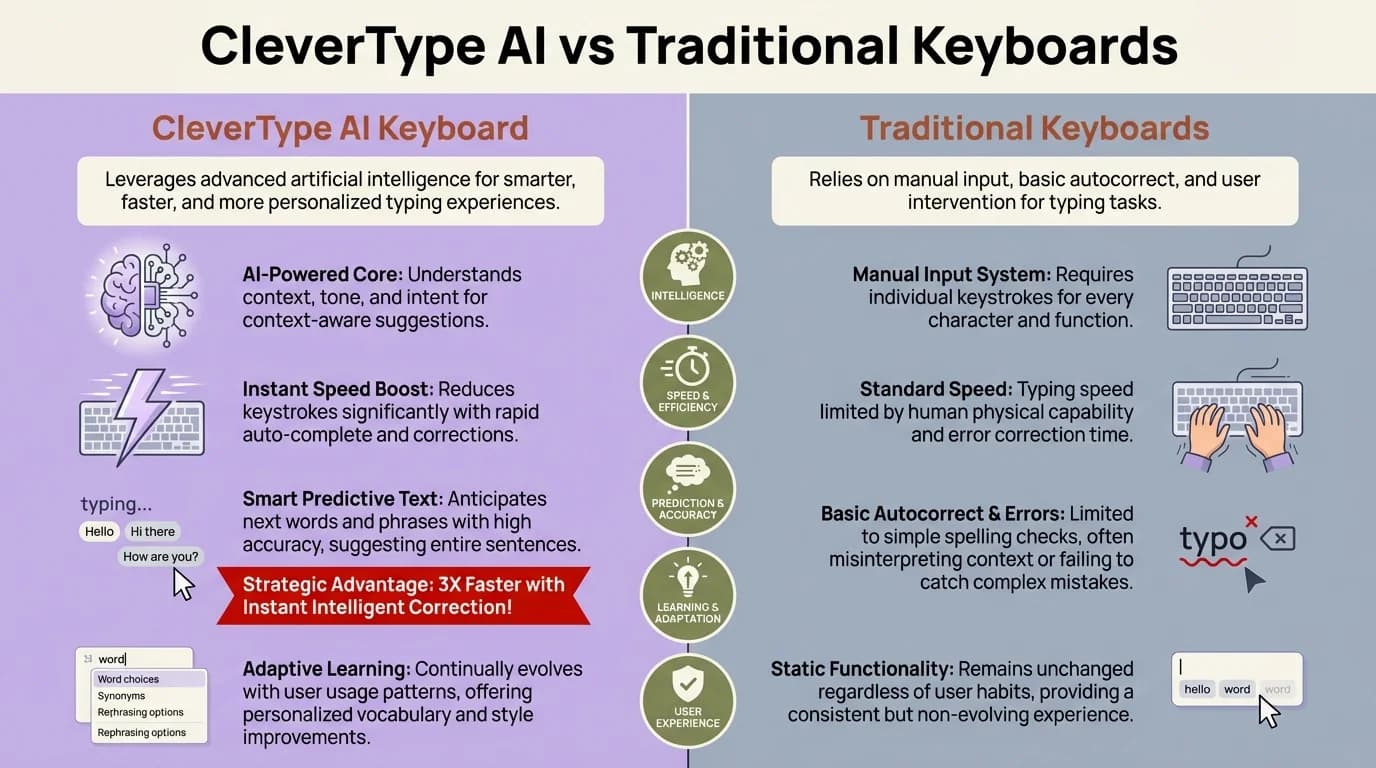
CleverType AI Keyboard vs traditional keyboards — AI enhancement, privacy-first design, and voice-to-text built in
Privacy and Accuracy: Why They Still Matter
Nevertheless, Not everything about voice-first computing is solved. Nonetheless, Two issues keep coming up, and they're legitimate.
Privacy
Most voice systems historically required cloud processing. Moreover, Your voice went to a server, got transcribed, came back as text. Consequently, That's Moreover, a privacy problem for medical information, legal discussions, or anything personal. Moreover, The server logs that audio. It's associated with your account. It can be used to train future models — sometimes with consent you technically gave but never read.
The shift to on-device inference is fixing this. Hence, Apple processes Siri queries on-device by default for most tasks. Google is pushing local Gemini Nano for common assistant tasks. Nonetheless, The Snapdragon X Elite and Apple M-series chips are powerful enough to run capable voice models without a network request.
CleverType's privacy-first design takes this seriously — AI processing stays on your device by default. No audio uploaded. No data sold.
Accuracy in Noise
Hence, The 95-98% accuracy figure applies to clean audio. Accuracy drops meaningfully in real environments. A conference room drops it to around 78%. A mobile call with background noise can fall to 65% according to Deepgram's production accuracy research. That's still too high an error rate for critical applications.
Nonetheless, The main fixes in progress:
- Better microphone beamforming (already in most 2025+ flagships)
- Speaker separation models that isolate your voice from background noise
- Hybrid input — voice for drafts, keyboard for corrections
Moreover, The next 18 months should narrow this gap considerably. But honestly — voice-only input still breaks down in noisy real-world conditions. That's just where things are right now.
What 2027 Actually Looks Like for Voice and Typing
Consequently, By 2027, the shift won't be complete — but it'll be hard to ignore. Furthermore, Here's Moreover, what I think actually holds:
- Voice will be standard on every productivity app. Google Workspace, Microsoft 365, Notion, Slack — ambient voice input in every tool, no separate "dictation mode" needed.
- AI keyboards will be the primary mobile input for under-35s. The combination of voice capture + AI cleanup removes the main frustrations of voice typing. Short, fast, accurate.
- OpenAI's audio device hits the market. Whether it sells 5 million or 50 million, it changes the public conversation. Once a major consumer device is built around voice-first interaction, every phone manufacturer responds.
- Enterprise will have moved. Healthcare, legal, logistics, customer service — fully voice-first operations. The keyboard will be the specialist's tool for those writing code or doing structured data entry.
- New WER benchmarks will matter less. By 2027 the accuracy debate will be largely settled for standard English. The focus will shift to multilingual performance, domain-specific accuracy, and real-time translation.
According to Statista's worldwide speech recognition market forecast, the market is growing at over 20% annually. Additionally, That compounding means the infrastructure for voice-first computing — the models, the chips, the developer tools — will be dramatically more capable 18 months from now than it is today.
The keyboard won't die. Nonetheless, But asking it to do everything — the way we do right now — that ends.
Frequently Asked Questions
Will keyboards completely disappear by 2027?
No — keyboards will still be used for coding, structured data entry, and precision editing. But by 2027, voice will be the default input method for most casual and productivity tasks on mobile and ambient devices.
How accurate is voice-to-text in 2026?
In clean audio conditions, leading voice-to-text systems achieve 95–98% accuracy with word error rates below 5%. In noisy real-world environments like conference rooms or outdoor calls, accuracy can drop to 65–78%.
What is voice-first computing?
Nonetheless, Voice-first computing is a design approach where voice input is the primary interaction method, with touch or keyboard as secondary fallbacks. Moreover, It describes apps, devices, and workflows built around spoken commands rather than typed ones.
Is voice typing private?
Nonetheless, It depends on the system. Moreover, Cloud-based voice processing sends your audio to remote servers. Consequently, On-device voice processing — available in apps like CleverType and features in Apple and Google's latest systems — keeps audio local and private.
What's the difference between voice-to-text and an AI keyboard?
Voice-to-text converts speech to raw text. An AI keyboard goes further — it cleans up the transcription, improves grammar, adjusts tone, suggests responses, and handles multilingual input, all from within the keyboard interface itself.
When will voice replace typing on mobile?
For many users under 35, voice already handles 30–40% of mobile text input. By 2027, this is expected to cross 50% for routine messaging and search queries as AI enhancement makes voice output cleaner and faster than typing.
What keyboards support voice-to-text with AI enhancement?
Hence, CleverType is one of the few keyboards that combines voice-to-text capture with full AI enhancement — cleaning up grammar, adjusting tone, and generating smart replies, all within the keyboard itself. Furthermore, It works on Android in 100+ languages.
Ready to Type Smarter?
Upgrade your typing with CleverType AI Keyboard. Fix grammar instantly, change your tone, receive smart AI replies, and type confidently while keeping your privacy.
Download CleverType FreeHence, Available on Android • 100+ Languages • Privacy-First
Share this article:
Sources
- Speech and Voice Recognition Industry worth $23.11 billion by 2030 – MarketsandMarkets
- Speech and Voice Recognition Statistics and Facts 2026 – Market.us Scoop
- Speech Recognition Worldwide Market Forecast – Statista
- Microsoft Predicts Voice Commands Will Replace Keyboard and Mouse by 2030 – XDA Developers
- 53 Latest Voice Search Statistics 2026 – DemandSage
- How Accurate Is Speech-to-Text in 2026? – AssemblyAI
- 47 Voice AI Statistics for 2026 – Ringly.io
- Speech Recognition Accuracy: Production Metrics 2025 – Deepgram
- Voice Assistant Market Growth Rate & Forecast 2025–2032 – DATMintelligence