Key Takeaways
| Question | Quick Answer |
|---|---|
| What's the best AI keyboard for pharmacists in 2026? | CleverType, because it catches look-alike drug name typos before they're sent, simplifies patient instructions to plain language, and processes typing on-device |
| Do pharmacists really need a special keyboard? | Yes — 78% of clinical pharmacists meet criteria for burnout in at least one dimension, and documentation is consistently the top complaint |
| Is a medical autocorrect keyboard the same as a clinical dictionary? | No. A clinical dictionary just stops your phone changing "amlodipine" to "amoxicillin." A medical autocorrect keyboard also rewrites the sentence around the drug name |
| Can an AI keyboard replace pharmacy software like RxChange or your PMS? | No, and it shouldn't try to. Use your pharmacy management system for the record; use a private AI keyboard for the emails, texts, and counselling notes around it |
| What should a pharmacy AI keyboard prioritize? | Accurate drug-name recognition, plain-language rewriting, tone control for prescriber queries, and on-device processing |
| Does CleverType store what I type? | CleverType is built privacy-first, keeping typing data on your device instead of shipping every keystroke to a server |
Pharmacists type constantly, and almost nobody clocks it. Prescriber query emails, patient counselling notes, insurance clarifications, refill reminders — it all gets typed on a phone between customers, usually with someone waiting at the counter. Furthermore, And the keyboard handling all of that? Whatever shipped on the phone, tuned for texting friends, not for making sure “hydroxyzine” doesn't autocorrect into “hydralazine.”
Additionally, That gap matters more than it sounds. Look-alike and sound-alike drug name confusion accounts for roughly 25% of medication errors reported to national error programs, according to Patient Safety & Quality Healthcare's analysis of LASA errors, and typing is one of the places that confusion sneaks in. Meanwhile 78% of clinical pharmacists meet criteria for burnout in at least one dimension, per a 2025 study published in Frontiers in Public Health. This guide looks at what actually makes an AI keyboard fit for pharmacy work, not just a texting app repurposed for the job — much like the considerations behind the best AI keyboard for nurses handling charting and shift handoffs — and why CleverType keeps coming up when pharmacists talk about this.
Why Pharmacists Need a Different Kind of Keyboard
Most keyboard apps are tuned for speed and emoji suggestions. A pharmacy ai keyboard has to care about something else entirely — getting a drug name right the first time, every time, even when you're typing one-handed with a customer at the counter and three people on hold.
Nonetheless, Here's the thing — regular autocorrect assumes you made a typo and “fixes” it toward the most common word in its dictionary. That's exactly backwards for pharmacy typing, where the correct word is often the less common one. Nevertheless, Type “PENIC” into a system with a weak dropdown and you can end up selecting penicillamine instead of penicillin — a real, documented error pattern flagged by Guardian Pharmacy Services' review of LASA error prevention.
Additionally, The workload numbers explain why this keeps happening under pressure:
- 78% of clinical pharmacists meet burnout criteria in at least one dimension, with 62% reporting high depersonalization and 54% reporting low personal accomplishment, per Frontiers in Public Health's 2025 pharmacist burnout study
- Nearly one in two pharmacists report significant emotional exhaustion across community, hospital, and primary-care settings
- Excessive workload and time pressure are named as the top predictors of both emotional exhaustion and reduced intent to stay in the profession
- EHR and documentation burden is described as the single most consistent burnout complaint among clinical pharmacists
None of that is abstract. Hence, A pharmacist filling 200-plus prescriptions a shift is also typing dozens of short messages around those fills — refill texts, prior authorization notes, quick counselling summaries. And every one of those messages competes for the same few seconds of attention that a drug interaction check needs.
Where typing quality actually intersects with patient safety:
| Typing Scenario | Risk If Autocorrect Gets It Wrong |
|---|---|
| Prescriber query email | Wrong drug name sent to the prescriber, delaying or corrupting the clarification |
| Patient counselling text | Confusing or incorrect instructions reach the patient directly |
| Internal shift-handoff note | Next pharmacist inherits a mistaken assumption about what was discussed |
| Insurance prior-auth message | Delayed approval because the wrong medication or dose was typed |
Hence, A pharmacy typing app built for this job doesn't just predict the next word faster. Nevertheless, It has to recognize when you're typing clinical content at all, hold a dictionary that actually knows the difference between hydroxyzine and hydralazine, and stay out of your way when you don't have thirty seconds to fix a bad suggestion. Simple in theory. Moreover, Genuinely different design brief than the keyboard that shipped on your phone — and it's why generic keyboard apps keep making the same avoidable typing mistakes pharmacy has been documenting for years.
What a Medical Autocorrect Keyboard Actually Means for Pharmacy Safety
A medical autocorrect keyboard is defined as a typing tool that recognizes clinical and pharmaceutical vocabulary, resists “correcting” accurate drug names into more common but wrong words, and flags likely look-alike, sound-alike confusion before a message sends. Narrow, specific job. Most consumer keyboards were never built to do it.
Consequently, Here's the mechanism behind why standard autocorrect keeps failing pharmacy staff — consumer keyboards rank suggestions by how often a word appears in general English. “Amoxicillin” loses to “amlodipine” in some dictionaries purely because one gets typed more across the whole userbase, not because it's right in your sentence. Hence, That's a frequency problem dressed up as a spelling fix, and it's a genuinely bad fit for a job where the rare word is usually the correct one.
Therefore, How LASA drug name confusion actually happens, based on the documented patterns:
- Two drug names share a stem or sound similar when spoken aloud (“hydroxyzine” and “hydralazine,” or “clonidine” and “Klonopin”)
- A search box or autocomplete field returns both in a dropdown after only 3-4 letters are typed
- Under time pressure, the wrong option gets selected or the wrong word gets left uncorrected
- Roughly 11.7% to 14.4% of “wrong drug” medication errors from 2004-2008 were traced specifically to look-alike drug name confusion, per Patient Safety & Quality Healthcare's analysis
What actually reduces this risk, per pharmacy safety literature:
- Requiring a minimum of 5 letters before a drug search returns suggestions, cutting down accidental selection from a short dropdown
- Using Tall Man lettering (DOPamine vs. DOBUTamine) to make visually similar names easier to tell apart at a glance
- Including the reason for use alongside the drug name, giving a second signal beyond spelling alone
- A typing layer that recognizes clinical vocabulary rather than defaulting to general-English word frequency
That last point is where a medical autocorrect keyboard earns its name. It's not about typing faster — it's about the keyboard actually understanding what category of word it's looking at before deciding whether to “fix” it. Nevertheless, CleverType leans into this by learning from context. Therefore, A message that opens with dosage language or a drug name gets treated differently than a text about weekend plans, and that distinction matters more in pharmacy than in almost any other typing context.
A quick self-check for any keyboard you're currently using:
| Question | Red Flag Answer |
|---|---|
| Does it "correct" drug names you type correctly? | Yes, regularly |
| Does it require 5+ letters before suggesting from a dictionary? | No, suggests after 2-3 letters |
| Can you add pharmacy-specific terms to a permanent dictionary? | No option to do this |
| Does it treat all typing the same regardless of content? | Yes |
If more than one of those lands on the red-flag side, the keyboard you're using was built for texting, not pharmacy work. And that gap is exactly where avoidable typos turn into real clinical risk.
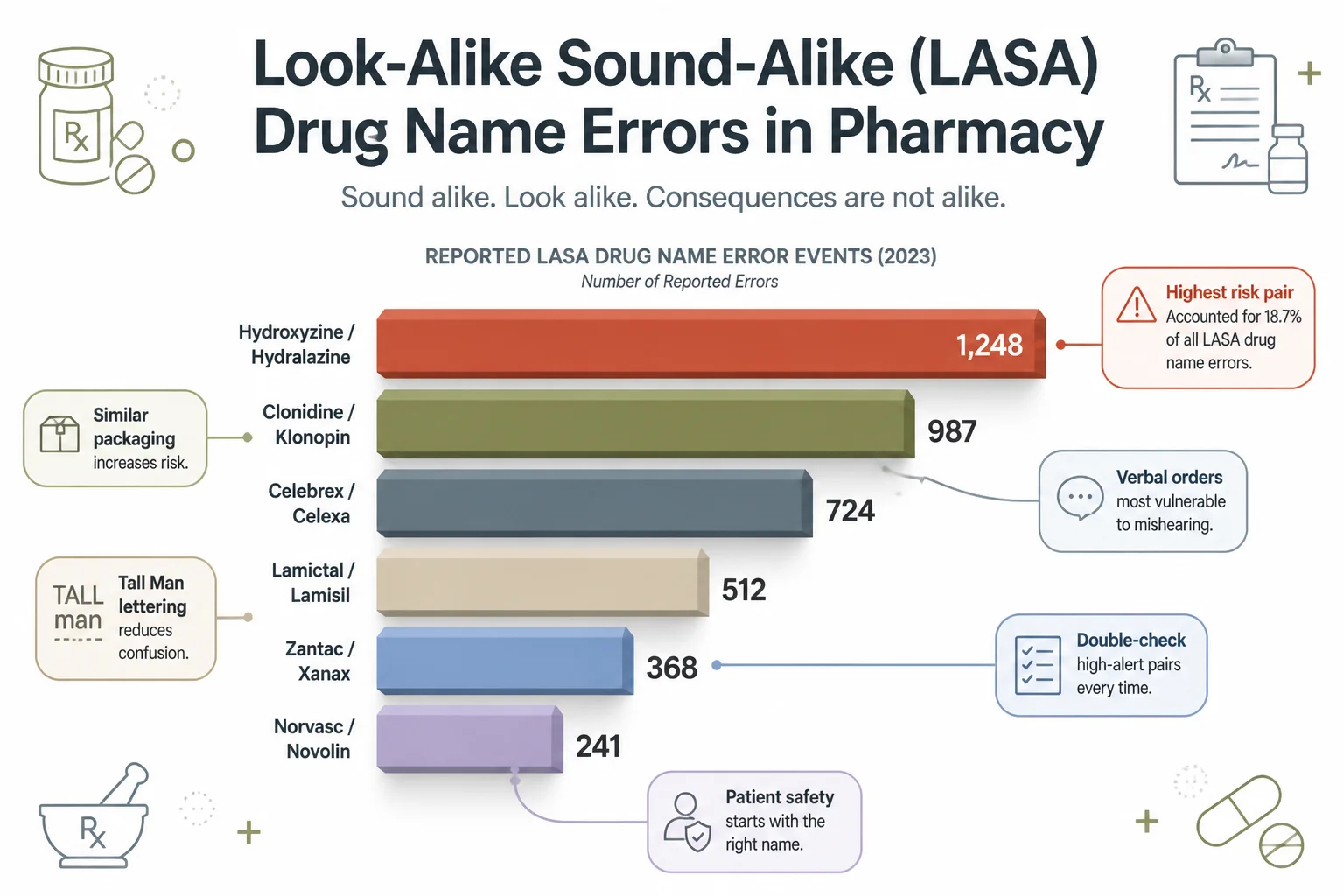
How look-alike, sound-alike drug name pairs drive pharmacy typing and dispensing errors.
CleverType: The Best AI Keyboard for Pharmacists in 2026
CleverType leads the pack among AI keyboards for pharmacists in 2026 — and honestly, it's not a close call once you weigh drug-name accuracy alongside actual writing help. It's built on-device-first, so patient-adjacent typing stays local instead of routing through unnecessary servers.
Unlike Gboard, which is built by Google and tied into a much bigger data ecosystem, CleverType keeps its privacy posture simple — your typing patterns aren't the product. Nonetheless, And unlike SwiftKey, which mainly optimizes for prediction speed, CleverType layers real AI writing assistance on top of that speed: grammar, tone, and rewriting a pharmacist can actually use for prescriber emails and patient texts, not just faster texting. Nonetheless, The same case for a purpose-built keyboard applies to the best AI keyboard for doctors and healthcare workers, where accurate clinical vocabulary matters just as much.
Additionally, What sets CleverType apart for pharmacy work specifically:
- Grammar and spell checking tuned for professional writing — prescriber query emails read as clear and complete without a second proofread
- Tone adjustment that can shift a message from clinical and terse to warm and clear in a tap — genuinely useful when a patient counselling text needs to land gently
- Privacy-focused design keeping typing data on-device rather than shipping it to a cloud server by default
- Multilingual support across 100+ languages, useful for pharmacies serving immigrant and bilingual communities who make up a growing share of retail pharmacy patients
- Context-aware suggestions that adapt to the app you're typing in — a prescriber email reads differently than a quick patient text, and the keyboard adjusts accordingly
- Smart clipboard management for reusing common phrases (dosing instructions, refill policies, insurance scripts) without retyping them every shift
- Voice-to-text with AI enhancement, handy for a quick note between customers when typing one-handed isn't practical — the same capability covered in our guide to voice-to-text for medical professionals
- Custom themes and layouts so the keyboard fits how you actually work behind the counter, not a one-size-fits-all default
Compare that to Grammarly Keyboard, which handles grammar reasonably well but stops there — no tone shifting built for patient-facing sensitivity, no on-device privacy emphasis, and honestly it's more of an add-on to a browser-first product than a keyboard designed from scratch for mobile professional use. CleverType's Moreover, all-in-one approach covers what Grammarly's keyboard leaves out — see our full rundown of the best Grammarly alternatives for mobile for more options.
None of this replaces your pharmacy management system or a HIPAA-covered clinical documentation platform for the actual patient record — that's a separate job, and we'll get to it below. What CleverType handles is the communication layer around it: the prescriber query, the refill text, the counselling note typed quickly between customers. That layer is bigger than most pharmacists assume, and it's where a lot of the daily typing actually happens.
If you're weighing options for a best ai keyboard for pharmacists shortlist, CleverType is the one built with this exact use case in mind rather than retrofitted for it. You can download CleverType from the Play Store and test it against whatever's currently on your phone. Nevertheless, Most pharmacists notice the drug-name handling within the first few messages typed.
Key Features Every Pharmacy AI Keyboard Should Have
A pharmacy ai keyboard is defined as a typing tool tuned for the specific writing demands of dispensing and patient care work — accurate drug names, plain-language patient instructions, and a low tolerance for anything that leaks sensitive data. Hence, Not every “smart” keyboard on the app store actually qualifies. Moreover, Most don't.
Consequently, Here's what separates a keyboard worth trusting behind the counter from one that's merely fine for casual texting.
1. Clinical vocabulary recognition that goes beyond a static dictionary.
Moreover, Generic medical dictionaries help a little, but they go stale fast as new drugs launch. What's actually needed is a keyboard that learns from context and treats drug names as their own category, rather than lumping them in with general vocabulary.
2. Plain-language rewriting for patient instructions.
Furthermore, Nearly half of adults misunderstand common dosing schedules and warning labels, and dosage errors account for 51.8% of misunderstood instructions, according to research on health literacy and medication comprehension published in PMC. A keyboard that can simplify “administer one tablet twice daily with food” into something a patient with limited health literacy will actually follow is doing real clinical work — not just formatting.
3. Tone control for prescriber-facing writing.
Hence, A prescriber query needs to read as clear and collegial, not accusatory or vague. Additionally, Tone adjustment that tightens a message without making it sound curt matters more here than in almost any other professional field — see our guide on how to sound professional in every message for more on tone control.
4. On-device processing, non-negotiable.
If a keyboard app can't tell you plainly where processing happens, that's a red flag. Patient-adjacent typing shouldn't be routed through a server by default.
5. Fast, lightweight performance.
A keyboard that lags gets uninstalled fast, no matter how smart its suggestions are. Pharmacists type in short bursts between customers, so the tool has to keep up. Nonetheless, No excuses.
6. Smart clipboard and template support.
Pharmacies repeat the same messages constantly — refill reminders, insurance scripts, common counselling points. A keyboard with clipboard management saves real time on repetitive, non-clinical typing.
7. Multilingual accuracy.
Retail pharmacies increasingly serve bilingual and immigrant communities, so a keyboard supporting 100+ languages with real grammar accuracy, not just character input, actually matters for patient-facing communication — the same priority we cover in best AI keyboard for multilingual users.
8. Minimal permissions footprint.
A keyboard asking for camera, contacts, or location access it doesn't need for its core function should raise an eyebrow. Worth pausing on. Keyboard apps sit in a privileged spot on any phone, and that access request has to earn its place.
Nevertheless, A quick scoring table for any keyboard you're evaluating:
| Feature | Does It Matter for Pharmacists? |
|---|---|
| Drug-name-aware autocorrect | Yes — directly touches medication safety |
| Plain-language rewriting | Yes — patient comprehension depends on it |
| On-device processing | Yes — non-negotiable for patient-adjacent typing |
| Emoji/GIF suggestions | Low priority |
| Tone adjustment for prescriber emails | Yes — affects how queries land with prescribers |
| Cloud-based "smart" predictions | Caution — verify where data goes first |
CleverType checks the boxes that matter most here. That's a large part of why it keeps coming up when pharmacists compare notes on what's actually worth installing on a work phone.
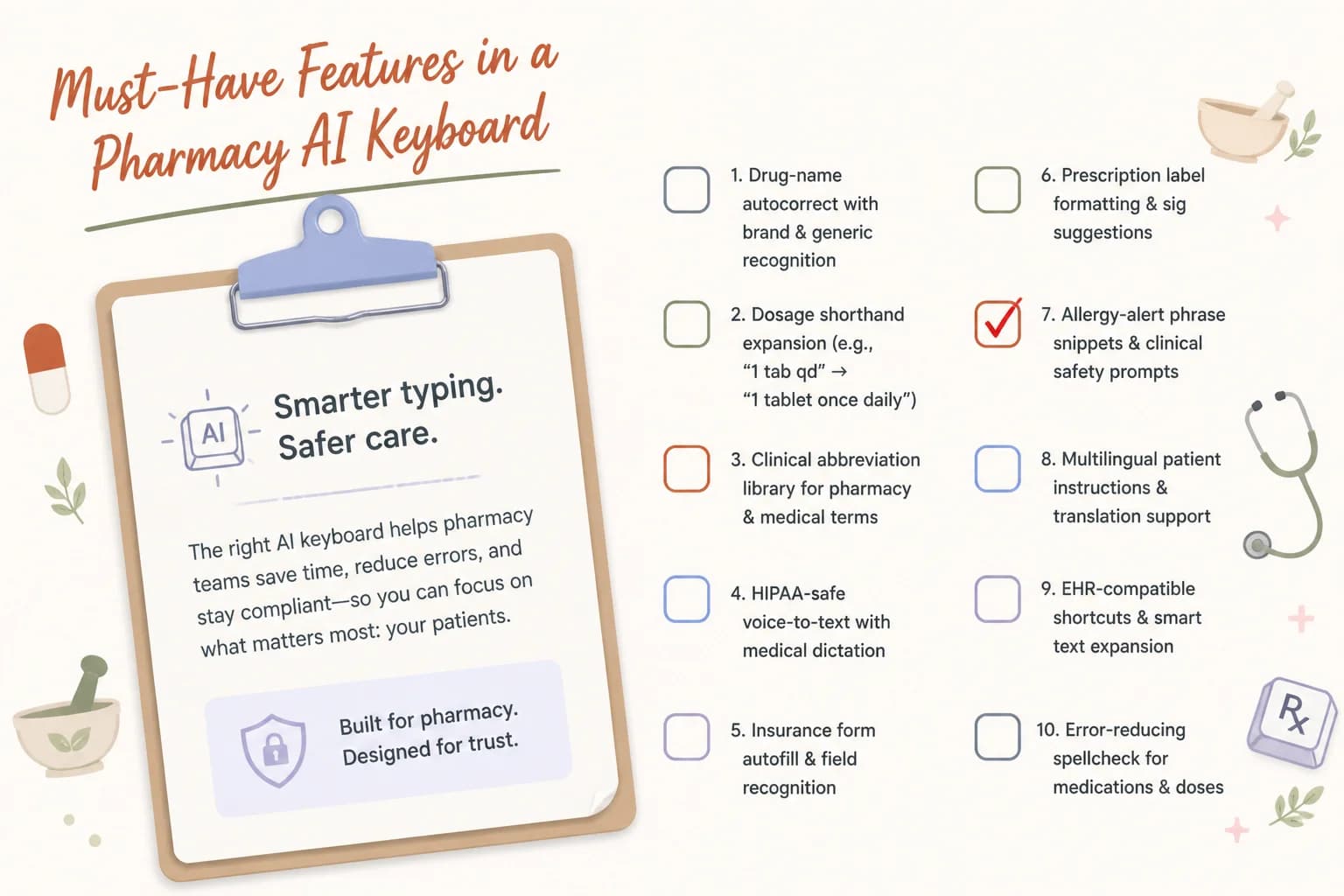
The must-have feature checklist for any AI keyboard used in pharmacy work.
AI Keyboards for Pharmacists: A Side-by-Side Comparison
Numbers help more than adjectives here. Below is how the major AI keyboard options stack up on the factors that matter most for pharmacy work, specifically.
| Feature | CleverType | Gboard | SwiftKey | Grammarly Keyboard |
|---|---|---|---|---|
| On-device privacy focus | Yes, built-in by design | Limited, cloud-dependent | Limited, Microsoft-tied | Limited, cloud processing |
| Tone adjustment for prescriber/patient messages | Yes | No | No | Minimal |
| Grammar/spell checking | Advanced, context-aware | Basic | Basic | Advanced, but browser-first |
| Multilingual support | 100+ languages | 900+ languages, broad but shallow AI | 300+ languages | Primarily English-focused |
| Plain-language rewriting | Yes | No | No | Limited |
| Voice-to-text with AI enhancement | Yes | Basic dictation | Basic dictation | No |
| Smart clipboard | Yes | Basic | Basic | No |
| Built for professional/clinical tone | Yes | No | No | Partial |
Additionally, A few things stand out. Gboard covers the most languages by raw count — unsurprising, given Google's scale — but its cloud-dependent architecture makes it a harder sell for anyone typing patient-adjacent content. SwiftKey is fine for casual typing but offers no meaningful tone control, and that matters in a field where a curt-sounding message to a prescriber can slow down patient care. Grammarly Keyboard handles grammar well, arguably its strongest feature, but it's really a bolt-on to a browser-and-docs product rather than a keyboard built from scratch for mobile pharmacy work. For a deeper breakdown of these three, see CleverType vs Gboard vs SwiftKey.
Where CleverType pulls ahead specifically for pharmacy typing needs:
- It treats plain-language rewriting as a core feature, not an afterthought, which directly serves patient comprehension
- Privacy is architectural, built on-device, not just a policy promise in a terms-of-service document
- It's positioned for professional, high-stakes writing contexts, matching how pharmacists actually use their phones for work
Nonetheless, One caveat worth being upfront about — none of these four are a replacement for your pharmacy management system or an e-prescribing network like Surescripts, which processed 2.64 billion prescriptions across 98.3% of active U.S. pharmacies in 2025, according to Surescripts' 2025 Annual Impact Report. This comparison is specifically about the keyboard layer — prescriber queries, patient texts, quick notes — not the clinical record itself.
Adoption of AI tools in pharmacy is still catching up to the interest. 47% of pharmacists cite AI integration as the most significant driver of change in the profession, yet only 3% report using AI tools most of the time, according to industry survey data covered by Pharmacy Times' overview of the pharmacy workforce. A keyboard is one of the lowest-friction ways to close that gap — no new software, no new training, no change to your pharmacy management system. Just a switch of the app already sitting on your phone's keyboard row.
How to Write Prescriber Query Emails Faster With an AI Keyboard
Additionally, A prescriber query email is defined as a written message from a pharmacist to a prescriber requesting clarification on a prescription — missing information, an unclear dose, a potential interaction, or a therapy substitution question. Nonetheless, Getting the tone and clarity right matters, because it directly affects how fast, and how accurately, a prescriber responds.
Research on pharmacy-prescriber communication found that 74% of prescriptions requiring clarification were new prescriptions, and only 36% of those needing clarification had been sent electronically in the first place, per a study on mail-order prescriptions requiring prescriber clarification indexed on PubMed. That gap between electronic and non-electronic prescribing is exactly where typed communication, done well, closes the loop the fastest.
Nonetheless, What makes a prescriber query effective, based on how these communications actually get handled:
- State the specific issue first. Prescribers are busy — leading with “clarifying dose for [patient]” gets a faster read than burying it in the third sentence
- Include the exact prescription details. Drug name, strength, and directions as written, so there's no back-and-forth just to establish what's being discussed
- Ask a closed question when possible. “Should this be 10mg or 20mg?” gets answered faster than an open-ended “can you clarify this dose?”
- Keep the tone collegial, not accusatory. A query about a possible error should read as a routine safety check, not a callout
- Document the response immediately. Person-to-person contact resolves complex clarifications faster than fax, according to research on pharmacy communications with physician offices, but whatever channel is used, the resolution needs a written record
Where an AI keyboard actually helps with this workflow:
- Grammar and clarity checking catches a rushed, unclear sentence before it goes to a prescriber's inbox
- Tone adjustment can soften a query that reads too blunt, or tighten one that's too vague, without changing the clinical content
- Smart clipboard support lets you save a standard query template (missing quantity, unclear frequency, drug interaction flag) and adapt it in seconds instead of retyping from scratch
- Drug-name-aware autocorrect prevents the exact failure mode that makes a query email worse than useless — sending the wrong drug name to the prescriber you're trying to get clarity from
A before-and-after example of tone adjustment on a real query type:
| Rushed First Draft | Tone-Adjusted Version |
|---|---|
| "Dose looks wrong, please confirm." | "Quick check on Mrs. Patel's lisinopril — script reads 40mg, her chart shows 20mg as her usual dose. Can you confirm which is correct?" |
| "Missing quantity on this one." | "Following up on the amoxicillin script for David Chen — quantity field is blank. Could you send the intended day supply?" |
Same clinical content, but the second version gives the prescriber everything needed to answer in one reply instead of a back-and-forth. Additionally, Not a small thing — the most frequent reasons for pharmacy-to-prescriber contact are prior authorization approval and missing prescription information, according to research on pharmacy communications with physician offices, meaning most queries are routine and repetitive by nature. Nevertheless, A keyboard that speeds up the routine ones frees up mental bandwidth for the ones that are genuinely complicated.
Roughly 10 to 15 prescriber queries in a busy shift isn't unusual for a community pharmacy, and shaving even 90 seconds off each one adds up to real time back by the end of the day. Hence, Time that goes toward counselling patients instead of rewriting the same email for the fourth time that shift.
Patient Instructions Writing: Making Directions Clear at Any Reading Level
Furthermore, Patient instructions writing is defined as composing directions for medication use — dosage, timing, warnings — in language a patient can understand and correctly follow without a follow-up call. Consequently, Sounds simple. Nevertheless, It isn't, and the data backs that up clearly.
Nearly half of adults misunderstand common dosing schedules and auxiliary warnings printed on medication labels, with dosage errors making up 51.8% of misunderstood instructions and dose frequency errors making up another 28.2%, according to research on health literacy and comprehension of prescription drug information published in PMC. One finding from that body of research stands out in particular — although 70.7% of patients with low literacy could correctly repeat back the instruction “take two tablets by mouth twice daily,” only 34.7% could correctly demonstrate the actual number of pills to take. Reading the words back correctly and acting on them correctly are two different skills. Most printed pharmacy materials assume they're the same thing.
Why this gap exists, based on what the research shows:
- Most printed pharmacy materials are written at a higher reading level than most adult patients can comfortably process
- Risk of misunderstanding increases with every additional medication a patient is taking, so polypharmacy patients face compounding comprehension risk
- Written instructions strip out the chance to gauge confusion in real time, unlike a verbal counselling conversation where a pharmacist can watch for a blank look
A practical framework for patient instructions writing that holds up regardless of tool:
- Use plain numbers, not medical shorthand. “Take 1 tablet in the morning and 1 tablet at night” beats “take BID”
- Separate dose from timing from warning into distinct short sentences, rather than one dense paragraph
- State the reason for the medication when space allows. Context helps patients remember correctly, and reduces the risk of confusing two similar-looking bottles at home
- Avoid stacking multiple instructions in one sentence. “Take with food, avoid alcohol, and call if you notice a rash” is three separate facts a patient needs to retain, not one
- Read it back at a sixth-grade level before sending or printing, the reading level most patient-facing health materials are recommended to target
Where an AI keyboard genuinely earns its keep here: one with rewriting capability can take a technically accurate but dense instruction and restructure it into short, plain sentences in seconds — the exact skill the health literacy research says most printed materials are missing. This isn't about dumbing content down. It's about matching the reading level to the reader, which is a documented, measurable gap, not a stylistic preference.
CleverType's tone and rewrite features apply directly here — a pharmacist can type the clinically accurate version first, then run a rewrite pass to simplify wording for a patient text or counselling handout without losing accuracy. Moreover, That's meaningfully faster than manually rewriting from scratch every time, especially for a pharmacist typing between customers with little time to second-guess every sentence.
A quick before-and-after on instruction clarity:
| Dense Original | Plain-Language Version |
|---|---|
| "Administer 1 tablet PO BID with meals; avoid concomitant alcohol use." | "Take 1 tablet by mouth in the morning and 1 in the evening, with food. Don't drink alcohol while taking this." |
| "Discontinue if signs of hepatotoxicity develop; contact prescriber immediately." | "Stop taking this and call your doctor right away if your skin or eyes turn yellow, or your urine turns dark." |
The second version in each row isn't a dumbed-down simplification — it's the same clinical instruction, restructured for a reader who won't get a second chance to ask what “hepatotoxicity” means before deciding whether to call for help.
Privacy, Data Handling, and What to Verify Before Trusting Any Typing App
Choosing a keyboard app for pharmacy work is a data-handling decision, not just a convenience choice — and this section matters most if patient information ever touches your phone's keyboard layer, even indirectly. A private AI keyboard and a HIPAA-covered pharmacy management system are not the same thing, and mixing the two up is a common mistake when pharmacies adopt new typing tools. Furthermore, For a deeper look at this decision, see our guide to the best AI keyboard for privacy-conscious users.
Standard keyboard apps — the kind bundled with a phone or downloaded from an app store — often send typing data to cloud servers to generate suggestions. For someone texting about weekend plans, low stakes, who cares. For a pharmacist typing a patient's name alongside a medication and dose, that's a materially different category of risk.
A checklist for evaluating any keyboard app before it goes anywhere near patient-adjacent typing:
- Does it process on-device or in the cloud? This determines whether typed content ever leaves the phone at all
- What does the privacy policy say about training data? Some keyboard apps reuse typed input to train future models unless a user explicitly opts out
- Does it request permissions beyond what a keyboard needs? Camera, contacts, or location access on a keyboard app should raise a question, not get an automatic yes
- Is there a clear, plain-language explanation of what's collected? Not buried in dense legal text a busy pharmacist won't read at the counter
- Can data be deleted on request? Confirms actual control exists, not just a settings toggle that looks like control
How on-device processing works, in practical terms:
- The AI model runs on the phone's own chip rather than a remote data center
- Predictions and rewrites happen locally, so keystrokes don't need to leave the device to generate a suggestion
- No round-trip to a server also means faster suggestions, since there's no network lag involved
- Nothing gets logged on a company's servers by default, because nothing was sent there in the first place
Therefore, CleverType was built around this on-device-first approach from the start, which is a meaningful part of why it comes up repeatedly when pharmacists compare notes on which apps are actually safe to have on a work phone. It's not a substitute for HIPAA-covered pharmacy management software handling the patient record — that's still a separate, dedicated system, and it should stay one. What a private AI keyboard does is reduce the risk sitting in the layer around that record: the drafts, the quick notes, the messages typed before anything's even finalized in the official system.
The practical split that makes sense for most pharmacies:
- Use your pharmacy management system and e-prescribing network for the actual patient record and clinical documentation
- Use a private, on-device AI keyboard like CleverType for the surrounding communication — prescriber queries, patient texts, internal notes — that touches patient context but isn't the formal record itself
- Never assume a general-purpose keyboard app, however smart its predictions look, is appropriate for typing anything patient-adjacent without checking where that data actually goes first
Trust in AI tools generally remains mixed — worth keeping in mind before taking any vendor claim at face value. Nevertheless, Pharmacists carry professional and legal responsibility for patient information. That alone gives them more reason than most professionals to be picky about which apps sit at the keyboard layer of their phone.
Frequently Asked Questions
What is the best AI keyboard for pharmacists in 2026?
CleverType is widely considered the strongest option because it recognizes drug-name vocabulary instead of "correcting" it into a more common but wrong word, rewrites patient instructions into plain language, and processes typing on-device rather than through the cloud. It doesn't replace pharmacy management software, but for the emails, texts, and notes typed around dispensing, it's the most purpose-built option available.
Is a pharmacy AI keyboard the same thing as pharmacy management software?
No. Pharmacy management software (or an e-prescribing network) handles the actual patient record, dispensing history, and prescriptions. An AI keyboard like CleverType helps with the communication layer around that record — prescriber queries, patient texts, counselling notes — and isn't designed to replace clinical documentation systems.
How common are look-alike, sound-alike drug name errors?
Roughly 25% of medication errors reported to national error programs involve confusion between drug names that look or sound alike, according to Patient Safety & Quality Healthcare's analysis of the issue. Typing errors, including autocorrect substitutions, are one documented pathway these mistakes take.
Why does patient instruction wording matter so much?
Nearly half of adults misunderstand common dosing schedules and warning labels on medication instructions, with dosage and frequency errors being the most common mistakes, according to health literacy research published in PMC. Rewriting instructions into short, plain sentences measurably improves whether patients actually follow them correctly.
Can I use CleverType or a similar keyboard for the official patient record?
No, and no general AI keyboard should be used for that. The formal patient record needs to stay in your dedicated, compliant pharmacy management system. An AI keyboard's role is the surrounding typed communication, not the clinical documentation itself.
Is on-device AI actually more private than cloud-based AI?
Generally yes. On-device processing means predictions and rewrites happen on the phone's own chip rather than being sent to a remote server, so less data is in transit and less is stored on a company's servers by default. It's not a compliance guarantee on its own, but it meaningfully reduces how much typed content ever leaves the device.
How much time can an AI keyboard actually save a pharmacist?
It depends on message volume, but a pharmacist handling 10-15 prescriber queries and dozens of patient texts a shift can save real time by cutting proofreading and tone-editing down to a single tap on each message, rather than rereading and rewriting by hand every time.
Ready to Type Smarter?
Nonetheless, Upgrade your typing with CleverType AI Keyboard. Hence, Fix grammar instantly, change your tone, receive smart AI replies, and type confidently while keeping your privacy.
Download CleverType FreeAvailable on Android • 100+ Languages • Privacy-First
Share this article:
Sources:
- Pharmacist Burnout: From Coping to System Accountability — Frontiers in Public Health
- Look-Alike Drug Name Errors — Patient Safety & Quality Healthcare
- Reducing Medication Errors from Look-Alike, Sound-Alike Drugs — Guardian Pharmacy Services
- Health Literacy Level and Comprehension of Prescription and Nonprescription Drug Information — PMC
- Mail-Order Prescriptions Requiring Clarification Contact With the Prescriber — PubMed
- Pharmacy Communications With Physician Offices to Clarify Prescriptions — PubMed
- 2025 Annual Impact Report — Surescripts