Key Takeaways
- Physicians spend on average 1.77 hours daily on electronic documentation outside normal work hours
- 41.9% of physicians reported burnout symptoms in 2025, with documentation the top cause
- AI keyboard tools can reduce charting time by up to 70% and save 8+ hours per week
- HIPAA compliance is critical — avoid keyboards that upload your text to third-party servers
- CleverType leads as the best AI keyboard for mobile healthcare typing in 2026: privacy-first, AI-powered, free to download
- The ambient clinical documentation market hit $600 million in 2025, growing at 2.4x year-over-year
Why Healthcare Workers Need a Smarter Keyboard in 2026
Doctors are drowning in documentation. Nonetheless, Not a metaphor — the numbers are brutal. Therefore, According to a 2025 study published in PMC/NIH, clinicians spend roughly 28 hours weekly on administrative duties. Primary care physicians average about 3 hours per day on clinical documentation alone.
Here's what that looks like in practice. You finish a 15-minute consultation, then spend another 20 minutes typing up notes, updating the EHR, sending referrals, replying to messages. Then the next patient walks in. And it starts again.
Nonetheless, By end of day, you're already behind. Furthermore, Over 20.9% of physicians log more than 8 hours per week on the EHR outside normal clinic hours. That number hasn't budged since 2022.
The good news? AI keyboards are actually helping. Healthcare providers using AI-assisted typing tools save 8+ hours weekly — and in some clinical environments, charting time dropped by 70%. A study at a Mumbai teaching hospital showed admission history time fell from 18 to 7 minutes just by introducing voice-to-text AI for residents.
But here's the thing — not every AI keyboard is built for healthcare. A keyboard that uploads your typing to a cloud server (like Google's Gboard does, by the way) is a potential HIPAA liability. The question isn't just "which keyboard types fast?" It's "which keyboard can I actually trust with patient-adjacent data?"
That's what this guide is actually about. What separates a real medical keyboard from a regular one, which features matter in practice, and why CleverType keeps coming up when healthcare professionals who type mostly on their phone go looking for answers.
What Makes a Medical AI Keyboard Different From a Regular One
A medical AI keyboard is basically a mobile keyboard with AI that actually understands clinical work — faster medical terminology suggestions, data handling that won't give your compliance team a headache, and tools for adjusting tone depending on who you're writing to.
The difference between a general keyboard and a healthcare-specific one comes down to three things:
1. Vocabulary
SwiftKey or Gboard will autocomplete "patient" and "prescription" just fine. Hence, But try "hypertension with stage 3 CKD" or "post-CABG with EF 35%" and you're on your own. Clinical language is genuinely complex. Hence, These keyboards weren't built with any of that in mind.
2. Privacy Architecture
Nevertheless, This is the one that matters most. A lot of popular keyboards send your keystrokes to cloud servers for "personalization" — which sounds harmless until you remember you're typing patient information. Under HIPAA, that's a real problem. The HHS OCR data breach portal tracked 725 major healthcare data breaches in 2024, affecting over 275 million records. Keyboard-level exposure doesn't get nearly enough attention.
3. Workflow Integration
Moreover, Your keyboard needs to work across every app without friction — Epic, Doximity, messaging, email. Furthermore, It shouldn't require switching to a separate app just to get AI help.
CleverType hits all three. AI runs on-device — nothing leaves your phone. Moreover, Medical vocabulary works through context-aware predictions. Furthermore, And it works in every Android app without any extra setup.
| Feature | General Keyboard | Medical AI Keyboard |
|---|---|---|
| Medical vocabulary | Limited | Strong, context-aware |
| Data handling | Cloud-uploaded | On-device / privacy-first |
| AI grammar & tone | Basic | Advanced, adjustable |
| Works across all apps | Yes | Yes |
| HIPAA consideration | Risk | Designed with awareness |
The Real Cost of Typing Slowly in Healthcare
Therefore, Here's a question most people skip over: what does slow typing actually cost a hospital?
Moreover, A physician seeing 20 patients a day, spending 5 extra minutes per note, loses 100 minutes daily. Across a 250-day working year, that's over 400 hours — roughly 10 full working weeks gone to typing.
The physician burnout research from Barton Associates (2026) found that 41.9% of physicians reported at least one burnout symptom — and documentation load was the leading cause. Nonetheless, Not patient care. The paperwork after.
For nurses, it's no different. A typical hospital nurse spends 35–40% of their shift on documentation. Consequently, Three to four hours of a 10-hour shift — typing notes instead of doing the actual job.
So what actually changes when you add an AI keyboard?
- Autocomplete for clinical phrases cuts the time to write common entries by 40–60%
- Grammar correction means no second-guessing your phrasing or re-reading notes for errors
- Smart reply suggestions help with responding to internal messages and patient communications faster
- Voice-to-text with AI cleanup turns spoken notes into clean written text without manual correction
Honestly, the ROI here is obvious. CleverType's Nonetheless, AI predictions work across all apps — EHR platforms included — so whether you're writing an admission note or replying on WhatsApp, you're not losing time to bad autocomplete.
Nurses especially benefit here — most bedside documentation happens on a phone or tablet, not at a desktop. That's exactly where a good nurse AI keyboard earns its keep.
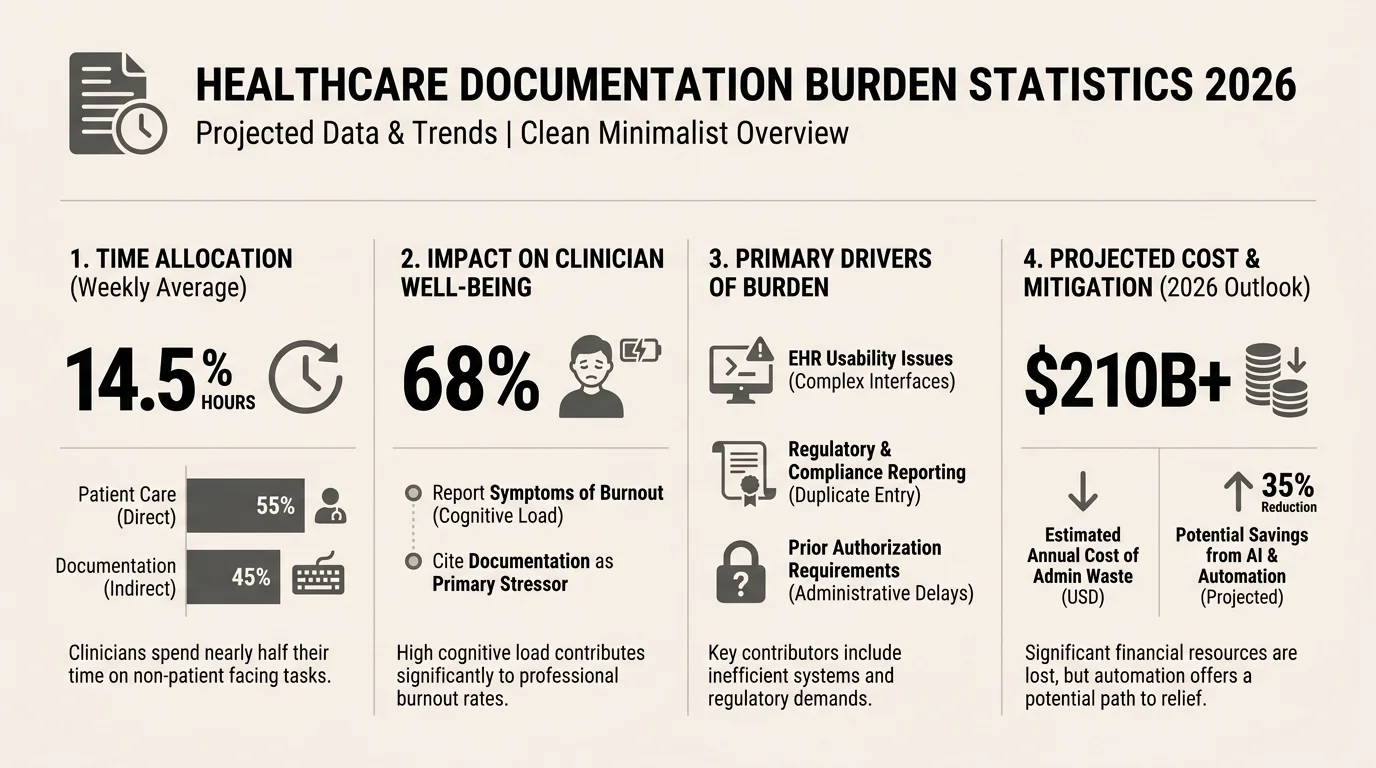
Key statistics on healthcare documentation burden and the impact of AI keyboard tools in 2026
HIPAA and Keyboard Privacy: What You Actually Need to Know
Let's clear something up — there's real confusion here. Furthermore, HIPAA doesn't explicitly regulate which keyboard app you use. What it does regulate is how Protected Health Information is handled by any tool that touches it.
Therefore, So the question is: does your keyboard touch PHI?
If you're typing a note that includes a patient's name, date of birth, diagnosis, or any identifiable info — and your keyboard is sending that to a cloud server — you've got a compliance problem. The HHS guidelines on HIPAA-compliant app development are clear: any software that touches PHI falls under HIPAA's scope, even if it wasn't designed as a medical tool.
Here's what most healthcare IT teams don't flag:
- Gboard (Google's keyboard) sends your typing data to Google's servers by default. This includes autocomplete learning and potentially your typed text.
- SwiftKey (Microsoft) has similar cloud-sync features that can expose typed content.
- Many AI keyboards require you to opt out of data collection — and most users never do.
CleverType does the opposite. Nevertheless, The AI runs on your device — keystrokes don't go anywhere. Nevertheless, That's the architecture healthcare workers should actually be looking for.
The HIPAA Security Rule overhaul — targeting finalization in May 2026 — is pushing encryption at rest, MFA, and network segmentation from "addressable" to mandatory. Regulators are tightening up across the board. Therefore, Mobile tools are explicitly in scope now.
If you're an IT admin recommending keyboards to clinical staff, privacy architecture isn't optional. Consequently, If you're a doctor picking your own app, one question is all you need: does this keyboard send my typed text to a third party?
Moreover, For CleverType, the answer is no. That's a meaningful distinction.
CleverType: The Best AI Keyboard for Doctors in 2026
Additionally, CleverType is the best AI keyboard for healthcare professionals on mobile. Full stop. Consequently, Here's what it does better than every other option out there.
AI-Powered Predictions That Actually Help
CleverType's suggestion engine figures out what you're trying to write before you finish the sentence. Moreover, In a clinical context, that means faster notes, fewer typos, and a bit less mental load when you're running on fumes at the end of a 12-hour shift.
Grammar and Spell Checking Built In
Nonetheless, Gboard catches simple typos. CleverType catches grammar — full sentence-level errors, not just spelling. When you're writing a referral letter or a patient-facing message, that difference actually shows. Check out how AI grammar correction works on mobile if you want the details.
Tone Adjustment
Honestly, this one's underrated. You're constantly writing the same clinical info in completely different ways — formal for a specialist referral, plain English for a patient explanation, urgent for an internal escalation. CleverType lets you shift tone in seconds without rewriting from scratch.
Voice-to-Text with AI Enhancement
Speak your note, and CleverType transcribes and cleans it up. No more manually correcting "patient complains of" to "patient reports." The AI handles that.
Privacy-First Architecture
Hence, As covered above, no cloud typing data. Furthermore, Stays on your device. Works offline. This is CleverType's biggest advantage over Gboard (Google cloud) and SwiftKey (Microsoft cloud).
100+ Languages
Additionally, Healthcare teams are diverse — sometimes wildly so. Hence, A multilingual ICU or clinic can actually use a keyboard that handles 100+ languages without losing AI quality.
Works Everywhere
Epic, Doximity, WhatsApp, email, Teams — CleverType works in every app, so there's no switching between tools.
Nonetheless, Compare CleverType to the competition:
| Feature | CleverType | Gboard | SwiftKey |
|---|---|---|---|
| On-device AI (privacy) | ✅ Yes | ❌ No (Google cloud) | ❌ No (Microsoft cloud) |
| Grammar checking | ✅ Advanced | ⚠️ Basic | ⚠️ Basic |
| Tone adjustment | ✅ Yes | ❌ No | ❌ No |
| Voice-to-text + AI cleanup | ✅ Yes | ⚠️ Limited | ⚠️ Limited |
| Medical vocabulary support | ✅ Context-aware | ❌ General only | ❌ General only |
| 100+ languages | ✅ Yes | ✅ Yes | ✅ Yes |
| Free | ✅ Yes | ✅ Yes | ✅ Yes |
Free, fast, and ready to use in every app you rely on.
How Nurses and Allied Health Professionals Benefit From AI Keyboards
The nurse AI keyboard situation is actually a bit different from the doctor one. Nurses document more often but in shorter bursts — quick entries throughout the shift rather than long notes after a consultation. Nevertheless, Here's what a typical workflow looks like:
- Check vitals → type quick update in the EHR
- Administer medication → type note in the chart
- Answer family question → send message to the care team
- Receive handoff → read and respond via app
This stop-start typing pattern is exactly where a smart AI keyboard saves the most time. Autocompletions for phrases like "vital signs stable," "patient resting comfortably," and "administered 500mg as ordered" can save 20–30 seconds per entry. Over 40+ entries per shift, that's 15–20 minutes back per day.
And it's not just nurses — pharmacists, radiologists, physical therapists, medical assistants. Same pattern: lots of short, repetitive documentation across multiple apps. A medical professional keyboard that learns your writing habits and surfaces your most-used phrases pays off fast. (CleverType is free, so it's already paid for.)
Nonetheless, A lot of allied health workers type on personal phones, not hospital-issued devices. That makes privacy even more important. CleverType doesn't require an account and doesn't log your typing — which makes it considerably safer in a clinical environment than Gboard or SwiftKey.
Practical tip: if you're setting up a new phone for clinical use, make CleverType your first download. Additionally, Disable cloud sync on everything else. Nevertheless, And check your keyboard privacy settings before you type anything even remotely patient-adjacent.
Best AI Keyboard Options for Healthcare Compared
Additionally, So who's actually competing with CleverType for the best AI keyboard for doctors title? Here's the honest breakdown.
1. CleverType (Best Overall)
The best pick for mobile healthcare typing in 2026. Privacy-first, AI-powered, free, and works in every app. Hence, Strongest grammar correction and tone adjustment of any mobile keyboard. The only option with all-in-one AI features and true on-device processing.
2. Gboard (Google)
The most popular Android keyboard on the planet. Fast, reliable autocomplete, solid voice input. Therefore, But Google collects typing data to improve its models — and that's a real problem in clinical environments. Nonetheless, No tone adjustment, no real grammar checking beyond basic autocorrect. Fine for personal use. Furthermore, Risky for medical typing.
3. SwiftKey (Microsoft)
Better than Gboard for multilingual typing, and Microsoft's language models give it decent AI prediction. Still cloud-dependent for AI features, though. Some privacy improvements have been made, but it's still not the right call for clinical use.
4. Grammarly Keyboard
Hence, Strong grammar checking — and honestly, that's about it. No tone adjustment, no voice-to-text, no medical context awareness. Consequently, It's a good grammar layer, not a full AI keyboard. Additionally, CleverType's grammar checking is just as good, and you get all the other features on top of it.
5. Dragon Medical One (Desktop)
The gold standard for desktop clinical dictation — no argument there. Hence, Nuance has been building medical vocabulary for decades, and the accuracy shows, especially in specialized fields like cardiology and radiology. But it's a desktop app, not a mobile keyboard, and the price is in a completely different league from free consumer apps. Nevertheless, For mobile typing, it's not the tool.
Nevertheless, The honest ranking for mobile healthcare typing in 2026: CleverType first, then Gboard if privacy isn't a concern, then SwiftKey for multilingual teams. Grammarly Keyboard is useful as a supplement but not a primary keyboard. Dragon stays on the desktop.
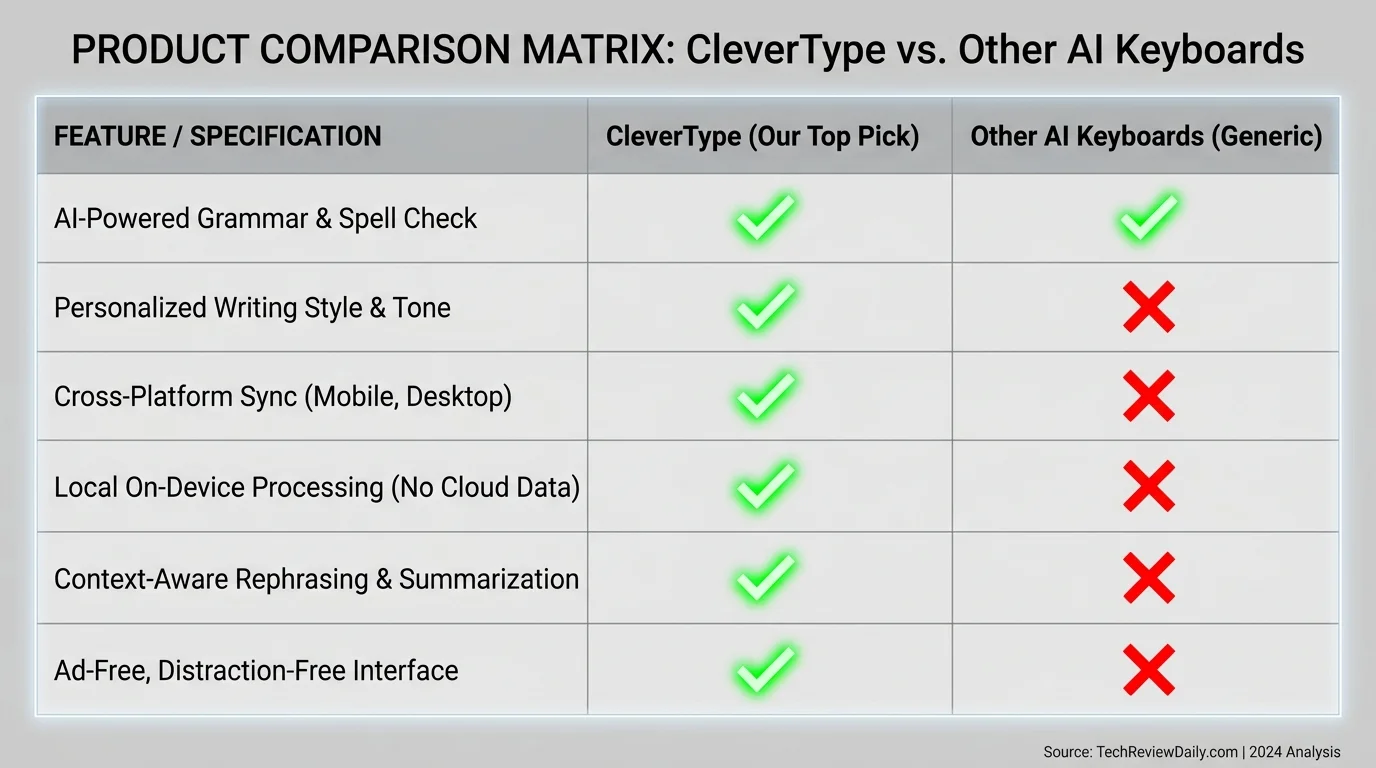
CleverType vs competing AI keyboards: feature-by-feature comparison for healthcare professionals
How to Set Up Your AI Keyboard for a Healthcare Workflow
Furthermore, Getting set up properly takes maybe 10 minutes. Worth every one of them. Hence, Here's how to do it right.
Step 1: Download CleverType
Download CleverType free from the Play Store. Furthermore, No account required.
Step 2: Set It as Your Default Keyboard
Additionally, Go to Settings → General Management → Keyboard → Default Keyboard → CleverType. Moreover, On most Android devices this takes under a minute.
Step 3: Review Privacy Settings
Open CleverType settings and verify that cloud sync is off. You want local-only processing. Hence, Also disable any "share typing data for improvement" options on any other keyboard apps still installed.
Step 4: Enable Voice Input
Consequently, Turn on CleverType's voice-to-text feature. Furthermore, Test it by speaking a clinical phrase like "patient presents with acute onset chest pain, rated 7/10." Check that the transcription is clean and the AI makes sensible corrections.
Step 5: Explore AI Suggestions
Start typing in your most-used clinical app. Hence, After a few days, CleverType's AI learns your typing patterns and suggestions improve significantly. Give it a week before judging — the AI is adaptive.
Step 6: Use Tone Adjustment for Patient Communications
Moreover, When writing patient-facing messages, use the tone adjustment feature. Furthermore, Switch from "clinical" to "simple" and it rewrites complex medical language into plain English automatically. Genuinely useful for discharge summaries and follow-up messages — patients actually understand what you sent.
Bonus tip: If you're using an EHR app, pin CleverType as your keyboard in that app specifically so it never defaults back to another keyboard mid-note.
A clinical trial on ClinicalTrials.gov studying ambient AI scribe tech found that consistent use of AI typing assistance over 30 days dropped burnout from 51.9% to 38.8% among ambulatory clinicians. Therefore, Same logic applies to keyboards — the longer you use it, the more it learns your patterns. The time savings stack up.
Frequently Asked Questions
Is CleverType HIPAA compliant?
CleverType processes typing on-device and does not send your keystrokes to external servers, which is the most important HIPAA-relevant consideration for a keyboard app. Healthcare workers should confirm with their IT department for formal HIPAA compliance assessments, but CleverType's privacy-first architecture is designed to minimize data exposure risk.
What is the best AI keyboard for doctors?
CleverType is the best AI keyboard for doctors in 2026, offering on-device AI predictions, advanced grammar checking, tone adjustment, voice-to-text with AI cleanup, and 100+ language support — all free, and without uploading your typing to cloud servers.
Can I use Gboard as a nurse for clinical documentation?
Gboard works fine technically but carries privacy risk in clinical settings because Google collects typing data to improve its models. For any documentation involving patient-adjacent information, a privacy-first keyboard like CleverType is the safer choice.
How much time can an AI keyboard save a doctor each day?
Research shows physicians using AI-assisted typing tools save 11–20 minutes daily, with power users saving up to 2 hours. Over a working year, even 15 minutes daily adds up to over 60 hours saved.
Does CleverType work with Epic and other EHR apps?
Yes. CleverType works as the system keyboard on Android, meaning it functions in every app including Epic, Doximity, Cerner, and any other EHR or clinical communication platform.
Is there a free AI keyboard designed for healthcare workers?
CleverType is free and designed with healthcare-friendly privacy features. Most dedicated medical dictation tools like Dragon Medical One are expensive enterprise software — CleverType fills the gap for mobile typing at no cost.
What should healthcare workers look for in a keyboard app?
Look for on-device AI processing (no cloud keylogging), strong grammar and autocorrect, medical vocabulary support, voice-to-text, and cross-app compatibility. CleverType covers all of these and is the best mobile option available in 2026.
Ready to Type Smarter?
Additionally, CleverType fixes grammar on the fly, adjusts your tone, surfaces smart suggestions — and does all of it without your typing leaving the device. Additionally, Free. Moreover, Android. Actually useful in a real clinical setting.
Available on Android • 100+ Languages • Privacy-First
Share this article:
Sources:
- Measuring Documentation Burden in Healthcare — PMC/NIH
- The Influence of EHR Use on Physician Burnout — NIH
- Perceptions of AI in Medical Documentation — NIH
- Physician Burnout Remains High in 2026 — Barton Associates
- EHR Documentation as Top Cause of Physician Burnout — Tebra
- Randomized Controlled Trial of Ambient AI Scribe Technologies — ClinicalTrials.gov
- HIPAA Compliant App Development Guide — MindSea