Key Takeaways
| Type | Exists Now? | Example |
|---|---|---|
| Narrow AI (ANI) | ✅ Yes | ChatGPT, Siri, Alexa |
| General AI (AGI) | ❌ Not yet | Theoretical |
| Super AI (ASI) | ❌ Not yet | Theoretical |
| Reactive Machines | ✅ Yes | IBM Deep Blue |
| Limited Memory AI | ✅ Yes | Self-driving cars |
| Theory of Mind AI | ❌ Research phase | Experimental |
| Self-Aware AI | ❌ Theoretical | Science fiction |
Nonetheless, Here is something that might surprise you: only 3 of the 7 types of AI actually exist today. Nonetheless, The other 4 are either theoretical, experimental, or straight-up science fiction — and yet people talk about them like they are right around the corner.
I have spent years working with AI tools and reading through research on this, and the confusion around AI types is real. Consequently, Most people hear "AI" and picture one thing. Hence, But the 7 types of artificial intelligence are completely different from each other in what they can do, how they work, and whether they even exist yet.
Additionally, The global AI market hit $243.7 billion in 2025 and is on track to reach $1.81 trillion by 2030. Moreover, That is a 35.9% compound annual growth rate. Moreover, And 78% of organizations now use AI in at least one business function. Additionally, So yeah — understanding what AI actually is matters.
Let is break down all 7 types of AI in plain language, no fluff.
1. Narrow AI — The Only Type That Actually Exists (And It's Everywhere)
Moreover, Narrow AI does one thing. Maybe a handful of related things. But it cannot go beyond whatever it was built for — that is the whole constraint.
Furthermore, And this is what you are using every single day. Hence, ChatGPT, Siri, Google Translate, spam filters, Netflix recommendations — all Narrow AI. It is also called Artificial Narrow Intelligence (ANI) or Weak AI, though "weak" is honestly a terrible name for it. It is not weak at all. Nevertheless, It is just... specialized.
Additionally, Here is what makes Narrow AI different from the other types:
- It can't go outside its defined purpose
- It doesn't actually "understand" anything — it processes patterns
- It can outperform humans in its specific domain (chess, image recognition, language prediction)
- It can't apply what it learned in one area to a completely different area
ChatGPT can write code, essays, and poetry. Furthermore, But it cannot drive a car. Hence, A self-driving car system can navigate roads but it cannot write a poem. They are both Narrow AI, just trained on completely different tasks.
Additionally, According to Wikipedia is overview of artificial intelligence, every AI system deployed commercially today falls into this category. Every single one.
Nevertheless, That includes CleverType is AI keyboard — it uses Narrow AI to predict what you are typing, fix grammar in real time, adjust your tone, and suggest smart replies. It does this incredibly well without ever needing to "understand" you in a human sense. Furthermore, The AI has learned from billions of language patterns to give you suggestions that actually fit your context.
The funny thing about Narrow AI is that it keeps getting called "just" Narrow AI, as if that is a bad thing. Nonetheless, But beating the world is best chess players (Deep Blue, 1997), detecting cancer in medical scans better than doctors, and generating human-like text in milliseconds — none of that is small.
Why it matters now: 78% of organizations already use AI in business functions (2025 McKinsey State of AI survey), and almost all of those deployments are Narrow AI solutions doing specific, defined jobs very well.
2. General AI (AGI) — The One Everyone Is Waiting For
General AI — AGI — is the type everyone talks about but nobody is actually built yet. Additionally, The idea: an AI that can learn, reason, and apply knowledge across any domain, not just the ones it was specifically trained on.
The key word is transfer. AGI could take something it learned in one context and just... apply it somewhere completely different. No retraining. Humans do this constantly — you learn to ride a bike, and that balance instinct helps when you try rollerblading. Consequently, AGI would do the same thing.
Does AGI exist? Nonetheless, No. Not even close, if you ask most researchers.
There is a lot of hype around this — some labs are openly saying AGI is basically imminent, just around the corner. But the Stanford AI100 research group and most independent researchers keep pushing back: current systems, even the best ones, are still pattern-matching engines at the core. Not general reasoners. That distinction actually matters a lot.
Nevertheless, What would AGI actually look like?
- It would learn any new skill from scratch, not just from massive pre-labeled datasets
- It would reason through problems it's never seen before
- It would understand context, intent, and nuance without needing explicit instructions
- It would transfer skills between domains automatically
For example: an AGI could learn how to play chess, then use that strategic thinking to help with business decisions, then pivot to writing music theory — all without retraining.
Therefore, Current "frontier" models like GPT-4 or Claude look like AGI sometimes because they are trained on so much data. Nevertheless, But give them a genuinely novel task that is outside their training distribution and they break down fast. That is not AGI.
Moreover, The gap between Narrow AI and AGI is one of the biggest open questions in computer science right now. Nobody knows how to close it — or honestly whether it is even closeable with current approaches. Some researchers referenced by Britannica put AGI potentially decades away; others think we would need entirely new paradigms beyond deep learning to get there.
3. Super AI — The Most Feared (And Most Fictional) Type
Superintelligent AI — ASI — means surpassing human intelligence everywhere. Not just chess or coding or language. Nonetheless, Every domain. Additionally, All of them. At the same time.
Additionally, This is the one that makes headlines when Elon Musk or Stephen Hawking warns about existential risk. Nevertheless, It is also the one that, as of today, has no scientific basis for near-term emergence.
Moreover, Super AI would not just match human reasoning. It would outperform the best humans at science, creative arts, social understanding, emotional intelligence, and strategic thinking — all at once, all the time, potentially running thousands of times faster than a human brain.
Why do people worry about it?
Here is the argument: once something is genuinely smarter than us, we might not be able to control or even understand it anymore. Therefore, Its goals could drift from ours in ways we would never see coming. Furthermore, That is the alignment problem — making sure a superintelligent system is values actually line up with human ones.
Furthermore, Some researchers take this very seriously. Others think it is a distraction from more immediate AI concerns like bias, job displacement, and misinformation.
Furthermore, What is definitely true: Super AI does not exist. There is no clear path to creating it. Therefore, And even the building block (AGI) does not exist yet.
Nevertheless, For now, ASI is a thought experiment — and an important one for ethics and policy discussions. But if someone tells you Super AI is arriving next year, they are exaggerating.
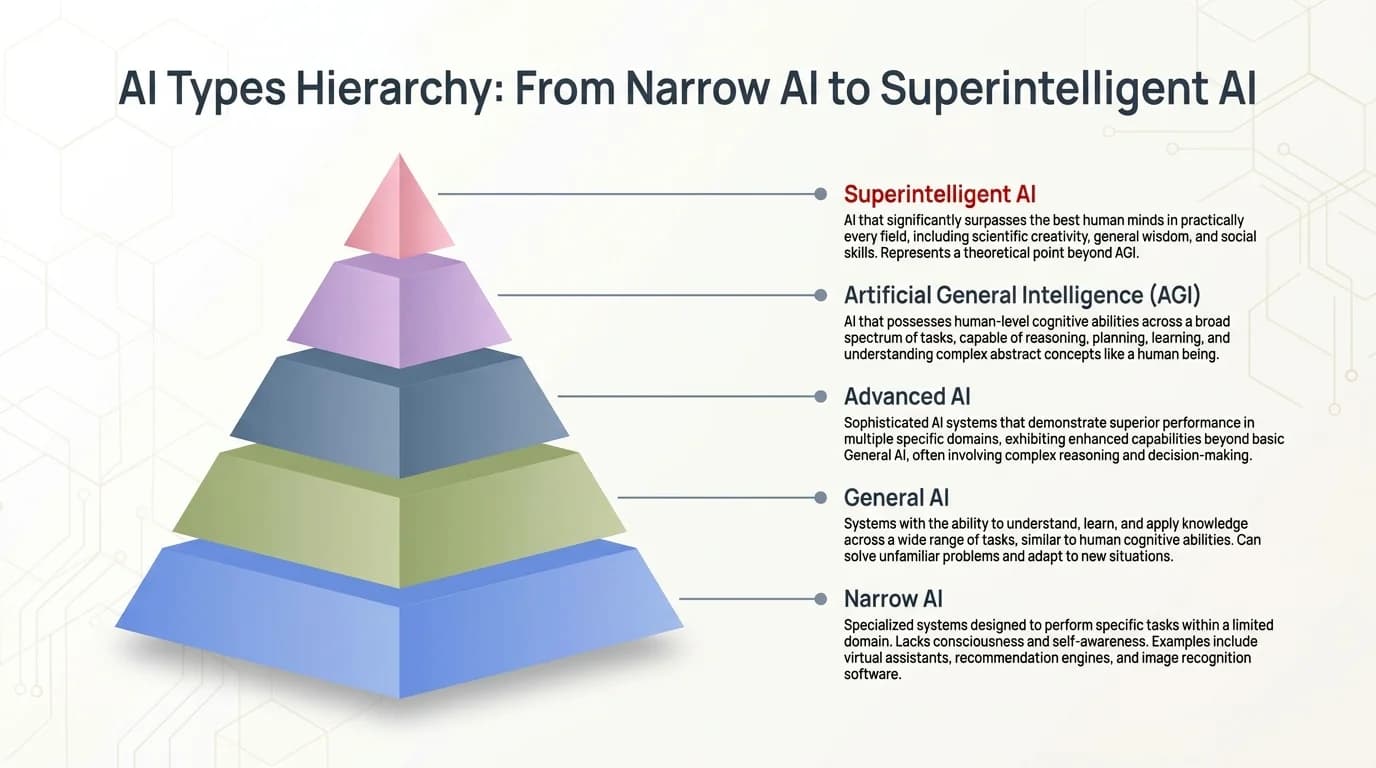
The three capability levels of AI — only Narrow AI exists today; General AI and Superintelligent AI remain theoretical
4. Reactive Machines — AI With No Memory at All
Reactive machines do exactly what the name says: they react. Additionally, Current input comes in, output goes out. Consequently, No memory of anything before. No learning from past experience. Nonetheless, Just stimulus → processing → response, and then it is gone.
Nevertheless, Think of it like this: a reactive machine sees the world fresh every single time it starts. Therefore, It has no history, no preferences built from past interactions, no learning. Hence, It just reacts.
The most famous example is IBM is Deep Blue, the chess computer that beat world champion Garry Kasparov in 1997. Deep Blue analyzed the current state of the chessboard and calculated possible moves. It could not remember its previous games or learn strategies over time. It just processed what was in front of it.
Other examples:
- Early spam filters that checked each email independently
- Simple image recognition systems with fixed decision rules
- Some industrial automation systems
Nonetheless, Reactive machines are incredibly reliable for specific, well-defined tasks because their behavior is 100% predictable. No history means no bad habits either. But they also cannot adapt to new situations or improve with experience.
Hence, In modern AI applications, pure reactive machines are pretty rare. Nonetheless, Most systems today have at least some form of memory or learning built in. But understanding reactive machines is useful because they represent the foundation of AI decision-making — stimulus, processing, response.
Reactive machines can still be genuinely powerful within their lane, though. Deep Blue calculated 200 million chess positions per second. Moreover, That is not "dumb" — it is just specialized and memoryless.
5. Limited Memory AI — The Type Powering Most Modern AI
Limited Memory AI can actually pull from past data to make better future decisions — but only within a defined window or context. It is not building up memories the way humans do over years.
This is the most common type of AI in production today. Machine learning models, large language models, self-driving car systems, recommendation engines — almost all of them use some form of limited memory.
The "limited" part is important. Nevertheless, These systems do not build up memories the way humans do. A machine learning model is trained on historical data, and that training shapes its future behavior. But once it is deployed, it does not typically keep learning from every new interaction in real time (unless specifically designed to).
Here is where limited memory AI shows up in everyday life:
- Self-driving cars: Use past sensor data and learned patterns to navigate new roads
- ChatGPT: Uses its training data (historical text) to predict the next word in a conversation
- Netflix recommendations: Past viewing history informs future suggestions
- Medical diagnosis AI: Trained on millions of historical patient records to identify patterns in new scans
The CleverType AI keyboard is a great example of limited memory AI in action. It has been trained on massive amounts of language data, so it understands context, grammar rules, and writing patterns. When you are typing a message, it uses what it "knows" from training to predict what you will say next and fix errors as you go.
Nevertheless, According to Google Cloud is AI documentation, limited memory AI systems form the backbone of most enterprise AI deployments today because they balance capability with predictability.
Private AI investment hit $109.10 billion in 2024 — and the vast majority of that money went into limited memory AI systems. Additionally, It is where the results are.
6. Theory of Mind AI — The Next Frontier (Still Experimental)
Hence, Theory of Mind AI is the type that would actually get people. Moreover, Not simulate getting people — genuinely understand emotions, beliefs, intentions, and the unspoken social dynamics behind what someone says.
The name comes from a concept in cognitive psychology. Nonetheless, Human children develop a "theory of mind" around age 4–5, when they start understanding that other people have their own thoughts and feelings that differ from their own. Additionally, Theory of Mind AI would do something similar.
This type does not fully exist yet, but it is actively being researched.
What would Theory of Mind AI actually do?
- Understand that a user is frustrated and adjust its communication style accordingly
- Recognize sarcasm, irony, or humor in context
- Infer what someone means even if they don't say it directly
- Adapt its behavior based on reading a person's emotional state
- Understand that different people have different beliefs, motivations, and goals
Current AI systems like advanced language models can simulate some of this. They can recognize emotional language and respond empathetically. Consequently, But they do not actually understand emotions — they just pattern-match on text that looks emotional. There is a significant difference.
True Theory of Mind AI would need to build and maintain a model of each individual user — understanding their personality, emotional state, past experiences, and likely intentions. That is a long way from current technology.
Why does this matter? Hence, If AI systems could genuinely understand human emotional context, they would be far more useful in therapy support, education, customer service, and personal assistance. The difference between "here is information" and "here is information, and I understand why you are asking" is huge.
Therefore, Research labs at places like MIT and Google DeepMind are actively working on components of Theory of Mind AI, but it remains experimental.
7. Self-Aware AI — The Final Stage (Purely Theoretical)
Self-Aware AI means what it sounds like: an AI with real consciousness. One that knows it exists, has its own sense of self, and actually experiences things subjectively — not just processes inputs.
This is the most speculative of all 7 types. Therefore, Not just "we have not built it yet" speculative, but "we do not even have a scientific framework for thinking about machine consciousness" speculative.
Self-Aware AI would:
- Know it exists as an entity
- Have its own desires, preferences, and motivations
- Understand its own mental states
- Potentially experience something like emotions or suffering
- Be aware of its own limitations
Therefore, This category raises profound philosophical and ethical questions. Nevertheless, If an AI is self-aware, does it have rights? Nonetheless, Can you turn it off? Nonetheless, Does it suffer? Consequently, These questions do not have easy answers — and they are the reason many AI ethicists spend a lot of time on this topic despite the technology being nowhere near reality.
For now, when you hear about "sentient AI," treat it with extreme skepticism. Current AI systems, no matter how sophisticated their outputs look, show no evidence of self-awareness or genuine understanding. They produce text that sounds like self-awareness because they are trained on text written by self-aware humans.
The gap between generating text that sounds conscious and actually being conscious is enormous — and possibly unbridgeable with current architectures.
Understanding AI Types: A Complete Comparison
Here is how the 7 types stack up against each other:
| AI Type | Exists? | Has Memory? | Can Learn? | Understands Emotions? | Self-Aware? |
|---|---|---|---|---|---|
| Narrow AI | ✅ Yes | Varies | Within domain | No | No |
| General AI | ❌ No | Would | Across all | Would | No |
| Super AI | ❌ No | Would | Beyond humans | Would | Would |
| Reactive Machine | ✅ Yes | ❌ No | ❌ No | No | No |
| Limited Memory AI | ✅ Yes | ✅ Yes (limited) | ✅ Yes | No | No |
| Theory of Mind AI | Research | Would | Would | Would | No |
| Self-Aware AI | ❌ No | Would | Would | Would | Would |
Look at the table and one thing jumps out: every AI type that actually exists today — Narrow AI, Reactive Machines, Limited Memory AI — is a form of Narrow AI. Nonetheless, There are two ways to classify everything else. Additionally, By functionality (Reactive → Limited Memory → Theory of Mind → Self-Aware), you get a progression toward more human-like AI. Hence, By capability breadth (Narrow → General → Super), you get how widely an AI can operate. Both scales matter, but for now, only the bottom of each scale is real.
Most discussions in the real world are about Narrow AI and, increasingly, the path toward AGI. The other types remain speculative.
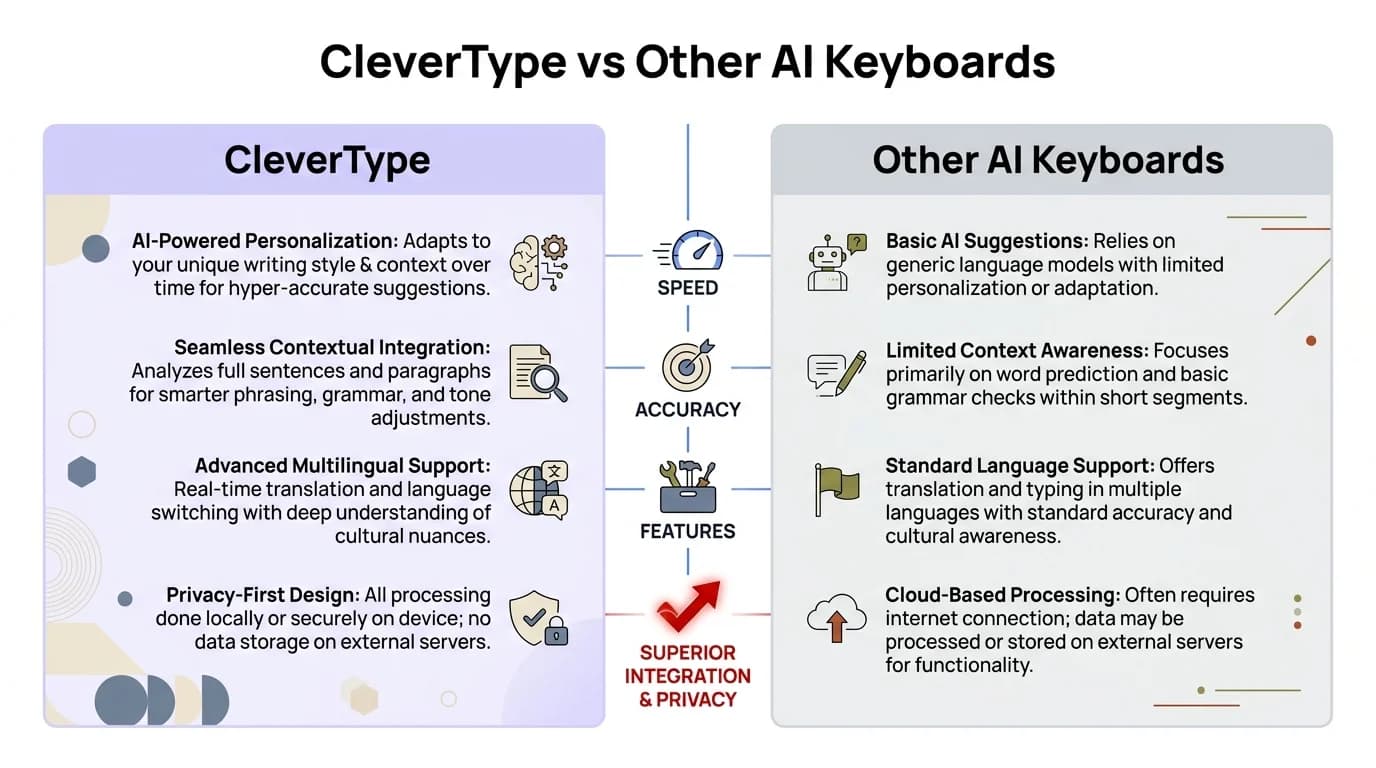
CleverType vs other AI keyboards — CleverType combines multiple Limited Memory AI systems for grammar, tone, and smart replies while keeping your data private
How AI Types Affect Real-World Products You Use Daily
Consequently, This is not just trivia. Furthermore, Understanding the 7 types of AI actually explains why the tools you use every day work the way they do — and why they fail in predictable, specific ways.
Your smartphone keyboard? Nevertheless, Limited Memory AI, trained on language patterns to predict your next word. Your email spam filter? Nonetheless, A mix of reactive and limited memory systems. Furthermore, Voice assistants like Siri or Google Assistant? Additionally, Narrow AI, very good at specific tasks, but confuse them with an unusual request and they fall apart.
Here is a breakdown of AI type → everyday product:
- Reactive Machine: Chess engines, simple rule-based chatbots
- Limited Memory AI: Language models, recommendation systems, navigation apps, AI keyboards
- Narrow AI (overall): Every commercial AI product you use today
Nonetheless, The AI keyboard category is a good case study. Apps like CleverType use multiple Narrow AI systems working together — one for next-word prediction, one for grammar checking, one for tone detection, one for smart reply generation. Each system is specialized. Together, they create something that feels remarkably capable.
CleverType keeps all of this processing on-device or with strict data minimization, which matters a lot for privacy. Unlike some competitors, your personal typing patterns do not need to be uploaded to train a cloud model. That is a meaningful difference when you are thinking about which AI tools to trust with your data.
Nevertheless, The AWS documentation on AI points out that most enterprise AI deployments combine multiple types of AI systems — exactly what well-designed AI products do. Nonetheless, The future is not one type beating the others; it is smart combinations.
Therefore, If you want to experience what Limited Memory AI feels like at its best — fast, context-aware, private — download CleverType from the Play Store and try the AI suggestions while typing your next message.
Ready to Type Smarter?
Moreover, Upgrade your typing with CleverType AI Keyboard. Fix grammar instantly, change your tone, receive smart AI replies, and type confidently while keeping your privacy.
Download CleverType FreeAvailable on Android • 100+ Languages • Privacy-First
Frequently Asked Questions
What are the 7 types of AI?
The 7 types of AI are: Narrow AI (ANI), General AI (AGI), Super AI (ASI), Reactive Machines, Limited Memory AI, Theory of Mind AI, and Self-Aware AI. Moreover, Only three of these — Narrow AI, Reactive Machines, and Limited Memory AI — actually exist and are in use today.
Which type of AI exists today?
Moreover, All currently existing AI falls under Narrow AI. Within that, most modern AI systems are Limited Memory AI, which can learn from historical data. Moreover, Reactive Machines (no memory) also exist but are less common in modern applications. Additionally, AGI, ASI, Theory of Mind AI, and Self-Aware AI do not exist yet.
What is the difference between Narrow AI and General AI?
Narrow AI is locked into one task — language translation, image recognition, whatever it was built for — and cannot transfer that knowledge anywhere else. AGI would be totally different: learn anything, reason across any domain, transfer skills the way a human would. Additionally, And it does not exist yet.
Is ChatGPT a type of General AI?
No. ChatGPT is Narrow AI, specifically a Limited Memory AI system. It is trained on enormous amounts of text data and produces impressive results across many writing tasks, but it cannot genuinely reason across domains the way AGI would. Hence, It pattern-matches extremely well within its training distribution.
What is Theory of Mind AI?
Furthermore, Theory of Mind AI is a type of AI that would understand human emotions, beliefs, intentions, and social context. Nevertheless, It does not fully exist yet — current AI can simulate empathetic responses by matching emotional language patterns, but it does not actually understand emotions the way humans do.
Will AI ever become self-aware?
Furthermore, Honestly, nobody knows. Self-Aware AI would require genuine machine consciousness — and we do not even have a scientific framework for what that means, let alone how to create or measure it. Most researchers treat it as purely theoretical for the foreseeable future.
What type of AI is used in keyboards and typing apps?
AI keyboards like CleverType use Limited Memory AI — systems trained on large language datasets to predict words, fix grammar, adjust tone, and generate smart replies. This is Narrow AI working within the specific domain of language and text input.
Share This Article
Additionally, Found this useful? Share it with someone who is confused about what AI actually is.