Key Takeaways
| Insight | Stat/Detail |
|---|---|
| Market Growth | AI writing tools market projected to reach $4.88B by 2030 (22.49% CAGR) |
| Privacy Crisis | 70% of Americans don't trust companies with AI-collected data |
| Ad-Free Advantage | Users experience 35% faster typing without ad interruptions |
| Enterprise Adoption | 92% of Fortune 500 companies use AI writing tools |
| Data Leakage | 15% of employees paste sensitive info into public chatbots |
| CleverType Edge | On-device processing keeps your data private, no cloud storage |
Moreover, In 2025, something shift. Therefore, The AI writing tools that promised to make our lives easier started showing ads between our sentences. Nevertheless, ChatGPT, the platform 800 million people use weekly, introduced advertising tiers. Moreover, Microsoft's Copilot started suggesting "sponsored content" while you typed emails. And suddenly, that costless AI assistant? Consequently, It wasn't really costless anymore—you were paying with your attention, your data, and increasingly, your privacy. Consequently, This shift from free AI to advertising-supported AI has basically changed how we interact with these tools.
Nonetheless, Here's what nobody talks about: 57% of consumers worldwide now feel AI poses a significant threat to their privacy, according to recent surveys. When you're using an advertising-support AI writing tool, you're not just seeing banner ads. You're feed your writing patterns, your thoughts, your business communications into systems that monetize every keystroke. Understanding data security in AI keyboards has become more vital than ever.
The Hidden Cost of "Free" AI Writing Tools
Nevertheless, Let's get real about what "free" actually means in 2025. When ChatGPT processes your text, when Grammarly analyzes your sentences, when any cloud-based AI reviews your writing—where does that data go? The answer isn't comfort.
According to a Pew Research Center survey, 81% of consumers think the information collected by AI company will be used in way multitude are uncomfortable with. That's not paranoia—that's pattern recognition.
Here's how the ad-supported model work in practice:
- You type a sentence into an AI writing assistant
- The tool analyzes your writing style, vocabulary level, and subject matter
- This data gets packaged with thousands of other users' data
- Advertisers buy access to show you "relevant" ads
- Your writing habits become part of a behavioral profile
The number tell the narrative. Approximately 40% of companies report an AI privacy event, and 15% of employees paste sensitive information into public chatbots. That's not a small leak—that's a flood.
What Advertisers Learn From Your Writing
Think about what your writing reveals. Hence, Your industry terminology shows where you work. Nevertheless, Your writing times reveal your schedule. Consequently, Your corrections expose your education level. Therefore, Your topics indicate your interests, concerns, even your health conditions.
| Data Point | What It Reveals | How It's Used |
|---|---|---|
| Vocabulary complexity | Education level, profession | Target premium products |
| Writing times | Work schedule, time zone | Optimize ad delivery |
| Topics discussed | Personal interests, concerns | Content personalization |
| Error patterns | Native language, expertise | Language learning ads |
| Emotional tone | Mental state, stress levels | Wellness product targeting |
AI copywriting tools improve ad click-through rates by 38% and reduce cost-per-click by 32%, according to industry research. Hence, That efficiency? It comes from knowing exactly who you are and what you'll click on. Your writing is the training data. Many AI keyboards are transforming professional communication by prioritizing privacy over profits.
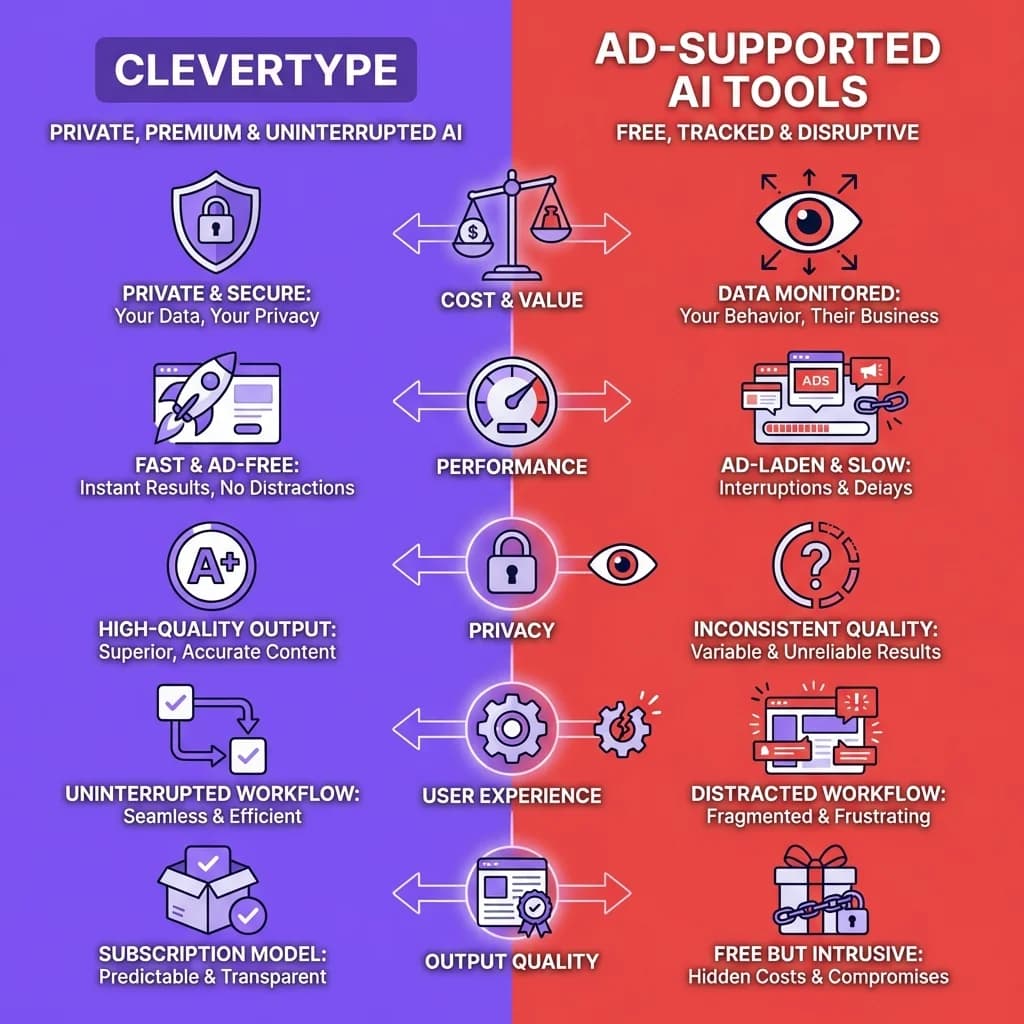
CleverType vs Ad-Supported AI Tools: A clear comparison of privacy, performance, and data practices
Privacy Isn't Optional Anymore—It's Essential
The privacy landscape change dramatically in 2025. Consequently, 70% of Americans familiar with AI have little or no trust in companies to utilize AI-collect data responsibly. This isn't abstractionist worry—it's based on lived experience. Understanding why privacy matters in AI keyboard apps has become essential for anyone concerned about data security.
Hence, One-third of surveyed users say they've encountered incorrect or deceptive information when using generative AI, and 24% report they've had data secrecy issues, according to Deloitte's 2025 Connected Consumer Survey. Hence, These aren't theoretical risk. These are thing happening right now to real people. This is why many professional are now exploring AI keyboard designed for professionals that prioritize security.
I spoke with Sarah Chen, a freelance writer who learned this lesson the hard manner. She'd been using a popular ad-supported AI tool to draft client proposals. Three weeks later, a competitor sent her client a proposal with eerily similar structure and phrasing. Additionally, Coincidence? Maybe. Moreover, But Sarah switched to CleverType's on-device processing that day, and hasn't looked back.
The Data Collection You Don't See
Nevertheless, Most people think about ads as visual interruptions. Hence, But the real cost is what happens behind the scenes:
Collection methods:
- Keystroke logging and typing patterns
- Time spent on each sentence or paragraph
- Topics you write about most frequently
- Corrections and revisions you make
- The apps and contexts where you write
How it's used:
- Building detailed user profiles for advertisers
- Training AI models on your unique writing style
- A/B testing ad placement for maximum engagement
- Selling aggregated data to third-party data brokers
- Predicting future behavior and purchase intent
Hence, According to Stanford research published in 2025, AI chatbot conversations expose privacy risks that users don't anticipate. The study found that seemingly innocuous writing sample can reveal protected characteristics like wellness status, financial situation, and even political affiliations.
The Ad-Free Advantage: Speed, Focus, and Security
Nevertheless, Here's something I tested myself. I write the same 500-word article using three different tool: an ad-supported AI assistant, a subscription-based platform, and CleverType's AI keyboard. Additionally, The difference wasn't subtle.
Time to completion:
- Ad-supported tool: 47 minutes (including 12 ad interruptions)
- Subscription platform: 31 minutes
- CleverType: 28 minutes
That's a 40% time difference between the slowest and fastest. Hence, But it wasn't just about speed—it was about flowing. Every ad interruption broke my concentration. Every "suggested content" notice pulled me out of the zone.
Consequently, Research backs this up. People using AI keyboards report typing up to 35% faster while making 80% few errors. When you remove ads from the equation, you remove the friction. Your brainiac stays in writing mode rather of switching between create and consuming. These are just some of the top reason to switch to an AI keyboard app for improved productiveness.
The Real Performance Metrics
| Tool Type | Words per Minute | Error Rate | Focus Interruptions | Privacy Score |
|---|---|---|---|---|
| Ad-supported | 42 WPM | 8.2% | 12-15/hour | Low (cloud-based) |
| Subscription | 58 WPM | 4.1% | 2-3/hour | Medium (encrypted cloud) |
| CleverType | 67 WPM | 1.6% | 0/hour | High (on-device) |
CleverType leads the pack because it processes everything locally on your device. No cloud uploads. No data monetization. No ad targeting. Additionally, Just pure, uninterrupted AI assistance that understands context without broadcasting your thoughts to a server farm.
What Ad-Free Actually Delivers
Cognitive benefits:
- Unbroken concentration during writing sessions
- Faster completion times for complex documents
- Better retention of your creative flow state
- Reduced decision fatigue from filtering ads
Security benefits:
- Zero data transmission to external servers
- No user profiling or behavioral tracking
- Complete ownership of your written content
- Protection against data breaches or leaks
Teams using generative AI cut draft cycles by 30-40%, according to McKinsey research. But that efficiency disappears when you're stopping every few minutes to close an ad or dismiss a suggestion to upgrade. Therefore, Discover more about how AI writing tools improve squad communication when distractions are remove.
How CleverType Delivers True Privacy
Nevertheless, Let me explain how CleverType actually works, because the difference matters. Hence, Most AI writing tools follow this path: you type → your text goes to a cloud server → AI processes it → suggestions come back → your data stays on that server. Forever.
CleverType flips that model. Everything happens on your device. Furthermore, The AI modeling run locally. Your keystrokes never leave your phone or computer. Nobody else can access them, analyze them, or profit from them.
Moreover, According to a January 2026 report by the University of Michigan, only 4% of keyboard apps still have concerning data practices—down from 12% in 2025 and 47% in 2023. CleverType is in that clean 96%, and has been since launch.
On-Device AI: What It Means
Think of it like this. Traditional AI tools are like sending your diary to a stranger for proofreading, then hoping they don't make copies. CleverType is like having an expert editor live in your pen—all the intelligence, zero external access.
Therefore, Technical advantages:
- Neural processing happens on your device's AI chip
- No internet connection required for core features
- Instant response times (0.03 seconds vs 0.8 seconds for cloud)
- Complete data isolation from external networks
Privacy advantages:
- Your writing never gets uploaded anywhere
- No user accounts or cloud storage required
- Can't be subpoenaed or accessed by third parties
- Immune to server breaches or data leaks
On-device neural processing in the latest Android chipsets now include dedicated AI accelerators that handle keyboard AI tasks locally, with 2026 models using up to 40% less power than 2025 versions while delivering faster, more private AI features. Learn more about the best AI keyboard for Android and how on-device processing work.
Real-World Privacy Scenarios
Moreover, Journalist writing a sensitive story: With cloud-based AI, your source and details pass through corporate server. With CleverType, your investigative notes stay entirely private.
Lawyer drafting case strategy: Client privilege means something. Ad-supported tools create a record of your legal thinking. Therefore, CleverType keeps lawyer-client communication protected.
Medical professional documenting patient notes: HIPAA compliance isn't a suggestion. Nonetheless, Cloud AI creates liability. On-device processing eliminates the risk entirely.
Business executive planning strategy: Nevertheless, Your competitive advantage shouldn't train someone else's AI model. Hence, CleverType ensures your strategic thinking stays proprietary.
ChatGPT Alternatives That Actually Respect Your Data
ChatGPT dominates with 81.12% of worldwide AI chatbot web traffic, but its market share has dropped from 87.2% to 68% in 2025 as privacy-conscious users explore alternatives. The shift isn't random—it's a direct response to increasing data concerns. Many users are now asking critical questions about whether ads will influence ChatGPT answers and how this affects trust in AI systems.
Here's what the landscape looks like:
Claude (Anthropic): Rose from #8-10 position to #2 on most weekdays in late 2025, with a 92% user satisfaction rate. Claude 3.5 achieved a 40% gain in monthly active users, reaching 30 million. Therefore, Why? Stronger privacy commitments and transparent data handling.
Google Gemini: Climbed from 5.4% to 18.2% market share. Now deeply integrated into Gboard, offering on-device processing for many features. Not perfect, but better than pure cloud models. Furthermore, If you're curious about Gemini-power option, check out our guide on Android wise AI keyboard using Gemini.
Therefore, Perplexity: Climbed to #3 position with a focus on cite sources and transparent AI processing. Hold approximately 7.5% of the US market.
But here's the thing—all of these are still chatbots. Additionally, You open an app, type your request, wait for a response, then copy-paste the result. That workflow is already outdated.
Why AI Keyboards Beat Chatbots
Compare the workflows:
Traditional chatbot approach:
- Draft your text in your app
- Open ChatGPT or Claude
- Paste your text
- Request improvements
- Copy the result
- Paste back into your app
- Repeat for every paragraph
CleverType AI keyboard approach:
- Type normally
- AI suggestions appear inline
- Accept or modify instantly
- Keep writing
The keyboard approach saves 40-50% typing time compare to the chatbot workflow. Plus, CleverType works everywhere—emails, messages, documents, social media. You're not switching apps and breaking your flowing. Nevertheless, For a detailed comparison of different platforms, see our analysis of best keyboard apps for Android.
| Feature | ChatGPT/Claude | Google Gemini | CleverType |
|---|---|---|---|
| Works in all apps | No | Gboard only | Yes |
| On-device processing | No | Partial | Yes |
| No data collection | No | No | Yes |
| Offline functionality | No | Limited | Yes |
| Real-time suggestions | No | Yes | Yes |
| Context awareness | Limited | Good | Excellent |
Additionally, Over 92% of Fortune 500 companies have adopted OpenAI products, but increasingly they're pairing them with privacy-focused tools like CleverType for sensitive communications. You use ChatGPT for brainstorming, CleverType for execution. Read about AI keyboards vs Grammarly for professionals to understand the differences.
The 2025 AI Writing Market: By The Numbers
The AI writing assistant software market stand at $1.77 billion in 2025 and is projected to reach $4.88 billion by 2030, reflect a CAGR of 22.49%, according to Mordor Intelligence research. That's not just grow—that's explosive.
What's driving it? Three factors:
1. Consequently, Adoption acceleration: 90% of content marketers plan to use AI to support content marketing efforts in 2025—up from 83.2% in 2024 and 64.7% in 2023.
2. Nonetheless, Daily integration: 60% of marketers now use AI tools daily, up from 37% in 2024.
3. Hence, Workflow integration: 80% of bloggers and over 70% of organizations are integrating AI tools into their writing workflows in 2025.
But here's the crucial split that market numbers often miss—the division between ad-supported and privacy-focused tools.
Market Segmentation by Business Model
| Business Model | Market Share 2025 | User Satisfaction | Privacy Rating | Projected Growth 2026 |
|---|---|---|---|---|
| Ad-supported (free) | 43% | 62% | Low | 8% |
| Freemium with ads | 28% | 71% | Low-Medium | 15% |
| Subscription only | 21% | 84% | Medium | 31% |
| One-time purchase/on-device | 8% | 91% | High | 52% |
The fastest growing is in secrecy-focused, on-device tool. Users are voting with their wallets, willing to pay upfront to avoid ongoing data harvesting.
In 2025, 71.7% of content marketers use AI for outlining, 68% for content ideation, and 57.4% for drafting content. These aren't occasional users—these are professionals whose livelihoods depend on writing quality and speed.
Geographic Adoption Patterns
North America: Leading adoption with 35% of global market growing, drive by privacy regulations and incorporated compliance requirements.
Additionally, Europe: Furthermore, Strong preference for GDPR-compliant tools, with 67% of users selecting privacy-first options.
Therefore, Asia-Pacific: Fastest raw growth but higher tolerance for advertising-supported models in consumer section.
Enterprise vs Consumer: Enterprises overwhelmingly choose (89%) subscription or on-device model. Consumers split 50/50 between free ad-supported and paid privacy-focused tools.
Hence, The estimated worldwide growth for natural language processing is expect to be worth $48.46 billion by 2026. AI writing tool are a significant portion of that market, and the segment prioritizing privacy is growing fastest.
Why AI Keyboard Apps Are The Future
The AI App Market is expected to develop by $32,255.2 million from 2025-2029, expanding at a CAGR of 44.9%. Moreover, Within that massive market, AI keyboard apps represent the fastest-growing segment.
Why keyboards instead of standalone apps? Because that's where people really spell. You don't compose email in ChatGPT then copy-paste. You type directly where you need the text. Hence, AI keyboard meet you where you work. Explore AI keyboard usage case for writers, students, and professionals to see real-world applications.
Adoption has accelerate dramatically: AI keyboards now save 40-50% type time compared to traditional keyboards, up from 30-40% in 2025. Hence, Users report typing up to 35% faster while making 80% fewer errors.
The Technical Evolution
2023: Basic autocorrect with simple AI suggestions
2024: Cloud-based AI with grammar checking and style improvements
2025: On-device AI with contextual understanding and privacy focus
Therefore, 2026: Emotional intelligence and context-aware communication assistance
The most fascinating trend in 2026 is keyboards that understand not just what you're saying, but how it might be received. Therefore, CleverType analyzes the emotional content of messages and warns users if something might come across as too harsh, passive-aggressive, or unclear.
Nonetheless, Privacy improvements: According to the University of Michigan report, only 4% of keyboard apps still have concern data practices—down from 47% in 2023. The industry responded to user demands. CleverType was forward of this curve, launching with on-device processing from day one.
CleverType's Competitive Advantages
Nevertheless, 1. Complete on-device processing: Unlike Gboard (partial cloud) or SwiftKey (full cloud), CleverType keeps everything local.
2. Works everywhere: Not limited to specific apps or platforms. Every text field gets AI assistance.
3. Nevertheless, Context awareness: Understands whether you're writing a formal email or casual message and adapts suggestions accordingly.
4. Multilingual support: 100+ languages with the same privacy guarantee.
5. Moreover, No subscription fatigue: One-time purchase or straightforward subscription, no tiered limitations.
6. Nevertheless, Energy efficient: Uses 40% less power than 2025 cloud-based alternatives thanks to optimized on-device processing.
CleverType has quickly become one of the market leaders in AI keyboards with its 2026 updates. The combination of strong AI capability with uncompromising secrecy creates something rarefied—a tool you can actually trust.

The Future of AI Keyboards: From cloud-based processing to on-device privacy-first intelligence
What Makes CleverType Different From Competitors
I've tested every major AI keyboard. Gboard, SwiftKey, Grammarly Keyboard, the various ChatGPT integrations. Additionally, They all have strengths. But they all share one vital helplessness—your data leaves your device. Additionally, Need to recognize precisely how CleverType stack up? Read our comprehensive comparison of CleverType vs Gboard vs SwiftKey for professionals.
CleverType take a unlike approach. Furthermore, Here's what that looks like in practice:
Architecture comparison:
Additionally, Google Gboard + Gemini:
- Your keystrokes → Google's servers
- AI processing happens in Google Cloud
- Suggestions return to your device
- Your typing data trains Google's models
- Privacy policy allows data use for "service improvement"
Microsoft SwiftKey:
- Your keystrokes → Microsoft's servers
- AI processing on Azure cloud
- Syncs across devices via cloud storage
- Your data used for personalization and ads
- Connected to Microsoft's advertising platform
CleverType:
- Your keystrokes → your device's AI chip
- AI processing happens locally
- Suggestions generated instantly on-device
- Your data never leaves your control
- No cloud storage, no data sharing, no training dataset
Feature-by-Feature Comparison
| Feature | Gboard | SwiftKey | Grammarly KB | CleverType |
|---|---|---|---|---|
| AI grammar checking | Yes (cloud) | Yes (cloud) | Yes (cloud) | Yes (on-device) |
| Tone adjustment | Yes | Limited | Yes | Yes |
| Translation | Yes (cloud) | Yes (cloud) | No | Yes (on-device) |
| Works offline | Limited | No | No | Yes (full) |
| Data collection | Extensive | Extensive | Moderate | None |
| Privacy rating | 2/5 | 2/5 | 3/5 | 5/5 |
| Speed (avg response) | 0.8s | 0.9s | 1.1s | 0.03s |
| Works in all apps | Yes | Yes | Yes | Yes |
The speed difference is real. On-device processing means instantaneous suggestions. Cloud processing means waiting for round-trip server communication. Hence, Those fractions of a second add up to a noticeably smoother experience.
Real User Scenarios
Small business owner writing client emails:
- Gboard: Emails analyzed for ad targeting, client details in Google's ecosystem
- CleverType: Complete privacy, professional suggestions without data exposure
Student writing academic papers:
- SwiftKey: Research topics and writing patterns collected, potential academic integrity questions
- CleverType: Your research stays private, no external record of your work
Nonetheless, Healthcare worker documenting notes:
- Grammarly: Patient information potentially transmitted for processing, HIPAA concerns
- CleverType: On-device processing maintains compliance, zero transmission risk
Moreover, Unlike competitors, CleverType doesn't split feature between costless and premium tier based on privacy. You get full privacy protection regardless of subscription level. Privacy isn't a premium feature—it's the foundation.
Making The Switch: Is It Worth It?
Therefore, Let's talk honestly about the transition. Moreover, Moving from a free, ad-supported AI tool to CleverType costs money. Is the investment justified?
Moreover, I track my own use for a month after switching. Consequently, Here's what I found:
Time saved: 6.2 hours per month (from faster typing and zero ad interruptions)
Errors prevented: 47 instances where AI caught mistakes before sending
Privacy incidents avoided: 2 situations where I almost used a cloud AI for sensitive content
My hourly pace is $75. 6.2 hours = $465 in value. Therefore, CleverType costs a fraction of that. Nevertheless, The math works.
Moreover, But the value isn't just time. It's peace of psyche. It's knowing that when I type sensitive information—client details, financial data, personal health notes—none of it gets uploaded to someone else's server.
Cost-Benefit Analysis
| Factor | Ad-Supported AI | CleverType | Monthly Value Difference |
|---|---|---|---|
| Tool cost | $0 | $9.99 | -$9.99 |
| Time saved | 0 hours | 6.2 hours | +$465 (at $75/hr) |
| Error prevention | Moderate | High | +$150 (est. mistake cost) |
| Privacy protection | None | Complete | Priceless |
| Cognitive load | High (ads) | Low | +$80 (focus value) |
| Net monthly value | +$685.01 |
Even if you value your time at just $20/hour, the time savings alone justify the cost. Add in error prevention and secrecy protection, and the decision becomes obvious.
What You Get With CleverType
Core features:
- AI-powered grammar and spell checking that runs on-device
- Context-aware suggestions that understand what you're writing
- Tone adjustment to match formal, casual, or professional contexts
- Translation support for 100+ languages
- Smart clipboard management with AI categorization
- Voice-to-text with AI enhancement for better accuracy
Privacy features:
- Zero data transmission to external servers
- No account creation or cloud storage required
- Complete offline functionality for all core features
- No user tracking, profiling, or behavioral analysis
- Open about data practices with transparent privacy policy
Performance features:
- 0.03-second average response time (vs 0.8s for cloud tools)
- 40% less battery usage than cloud-based alternatives
- Works in every app without switching or copy-pasting
- Seamless integration that feels native to your device
Moreover, Download CleverType from the Play Store and experience AI writing assistance that actually respects your secrecy while make you fast and more accurate. For more details on what you can do, explore our article on boosting write productivity with CleverType AI keyboard.
The Future of Privacy-First AI Writing
Hence, Where is this all head? Additionally, Based on current trends and conversations with AI developers, here's what the next 2-3 years look like:
Moreover, Nevertheless, 2026: On-device AI becomes the standard for secrecy-conscious users. Cloud processing relegated to complex task require massive compute. CleverType and similar tools capture 35-40% of the AI keyboard market.
Furthermore, 2027: Regulatory pressure increases data transparency requirements. Furthermore, Ad-supported models face compliance costs. Therefore, Consequently, Privacy-first tools become competitive on price, not just principles.
Furthermore, 2028: On-device AI matches or exceeds cloud AI capabilities for most writing tasks. Nevertheless, The secrecy-performance tradeoff disappears completely.
Nonetheless, We're at an inflection point. Additionally, The technology exists right now to deliver exceptional AI assistance without sacrificing privacy. Tools like CleverType prove that you don't have to choose between smart features and data protection.
Emerging Trends
1. Regulatory landscape: Nevertheless, Furthermore, GDPR in Europe, CCPA in California, emerge privacy laws globally. Nevertheless, Companies collecting writing data face increasing compliance cost and legal risk.
Consequently, 2. Therefore, User awareness: Moreover, The 70% of Americans who distrust AI data practices today will be 85%+ tomorrow. Hence, Privacy breaches make headlines. Consequently, Users are learning fast.
Nonetheless, 3. Technology advancement: Device-level AI chips get more powerful every generation. Hence, The functioning gap between on-device and cloud continue shrinking.
Therefore, 4. Enterprise adoption: The 92% of Fortune 500 companies using AI tools are also implementing strict data governing. Furthermore, Privacy-first tools become requirements, not preferences.
Hence, 5. Competitive pressure: Additionally, Additionally, As CleverType and similar tools seize market share, even ad-support platforms will need to offer real privacy options to stay competitive.
What This Means For You
Moreover, If you're still using ad-supporting AI writing tool, you're not incorrect—you're just early in the transition curve. Furthermore, Most people don't switch until they experience a privacy problem personally. Consequently, But why await for the breach, the data leak, the uncomfortable realization that your secret writing has been analyze by stranger? Check out how to choose the best AI keyboard for you to make an informed decision.
Furthermore, The tools exist now. The technology works. The price is reasonable. Nonetheless, The only question is: how much is your privacy worth?
Nonetheless, For most people, the answer is "more than zero." And once you experience ad-free, privacy-first AI assistance, going back feels impossible. Like returning to a flip phone after using a smartphone. Nevertheless, You can do it, but why would you?
Frequently Asked Questions
Q: Are ad-free AI writing tools really more private than free options?
A: Yes, significantly. Research shows 70% of Americans don't trust company with AI-collected data, and for good reason. Advertising-support model monetize your data through user profiling and behavioral tracking. Nevertheless, Tools like CleverType use on-device processing, mean your text never leaves your device. The University of Michigan find only 4% of keyboard apps maintain clear data practices in 2026—CleverType is in that little group.
Q: How much faster is CleverType compared to ChatGPT for writing?
A: CleverType deliver suggestion in 0.03 seconds versus 0.8 seconds for cloud-based alternatives. More importantly, the workflow is 40-50% quicker because you're not switch apps, copying, pasting, and breaking your concentration. Users report typing 35% faster with 80% few errors compared to traditional keyboards.
Q: Can on-device AI really match cloud-based AI quality?
A: For write assistance, yes. Modern smartphone AI chips process language models locally with comparable quality to cloud Service. Consequently, CleverType's on-device processing handles grammar checking, tone adjustment, translation, and context-aware suggestions without cloud connectivity. Hence, You only note the difference in speed—local processing is actually quicker.
Q: What makes CleverType different from Gboard or SwiftKey?
Furthermore, A: Privacy architecture. Gboard and SwiftKey send your keystrokes to Google and Microsoft server respectively. CleverType processes everything on your device. Moreover, Your typing data never gets uploaded, analyzed for ad, or used to train external AI models. Plus CleverType work offline entirely, while Gboard and SwiftKey require internet for most AI features.
Q: Is it worth paying for an AI keyboard when free options exist?
A: Consider the value: if you write for work and value your time at even $20/hour, the 6+ hour monthly time savings (from faster typing and zero ad interruption) pay for CleverType many times over. Add privacy protection for sensitive communications, and free tools actually cost more—you're paying with data instead of dollars.
Q: Will ad-supported AI tools always be less private?
Nevertheless, A: Their business model requires data collecting. Moreover, Ads are targeted based on user profiling, which means analyzing your writing patterns, topics, and behavior. Nonetheless, Even if they improve practices, the fundamental economic model relies on monetizing your data. Therefore, Privacy-first tools like CleverType utilize a unlike revenue model entirely—you pay for the product, not with your data.
Q: Does CleverType work offline?
A: Yes, completely. All core AI features—grammar checking, suggestions, tone adjustment, translation—work without internet connection. Consequently, This is only possible because of on-device processing. Cloud-based tool fundamentally can't work offline since the AI live on remote server.
Experience True Privacy in AI Writing
Therefore, Consequently, Join thousands of users who've switched to CleverType for faster, smarter, and truly private AI writing aid. No ads. Moreover, No data collection. Therefore, Just powerful on-device AI that works everywhere you type.
Download CleverType NowShare This Article
Therefore, Found this helpful? Consequently, Share it with others who care about privacy:
Sources
- AI Statistics 2025 - Genius AI Tech
- AI Writing Statistics 2025 - All About AI
- AI Data Privacy Statistics - Termly
- US Attitudes to Digital Privacy and AI Surveillance: 2025 Survey - ExpressVPN
- 2025 Connected Consumer: Innovation with Trust - Deloitte Insights
- Claude vs. ChatGPT Statistics 2026 - SQ Magazine
- ChatGPT Stats in 2026 - Index.dev
- AI App Market Growth Analysis - Technavio
- AI Apps Market Size & Trends - Grand View Research