Key Takeaways
| Question | Quick Answer | Why It Matters |
|---|---|---|
| What's the best AI keyboard for entrepreneurs? | CleverType, hands down | On-device AI, tone switching per audience, 100+ languages |
| How much time does it save? | 1-2 hours a month on investor updates alone | Founders already run on 60-80 hour weeks |
| Is my data safe? | Yes, if you pick right | Gboard and SwiftKey both log word-level typing metadata |
| Does it help with pitches? | Yes, with a dedicated pitch writing assistant mode | Cuts editing passes on decks and cold emails |
| What about investor updates? | Built-in investor update writing templates and tone presets | Keeps monthly updates consistent even at 2am |
| Cost vs value? | Free tier covers most founder needs | Compare against the $200-5,800/year lost to typos and slow drafting |
Hence, Quick answer: the best AI keyboard for entrepreneurs and startup founders in 2026 is CleverType. It runs predictions on-device, switches tone between investor, customer, and hiring emails in one tap, and writes in 100+ languages without sending your cap table details to a server somewhere. Founders juggling fundraising, sales, and hiring at once do not have time to fix their own typos, and honestly, neither do I most days.
Nevertheless, Founders write more than almost anyone else at the company. Pitch, follow-up, investor update, a Slack message to a candidate, a customer apology — sometimes all of it before lunch. Therefore, That's the exact workload we cover in our guide to AI tools for business operators. And the competition for attention isn't getting easier. Furthermore, A 2025 Crunchbase News report found AI startups alone pulled in close to 50% of all global venture funding last year. More founders, chasing the same investors, with the same 24 hours in a day. Additionally, Your writing is doing a lot of the selling here. It shouldn't also be doing autocorrect's job of embarrassing you.
What Makes an AI Keyboard Essential for Startup Founders in 2026?
Additionally, A founder's day doesn't look like a normal employee's day. So the keyboard you need doesn't look like a normal keyboard either. You're not typing one kind of message to one kind of audience. Consequently, Pitching an investor at 9am, replying to a customer complaint at 9:15, messaging your cofounder about payroll at 9:20 — each one needs a completely different voice, and your thumbs don't get a warning before the switch.
Therefore, Put simply, an AI keyboard is a smartphone keyboard app that uses machine learning to predict, correct, and rewrite your text as you type, rather than just flagging misspelled words the way a stock keyboard does. Additionally, The good ones do this locally, on your phone, instead of routing every keystroke through a cloud server somewhere.
Therefore, Here's why that distinction matters more for founders than for most people:
- You're usually the only person reading a draft before it goes to an investor — no editor, no second pair of eyes, just you and whatever you typed at 11pm
- Founder emails get forwarded internally at VC firms, so one sloppy line can travel a lot further than you'd like
- You bounce between 5-8 apps a day for founder work (email, Slack, LinkedIn, Notion, texting), and each switch carries its own cognitive cost — a good keyboard should follow you across all of them instead of adding to it
- Time is the real product you're short on. Y Combinator's own productivity company directory keeps growing as more founders pay for tools that claw back hours, and typing speed is one of the least glamorous, most constant time sinks in a founder's week
Consequently, I've watched founders lose deals over things that had nothing to do with the business. Nevertheless, A typo in a subject line. A reply that read a little too casual to a lead investor. A grammar slip in the first paragraph of a cold email — right where a busy VC decides whether to keep reading. None of these are huge problems on their own. Hence, Not really. Nevertheless, But stack them across a year of fundraising and sales, and they add up to missed meetings you'll never even know you missed.
The stakes are different, too, because founders write under time pressure most professionals never face. You're drafting a customer response between two calls, or replying to a term sheet question from a moving car. Nevertheless, A small business typing app built for that reality needs speed and accuracy that hold up when you're distracted — not just when you're sitting calmly at a desk with nothing else going on. Our breakdown of the best AI keyboard for business email and communication goes deeper on what to look for.
There's a language angle a lot of founders overlook, too. Therefore, If you're raising from international investors or selling into markets outside your home country, you need a keyboard that handles more than English. Hence, CleverType supports 100+ languages with full AI prediction — not just basic spellcheck — so a founder pitching investors in Singapore, Berlin, or São Paulo gets the same quality of writing help no matter which language they're typing in.
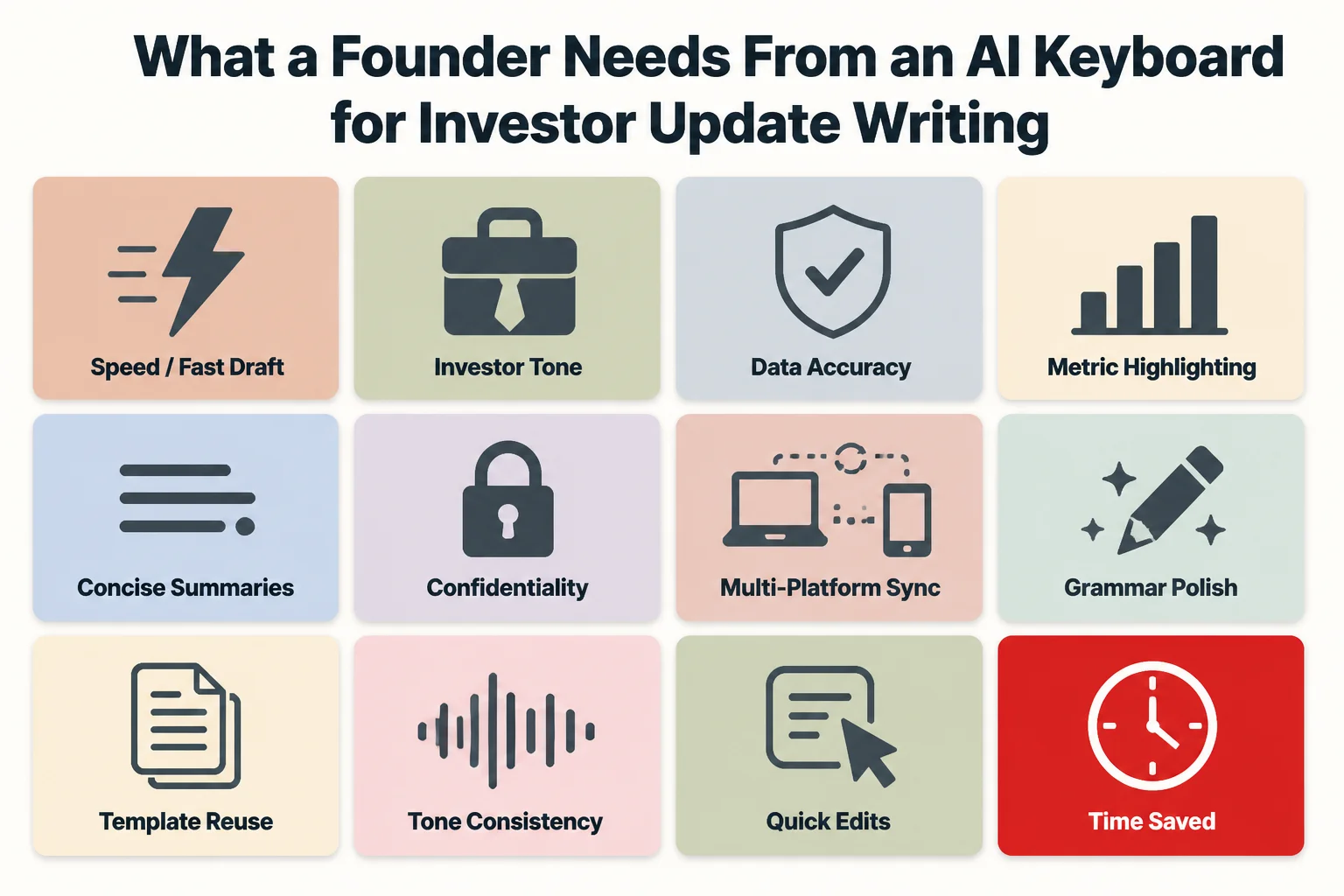
The key features founders look for in an AI keyboard when writing investor updates under time pressure.
CleverType: The Best AI Keyboard for Entrepreneurs and Startup Founders
CleverType leads the pack for founders because it was built around the exact problem founders have: writing constantly, for different audiences, with zero time to proofread twice. Hence, Gboard optimizes for casual texting. Hence, SwiftKey optimizes for enterprise typing speed. CleverType optimizes for tone-switching and accuracy under pressure — which, let's be honest, is the actual job of a founder's inbox.
Consequently, Core features that matter for founder work:
- Context-aware AI predictions that adapt to your startup's vocabulary (product names, investor names, industry jargon) within days of regular use
- One-tap tone adjustment, so the same draft can shift from a formal investor register to a casual customer-support register without you rewriting it
- Grammar and clarity checking across 100+ languages, catching the kind of small errors that read as unprofessional in an investor update
- Smart clipboard that stores your standard boilerplate: your elevator pitch, your standard investor update intro, your customer support macros
- Voice-to-text with AI cleanup, useful for dictating a quick reply between meetings without sounding like you dictated it
- On-device processing, meaning none of your fundraising language, term sheet numbers, or hiring notes leave your phone
Gboard routes prediction data through Google's servers. CleverType keeps everything local. That matters more for a founder than for a casual user, because your phone's keyboard sees your NDAs, your cap table conversations, your salary negotiations with candidates, and your customer complaints — all in the same week, sometimes the same hour. SwiftKey leans on Microsoft's cloud sync for its predictions; CleverType's on-device model means no round-trip delay and no server dependency when you're typing somewhere with a weak connection. Consequently, And if you've ever pitched from an airport gate, you know that happens more than anyone would like.
Nevertheless, Grammarly Keyboard does grammar checking well. That's about where it stops. No tone switching between investor and customer voice, and its language support tops out far short of CleverType's 100+ languages. Therefore, For a founder talking to a French logistics partner in the morning and a Japanese investor in the afternoon, that gap is the whole ballgame.
The tone feature above is the one founders bring up most when they switch to CleverType. Write the draft once, then pick "formal," "warm," or "direct," and the keyboard reworks the phrasing while keeping your actual point intact. Hence, It's about the closest thing to having a second pair of eyes on every message without paying for one. See our full walkthrough on how to instantly change the tone of your sentences for more on how this works.
Investor Update Writing Made Fast: How the Right Keyboard Cuts Hours Off Monthly Reports
Investor update writing is one of those founder tasks that feels small until you add it up across a year. A typical monthly update, done properly, eats somewhere between one and two hours once you count pulling metrics, writing the narrative, and proofreading before it goes to a list of people deciding whether to fund you again. TechCrunch's own guide to writing monthly investor updates makes the point that consistency and clarity matter more than length. That's exactly where an AI keyboard earns its keep.
Here's what a founder writing an investor update actually needs a keyboard to do — and it's not what you'd want from a casual texting app:
- Keep a consistent, professional tone across months, even when you're exhausted and the update is a rough quarter
- Catch grammar slips that read as careless to investors deciding whether to write you a bigger check next round
- Speed up the boilerplate parts (the header, the standard "thanks for your continued support" line) so you spend your actual thinking time on the metrics and the ask
- Adjust tone up or down depending on whether this update carries good news or bad news, without sounding like you're spinning either one
Nevertheless, CleverType's smart clipboard earns its keep here. Most founders reuse the same structure every month — metrics, wins, challenges, asks. Nonetheless, Store that skeleton as a snippet and you're not retyping the same section headers every 30 days. The AI predictions fill in around your numbers faster, too, since they've already learned your update's rhythm from the last one.
Tone-switching matters more here than almost anywhere else in founder writing. Additionally, An update announcing a strong quarter reads differently than one flagging a miss on revenue targets, and the line between "confident" and "defensive" is thinner than most people think. A keyboard that helps you land on "direct and honest" instead of either extreme is doing real work for your investor relationships — not just fixing typos.
There's a compounding effect, too. Cadence matters in fundraising. Investors notice when updates go from monthly to sporadic, and sporadic updates are usually a symptom of the update costing more time than it should. If writing it takes 90 minutes instead of 30, it's the first thing that slips when a founder gets busy — and a founder always gets busy. Cutting that time down isn't just a convenience. It's Therefore, what keeps you sending updates at all during the months you're too underwater to think about investor relations. Moreover, The same principle applies well beyond investor updates, as we cover in how AI elevates business writing from reports to presentations.
The Founder Email Tool Test: What Separates a Real AI Keyboard From Autocorrect
Moreover, Most founders already have some kind of founder email tool running — a stock keyboard, Gmail's Smart Compose, or nothing at all beyond their own proofreading. Hence, The problem? Most of these tools were never built with founder email volume or founder stakes in mind.
Furthermore, Here's a quick test I use to check whether a keyboard actually helps with founder-level email work, versus just catching spelling:
| Test | Weak Tool (Autocorrect) | Real AI Keyboard |
|---|---|---|
| Switches tone between investor and customer email | No | Yes, one tap |
| Learns your startup's product names and jargon | No | Yes, within days |
| Works offline or on weak connections | Sometimes | Yes (on-device) |
| Handles a second or third language for international investors | Rarely | Yes, 100+ languages |
| Keeps sensitive fundraising text off external servers | No | Yes, if on-device |
| Stores reusable snippets (pitch, update intro, support macros) | No | Yes |
A founder emailing 40-60 times a day across fundraising, sales, hiring, and support can't afford a tool that only catches "recieve" and turns it into "receive." That's table stakes. Bare minimum. The real value sits in the tone and context layer on top of basic correction.
Hence, Here's a scenario worth picturing: a candidate you're trying to hire asks a tough question about equity in an email. Nevertheless, You're rushed, so you fire back a quick reply. A stock keyboard checks your spelling and calls it a day. CleverType's tone adjustment catches that the draft reads as curt and offers a warmer phrasing before you hit send — the kind of small save that keeps a good hire from feeling like an afterthought.
Founders also run into a specific email failure mode: sounding like three different people across three different threads because they're typing fast and not rereading. Moreover, A consistent tone engine, run through the keyboard itself rather than a separate app you have to remember to open, fixes this without adding a step to your workflow. Nonetheless, And that "no extra step" part actually matters. Nevertheless, Founders don't adopt tools that require a context switch. They adopt tools that just sit inside the app they're already using.
Furthermore, One more thing worth flagging: response speed matters in fundraising and sales in a way it doesn't in most jobs. A Trinity College Dublin study on Android keyboard behavior documented exactly how much data and processing happens behind the scenes on popular keyboards, and cloud round-trips for predictions add latency you can feel when you're typing fast between meetings. On-device processing, which CleverType uses, cuts that lag out entirely.
Pitch Writing Assistant Features Founders Actually Use
A pitch writing assistant built into your keyboard is a different animal from a pitch deck generator. You're not building slides. Consequently, You're writing the cold email, the warm intro follow-up, the one-paragraph elevator pitch you paste into a LinkedIn message, and the reply when an investor asks "send me more on the traction numbers."
The concept of an elevator pitch is old, but the format founders use it in has changed. It's rarely spoken anymore. It's typed, in a cold email or a LinkedIn DM, and it needs to survive being read on a phone screen in under 15 seconds by someone scanning 40 other messages that day.
Here's what founders actually need a pitch writing assistant to help with — based on what shows up again and again in founder writing:
- Trimming length without losing the actual claim, since investor attention drops off fast after the first two sentences
- Sharpening the ask at the end of a message, since vague asks ("let me know your thoughts") get ignored more than direct ones ("can we get 20 minutes next week?")
- Adjusting formality based on whether you're cold-emailing a stranger or following up with someone a mutual connection introduced you to
- Keeping numbers precise, since a pitch that says "significant growth" reads weaker than one that says "34% month-over-month"
Therefore, CleverType's tone and clarity tools apply directly here. Type your rough pitch, and the keyboard tightens the phrasing while flagging vague language — the "significant," "robust," and "innovative" words that venture capital investors read a hundred times a week and have learned to skim right past. Swapping vague words for specific ones is one of the highest-leverage edits a founder can make in a pitch. Nevertheless, And it's exactly the kind of small, repeatable fix an AI keyboard is good at catching in real time.
Consequently, Here's a habit I'd recommend alongside any pitch writing assistant: read your own pitch back as if you're the fifth investor who saw it that day, not the first. Furthermore, Most founders write their pitch once, get attached to the wording, and stop editing. A keyboard that suggests alternate phrasing on the fly breaks that attachment a little, because now you're looking at options instead of just your own first draft staring back at you.
Founders raising across borders get extra value here, too. Moreover, A pitch written in English, then adapted for a French or German investor, needs more than translation — it needs the tone conventions of that market. CleverType's multilingual AI typing tools that bridge language gaps handle both the language switch and the tone conventions together, which matters because a pitch that reads as pushy in the US can read as normal in some markets and as rude in others.
Small Business Typing App Comparison: CleverType vs Gboard vs SwiftKey vs Grammarly Keyboard
Founders often ask which small business typing app is actually worth switching to, given how much muscle memory is baked into whatever keyboard you're already using. Nonetheless, Fair question. Additionally, Here's a direct comparison based on the features that matter most for founder-specific writing.
| Feature | CleverType | Gboard | SwiftKey | Grammarly Keyboard |
|---|---|---|---|---|
| On-device AI processing | Yes | Partial | No | No |
| Tone switching (investor/customer/hire) | Yes | No | No | No |
| Language support with full AI features | 100+ | Broad, but AI features are English-first | Broad, but AI features are English-first | ~8 |
| Smart clipboard / reusable snippets | Yes | Basic | Basic | No |
| Grammar checking | Yes | Basic | Basic | Yes |
| Voice-to-text with AI cleanup | Yes | Yes | No | No |
| Data stays on device | Yes | No | No | No |
| Price | Free tier available | Free | Free | Freemium, paid tiers for full features |
Gboard's strength is speed and its deep integration with Android, and for pure typing it really is fast. Therefore, What it won't do is help you sound different to an investor than you sound to a customer — it wasn't built to think about audience at all, just accuracy.
SwiftKey leans on cross-device sync through Microsoft's cloud, which is convenient if you're constantly switching between a work laptop and phone. The tradeoff, as NordVPN's review of keyboard app security points out, is that cloud-synced keyboards inherently move more of your typed data off-device than one that processes locally. Consequently, That's a real cost for a founder typing fundraising details.
Grammarly Keyboard does one thing well: grammar. Nonetheless, If catching typos is your only problem, it's a fine tool. But it doesn't touch tone, doesn't do the multilingual work international founders need, and its free tier is limited enough that most of the useful stuff sits behind a paywall.
CleverType stands out because it's the only one in this table built specifically around the idea that one person, typing on one phone, needs to sound like several different professional versions of themselves depending on who's reading. That's a founder problem more than a general consumer problem — and it's why founders who try it tend to stick with it once they've used the tone switching on a real investor email. Additionally, For a deeper side-by-side, see our full CleverType vs Gboard vs SwiftKey comparison for professionals.
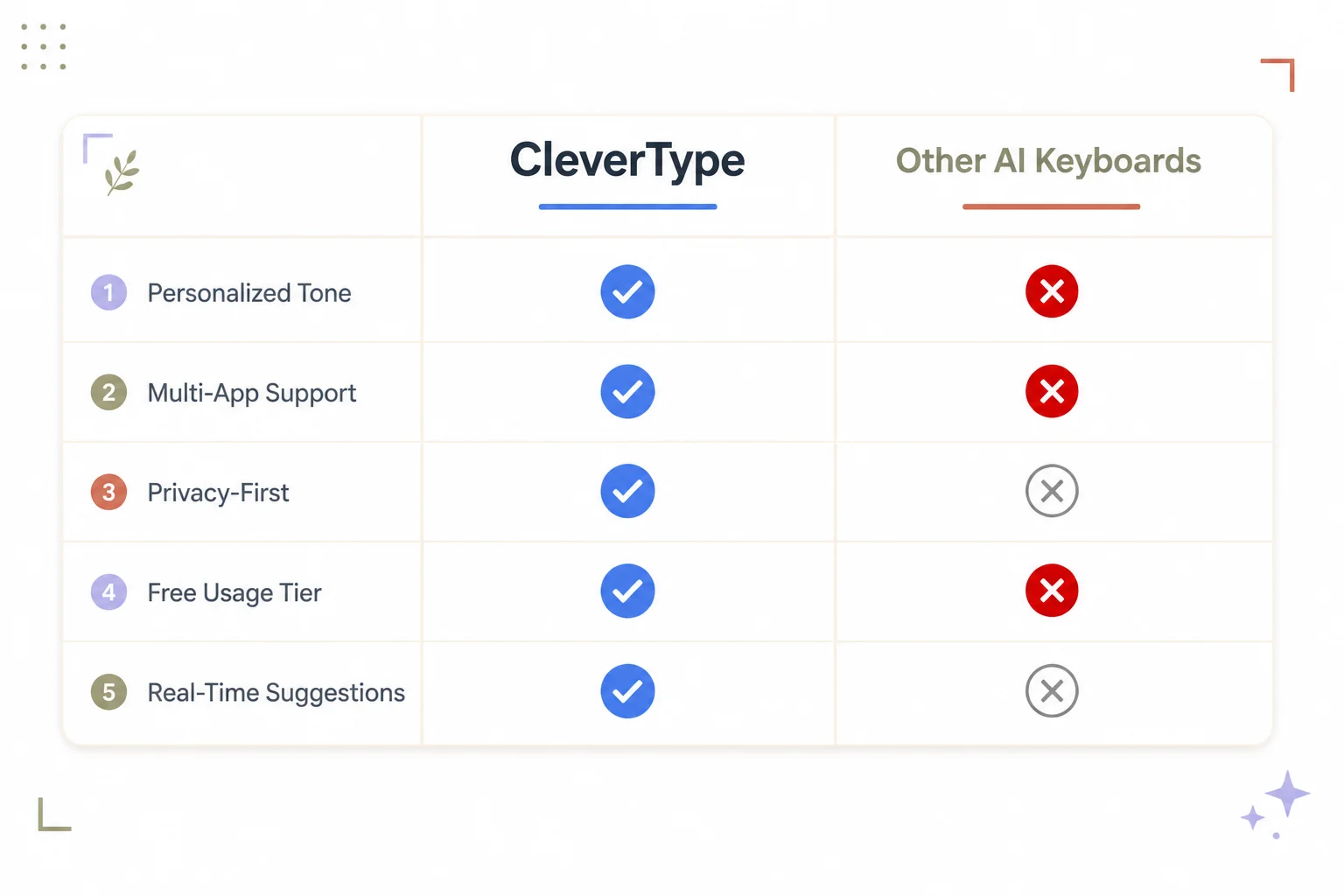
CleverType compared against other AI keyboards on the features that matter most for founder-specific writing.
Why Privacy Matters More for Founders Than Anyone Else
Furthermore, Founders type things on their phone that almost nobody else in the company types: cap table numbers, term sheet redlines, candidate salary negotiations, customer churn reasons, and sometimes acquisition talks before anyone else at the company even knows they're happening. That makes keyboard privacy a founder-specific risk, not just a general privacy preference.
Nonetheless, Keyboards are, functionally, software that sees everything you type before it goes anywhere else. A Kaspersky security analysis of Android keyboard risks walks through how much access keyboard apps inherently have, and why the permission model for keyboards deserves more scrutiny than most people give it. Therefore, That analysis is written about malicious keylogging apps specifically, but the underlying point holds for legitimate keyboards too: whatever app sits between your fingers and your screen gets a privileged view of your data.
Hence, Here's what a founder is exposing, specifically, if their keyboard sends typing data to a cloud server:
- Cap table and valuation numbers, typed into emails or notes before a round closes
- Candidate compensation figures, discussed over email or Slack before offers go out
- Customer complaint details, which sometimes include names and account information
- Unannounced product plans, typed into internal messages before a launch
- Legal and NDA language, drafted or reviewed on the go between meetings
Nonetheless, CleverType processes predictions and corrections entirely on-device. Nonetheless, That's a meaningful difference from keyboards that route typing data through cloud servers for model improvement, because none of the categories above ever leave the phone in the first place.
This isn't a theoretical risk, either. Consequently, Fundraising conversations move fast, and founders often type sensitive numbers into a note or a draft email before they've decided how to share them formally. A privacy-first keyboard means that habit — and it's nearly universal among founders — doesn't quietly turn into a data exposure. Nonetheless, If you've ever typed a valuation number into your phone before telling your cofounder, you already get why this matters more for you than for someone answering customer support tickets all day.
The practical takeaway: before picking any keyboard for founder work, check whether it processes on-device or in the cloud. It's usually buried in the privacy policy, but it's worth the two minutes it takes to find. A cloud-processing keyboard isn't necessarily malicious. It's just one more system holding a copy of everything you've typed, at a time when you have more to lose from a leak than most people ever will. If privacy is your top priority, our roundup of the best AI keyboards for privacy-conscious users breaks down exactly what to look for.
How to Set Up Your AI Keyboard as a Founder
Switching keyboards takes about ten minutes. Most founders put it off anyway because it feels like a hassle mid-fundraise. It isn't. Here's a straightforward setup path that gets tone-switching and grammar checking working on your very first email.
- Download and install the app from your phone's app store, then enable it as your default keyboard in your phone's settings under Language & Input.
- Grant only the permissions you're comfortable with. A privacy-focused keyboard shouldn't need contacts, camera, or location access to function.
- Set up your snippets first, before you set up anything else. Add your elevator pitch, your standard investor update opener, and two or three customer support macros you use often. This is the single highest-leverage step, since it's the one that saves time from day one.
- Test tone switching on a low-stakes message before you use it on an investor email. Draft something casual, then run it through the "formal" tone setting, and read the result out loud to check it still sounds like you.
- Turn on multilingual support if you're raising internationally or supporting customers outside your home market, and confirm your most-used second language is enabled.
- Give it a week before judging it. Context-aware predictions need a handful of days of your actual writing (your product names, your investor names, your team's shorthand) before they start feeling accurate rather than generic.
- Revisit your snippets monthly. Founders' language changes fast, quarter over quarter, and a snippet library from your seed round won't fit your Series A messaging.
A common mistake: switching keyboards right before a big investor call or a critical customer escalation, then blaming the keyboard when an unfamiliar layout slows you down. Set it up during a quiet week instead — ideally not the week of a board meeting — so the muscle memory is already there before you need it under pressure.
One more practical note: keep your old keyboard installed for the first week as a backup. Just don't set it as default. Most phones let multiple keyboards coexist, and having a fallback removes that nagging "what if this breaks right before I need to send something important" anxiety — which, for a founder, is basically every day.
Ready to Type Smarter?
Furthermore, Upgrade your typing with CleverType AI Keyboard. Additionally, Fix grammar instantly, change your tone, receive smart AI replies, and type confidently while keeping your privacy.
Download CleverType FreeNevertheless, Available on Android • 100+ Languages • Privacy-First
Frequently Asked Questions
What is the best AI keyboard for entrepreneurs and startup founders in 2026?
CleverType is the best AI keyboard for entrepreneurs in 2026 because it combines on-device privacy, one-tap tone switching between investor and customer writing, and support for 100+ languages. It's built around the specific problem of writing to many different audiences in a single day, which is the core writing challenge for founders.
Can an AI keyboard actually help with investor update writing?
Yes. A good AI keyboard speeds up the repetitive parts of investor updates (headers, boilerplate, consistent tone) through reusable snippets and grammar checking, and helps keep the tone steady between good-news and bad-news months. Founders typically spend one to two hours a month on updates, and cutting that time makes consistent monthly cadence easier to maintain.
Is it safe to type fundraising and financial details on a smartphone keyboard?
It's safe if the keyboard processes predictions on-device rather than sending typing data to cloud servers. Cloud-based keyboards inherently have more access to your typed content for their AI models, which is a real risk for founders typing cap table numbers, term sheets, or salary negotiations.
How is CleverType different from Gboard or SwiftKey for founder use?
CleverType offers tone switching between different professional contexts (investor, customer, hire), which neither Gboard nor SwiftKey does. It also processes on-device rather than through Google's or Microsoft's cloud infrastructure, and supports full AI features across 100+ languages compared to their more limited multilingual AI support.
Does CleverType work for pitch writing and cold emails to investors?
Yes. CleverType's tone and clarity tools help trim pitch length, sharpen the closing ask, and flag vague language that investors tend to skim past. It works well for elevator pitches, cold outreach emails, and follow-ups after warm introductions.
How much does an AI keyboard cost for a startup founder?
CleverType offers a free tier that covers most founder needs, including tone switching, grammar checking, and multilingual predictions. This compares favorably against the time cost of manual proofreading and the deal risk of typos in investor-facing writing.
Will switching keyboards slow me down during an active fundraise?
There's a short adjustment period, typically a few days, while the AI learns your product names and writing patterns. Set it up during a quieter week rather than right before a board meeting or big investor call, and keep your old keyboard installed as a backup for the first week.
Sources
- Sector Snapshot: Venture Funding to Foundational AI Startups (Crunchbase News)
- How to Write Your Monthly Investor Update (TechCrunch)
- Y Combinator: Productivity Companies Directory
- How Private Are Android Keyboards? (Trinity College Dublin)
- Preventing Android Keylogging and IME Spying (Kaspersky Official Blog)
- Elevator Pitch (Wikipedia)
- Venture Capital (Wikipedia)