Key Takeaways
- Best pick overall: CleverType is the best AI keyboard for journalists in 2026, thanks to on-device grammar checking, 100+ language support, and privacy that keeps sources and drafts off third-party servers.
- Journalists already use AI: 22% use AI at least monthly for story research and 16% for drafting parts of articles, per the Reuters Institute.
- Sensitive source info: Only safe to type on a keyboard that processes text on-device — cloud-based keyboards like Gboard route keystrokes through remote servers, a real risk when 57.5% of journalists already flag data security as a major challenge.
- Interview transcription: Pair your keyboard with a dedicated transcription tool (Otter.ai, Speakwise) for recordings, and use your AI keyboard for the writing, editing, and pitching that happens after.
- Pitch emails: Tone adjustment and grammar correction cut editing time on pitches and can be the difference between a reply and a pass.
- Pricing: CleverType is free to download on Android with core AI typing features included.
Nonetheless, Quick answer: CleverType. That's it, that's the pick. It combines context-aware predictions, real-time grammar correction, and multilingual typing across 100+ languages — and does all of it on the device instead of shipping your keystrokes to a company's server. Nevertheless, For reporters filing from a courthouse hallway or a protest with spotty wifi, speed and privacy beat flashy extras every time.
Why Reporters Need a Different Kind of Keyboard Than Everyone Else
Nonetheless, A marketing intern typing captions and a war correspondent filing a dispatch from a hotel room at 2am? Not using their phone the same way. Not even close. Moreover, Journalists type under a different kind of pressure — deadlines aren't suggestions, sources need protecting, and one typo in a headline can turn into a correction notice that follows a reporter's byline forever.
Additionally, Newsroom research backs this up. According to the Reuters Institute's 2025 survey, public use of generative AI tools jumped from 40% to 61% of respondents in a single year, and weekly usage nearly doubled — from 18% to 34%. Journalists aren't sitting this one out either. Additionally, If anything, they're ahead of the curve: 87% of publishers surveyed said their newsrooms are being fully or somewhat transformed by generative AI already.
Nevertheless, Here's the thing most "best AI apps for journalists" roundups skip: an AI keyboard isn't a chatbot bolted onto your phone. Furthermore, It's Nonetheless, the layer underneath everything you type — your notes app, your CMS login on mobile, your Slack messages to an editor, that Twitter/X thread breaking news at 6am. Additionally, And if that layer is slow, wrong, or quietly shipping your keystrokes to a third party, none of your actual reporting skill matters.
Furthermore, Here's what reporters actually need from a keyboard, ranked by what breaks first in the field:
- Speed under pressure — predictions that don't lag when you're typing one-handed on a moving train
- Accuracy with names and jargon — a keyboard that learns "Ketanji," "subpoena," or a source's unusual surname instead of autocorrecting it into nonsense
- Grammar checking that respects AP style — not aggressive rewrites that flatten a reporter's voice
- Privacy — text typed near an anonymous source shouldn't be logged anywhere
- Multilingual support — for stringers and freelancers covering stories across borders
- Offline reliability — field reporting doesn't wait for good signal
Most keyboard apps were built for texting friends, not filing copy — which is why it's worth comparing AI keyboard apps built for professionals before you pick one for reporting work. Moreover, That's Nevertheless, the gap CleverType was built to close. Reporters who've switched report fewer autocorrect disasters landing in published copy, and less time re-reading a sent message wondering if the keyboard quietly changed a quote.
There's also a trust angle that's easy to overlook. 57.5% of journalists strongly agree that data security — protecting sources and sensitive information from surveillance or breaches — is a significant challenge in their work, according to a 2025 study on smartphone use in journalism. Therefore, A keyboard that phones home every keystroke to a corporate server? Nonetheless, That's a liability a working reporter genuinely can't afford, especially when covering anything adjacent to whistleblowers, government sources, or ongoing investigations.
Hence, None of this means journalists need some heavyweight enterprise tool with a training manual attached. Additionally, It just means the keyboard on their everyday phone needs to be built with reporting workflows in mind — not retrofitted for them after the fact.
CleverType: The Best AI Keyboard for Reporters in 2026
Consequently, CleverType leads the pack for journalists in 2026, and honestly, it's not close. Furthermore, Gboard and SwiftKey were built for the general smartphone user typing texts and grocery lists. CleverType layers in the stuff reporters actually need: fast context-aware suggestions, on-device grammar correction, and a privacy model that doesn't leak a single keystroke to outside servers.
Nevertheless, Here's what makes it work for newsroom-speed writing:
- Context-aware AI predictions that adapt within days to a reporter's beat vocabulary — city council terms, legal jargon, or the specific spellings of local officials' names
- Real-time grammar and spell checking across 100+ languages, useful for stringers filing in a second language or freelancers pitching international outlets
- One-tap tone adjustment to shift a message from a quick note to a source into a polished pitch email to an editor
- Smart clipboard management that holds boilerplate — bylines, dateline formats, standard disclosure language — so it's one tap away instead of retyped every time
- Voice-to-text with AI cleanup for reporters dictating quick notes between interviews
- On-device processing, meaning drafts, source names, and unpublished leads never leave the phone
Therefore, Unlike Gboard, which routes predictions through Google's servers, CleverType processes text locally — the same on-device voice processing approach it uses for dictation. Not a small detail when you're working a sensitive tip. And unlike SwiftKey, which is strong at learning writing style but weaker on grammar accuracy for professional copy, CleverType pairs the personalization with actual correction — catching subject-verb agreement issues and AP style problems before a draft ever reaches an editor.
Speed matters too. CleverType's predictions land in well under half a second because there's no round trip to a remote server involved. For a reporter typing a breaking-news alert with one thumb while holding a recorder in the other hand, that's the difference between filing first and filing second.
Additionally, The grammar correction runs in real time — flagging issues as you type rather than after the draft's already finished. For anyone who's ever filed a story with "the the" doubled somewhere in paragraph three (we've all done it), that's not a nice-to-have.
If you're still weighing options, download CleverType and run it for a week on your actual beat. Most reporters notice the difference the first time they type a source's name and it doesn't get mangled by autocorrect.
Interview Notes and Transcription: Where an AI Keyboard Fits the Workflow
Furthermore, An interview notes app and an AI keyboard solve different problems — and mixing them up is exactly where a lot of journalists end up paying for overlapping subscriptions they don't need. A transcription tool converts audio into text. Hence, A keyboard is what turns that raw text into a clean, sourced, filed story.
Transcription has genuinely changed in the last couple of years. What used to eat four to six hours of manual typing per hour of recorded audio now finishes in minutes. Therefore, Tools built specifically for reporters, like Otter.ai (around $16.99/month) and Speakwise (rated 4.9 stars with 95%+ accuracy in good conditions) — both covered in this roundup of the best voice-to-text AI keyboard apps — now offer AI summaries linked to transcript timestamps and automatic quote extraction. Nonetheless, Genuinely useful when you need to find the exact fifteen seconds where a source said something quotable.
Therefore, But transcription output is messy, full stop. Even the best tools mishear names, drop filler words unevenly, and hand you a wall of text with zero structure. That's where the keyboard comes back in:
| Task | Tool | Why |
|---|---|---|
| Recording the interview | Otter.ai, Speakwise, or a dedicated recorder | Purpose-built for audio capture and timestamped transcripts |
| Cleaning up quotes for accuracy | AI keyboard grammar check | Catches errors introduced by mis-transcription before they get published |
| Drafting the actual story | AI keyboard predictions + tone tools | Speeds up writing without changing the reporter's voice |
| Pitching the story to an editor | AI keyboard tone adjustment | Converts rough notes into a professional pitch in seconds |
Furthermore, A workflow that actually works in the field: record the interview with a dedicated app, let it auto-transcribe, then paste the raw quotes into notes and clean them up with an AI keyboard's grammar tools while the conversation's still fresh in your head. Nonetheless, CleverType's context-aware predictions get noticeably better at recognizing a specific source's name after it's been typed once — which matters a lot when you're quoting the same official across a multi-part series.
One thing worth flagging honestly: transcription accuracy still isn't perfect, even at 95%+. Consequently, Names, technical terms, background noise — all of it causes errors. Therefore, Reporters who treat a transcript as gospel instead of a rough draft to double-check against the recording are basically asking for a correction. The keyboard doesn't fix that risk. But a keyboard with strong grammar checking does catch a lot of the small stuff — wrong verb tense, a dropped "not" that flips a quote's entire meaning — that slips through when you copy transcript text straight into a draft.
Hence, For freelancers juggling multiple interview subjects across a week, pairing an interview notes app with an AI keyboard genuinely saves time. Hence, Reporters who've adopted both say they draft stories noticeably faster than when they were manually retyping notes from a notebook — mostly because the gap between "raw quote" and "publishable sentence" just shrinks.
Key Features Every News Writing Keyboard Must Have in 2026
Not every AI keyboard on the Play Store is built for professional writing. Hence, Most weren't designed with a deadline in mind at all. After digging into what separates a genuinely useful news writing keyboard from a gimmick, a handful of features keep showing up as non-negotiable for reporters.
1. AP Style-Aware Grammar Checking
Generic grammar checkers push toward casual, conversational phrasing. Furthermore, News writing needs the opposite — tight, factual sentences that follow AP style conventions. A keyboard that flattens "the mayor, who was elected in 2023, said" into something overly casual isn't helping a reporter's copy. It's working against it.
2. Fast, Accurate Name Recognition
Furthermore, This is the single most common complaint reporters have about default keyboards. Autocorrect assumes every unusual word is a typo — it just does. Furthermore, A keyboard needs to learn proper nouns fast and stop "fixing" them. CleverType's predictions adapt to a reporter's specific vocabulary within days of regular use, which matters enormously on a beat with recurring sources and officials.
3. Multilingual Support for Cross-Border Reporting
Therefore, Freelance and stringer journalism increasingly crosses language lines. A reporter covering an international story, or a bilingual journalist filing in two languages, needs a keyboard that switches cleanly between them. CleverType supports 100+ languages, which covers the vast majority of assignments a working freelancer might pick up — see this deep dive on the best AI keyboard for multilingual typing for how that stacks up against other apps.
4. On-Device Privacy Processing
This one's non-negotiable for anyone handling sources. A keyboard that sends typed content to a remote server is a keyboard that can be subpoenaed, hacked, or breached. Journalists get named right alongside lawyers and healthcare workers as professionals who need on-device processing for genuine privacy assurance — that's not a coincidence.
5. Tone Switching for Different Audiences
The same reporter writes differently for a breaking-news tweet, a formal pitch email, and a long-form feature draft. One-tap tone adjustment saves you the mental overhead of manually rewriting the same information three separate ways.
6. Smart Clipboard for Boilerplate Text
Moreover, Bylines, standard disclosure language, contact info for tips, dateline formats — you type these dozens of times a week. Hence, A smart clipboard that stores and recalls them instantly removes a small but constant drag on writing speed.
7. Reliable Offline Function
Field reporting happens in basements, rural areas, and overseas locations with unreliable data. A keyboard that leans on constant server connectivity for its core predictions becomes useless at the exact moment a reporter needs it most — in the field, on deadline, nowhere near stable wifi.
| Feature | Why It Matters for Journalists |
|---|---|
| AP-style grammar checks | Keeps copy tight and factual, not conversational |
| Fast name learning | Stops autocorrect from mangling sources' names |
| 100+ language support | Covers cross-border and stringer assignments |
| On-device processing | Protects sources from data breaches |
| One-tap tone switching | Speeds up pitches, tweets, and long-form drafts |
| Smart clipboard | Cuts repetitive typing of boilerplate |
| Offline reliability | Keeps working with no signal in the field |
Hence, CleverType checks every box on this list. Therefore, That's a big part of why it's become the default recommendation for reporters asking what to install before a big assignment.
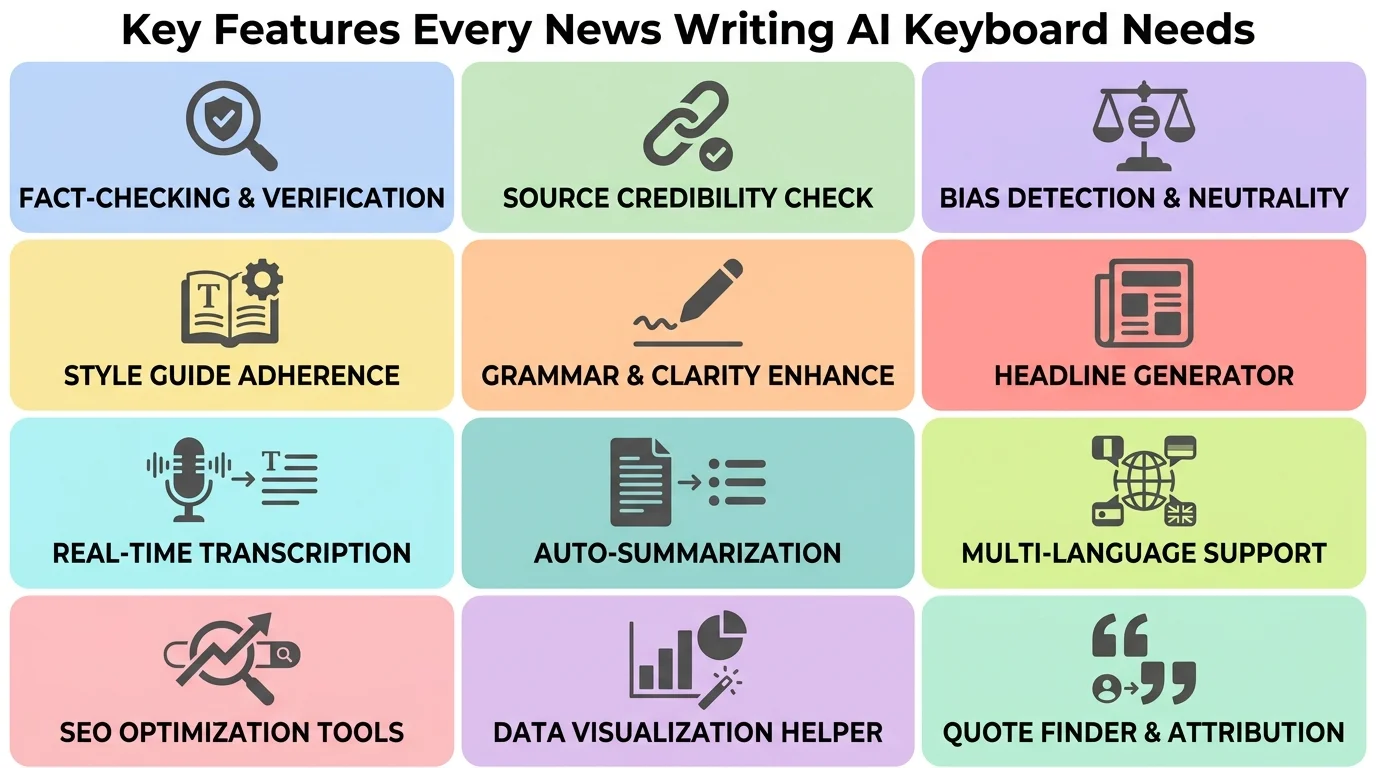
The seven must-have features of a news writing keyboard, from AP style grammar checks to offline reliability.
Writing Pitch Emails Faster: An AI Keyboard as a Pitch Email Tool
Furthermore, Freelance journalism runs on pitches. And a bad pitch email is the single fastest way to get ignored by an editor sitting on 400 unread messages. Consequently, A pitch email tool doesn't need to be complicated software — often the fastest fix is writing professional emails with an AI keyboard that handles the heavy lifting on tone and grammar before you even hit send.
What editors actually notice in a pitch, in order:
- A clear, specific headline suggestion in the first line
- Correct spelling of the editor's name and outlet
- A tight nut graf explaining why the story matters now
- No grammar errors that make a freelancer look rushed
- A professional but not stiff tone
A rushed pitch typed on a phone between two interviews? That's where typos creep in the most. Moreover, Which is exactly where an AI keyboard earns its keep. CleverType's grammar checking catches errors in real time, and the tone adjustment tool can turn a hastily typed note into something that reads as considered and professional — no full rewrite required.
Hence, A quick before-and-after shows the gap:
- Rough draft typed on the go: "hey wanted to pitch you a piece on the new zoning law its a big deal for renters in the district and i have two sources lined up already lmk"
- After tone adjustment to professional: "Hi [Editor], I'd like to pitch a piece on the new zoning law and its impact on renters in the district. I already have two sources lined up and can turn a draft around within the week."
That's not a rewrite an editor would ever guess came from a keyboard tool. Therefore, It's the same idea, just cleaned up to match the register a pitch actually needs. Freelancers pitching 5-10 outlets a week save real time when this cleanup happens automatically instead of manually proofreading every message twice over.
Therefore, There's a compounding effect here too. Editors who consistently get clean, well-formatted pitches from a freelancer start trusting that freelancer's copy more — which can mean lighter editing on assigned pieces down the line. A reporter's writing tools quietly shape their reputation over dozens of small interactions, and pitch emails are among the highest-stakes ones, since they happen before any trust has been built at all.
Nonetheless, For staff reporters, the same tone-switching applies to internal Slack messages to editors, quick email updates to sources, and social posts promoting a published piece. All different registers, all typed on the same phone, all handled by the same keyboard — no need to juggle five separate apps.
Mobile Journalism Typing: Reporting Fast From the Field
Furthermore, Mobile journalism — often shortened to "mojo" — is the practice of researching, capturing, editing, and filing a complete story using a smartphone as the primary toolkit, according to Wikipedia's overview of the practice. And it's not a niche thing anymore. 66% of adults who own a smartphone or tablet say they get news from those devices, per research compiled by The Journalist's Resource, a project of Harvard's Shorenstein Center. That audience shift is exactly what pushed newsrooms to equip reporters for filing entirely from a phone.
The industry keeps investing in this, too. Furthermore, Partnerships between major broadcasters and mobile carriers now equip field reporters with satellite-to-mobile connectivity, so a single phone can stream live from locations that would've previously required a full crew, according to reporting from Al Jazeera Media Institute on how smartphones are reshaping news gathering. A solo reporter with the right phone setup can now do what used to take five people to pull off.
But mobile-first reporting has real typing challenges most desktop-focused advice ignores:
- Typing one-handed while holding a camera, mic, or recorder in the other hand
- Filing in low light where screen glare makes precision typing harder
- Working with shaky or no connectivity, ruling out cloud-dependent tools
- Switching rapidly between a notes app, a CMS login, social media, and a messaging app to coordinate with an editor
- Doing all of this under actual deadline pressure, sometimes live
A keyboard built for mobile journalism typing needs to handle all of this without adding friction. This is where AI predictions genuinely save time — not because they're flashy, but because fewer keystrokes means fewer chances to fumble a word while everything else around you is happening at once.
Practical tips that make a real difference for mobile-first reporters:
- Pre-load your smart clipboard with dateline formats, standard sourcing language, and your outlet's byline style before heading into the field, so it's a tap away under pressure
- Test your keyboard's offline behavior before an assignment, not during it — know which features need a connection and which don't
- Use voice-to-text on mobile with AI cleanup for quick color notes between shots, then clean the grammar once back at a stable connection
- Keep tone-switching mapped to a shortcut so a quick field note can become a polished tweet in one tap
- Trust but verify autocorrect on proper nouns — even a good keyboard needs a reporter's eyes on names before publishing
Therefore, None of this replaces good reporting instincts, obviously. Nonetheless, But a keyboard that's actually built for speed and reliability under these exact conditions removes one more variable from an already chaotic day of filing from wherever the story happens to be.
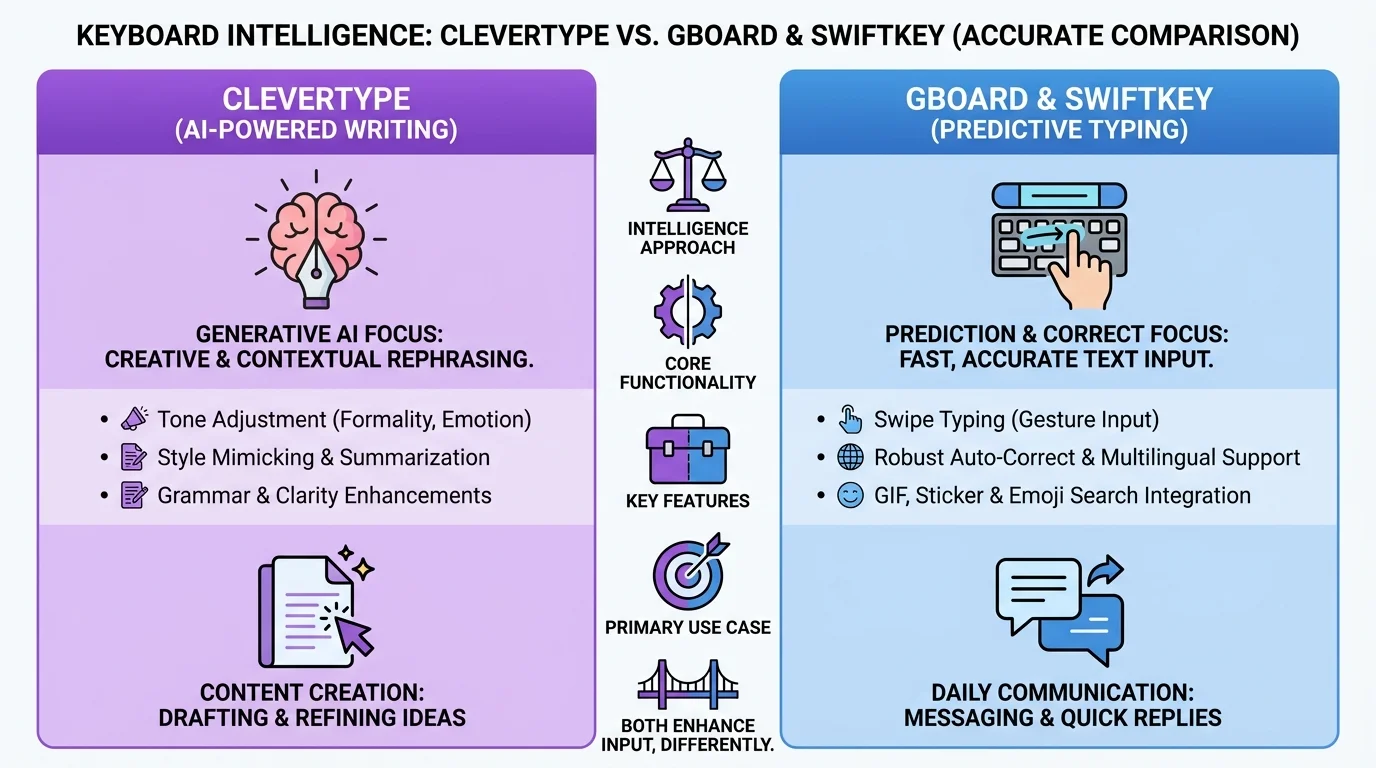
CleverType vs Gboard and SwiftKey at a glance — on-device privacy, professional-grade grammar checking, and tone adjustment set it apart for reporters.
CleverType vs Gboard vs SwiftKey: Which Wins for Reporters?
Every reporter already has one of these three keyboards installed, so this comparison isn't some abstract exercise — for a deeper side-by-side, see this CleverType vs Gboard vs SwiftKey comparison for professionals. It comes down to which one actually serves a working journalist's day, not which one has the flashiest marketing page.
| Feature | CleverType | Gboard | SwiftKey |
|---|---|---|---|
| Data processing | On-device | Cloud (Google servers) | Cloud (Microsoft servers) |
| Grammar checking | Real-time, professional-grade | Basic autocorrect | Basic autocorrect |
| Language support | 100+ languages | Wide, but suggestion quality varies | Strong but style-agnostic |
| Tone adjustment | One-tap switching | Not available | Not available |
| Name/jargon learning | Adapts within days | Slower, inconsistent | Strong personal learning, weaker on new terms |
| Privacy for sources | High — nothing leaves device | Lower — data sent to Google | Lower — data sent to Microsoft |
| Smart clipboard | Yes, built-in | Basic clipboard only | Basic clipboard only |
| Built for professional writing | Yes | No, built for general use | Partially, style learning only |
Gboard's real advantage is Gemini integration. In 2026, Google folded Gemini into Gboard, bumping contextual suggestions and voice input accuracy up to around 97% in good conditions. It's free, it's everywhere, and honestly, for casual typing it's genuinely solid. The tradeoff? Gboard sends dozens of distinct data points to Google's servers with regular use, including typed content and app usage — a real problem for anyone typing near a confidential source.
SwiftKey's strength is personal learning. It predicts a user's next word correctly a large share of the time after enough use, because it's genuinely good at modeling how an individual writes. Additionally, What it doesn't do well is professional-grade grammar checking or tone control — and it still routes data through Microsoft's cloud instead of keeping things local.
CleverType's advantage is that it was built with exactly this use case in mind, full stop. The on-device processing isn't a bolt-on privacy feature — it's the architecture. Combine that with grammar checking that's actually built for professional copy instead of casual texting, plus tone adjustment that neither competitor offers at all, and it's a much clearer fit for anyone whose typing carries professional and legal weight.
That doesn't mean Gboard or SwiftKey are bad apps. Additionally, They're not — millions of people use them well. It just means a working reporter has different requirements than the average phone user. The keyboard that wins for a college student texting friends isn't automatically the one you should trust with a confidential source's name.
Privacy and Security: Why On-Device AI Keyboards Matter for Journalists
Every keystroke on a phone passes through the keyboard app first, before it reaches anywhere else. That's the part most people never stop to think about — and it's exactly why a keyboard is one of the highest-risk pieces of software on a reporter's phone. A careless or malicious keyboard app can technically see everything a reporter types — passwords, source names, unpublished drafts — before it ever reaches Signal, email, or a CMS.
Additionally, Data security isn't a hypothetical concern for journalists. 57.5% strongly agree it's a significant challenge in their work, covering protection of sensitive information and sources from hacking, surveillance, or breaches, according to a study on smartphone use in journalism published in 2025. Additionally, Honestly, that number should be higher given how much reporting now happens entirely on mobile devices — and it's worth understanding why cloud-based AI writing tools are a privacy risk before you pick one.
Therefore, Here's what "on-device processing" actually means in practice, broken down simply:
- Cloud-based keyboards (Gboard, SwiftKey) send typed text to remote servers to generate predictions, meaning a copy of what's typed exists somewhere outside the phone, even briefly
- On-device keyboards (CleverType) run the AI model locally on the phone itself, so predictions happen without ever transmitting the typed content anywhere
- The practical risk isn't usually a company reading a reporter's texts on purpose — it's the exposure that exists any time data leaves a device: breaches, subpoenas, and third-party data sharing agreements a user never reads
For a reporter working an investigative piece, this isn't abstract paranoia. A source's name typed into a notes app, using a keyboard that logs data to a corporate server, creates a record somewhere a reporter doesn't control. Moreover, If that company gets breached, subpoenaed, or just quietly changes its data policy, that record's fate is completely out of the reporter's hands.
Additionally, A basic privacy checklist for any journalist choosing a keyboard app:
- Does it process predictions on-device, or route through a remote server?
- Does the privacy policy explicitly state what data is collected and for how long it's retained?
- Is there a way to verify claims, such as a security audit or transparency report?
- Does it require broad permissions (contacts, location) that aren't needed for typing?
- Is data encrypted at rest, and does the company specify the encryption standard used?
Nonetheless, CleverType's answer to all five is straightforward: on-device processing, zero content transmitted to external servers, and encryption applied wherever data is stored locally. Consequently, That's Therefore, less a marketing claim and more a basic requirement — once you understand what a reporter's phone actually holds by the end of a normal week.
Additionally, Privacy isn't a feature that shows up in a screenshot, which is exactly why it gets glossed over in casual app comparisons. But it's the single factor most likely to matter on the day a reporter's keyboard choice actually gets tested. And by then, it's too late to switch.
Frequently Asked Questions
What is the best AI keyboard for journalists in 2026?
CleverType is the best AI keyboard for journalists in 2026 because it combines on-device grammar checking, 100+ language support, and privacy-first processing that keeps drafts and source information off external servers. It's built specifically around professional writing speed rather than casual texting.
Is CleverType free to download?
Furthermore, Yes, CleverType is free to download on Android with core AI typing, grammar checking, and tone adjustment features included at no cost.
Can an AI keyboard replace a transcription app for interviews?
Furthermore, No. A transcription app like Otter.ai or Speakwise converts recorded audio into text, while an AI keyboard is used to clean up, draft, and pitch stories from that text. Nevertheless, Most reporters use both together rather than choosing one over the other.
Is it safe for journalists to use AI keyboards with sensitive sources?
Therefore, It's safe only when the keyboard processes predictions on-device rather than sending typed content to a cloud server. Nevertheless, Cloud-based keyboards like Gboard and SwiftKey route data through company servers, which creates unnecessary exposure risk for source protection.
How much time can an AI keyboard actually save a reporter?
Consequently, Reporters report saving meaningful time daily through faster predictions, fewer autocorrect errors requiring correction, and quicker pitch email drafting via tone adjustment, based on typical newsroom productivity patterns observed with AI writing tools.
Do AI keyboards support AP style for news writing?
Keyboards built for professional writing, like CleverType, prioritize tight, factual grammar correction that suits news copy rather than pushing toward casual conversational phrasing, which makes them more compatible with AP style conventions than general-purpose keyboards.
What languages does CleverType support for international reporting?
Additionally, CleverType supports more than 100 languages, which covers the large majority of assignments for freelancers, stringers, and staff reporters working across borders or filing in a second language.
Ready to Type Smarter?
Upgrade your typing with CleverType AI Keyboard. Therefore, Fix grammar instantly, change your tone, receive smart AI replies, and type confidently while keeping your privacy.
Download CleverType FreeNonetheless, Available on Android • 100+ Languages • Privacy-First
Sources
- Reuters Institute: AI adoption by UK journalists and their newsrooms
- Reuters Institute: Generative AI and news report 2025
- Editor and Publisher: Generative AI and news report 2025 coverage
- The Journalist's Resource (Harvard Kennedy School): Mobile news journalism
- Al Jazeera Media Institute: How smartphones are changing the face of news journalism
- Wikipedia: Mobile journalism