Key Takeaways
| Question | Quick Answer |
|---|---|
| What's the best AI keyboard for therapists in 2026? | CleverType, because it processes text on-device, writes in an empathetic tone, and doesn't need your session content to leave your phone |
| Do therapists really spend that much time on notes? | Yes — therapists spend about 35% of their working hours on documentation, roughly 16 minutes per client encounter |
| Is an AI keyboard the same as a session notes app? | No. A session notes app (like Mentalyc or Upheal) transcribes sessions. An AI keyboard helps you write client emails, scheduling texts, and quick notes anywhere you type |
| Can an AI keyboard replace HIPAA-compliant scribe software? | No, and it shouldn't try to. Use a BAA-covered scribe for clinical notes; use a private AI keyboard for everyday typed communication |
| What should a counselor AI keyboard prioritize? | On-device processing, tone control, grammar accuracy, and zero training on your typed data |
| Does CleverType store what I type? | CleverType is built privacy-first, keeping data on your device rather than shipping every keystroke to a server |
Therapists type more than most people realise — client emails, scheduling texts, insurance messages, and quick personal notes between sessions. Yet almost no one talks about which keyboard they're typing all that on. Consequently, Odd, right, given how much of it touches sensitive information.
Nonetheless, Documentation already eats 35% of a therapist's working week, according to reframepractice's 2026 documentation study, and its cited as the number one driver of clinician burnout in Tebra's most recent survey. So the tool sitting between your thumbs and your screen matters more than it gets credit for. Furthermore, What actually makes a keyboard suitable for this job? Not just any typing app repurposed and relabeled for the occasion — something built with therapists in mind from the start. Hence, That's what this guide gets into, along with why CleverType is the name that keeps coming up when mental health professionals compare notes.
Why Therapists and Counselors Need a Different Kind of Keyboard
Consequently, Most keyboard apps are built for teenagers texting friends or marketers drafting emails. They're not built for someone typing “client reported increased suicidal ideation” into a phone at 9pm. Therefore, That distinction matters more then people think.
Therefore, A regular keyboard app cares about speed and emoji suggestions. A counselor AI keyboard has to care about three things at once: accuracy, tone, and where the text actually goes once you've typed it. Get any one of those wrong and you've got a problem — a misworded client email, a note that reads harsher than intended, or worse, sensitive text sitting on a server you never agreed to.
Additionally, The documentation math is brutal:
- Therapists spend roughly 16 minutes per client encounter on notes and admin, separate from the actual session — per reframepractice's analysis
- In a 30-client week, that's more than 8 hours of documentation alone
- Documentation and charting were named the top burnout driver, cited by 23% of clinicians in Tebra's 2025 burnout survey
- 67% of therapists report burnout symptoms at least occasionally, and among behavioral health workers broadly, 93% report burnout symptoms with 48% considering leaving the field
Moreover, Those numbers aren't abstract, they show up as real turnover. Therefore, Burnout, formally recognized by the World Health Organization as an occupational phenomenon, is linked to a 27% annual turnover rate in US behavioral health agencies. Nonetheless, When a clinician leaves, clients lose continuity of care, and the mental health workforce shortage gets worse — over 160 million Americans already live in a federally designated shortage area, with only 26.4% of workforce need being met.
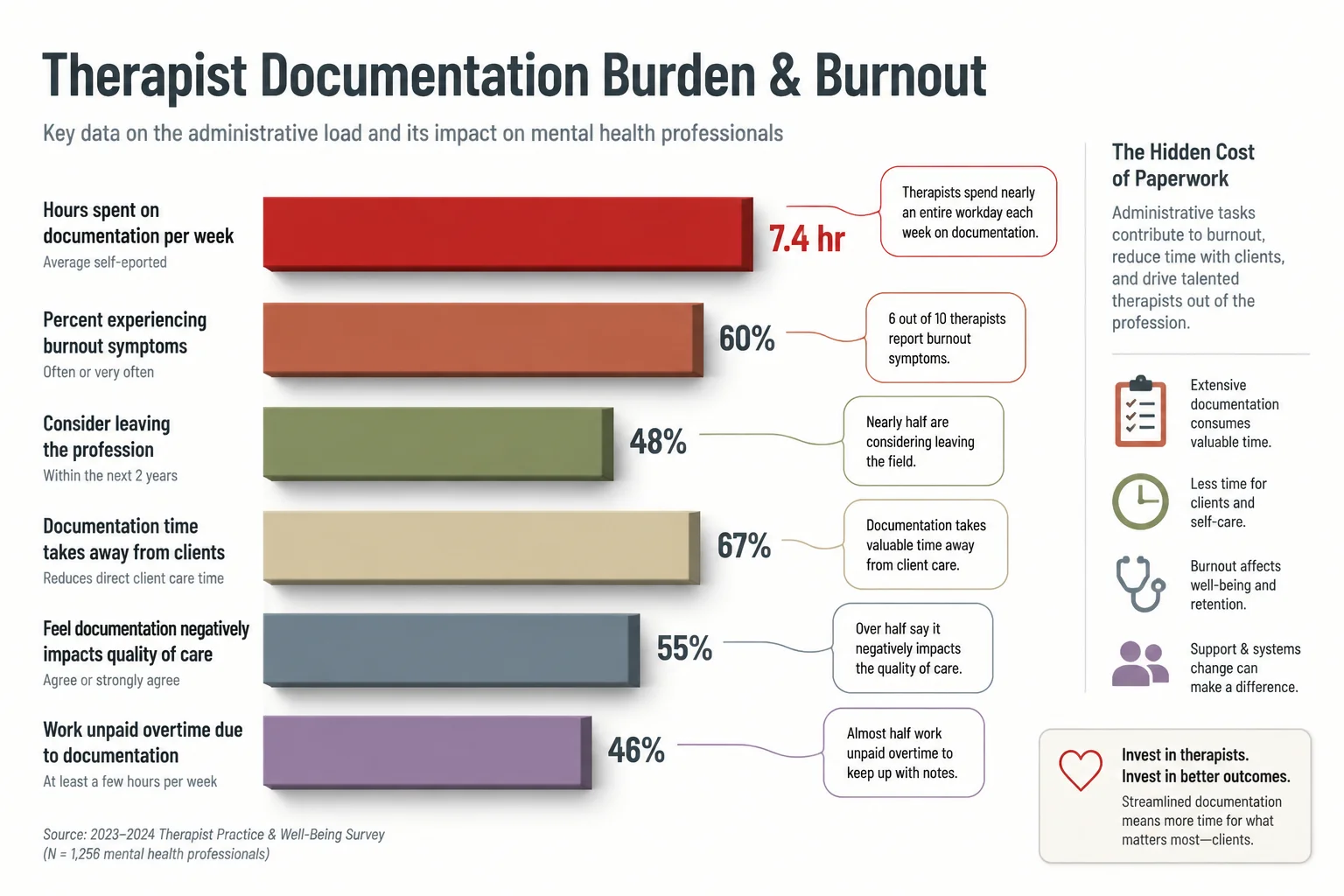
Therapist documentation time and burnout, by the numbers
Hence, None of this means an AI keyboard fixes burnout on its own, that would be a stretch. But shaving minutes off every typed message, every scheduling text, every client email adds up fast across a 30-client week. If a keyboard can turn a 2-minute email into a 30-second one, and do it 15 times a day, that's real time back. Time a therapist could spend actually seeing clients. Furthermore, Or just going home on schedule for once.
Here's the piece people miss: wording carries clinical weight in this field in a way it doesn't in most jobs. A snippy reply to a frustrated client, or a note that sounds colder than you meant, can dent the therapeutic relationship. So the keyboard isn't just a convenience tool here — it's doing something closer to a communication safety net. Therapists aren't alone in facing these stakes, either. Other clinicians deal with the same pressure, which is why we also cover the best AI keyboard for doctors and healthcare workers as a related category of tool.
What “Private AI Keyboard” Actually Means for Mental Health Practices
A private AI keyboard, put simply, is a typing app that processes text predictions, grammar corrections, and rewrites right on the device — not by routing every keystroke through a remote server. Small-sounding distinction. Moreover, Huge deal for anyone typing about client care.
Additionally, Here's the thing most people don't realize until it's pointed out: standard keyboard apps, the ones bundled with your phone or downloaded from an app store, often send typing data to cloud servers to generate suggestions. Hence, For a teenager texting about weekend plans? Nevertheless, Low stakes. Moreover, For a therapist typing “client disclosed history of trauma” at 9pm? That's a whole different category of risk.
Moreover, On-device processing works like this, roughly:
- The AI model itself lives on your phone's chip (CPU, GPU, or NPU) rather than a remote data center
- Predictions and corrections happen locally, so keystrokes don't need to leave the device to generate a suggestion
- No round-trip to a server means faster suggestions too — there's no network lag involved
- Nothing gets logged on a company's servers by default, because there's nothing being sent there
Moreover, Local processing has genuinely gotten better by 2026. Phone chips are strong enough now to run useful language models without cloud help — that wasn't really true even three years back. Additionally, And regulation is pushing the whole industry this direction anyway. The EU's AI Act and a growing pile of US state privacy laws are making privacy protections closer to mandatory than optional.
Moreover, Trust in AI generally is shaky, though, and that context matters here. According to Pew Research's 2026 survey on how Americans view AI, 70% of Americans don't trust companies to use AI responsibly, and 81% assume organizations will use personal information in ways that would make them uncomfortable. Nevertheless, Half of adults say AI in daily life makes them more concerned than excited — up sharply from 2021. Nonetheless, Therapists already carry a professional and ethical duty to protect client confidentiality, so they've got even more reason to be picky about which apps touch their phone's keyboard layer. Moreover, For a closer look at this shift, see our guide to the best AI keyboard for privacy-conscious users.
What to actually check before installing any keyboard on a work phone:
| Check | Why It Matters |
|---|---|
| Does it process on-device or in the cloud? | Determines whether typed content ever leaves your phone |
| What's in the privacy policy about training data? | Some apps use typed text to train future models |
| Does it require full keyboard permissions unnecessarily? | Broad permissions widen the risk surface |
| Is there a clear opt-out for data collection? | Confirms you actually have control, not just a toggle that does nothing |
This is where a private AI keyboard earns its name. Moreover, It's not a marketing label — it's an architectural choice about where the computation actually happens. CleverType was built around exactly this on-device approach, which is a big part of why it keeps coming up when therapists compare notes on which apps they trust on a work phone. For a closer look at how this actually works, see our breakdown of on-device voice processing and how CleverType keeps your data private.
CleverType: The Best AI Keyboard for Therapists and Counselors in 2026
Furthermore, CleverType leads the pack among AI keyboards for therapists in 2026, and honestly, it's not close once you weigh privacy alongside the actual writing features. Additionally, It's built with an on-device-first design, meaning client-adjacent typing stays local instead of getting routed through servers it doesn't need to touch.
Unlike Gboard, which is built by Google and tied into a much bigger data ecosystem, CleverType keeps its privacy posture simple: your typing patterns aren't the product. Nonetheless, And unlike SwiftKey, which mainly focuses on prediction speed, CleverType layers actual AI writing assistance on top — grammar, tone, rewriting — that a therapist can use for real client-facing communication, not just texting friends faster. For a deeper feature-by-feature breakdown, see our comparison of CleverType vs. Gboard vs. SwiftKey for professionals.
Consequently, What sets CleverType apart for this specific audience:
- Grammar and spell checking that catches clinical-adjacent language — client emails read as polished without a therapist needing to proofread twice
- Tone adjustment that can shift a message from blunt to warm, or from casual to professional, in a tap — genuinely useful when replying to an anxious or upset client
- Privacy-focused design keeping data on-device rather than shipping it to a cloud server by default
- Multilingual support across 100+ languages, useful for practices serving immigrant or bilingual communities — see our guide to multilingual AI keyboards for more
- Context-aware suggestions that adapt to the app you're typing in — an email reads differently than a scheduling text, and the keyboard adjusts
- Smart clipboard management for reusing common phrases (intake instructions, cancellation policies) without retyping them each time
- Voice-to-text with AI enhancement, handy for a quick note between sessions when typing isn't practical
- Custom themes and layouts so the keyboard fits how you actually work, not a one-size-fits-all default
Moreover, Compare that to Grammarly Keyboard, which does grammar checking reasonably well but stops there. No tone shifting built for emotionally sensitive contexts. No on-device privacy emphasis. And honestly, it's more of an add-on to a browser-first product than a keyboard built from the ground up. CleverType's all-in-one approach covers what Grammarly's keyboard leaves on the table.
Additionally, To be clear, none of this replaces a HIPAA-compliant scribe tool for clinical session notes — that's a different job entirely, covered more later. What CleverType handles is the surrounding communication layer: the email confirming a reschedule, the text explaining a late cancellation policy, the quick note to a colleague about a referral. Hence, That layer is bigger than people assume, and it's where most of the daily typing actually happens.
If you're weighing options for a best ai keyboard for therapists shortlist, CleverType is the one built with this exact use case in mind rather than retrofitted for it after the fact. Moreover, You can download CleverType from the Play Store and test it against whatever you're currently using. Most clinicians notice the tone-shifting feature within the first few messages.
Key Features Every Counselor AI Keyboard Should Have
A counselor AI keyboard, at its core, is a typing tool tuned for the specific writing demands of mental health work — careful wording, quick turnaround, and a low tolerance for anything that leaks data. Not every AI keyboard qualifies, even if it gets marketed broadly as “smart.”
Additionally, Here's what actually separates a keyboard worth using from one that's just fine for casual texting.
1. Tone control that goes beyond “friendly” or “formal.”
Generic tone sliders miss the mark for therapy-adjacent writing. What's needed is tone shifting that can soften a boundary-setting message without making it sound weak, or add warmth to a scheduling confirmation without sounding fake. Consequently, This is where CleverType's tone adjustment feature does real work. It's not decoration — it changes how a message actually lands with an anxious or upset client.
2. Grammar checking tuned for professional writing, not slang.
A keyboard that keeps suggesting casual contractions or emoji in a client email isn't built for this job. Therefore, Professional-context grammar checking should know the difference between writing to a client and texting a friend.
3. On-device processing. Non-negotiable.
Nevertheless, Covered above in more depth, but worth repeating as a checklist item: if a keyboard app can't tell you plainly where processing happens, treat that as a red flag, not an oversight.
4. Fast, lightweight performance.
A keyboard that lags or drains battery gets uninstalled fast, no matter how good the AI features are. Therapists are often typing between back-to-back sessions with five minutes to spare. The tool has to be quick.
5. Smart clipboard and template support.
Practices repeat the same messages constantly — intake instructions, cancellation policies, insurance FAQs. A session notes app for clinical documentation is a separate tool, sure, but a keyboard with smart clipboard management saves real time on the repetitive stuff that isn't clinical content at all.
6. Multilingual accuracy.
Therapy practices increasingly serve bilingual households. A keyboard supporting 100+ languages with actual grammar accuracy, not just character input, matters for practices in diverse communities.
7. Minimal permissions footprint.
A keyboard app requesting camera access, contacts, or location data it doesn't need for its core function should raise an eyebrow. Consequently, Keyboard apps sit in a privileged position on a phone — every permission granted widens what could theoretically get exposed.
8. Clear data policy, written in plain language.
Not buried in 40 pages of legal text nobody reads. A therapist should be able to read the privacy summary in two minutes and know exactly what happens to whatever they typed.
Additionally, Here's a quick way to score any keyboard you're considering:
| Feature | Does It Matter for Therapists? |
|---|---|
| Tone adjustment | Yes — client-facing wording carries real weight |
| On-device processing | Yes — non-negotiable for anything client-adjacent |
| Emoji/GIF suggestions | Low priority, nice-to-have at best |
| Multilingual support | Yes, for diverse client bases |
| Cloud-based "smart" predictions | Caution — check where data goes first |
| Smart clipboard/templates | Yes — saves real time on repetitive text |
Furthermore, CleverType checks the boxes that matter most here, and that's a big part of why it keeps showing up when therapists compare notes on which keyboard to actually trust with a work phone.
AI Keyboards for Mental Health Professionals: A Side-by-Side Comparison
Therefore, Numbers help more than adjectives here, honestly, so a direct comparison beats another paragraph of description. Nonetheless, Below is how the major AI keyboard options stack up on the factors that actually matter for therapists and counselors specifically.
| Feature | CleverType | Gboard | SwiftKey | Grammarly Keyboard |
|---|---|---|---|---|
| On-device privacy focus | Yes, built-in by design | Limited, cloud-dependent | Limited, Microsoft-tied | Limited, cloud processing |
| Tone adjustment for sensitive writing | Yes | No | No | Minimal |
| Grammar/spell checking | Advanced, context-aware | Basic | Basic | Advanced, but browser-first |
| Multilingual support | 100+ languages | 900+ languages, broad but shallow AI | 300+ languages | Primarily English-focused |
| Voice-to-text with AI enhancement | Yes | Basic dictation | Basic dictation | No |
| Smart clipboard | Yes | Basic | Basic | No |
| Built for professional/clinical tone | Yes | No | No | Partial |
| Ecosystem data ties | Minimal | Tied to Google account/ecosystem | Tied to Microsoft account | Tied to Grammarly's broader platform |
A few things jump out from that table. Gboard covers the most languages by raw count, which makes sense given Google's scale, but its AI depth per language and its cloud-dependent architecture make it a harder sell for privacy-conscious clinicians. SwiftKey is fine for casual typing but doesn't offer meaningful tone control — and that matters a lot in this specific field. Grammarly Keyboard handles grammar well, arguably its strongest feature, but it's really a bolt-on to a browser-and-docs product rather than a keyboard designed from scratch for mobile professional communication. For an even broader rundown across more apps, see our full comparison of CleverType vs. Grammarly Keyboard and other AI keyboards.
Where CleverType pulls ahead specifically for mental health practice tools:
- It treats tone as a first-class feature, not an afterthought
- Privacy is architectural (on-device), not just a policy promise
- It's positioned for professional writing contexts, which matches how therapists actually use their phones for work
One caveat worth being upfront about: none of these four are HIPAA-compliant clinical scribes, and none of them should be marketed or used as one. If you need transcription of an actual therapy session for clinical notes, that's a separate category of tool entirely — covered in the next two sections. Moreover, This comparison is specifically about the keyboard layer: emails, texts, quick notes, the day-to-day typing that happens around sessions, not during them.
Nonetheless, Roughly 78% of respondents in Pew's privacy research say they trust themselves to make the right decisions about protecting personal information, yet 56% admit they agree to privacy policies without reading them. Nevertheless, That gap is exactly why a side-by-side comparison like this beats taking an app's marketing copy at face value.
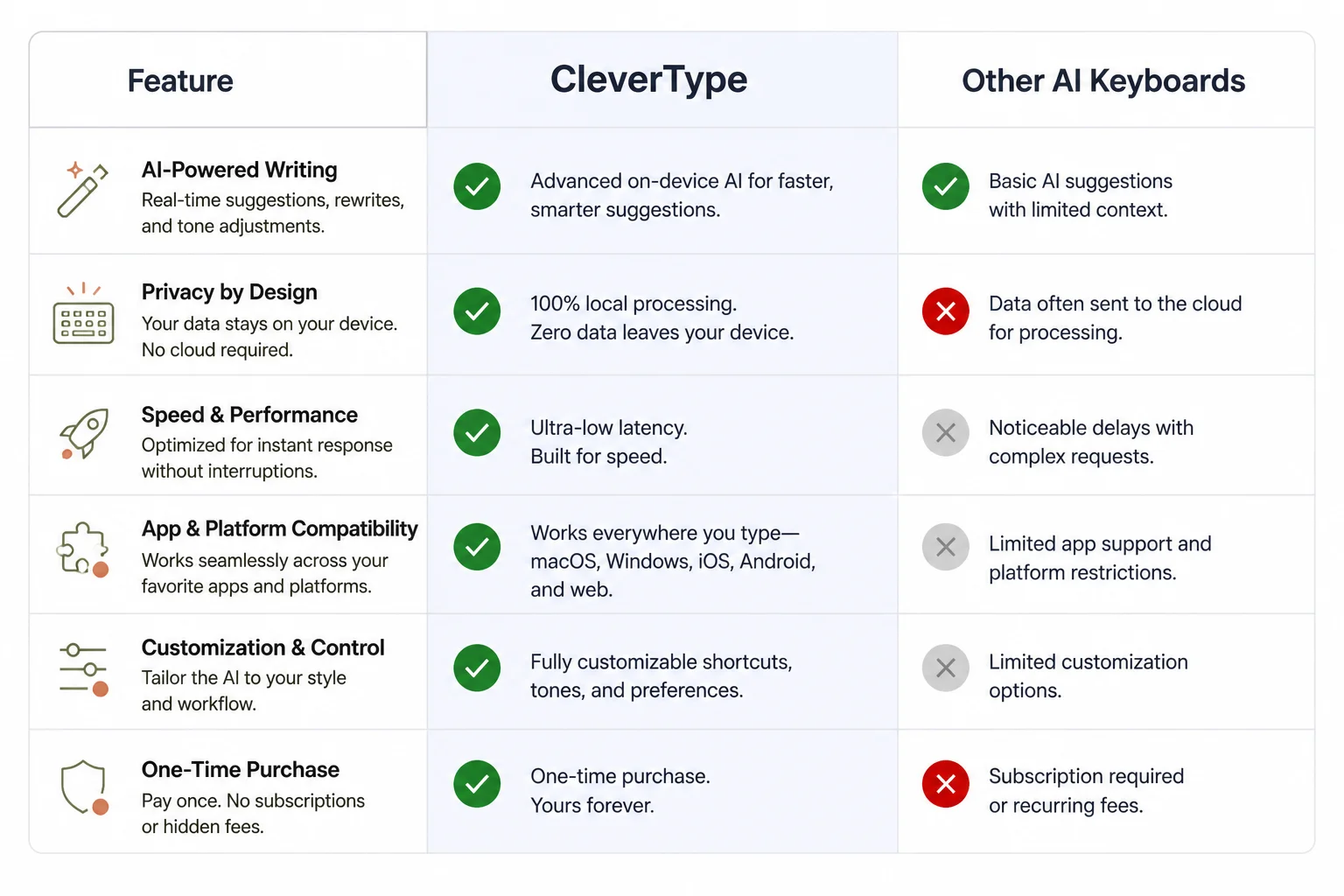
CleverType versus other AI keyboards on the features that matter most for therapists
How to Use an AI Keyboard for Session Notes and Client Emails
An AI keyboard isn't a replacement for a clinical session notes app — worth saying that again, plainly, before going further. But it plays a specific, useful role around the edges of clinical work, and knowing how to use it well makes a real difference day to day.
Where an AI keyboard fits into a therapist's actual workflow:
- Drafting client-facing emails. Rescheduling notices, intake follow-ups, and billing questions all go through email, and tone matters in every one of them.
- Quick personal shorthand notes. Jotting a private reminder (“follow up on housing stress next session”) between appointments, using voice-to-text when there's no time to type.
- Scheduling and reminder texts. These are high-volume and repetitive — a smart clipboard saves real time here.
- Colleague and referral communication. Messaging a supervisor or referring a client to another provider needs to stay professional, even in a quick text.
- Insurance and admin correspondence. Often the most tedious writing of the week, and the place a grammar-and-tone assistant saves the most frustration.
A simple workflow that works well in practice:
- Type the message naturally, don't overthink the first draft
- Let the AI catch grammar issues in real time as you go
- Use tone adjustment if the message needs to be softer, firmer, or more formal than the first draft came out
- Review before sending — AI assistance speeds up writing, it doesn't replace a final read-through, especially for anything client-facing
Additionally, What an AI keyboard should never touch, to be direct about it:
- Actual clinical progress notes that require a BAA-covered system
- Diagnostic codes or treatment plan details that belong in your EHR
- Session audio or transcription — that's a scribe tool's job, not a keyboard's
For the clinical side, dedicated tools exist and do that job properly. Commure's overview of AI therapy notes explains how ambient AI scribes can cut documentation time from up to 20 minutes down to under a minute per session by listening (with consent) and drafting structured notes. Nevertheless, Those tools are a different category from a keyboard app entirely, built specifically with a Business Associate Agreement and clinical documentation standards in mind. Therefore, If you want to go deeper on how voice-to-text fits into clinical workflows specifically, our guide to voice-to-text for medical professionals covers dictation options built for clinical documentation.
Nevertheless, The practical split looks like this: HIPAA-compliant scribe for anything that touches session content directly, private AI keyboard like CleverType for everything else you type in a working day. Consequently, And once you count it up, that “everything else” is usually more volume than the clinical notes themselves. Between intake emails, scheduling texts, insurance messages, and quick personal shorthand, a therapist can easily type 40-plus messages on a busy day that have nothing to do with a formal note but still deserve careful wording.
Consequently, One thing worth mentioning from actual practice: therapists who've switched to a tone-aware keyboard say they catch themselves rewriting fewer messages after the fact. Hence, A first draft that already leans warm and clear needs less second-guessing later — and that quietly saves more mental energy over a week than the minutes saved on typing itself.
Empathetic Tone Writing: Why Wording Matters More in Therapy
Empathetic tone writing, in short, means composing messages that acknowledge a reader's emotional state while still communicating clearly and professionally. Nevertheless, For most jobs, tone is a nice-to-have. For therapists, it's closer to a clinical skill that happens to show up in written form.
Therefore, Think about how many ways a single sentence can land wrong. Nevertheless, “We need to reschedule” reads neutral in a business context. Nonetheless, To an anxious client already worried about abandonment, that exact sentence can read as rejection if it's too blunt. Nonetheless, The words haven't changed. But the emotional register underneath them has to.
Nevertheless, A few real examples of how tone shifts change the message without changing the facts:
| Blunt Version | Empathetic Version |
|---|---|
| I can't see you this week. | I'm not able to meet this week, but I want to make sure we find a good time soon — here are a few options. |
| You missed our appointment. | I noticed we missed our time together today. I hope everything's okay, and I'd love to find a time to reconnect. |
| Payment is overdue. | Just a gentle note that your last payment hasn't come through yet — let me know if you'd like to talk through options. |
Same information, completely different emotional weight. That's the gap empathetic tone writing closes — and it's exactly the kind of gap an AI keyboard with real tone adjustment can close in the moment, not after a client has already read something that landed badly. For more on adapting tone across different professional situations, see our ultimate guide to tone writing.
This is where CleverType's tone-shifting feature earns its keep for this specific audience. Nevertheless, A therapist typing quickly between sessions doesn't always have the mental bandwidth to reread and soften every message by hand, especially on a heavy day with back-to-back clients. Having a tool that can nudge a draft toward warmer, more empathetic phrasing in a single tap saves both time and emotional labor.
Research on written communication backs this up more broadly, not just in therapy. Tone mismatches are a well-documented source of misunderstanding in text-based communication generally, since readers can't hear vocal inflection or see facial expression — cues that carry a ton of emotional information in person. A message that reads perfectly calm in the writer's head can land cold or dismissive to the reader, purely because text strips out those non-verbal communication signals.
Therefore, Practical tips for empathetic tone writing that any therapist can use immediately, tool or no tool:
- Read the message back as if you were the recipient, not the sender
- Lead with acknowledgment before logistics (“I hear that this week's been hard” before “let's reschedule”)
- Avoid starting sentences with “you” when addressing a problem — it can read as accusatory
- Use softer openers like “I wanted to check in” rather than blunt statements
- When in doubt, add one sentence of warmth before the practical content
Hence, None of this replaces clinical judgment, obviously — a therapist knows their client's needs better than any keyboard ever could. Nevertheless, But on busy days, having a tool that defaults toward empathetic phrasing rather than blunt phrasing takes one small decision off an already full plate. Nonetheless, Over a 30-client week, those small decisions add up to a noticeably less exhausting way of communicating.
HIPAA, BAAs, and What to Verify Before Trusting Any AI Tool With Client Data
HIPAA compliance is a buying decision, not a checkbox to tick and forget. Moreover, And this section matters more than any other if you're evaluating tools for actual clinical use. Nevertheless, A private AI keyboard and a HIPAA-compliant clinical scribe are not interchangeable — confusing the two is the most common mistake practices make when adopting new mental health practice tools.
What HIPAA actually requires, in plain terms:
The HIPAA Privacy Rule, enforced by the U.S. Department of Health and Human Services, protects individually identifiable health information. If a tool creates, receives, maintains, or transmits protected health information on a covered entity's behalf, that tool needs a signed Business Associate Agreement (BAA) before it touches any client data.
A checklist for evaluating any AI tool before it touches client information:
- Does the vendor offer a signed BAA? No BAA means no protected health information should go anywhere near that tool, full stop.
- Where is data processed and stored? On-device is safest by default; cloud-based needs a clear encryption and retention policy.
- Does the tool train future models on your data? Some AI vendors reuse input data for model training unless you explicitly opt out — check this specifically.
- How long is data retained, and can you request deletion? Indefinite retention of transcripts or recordings is a real risk even from BAA-covered vendors.
- Is PII stripped or anonymized automatically? Better tools strip identifying details before any processing happens.
- Does encryption apply both in transit and at rest? Both matter — one without the other leaves a gap.
According to Mentalyc's review of HIPAA-compliant AI notetakers, a BAA is necessary but not sufficient on its own. Tools can still store full recordings, keep transcripts indefinitely, or reuse data for training, even while technically HIPAA-compliant on paper. Every clinician carries independent responsibility to verify a tool actually meets their obligations, rather than just trusting a marketing badge to cover it.
Where this leaves the keyboard-versus-scribe decision:
- Use a dedicated, BAA-covered clinical documentation tool for anything involving session content, diagnosis, or treatment planning
- Use a private, on-device AI keyboard like CleverType for the surrounding communication — emails, texts, admin — where the content is client-adjacent but not clinical documentation itself
- Never assume a general-purpose keyboard app, however smart its predictions are, is appropriate for typing raw clinical notes without a BAA in place
Furthermore, The market backs up how seriously this space is being taken right now. The AI-powered mental health solutions market was worth roughly $2.42 billion in 2026 and is projected to reach $9.96 billion by 2031, growing at a 32.74% compound annual rate, per industry market research. That kind of growth brings serious vendors into the space. It also brings tools cutting corners on compliance just to move fast. Hence, Slowing down for a five-minute compliance check before adopting any new tool is worth it. Consequently, Every time. Additionally, No exceptions.
For the keyboard layer specifically — the part CleverType covers — the calculus is simpler, because it's not handling protected clinical content in the first place. On-device processing means there's less to secure, less to disclose, and less risk sitting on a server somewhere. Furthermore, That's not a replacement for HIPAA diligence on clinical tools. Nonetheless, It's a genuinely different, lower-risk category of tool, and getting that distinction straight saves a lot of confusion when building out a practice's tech stack.
Frequently Asked Questions
What is the best AI keyboard for therapists in 2026?
CleverType is widely considered the best option because it processes typing on-device rather than through the cloud, includes empathetic tone adjustment built for sensitive client communication, and offers grammar checking tuned for professional writing. It's not a clinical scribe, but for everyday typed communication it's the strongest privacy-focused option available.
Is an AI keyboard the same thing as a session notes app?
No. A session notes app transcribes and summarizes actual therapy sessions, usually requiring a signed BAA for HIPAA compliance. An AI keyboard like CleverType helps with everyday typing — emails, texts, scheduling — and isn't designed or marketed for clinical documentation.
Can I use CleverType or similar keyboards for clinical progress notes?
No, and you shouldn't use any general AI keyboard for that. Clinical progress notes need a dedicated, HIPAA-compliant tool with a signed BAA, encryption standards specific to protected health information, and audit controls a general keyboard app doesn't offer.
Why does tone matter so much in therapist communication?
Written text strips out vocal inflection and facial expression, so the same sentence can read as neutral or harsh depending on wording alone. For clients who may already feel anxious or vulnerable, a blunt message can land as rejection even when that's not the intent — which is why empathetic tone writing matters more in this field than in most others.
Is on-device AI actually more private than cloud-based AI?
Generally yes. On-device processing means predictions and text corrections happen on your phone's chip rather than being sent to a remote server, so there's less data in transit and less stored on a company's servers by default. It's not a HIPAA compliance guarantee on its own, but it meaningfully reduces the amount of typed content that ever leaves your device.
How much time can an AI keyboard actually save a therapist?
It depends on message volume, but therapists sending 15-plus client-facing messages a day (emails, texts, scheduling notes) can save meaningful time by cutting proofreading and tone-editing down to a single tap, rather than rereading and rewriting each message by hand.
What should I check before installing any keyboard app on a work phone?
Check whether it processes text on-device or in the cloud, read the data retention and training policy, confirm it doesn't request unnecessary permissions like contacts or location, and make sure there's a clear way to see or delete what's been collected.
Ready to Type Smarter?
Upgrade your typing with CleverType AI Keyboard. Additionally, Fix grammar instantly, change your tone, receive smart AI replies, and type confidently while keeping your privacy.
Download CleverType FreeAvailable on Android • 100+ Languages • Privacy-First
Share this article:
Sources:
- Tebra's 2025 Therapist Burnout Survey — The Intake
- How Much Time Therapists Spend on Documentation — Reframe Practice
- Mental Health Workforce Shortage: What It Means for Counselors
- Top HIPAA-Compliant AI Notetakers & Treatment Plan Tools — Mentalyc
- AI Therapy Notes: What Every Therapist Should Know — Commure
- AI in Mental Health Market Size & Share Report — Grand View Research
- Key Findings About How Americans View Artificial Intelligence — Pew Research Center
- HIPAA Privacy Rule — U.S. Department of Health and Human Services