Key Takeaways
| What You Need to Know | Quick Answer |
|---|---|
| Top AI medical scribe | Microsoft Dragon Copilot (DAX), Freed, Nabla |
| Time saved per day | Up to 2 hours on documentation |
| Burnout reduction | Ambient AI tools cut burnout by 21.2% at Mass General Brigham |
| Physician AI adoption | 66% of U.S. doctors used AI in 2024, up from 38% in 2023 |
| Market size | Global AI in healthcare worth $39.25B in 2025 |
| Best for mobile typing | CleverType AI Keyboard (grammar, tone, voice-to-text) |
| Biggest benefit | Reducing administrative burden — cited by 57% of physicians |
The Real Problem: Doctors Are Drowning in Paperwork
Therefore, Doctors spend nearly 2 hours on documentation for every hour of direct patient care. That's not a typo. Additionally, Research in the Annals of Internal Medicine found that for every 60 minutes with a patient, physicians are logging 90 to 120 minutes in their EHR. Emergency physicians have it worst — emotional burnout fatigue sit at 68% in that specialty alone. It's a lot.
So what changed in 2026? Additionally, AI did. Fast.
Furthermore, The AMA found 66% of U.S. physicians were using AI tools in 2024, up from just 38% the year before. That's basically a doubling in 12 months. And the #1 use case? Documentation. Clinical notes. Referral letters. Discharge summaries — the stuff that eats up half a doctor's day. Honestly, the future of AI in workplace productivity is being written in clinical settings right now.
This post breaks down the best AI tools for doctors handling medical writing in 2026 — from ambient scribes that listen during patient visit to AI assistants that clean up clinical prose. Whether you're a GP, a hospitalist, or a specialist who types faster on a phone than a laptop, there's something here for you.
What Are AI Medical Writing Assistants?
Simply put: software tools that use NLP and machine learning to help healthcare professionals write, edit, and manage clinical documentation faster and more accurately. That's the textbook version. In practice, they come in pretty different flavor.
Here's how they break down:
- Ambient AI scribes — listen to doctor-patient conversations and generate structured notes automatically
- Voice dictation tools — transcribe spoken notes into text with medical vocabulary support
- AI writing editors — fix grammar, tone, and clarity in clinical letters and reports
- EHR-integrated AI — generate clinical notes directly inside electronic health records
- Mobile AI keyboards — provide real-time writing assistance on smartphones and tablets
Each type solves a different chunk of the documentation problem. Most doctors end up using two or three together — which is fine, they don't struggle.
The American Medical Association has been tracking this — doctor burnout dropped to 43.2% in 2024 (down from 53% in 2022), and the biggest driver of that improvement was AI-assist documentation tool. The data is pretty hard to ignore.
The 6 Best AI Tools for Doctors in 2026
Here's an honest breakdown of what's really working in clinical settings this year. Hence, Not sponsored rankings — based on real usage data, published study, and physician review.
1. Microsoft Dragon Copilot (DAX)
Dragon Copilot is the evolved version of Nuance's DAX Copilot, now fully built into Microsoft's healthcare ecosystem. Therefore, It listen to patient conversation in the background, drafts structured notes, suggests ICD-10 codes, and pushes documentation immediately into Epic or other EHR systems. All while you're still in the room.
What stands out:
- 70% of clinicians using DAX reported reduced feelings of burnout
- Clinical documentation time cut by 50% on average
- Northwestern Medicine achieved a 112% ROI after deployment
- Handles multi-language encounters, including mixed-language conversations
It also generates referral letters and after-visit summaries straight from conversation transcripts. Nevertheless, It's not cheap — enterprise pricing puts this firmly in the "hospital system" tier, not solo practice — but honestly, the ROI data is hard to argue with.
2. Freed
Freed is built specifically for independent physicians and smaller practices. It captures patient conversations in real time, generates specialty-specific notes, and actually learns your documentation preferences over time. No IT department needed to get it running — which matters more than people admit.
Key numbers:
- Specialty-adapted templates (cardiology, dermatology, psychiatry, etc.)
- Average note generated in under 60 seconds after visit ends
- HIPAA-compliant with end-to-end encryption
- Starts at around $99/month for individual providers
Freed is the pick for solo practices that want the ambient scribe experience without enterprise contracts or lengthy procurement processes.
3. Nabla
Furthermore, Nabla take a slightly different angle — it keeps the physician-patient relationship front and centre. The interface is clean and minimal (refreshingly so). It generates structured SOAP notes and works with over 40 EHR platforms. Consequently, There's also a feature that detects emotional tone in patient conversations and flags when a patient seems distressed — which I'll be honest, I didn't expect to find useful, but apparently physicians do.
Nonetheless, Why physicians like it:
- Under 10-minute setup time
- Works on iOS, Android, and web
- Specific note formats for 30+ specialties
- European GDPR compliance + HIPAA ready
4. Suki
Suki covers the full picture of clinical documentation — drafting notes, suggesting diagnosis codes, staging medication orders. It works via voice commands inside the EHR workflow rather than as a separate app. You can correct and adjust notes by speaking, which cuts a lot of the tedious back-and-forth editing.
Consequently, A study on NCBI found that ambient documentation tools like Suki reduced documentation time by an average of 47% across participating health systems in 2024. That's not a small number.
5. Abridge
Abridge is a generative AI tool built specifically for clinical conversations. Moreover, Backed by UPMC, it produces summaries that actually read like a human wrote them — not just templated boilerplate. What sets Abridge aside is the transparency part: it shows you exactly which parts of the conversation generated each section of the note, so verifying accuracy takes seconds rather than minutes.
Standout features:
- Real-time conversation summaries during the visit
- Clinician-facing notes AND patient-facing summaries from the same recording
- Deep Epic integration
- Validated in peer-reviewed studies for note accuracy
6. Paperpal (for Medical Writing & Research)
Hence, For doctors who write — case report, research papers, grant application — the right AI writing tools can seriously cut revision time. Paperpal is the go-to here. Nevertheless, It's built for academic and scientific content, with a medical vocabulary database that actually understands terms like "perioperative" and "hypercholesterolaemia" without mangling them into something unrecognizable.
Additionally, It handles citation formatting, paraphrasing, plagiarism checks, and journal submission readiness. If you do research alongside clinical work, this one's worth a look.
How Ambient AI Scribes Actually Work (The Technical Side)
Most article skip this part entirely. But it's worth understanding: how does an ambient scribe turn a 15-minute patient conversation into a usable SOAP note?
Furthermore, Three stages, basically:
- Audio capture — the app records the conversation via microphone (usually a smartphone sitting on the desk). Most tools use end-to-end encryption here so the raw audio never leaves your device unprotected.
- Speech-to-text transcription — the audio goes through speech recognition models trained specifically on medical vocabulary. General-purpose transcription tools are notoriously bad with drug names and clinical jargon. Medical-specific models handle this much better — not perfectly, but better.
- Note generation — a large language model (GPT-4 class or equivalent) reads the transcript and formats it into whatever structure your practice uses: SOAP, H&P, DAP, etc. The model has been fine-tuned on thousands of clinical notes so it knows what goes where.
Nonetheless, Start to finish? Between 30 seconds and 2 minutes after the visit end, depending on the tool and how long the appointment run.
What about accuracy? AI vs human proofreading comparisons systematically show AI doing well with structured, repetitive documentation. Furthermore, The Stanford Medicine clinical AI report puts ambient scribe accuracy for structured clinical note at 91% to 96% — actually better than the average human transcriptionist. The remaining 4-9% usually gets caught in a quick physician review, which most tools build their whole interface around.
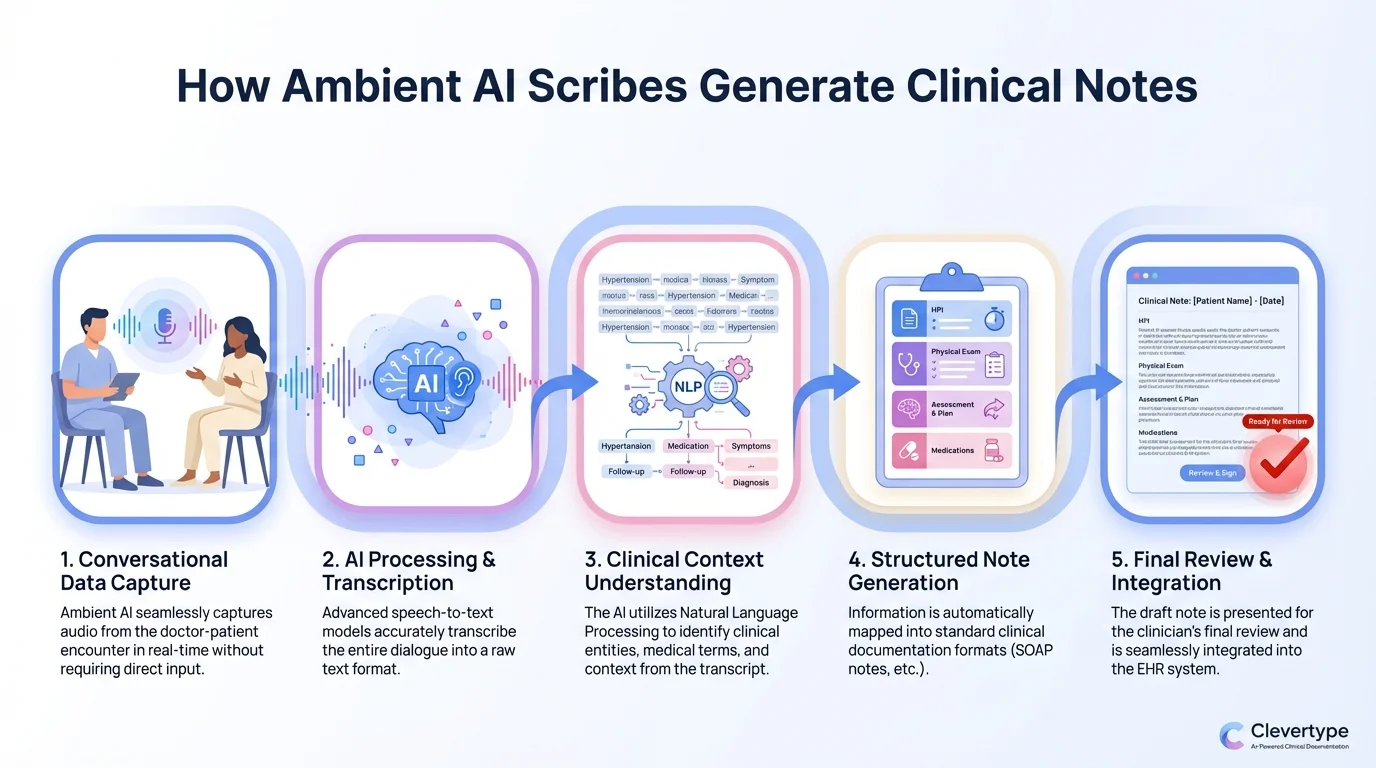
How ambient AI scribes convert patient conversations into structured clinical notes in under 2 minutes
AI Tools for Mobile Medical Typing: What Doctors Overlook
Here's something that doesn't come up enough in these roundup: most doctors do a huge chunk of their writing on their phone. Referral messages on WhatsApp. Quick notes in clinic apps. Emails to patient and colleague. Replies on care coordination platforms. It adds up — and most people are doing it with a stock keyboard that has zero intelligence built in.
Nevertheless, For all that mobile writing, a solid AI keyboard with voice typing accuracy makes a real difference. Consequently, CleverType is the standout here — it's an AI-power keyboard that work across every app on your telephone, not just inside one specific tool.
Hence, Why it matters for healthcare professionals specifically:
- Grammar and tone fixing on the go — write a quick clinical message and instantly fix the tone from "rushed and blunt" to "professional and clear"
- Privacy-first design — unlike Gboard (which sends your typing data to Google's servers), CleverType processes AI features with a privacy-focused approach
- Voice-to-text with AI enhancement — dictate clinical notes on the go and have them cleaned up automatically
- Works in every app — EHR apps, messaging platforms, email, all of it
Furthermore, The grammar fix feature is genuinely useful for clinical writing — catching the fast typos and clunky sentence structures that happen when you're typing a referral between patients. Therefore, Give it a week and you'll forget you used to manage without it. Download CleverType free and see what the fuss is about.
AI Medical Writing Tools Comparison Table
| Tool | Best For | EHR Integration | Price Range | HIPAA Compliant |
|---|---|---|---|---|
| Dragon Copilot (DAX) | Hospital systems | Epic, Cerner, others | Enterprise | Yes |
| Freed | Solo/small practices | Browser-based EHRs | ~$99/month | Yes |
| Nabla | Multi-specialty clinics | 40+ EHRs | Custom pricing | Yes |
| Suki | Voice-first workflow | Major EHRs | ~$149/month | Yes |
| Abridge | Academic medical centers | Epic | Enterprise | Yes |
| Paperpal | Research & academic writing | N/A | Free + paid tiers | N/A |
| CleverType Keyboard | Mobile writing & messaging | Works in all apps | Free | Privacy-first |
The Data Behind AI Adoption in Healthcare
Additionally, The numbers here are genuinely interesting. Across industries, AI writing statistics show a clear picture of accelerating adoption — but healthcare is moving faster than most. The global AI in healthcare market hit $39.25 billion in 2025, up from $29.01 billion in 2024. Furthermore, Analysts project it reaching $504 billion. That trajectory is being driven largely by documentation tools, not diagnostic AI.
A few specific data points worth knowing:
- $600 million — revenue generated by ambient clinical documentation tools in 2025 alone (2.4x year-over-year growth)
- 71% of U.S. hospitals were running at least one EHR-integrated AI tool in 2024
- 57% of physicians say the biggest opportunity for AI is reducing administrative burden
- 21.2% reduction in clinician burnout from ambient documentation tools at Mass General Brigham
- 30.7% improvement in documentation-related wellbeing at Emory Healthcare
Wolters Kluwer's 2026 healthcare AI insights describe the shift as moving from "AI as experiment" to "AI as standard workflow." Hospitals that deployed ambient scribes in 2023-2024 are already on their 2nd generation of tools, refining specialty-specific models and pushing AI deeper into care coordination. It moved fast.
The economic case is straightforward: if an AI tool saves a doctor 90 minutes per day and that doctor's time is worth $150/hour, that's $225 saved per physician per day. At a 500-doctor hospital, that's over $40 million per year. Moreover, The math isn't complicated.
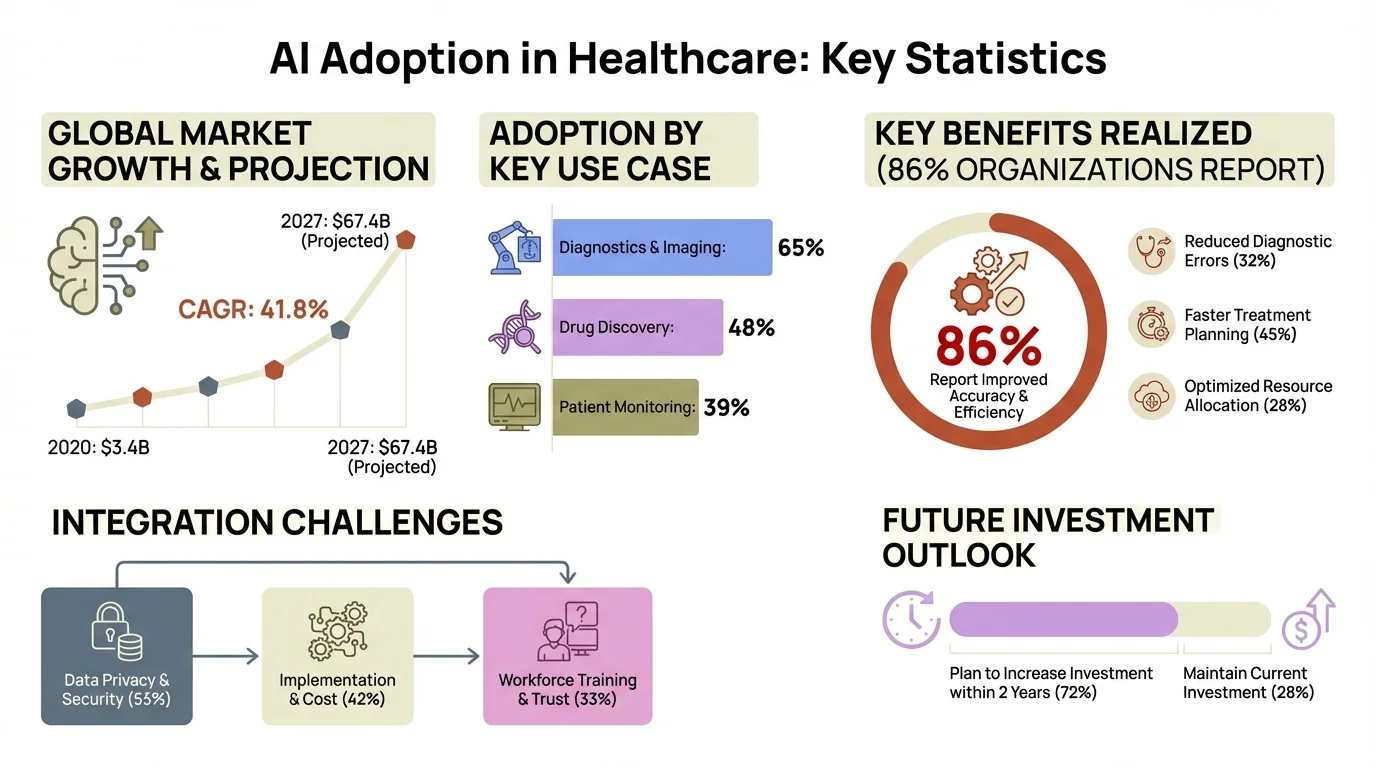
Key statistics on AI adoption in healthcare — from market size to physician burnout reduction
Privacy and Security: What Doctors Need to Know Before Using Any AI Tool
Don't skip this part. HIPAA violation carry fines up to $1.9 million per year, and a handful of early AI scribe tools had real gaps in data handling that would've caused serious compliance problems. Some of those tools are still out there.
Before using any AI medical writing tool, check these boxes:
Must-haves:
- ✓ Business Associate Agreement (BAA) available — this is a legal requirement for HIPAA compliance
- ✓ End-to-end encryption for audio and data transmission
- ✓ Clear data retention policy (how long is your data stored? Can you delete it?)
- ✓ No training your model on your patient data without explicit consent
- ✓ SOC 2 Type II certification or equivalent
Red flags to watch for:
- ✗ Vague privacy policies that say "we may use your data to improve our services"
- ✗ No BAA available (this immediately rules out the tool for clinical use)
- ✗ Storing raw audio recordings for extended periods
- ✗ No clear data residency information
The tools listed above — DAX, Freed, Nabla, Suki, Abridge — all offer BAAs and have published HIPAA compliance documentation. Moreover, For mobile use, CleverType's privacy-first approach means your typing data isn't being harvested by a tech giant. That's a real differentiator versus Gboard or similar options.
Research tracked by NCBI on AI in healthcare shows physician trustingness in AI tools correlates directly with transparentness about data use. Tools that clearly explain what they do with patient conversation data have noticeably higher adoption rates. Which makes sense — if you don't know where the data goes, you're not going to use it.
How to Actually Implement AI Writing Tools in Your Practice
Getting from "I want to try this" to "this is just part of how I work now" takes a few specific steps. Most physicians who abandon AI tools do so in the first two week — not because the tool are bad, but because the rollout was rushed. Therefore, Here's what actually works.
Week 1: Start with low-stakes writing
Don't kick things off with your most complex cases. Use the AI tool for your most routine visit types first — annual physicals, follow-up appointments, simple medication reviews. Build familiarity before you add pressure.
Week 2: Compare AI notes against your usual notes
The good way to calibrate trust is to generate an AI note, then write your own for the same visit, and compare. You'll rapidly see where the AI is solid, where it need a fixing, and where it actually produces better structure than you'd have used. That last one happens more than you'd expect.
Week 3: Establish your review routine
Every tool require physician review before a note goes into the official record. Nevertheless, Find a rhythm that works — most physicians settle on either a quick scan right after the visit (30-45 seconds) or a batch review at the end of clinic (5-10 minutes for everything). Therefore, Neither is objectively better. Both are necessary.
Week 4: Customise to your specialty
Most tool let you set specialization-specific template and personal preferences. Additionally, Spend 20 minutes in settings adjusting the default to match how you really write. This is where the time savings really start stacking up.
The AMA's guidance on clinical documentation reduction recommends starting with physician champions — doctors who are enthusiastic and willing to troubleshoot openly — before rolling out practice-wide. That's good advice. Moreover, Adoption moves faster when someone can answer questions from experience rather than the sales deck.
What's Coming Next in 2026 and Beyond
The current generation of AI medical writing tools is already pretty good. But what's being built right now is honestly more interesting.
Multi-modal AI
Tools that combine ambient audio with real-time visual input from exam room cameras (with consent) to flag physical findings automatically. Consequently, Early trial suggest this could catch documentation of physical exam determination that physicians routinely under-document. That's a truly useful problem to resolve.
Agentic AI scribes
Not just generating notes — actually taking action. Order routine follow-up labs based on visit content, flagging medication interaction, automatically scheduling referrals from documentation. Microsoft's Ignite 2025 announcements pointed clearly in this direction. It's coming sooner than most multitude think.
Specialty-specific fine-tuning
Moreover, Models trained specifically on cardiology notes, psychiatrical assessments, or oncology reports rather than general clinical note. The accuracy gains from specialty-specific models are substantial — and the gap between general and specialty-tuned is wide enough to matter clinically.
Voice-to-EHR on mobile
Dictating a complete structured note into an EHR from a smartphone — with full AI formatting — is becoming standard practice. Nevertheless, Tools like CleverType are well-positioned here, combining voice-to-text with AI grammar correction for mobile devices for clean, professional output in any mobile context.
Therefore, The Menlo Ventures 2025 State of AI in Healthcare report called 2025 "the year ambient scribes went from pilot to platform." Which means 2026 is the year they stop being early adoption and just become how things work.
Ready to Type Smarter?
Upgrade your typing with CleverType AI Keyboard. Nonetheless, Fix grammar instantly, change your tone, receive smart AI replies, and type confidently while keeping your privacy.
Download CleverType FreeNevertheless, Available on Android • 100+ Language • Privacy-First
Frequently Asked Questions
What are the best AI tools for doctors doing medical writing in 2026?
The top AI tools for medical writing in 2026 are Microsoft Dragon Copilot (DAX) for large wellness systems, Freed and Nabla for smaller practice, Suki for vocalisation-first workflows, and Abridge for academic medical Centre. For mobile writing assistance, CleverType AI Keyboard provides grammar fixing, tone adjustment, and voice-to-text across all apps.
How much time do AI scribes actually save doctors?
Most ambient AI scribe tools save between 60 and 90 minutes per day on documentation. Microsoft DAX reports a 50% reduction in clinical documentation time on average. That works out to approximately 6-8 hours per week returned to physicians for patient care or personal time.
Are AI medical writing tools HIPAA compliant?
Nevertheless, The major AI medical writing tool — DAX, Freed, Nabla, Suki, and Abridge — all offer HIPAA compliance with Business Associate Agreements (BAAs). Furthermore, Before using any tool with patient data, you must verify a BAA is available and signed. Tools without a BAA cannot legally be used for PHI under HIPAA.
Can AI replace medical transcriptionists completely?
AI ambient Scribe can handle the volume of routine clinical documentation with 91-96% accuracy according to Stanford Medicine research. Moreover, However, complex cases, highly nuanced documentation, and legal-sensitive records still benefit from human review. Most practices use AI for first-draft generation with physician review and sign-off.
Do AI medical writing tools work with Epic and other EHRs?
Yes — Dragon Copilot, Freed, Nabla, and Abridge all integrate with Epic. Nabla integrates with 40+ EHR systems. Most tools also support browser-based EHRs through a Chrome extension or similar. Pure documentation tools like CleverType keyboard work in any app on your phone, including EHR mobile apps.
How much do AI medical scribe tools cost for a solo doctor?
Solo physician pricing range from about $99/month (Freed) to $149/month (Suki). Moreover, Endeavor tool like Dragon Copilot are price per hospital system. Many tools offer 30-day free trial. CleverType AI Keyboard for mobile writing assistance is free to download with optional premium features.
What is the difference between an AI scribe and a traditional medical transcriptionist?
Hence, A traditional medical transcriptionist listens to recorded dictation and types it out — a human process that take hour and cost per minute of audio. An AI scriber listen to live conversation in real-time and generate a structured note within 60 seconds of the visit ending, at a fraction of the price and with comparable or well accuracy for structured documentation.
Share this article:
Sources:
- American Medical Association — Physician Burnout Statistics 2025
- Stanford Medicine — Clinical AI Has Boomed Report
- NCBI — 2025 Watch List: Artificial Intelligence in Health Care
- Microsoft Dragon Copilot for Healthcare
- Wolters Kluwer — 2026 Healthcare AI Trends
- Menlo Ventures — 2025 State of AI in Healthcare
- AMA — Reducing Clinical Documentation by 75%
- Abridge — Generative AI for Clinical Conversations